




Stainless Steel Knife Set Factory: What Buyers Should Check
A stainless steel knife set factory is responsible for more than producing sharp-looking blades. For importers, retailers, and private-label teams, the real concern is whether a supplier can repeat the same geometry, finish, balance, and packaging quality across a full production run. A knife set may look simple in a catalog image, but it combines multiple parts: different blade profiles, handles, a storage block, and retail presentation.
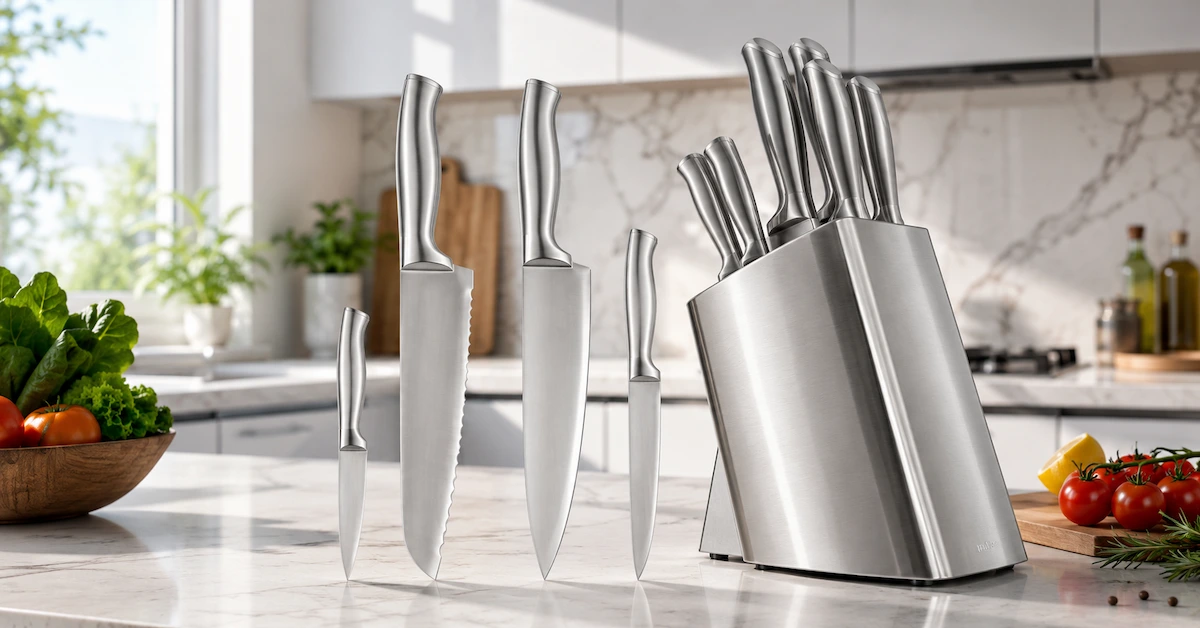
The visible product is a stainless-steel kitchen knife set with several knife sizes and a countertop block. At least one serrated blade, a chef-style knife, and smaller utility or paring-style knives are visible. The knives and block appear to use a brushed or satin metallic appearance. Because the image does not confirm steel grade, hardness, dishwasher suitability, or whether the blades are stamped or forged, buyers should treat those points as supplier questions rather than assumptions.
Key Takeaways
- Evaluate the knife set as a system: blades, handles, block, finish, and packaging all affect user satisfaction.
- Do not rely on product photos to confirm steel grade, manufacturing route, edge retention, or cleaning claims.
- Ask the factory how it controls blade geometry, surface consistency, handle comfort, and block fit.
- Compare production evidence, not only sample appearance, before approving an OEM or wholesale order.
What a Stainless Steel Knife Set Factory Must Control
In this category, consistency is often more important than adding more pieces to the set. A factory has to manage blade shaping, edge formation, handle finishing, and final assembly so that every knife looks related and performs its intended role. A chef-style knife, serrated knife, and small paring knife do not share the same geometry, but they should share the same finish standard and overall design language.
Buyers should also pay attention to the storage block. A slanted countertop block can make the set easy to access, but only if the slots fit correctly and the base feels stable. A block that tips, rattles, scratches easily, or holds the knives at an awkward angle can damage the perceived value of the whole set.
Visible Product Features to Verify
The product appears to use a uniform stainless-steel-like finish across the knives and block. That creates a clean, coordinated look, but it also means finishing defects are easy to spot. Uneven brushing, visible weld or joint marks, sharp handle edges, and mismatched tones between components can all create quality concerns.
Because some important details are not visible, buyers should verify them before quoting or approving production. Useful questions include:
- What steel grade is used for each blade, and is documentation available?
- Are the blades stamped, forged, or made by another process?
- How is edge sharpness checked before packing?
- How is the brushed or satin surface finish controlled between batches?
- What materials and internal structure are used in the block?
- What cleaning and care instructions will be provided to end users?
Supplier Comparison Checklist
A structured checklist helps sourcing teams compare factories more objectively. The goal is not to force every supplier into the same process, but to understand how each one controls risk.
| Evaluation Area | What to Check | Questions for the Supplier |
|---|---|---|
| Blade consistency | Thickness, edge alignment, grinding marks, profile repeatability | How are blade dimensions and edge quality inspected during production? |
| Handle comfort | Contour, grip feel, surface smoothness, sharp edges | Are handle samples reviewed for comfort as well as appearance? |
| Surface finish | Brushing direction, color consistency, scratches, visible marks | What finishing process is used, and how are cosmetic defects classified? |
| Block stability | Slot fit, balance, base contact, countertop footprint | How is the fit between each knife and the storage block checked? |
| Packaging | Blade protection, block protection, carton strength, labeling accuracy | What packing method prevents movement and surface damage in transit? |
Common Sourcing Mistakes
One common mistake is choosing the set with the highest knife count without studying whether each piece has a clear purpose. More pieces can help retail presentation, but duplicated functions or weak small knives may reduce user satisfaction. A practical assortment is usually better than a crowded block.
Another mistake is approving one attractive sample without asking how production variation will be controlled. Samples may receive extra attention. Buyers should ask whether pre-production samples, inline inspection, and final random checks are available, and what criteria will be used to judge defects.
A third mistake is ignoring the block. The holder is not just an accessory. It affects safety, countertop organization, shipping weight, and daily use. If the block is unstable or the knife slots are inconsistent, complaints may focus on the whole set rather than only the holder.
OEM and Private Label Questions to Ask
For OEM, wholesale, or private-label projects, commercial details should be confirmed directly with the supplier. Do not assume manufacturing capacity, MOQ, lead time, certification status, or available customization from a general product page. Instead, ask clear questions and request written confirmation.
- Which components are made in-house, and which are sourced from partner factories?
- What logo, packaging, or finish customization options are available?
- What is the minimum order quantity for the selected configuration?
- What production lead time applies after sample approval?
- What inspection standard is used for blade finish, edge condition, handle defects, and block stability?
- Can the supplier provide care instructions and product labeling details for the target market?
- What documents can the supplier provide to support material, packaging, or compliance requirements?
These questions help separate a general trader from a supplier that understands the technical and operational details of knife set production. They also reduce misunderstanding before tooling, samples, packaging artwork, or purchase orders are finalized.
How to Review Samples Before Approval
When a sample arrives, review it in the way an end user would handle it. Remove each knife from the block, check whether it inserts smoothly, and look for rattling or binding. Hold each handle with a dry hand and note whether the shape feels secure or awkward. Inspect the edge, spine, heel, and tip for visible unevenness or burrs.
Next, review finish consistency under strong light. Brushed stainless surfaces can show scratches and handling marks quickly, so buyers should decide what level of cosmetic variation is acceptable. If the set is intended for retail, also check how well the packaging protects the knives and block during shipment. Damage during transit can create returns even when the factory’s production quality is acceptable.
Practical FAQ
Is a stainless steel knife set suitable for home kitchens?
Yes, this type of set can suit general home preparation tasks such as slicing, chopping, trimming, and bread cutting. Final suitability depends on the confirmed materials, blade quality, handle comfort, and available counter space.
Can buyers assume the set is dishwasher safe?
No. Dishwasher suitability is not confirmed by the image. Buyers should ask the supplier for care guidance and should avoid making cleaning claims unless they are supported by product documentation.
What is the most important factory capability to verify?
Repeatability is critical. Buyers should verify how the factory controls edge quality, finish consistency, handle comfort, and block fit across production, not only on one sample.
Should buyers choose stamped or forged knives?
The best choice depends on target price, product positioning, and performance expectations. The visible product image does not confirm the manufacturing route, so buyers should ask the factory to explain the process and its quality controls.
A Practical Buying View
A stainless steel kitchen knife set succeeds when it combines a useful knife mix, controlled finishing, comfortable handling, and a stable block. For sourcing teams, the best approach is to treat the sample as the beginning of evaluation rather than proof of full production capability. Ask for process details, inspection standards, packaging information, and clear answers to technical questions before placing an OEM or wholesale order.
