




How to Choose a Stationery Scissors Supplier for Wholesale and Retail
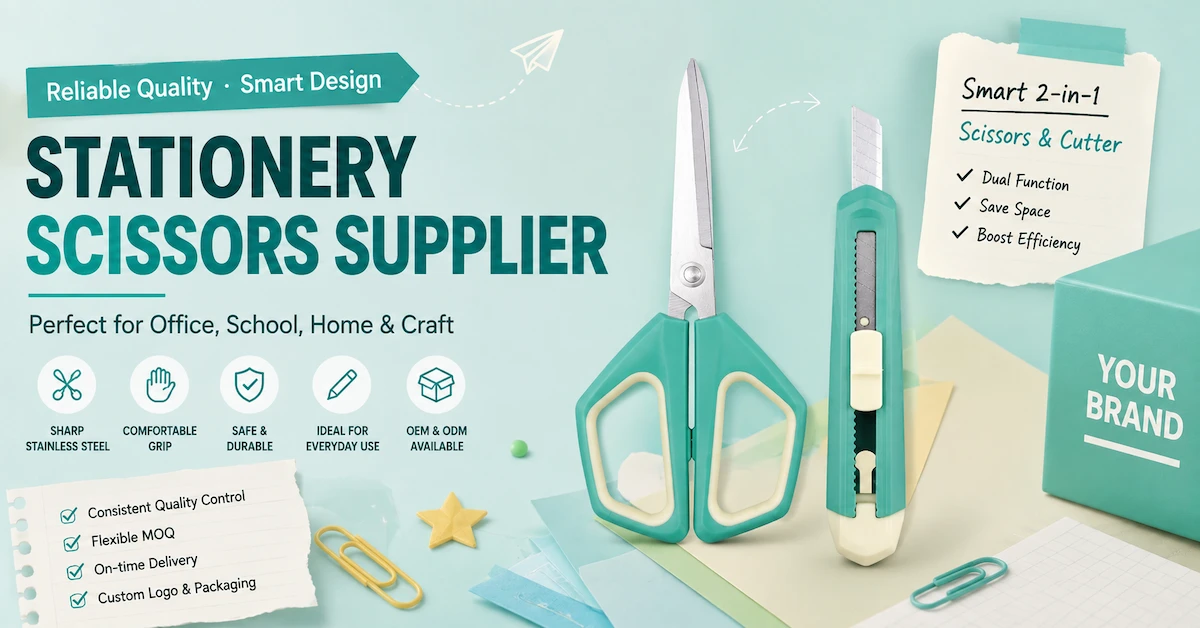
Finding a reliable stationery scissors supplier is more complicated than comparing unit prices. For stationery brands, importers, wholesalers, distributors, retailers, school-supply buyers, craft businesses, and e-commerce sellers, the right supplier needs to provide consistent cutting performance, comfortable handling, appropriate product designs, reliable quality control, suitable packaging, and a practical supply process.
Stationery scissors may look like simple products, but they are used repeatedly in offices, classrooms, craft rooms, packaging stations, homes, and retail environments. A supplier therefore needs to understand both the product and the commercial requirements behind it.
Quick answer: The best stationery scissors supplier should be evaluated across product range, blade and handle design, material consistency, manufacturing capability, sample quality, inspection procedures, customization, packaging, MOQ, lead time, and communication. Do not choose a supplier based on price alone. A better sourcing decision compares the complete value of the product and supply relationship.
BONET HOUSEWARE is a Yangjiang-based manufacturer of kitchenware and precision cutting tools.Its current scissors range includes tailor scissors, kitchen scissors, household scissors, stationery scissors, school scissors, and other scissors, providing a broader product base for B2B buyers.
The article follows the B2B SEO framework you established: search intent and buyer questions, keyword/entity coverage, technical and commercial depth, structured tables, FAQ, CTA, and self-assessment. The framework specifically requires coverage of product positioning, buyers, applications, technical specifications, materials, workmanship, QC, commercial considerations, OEM/ODM, CTA, and FAQ, within a 1,500–3,000-word article structure.
Key Takeaways
- Choose stationery scissors according to the actual application, not appearance alone.
- Evaluate blade alignment, cutting performance, handle ergonomics, finish, and overall consistency.
- Request physical samples before committing to wholesale production.
- Confirm materials, specifications, packaging, MOQ, lead time, and inspection requirements in writing.
- For private-label programs, evaluate logo, color, surface treatment, packaging, and product-development support together.
- Compare suppliers by total sourcing value rather than unit price alone.
What Is a Stationery Scissors Supplier?
A stationery scissors supplier provides scissors intended for office, school, craft, paper, packaging, and related light cutting applications.
Depending on the supplier's capabilities, the relationship may involve:
- Standard wholesale products
- Bulk purchasing
- Private-label products
- OEM manufacturing
- ODM development
- Customized colors
- Customized handles
- Logo printing
- Laser engraving
- Retail packaging
- Barcode labeling
- Product sets
For a simple wholesale order, the buyer may only need an existing model and standard packaging.
For a branded stationery range, the supplier may need to support product customization and packaging development.
This distinction matters because a wholesale supplier and a private-label manufacturing partner do not necessarily provide the same level of service.
Who Buys Stationery Scissors?
Different buyers have different sourcing priorities.
| Buyer Type | Main Requirement | Important Supplier Capability |
|---|---|---|
| Stationery Brand | Product differentiation | OEM/ODM and branding |
| Importer | Stable supply | Manufacturing and QC |
| Wholesaler | Competitive assortment | Product range and price structure |
| Distributor | Repeat supply | Consistency and communication |
| Retailer | Shelf-ready products | Packaging and labeling |
| Supermarket | Large-volume retail | Consistency and packaging |
| School Supplier | Student-oriented products | Suitable designs and safety considerations |
| Craft Retailer | Cutting performance | Blade and handle quality |
| E-commerce Seller | Product presentation | Packaging and differentiation |
| Promotional Buyer | Customized products | Logo and color customization |
BONET's existing stationery scissors sourcing content specifically identifies office distributors, stationery brands, promotional product buyers, and craft supply retailers as relevant B2B audiences.
What Applications Should You Consider?
Before choosing a model, define how the scissors will actually be used.
Office Applications
Common applications include:
- Cutting paper
- Trimming labels
- Opening light packaging
- Preparing presentations
- General desk tasks
- Craft and office projects
Office users may prioritize comfortable handles and predictable cutting performance because the scissors can be used repeatedly throughout the working day.
BONET's existing office stationery scissors content describes applications across offices, classrooms, design studios, packing stations, and craft areas.
School and Classroom Applications
School scissors require more careful product positioning.
Buyers should consider:
- Intended age group
- Handle design
- Tip configuration
- Product size
- Packaging
- Labeling
- Applicable destination-market requirements
Do not assume that a general stationery scissors model is automatically appropriate for children. Product suitability and applicable safety requirements should be verified for the intended market.
Craft Applications
Craft users may require more precise cutting performance.
Applications can include:
- Paper crafts
- Cardboard
- Scrapbooking
- DIY projects
- Decorative work
- Light packaging
For craft retailers, product differentiation can come from handle colors, special finishes, ergonomic designs, product sets, or other functional features.
What Should Buyers Check in Stationery Scissors?
A useful evaluation starts with the physical product.
| Checkpoint | What to Evaluate | Commercial Impact |
|---|---|---|
| Blade | Material, profile, edge and alignment | Cutting performance |
| Pivot | Smoothness and stability | User experience |
| Handle | Shape,grip and size | Comfort |
| Tip | Rounded or pointed configuration | Application suitability |
| Finish | Surface quality and consistency | Retail appearance |
| Dimensions | Length and proportions | Market positioning |
| Branding | Logo quality and placement | Brand recognition |
| Packaging | Protection and presentation | Retail readiness |
| Consistency | Sample vs. production | Repeat-order reliability |
The important principle is:
Do not evaluate stationery scissors only through product photographs.
A photograph can show color and shape, but it cannot reliably tell you how the blades meet, how the pivot feels, or how comfortable the handle is during repeated cutting.
How Blade Design Affects Stationery Scissors
The blade is one of the most important components.
Buyers should discuss:
- Blade material
- Blade thickness
- Blade profile
- Edge treatment
- Alignment
- Surface finish
- Intended cutting materials
For general office applications, the objective is usually controlled, predictable cutting rather than simply maximum sharpness.
For craft applications, the cutting requirements may be more specific.
For example, a stationery scissors designed primarily for paper may not be the best choice for thicker craft materials.
Blade Alignment Matters
The two blades need to interact correctly throughout the cutting motion.
Poor alignment can contribute to:
- Uneven cutting
- Paper tearing
- Difficult operation
- Poor user experience
- Inconsistent performance
This is why sample testing is more useful than relying on generic claims such as “sharp blade.”
How Handle Design Affects User Experience
The handle is often overlooked during supplier comparison.
A stationery scissors may be used dozens or hundreds of times in an office, classroom, or craft environment.
The handle therefore affects:
grip + control + comfort + cutting efficiency.
BONET's existing stationery and household scissors content highlights ergonomic handles and, for certain models, ambidextrous use.
For a B2B buyer, useful questions include:
- Is the handle suitable for different hand sizes?
- Can left- and right-handed users operate it comfortably?
- Is the grip surface comfortable?
- Can the handle color be customized?
- Is the handle material suitable for the intended application?
What Materials Should You Discuss With a Supplier?
Material requirements should be product-specific.
BONET's OEM/ODM capabilities include stainless steel, silicone, plastic, wood, bamboo, aluminum alloy, and composite materials across its kitchenware and household product development.
For stationery scissors, buyers should request the exact specification for the selected model.
Blade Material
Ask the supplier to confirm:
- Exact material
- Surface treatment
- Blade construction
- Corrosion-resistance expectations
- Intended application
Do not assume that every scissors model from one supplier uses the same steel.
Handle Material
Potential handle materials include different plastics or composite constructions depending on the model.
The correct choice should consider:
- Grip
- Durability
- Appearance
- Production process
- Color requirements
- Target price
If a specific material or technical grade is important to your project, request it in writing.
How Stationery Scissors Are Manufactured
Manufacturing capability matters because scissors are a multi-process product.
BONET's current manufacturing information describes processes including:
stamping → straight adjustment → heat treatment → rough grinding → water grinding → polishing → plastic injection → ultrasonic cleaning → assembly → quality checking → final cleaning/anti-rust treatment → packing.
This provides an important perspective for B2B buyers: final scissors quality is not determined by a single manufacturing step.
Stamping
The metal components are formed according to the required product geometry.
Straight Adjustment
Blade components need appropriate alignment before later processing and assembly.
Heat Treatment
Heat treatment is used as part of metal-processing control and can influence the properties of the finished component.
If your project requires a specific hardness or steel grade, ask the supplier to document the exact requirement rather than relying on generic industry assumptions.
Grinding and Polishing
Grinding and polishing influence blade geometry and surface finish.
For stationery scissors, the final cutting experience depends on how these stages work together with blade alignment and assembly.
Plastic Injection
For applicable products, plastic injection is used to produce handles.
This can support different handle shapes, colors, and ergonomic designs.
Ultrasonic Cleaning
Ultrasonic cleaning helps remove manufacturing residues before later assembly and finishing.
Assembly and Quality Check
The scissors are assembled and checked before final cleaning, anti-rust treatment where applicable, and packing.
This multi-stage process is one reason buyers should evaluate the manufacturer's overall production capability rather than only looking at finished product photos.
What Quality Control Should a Stationery Scissors Supplier Provide?
A strong QC process should connect the approved specification with the finished product.
A practical inspection checklist can include:
Material
- Correct material
- Correct components
- Consistent finish
Dimensions
- Product length
- Handle dimensions
- Blade dimensions
- Key tolerances where applicable
Function
- Cutting performance
- Blade alignment
- Pivot operation
- Handle stability
Appearance
- Scratches
- Surface defects
- Color consistency
- Injection defects
- Logo quality
Packaging
- Correct artwork
- Correct barcode
- Correct labels
- Product protection
- Carton information
BONET identifies ISO9001, BSCI, and Sedex among its company credentials and describes a 6S management approach.
These credentials can form part of supplier evaluation, but they should not replace product-specific inspection and sample approval.
How to Compare Stationery Scissors Supplier Options
Not every scissors product needs the same positioning.
| Product Direction | Main Features | Best For | Buyer Priority |
|---|---|---|---|
| Basic Office Scissors | Simple, practical design | Offices,general retail | Cost + consistency |
| Ergonomic Scissors | Comfortable handle | Frequent users | Comfort |
| Craft Scissors | More application-focused | Craft stores | Cutting performance |
| School Scissors | User-oriented design | School suppliers | Suitability + safety |
| Premium Retail Scissors | Enhanced finish and packaging | Retail brands | Appearance + branding |
| Private Label Scissors | Customized product and packaging | Brands | Differentiation |
This comparison is a starting framework. Actual specifications should always be confirmed against the individual model.
What Is the Difference Between Wholesale and Private Label Stationery Scissors?
The difference is primarily the level of customization and brand control.
| Factor | Wholesale | Private Label |
|---|---|---|
| Product | Existing model | Existing or customized |
| Logo | Often standard | Customized |
| Color | Standard options | Potential customization |
| Packaging | Standard | Brand-specific |
| Product Development | Limited | OEM/ODM possible |
| Differentiation | Lower | Higher |
| Best For | Distribution | Brands and retail programs |
If you simply need a proven stationery scissors model for distribution, standard wholesale may be efficient.
If you are building a branded stationery range, private labeling can provide more control over the final customer experience.
How to Customize Stationery Scissors for Your Brand
Private-label customization can happen at several levels.
Product
You may discuss:
- Handle design
- Handle color
- Product dimensions
- Blade configuration
- Surface finish
- Functional features
Branding
Possible options include:
- Logo printing
- Laser engraving
- Mold-related branding
- Branded labels
Packaging
Packaging can be adapted to the sales channel:
- Retail box
- Blister-style packaging
- Hang tag
- Gift box
- Barcode label
- Instruction insert
- Export carton
BONET's OEM/ODM service supports customized product development, materials, colors, logo applications, surface treatments, packaging, and production support.
How to Evaluate Samples Before a Bulk Order
Sample approval should be one of the most important stages of supplier selection.
Test the scissors under the actual application.
For office scissors:
paper + labels + light packaging
For craft scissors:
paper + card + intended craft materials
For school products:
appropriate classroom tasks under the intended-use conditions
Record:
- Cutting feel
- Blade alignment
- Handle comfort
- Pivot operation
- Product dimensions
- Surface finish
- Logo quality
- Packaging quality
BONET's own B2B sourcing guidance recommends requesting samples and comparing comfort, cutting performance, finishing, packaging, MOQ, lead time, and inspection expectations before committing to bulk production.
What Should You Ask a Stationery Scissors Supplier?
Before requesting a quotation, prepare a structured RFQ.
Product Questions
- Which stationery scissors models do you manufacture?
- What are the available sizes?
- What applications are they designed for?
- Which models are suitable for office, craft,or school channels?
Technical Questions
- What blade material is used?
- What handle material is used?
- What are the product dimensions?
- Can the specifications be documented?
Customization Questions
- Can we customize the handle color?
- Can we add our logo?
- Can the logo be printed or laser engraved?
- Can the packaging be customized?
- Can you manufacture according to our drawing or sample?
Quality Questions
- What inspection points are used?
- How is blade alignment checked?
- How is production consistency controlled?
- Can we approve a reference sample?
- Can third-party inspection be supported if required?
Commercial Questions
- What is the MOQ?
- What is the sample lead time?
- What is the mass-production lead time?
- What are packaging costs?
- What are the payment and shipping terms?
The more complete your RFQ, the easier it becomes to compare suppliers objectively.
How to Reduce Sourcing Risks
1. Do Not Compare Price First
Start with product requirements.
Otherwise, you may compare different specifications while assuming they are equivalent.
2.Approve a Physical Sample
The approved sample should become the production reference.
3. Document the Specification
Include:
material + dimensions + handle + blade + finish + logo + packaging + inspection criteria.
4. Confirm Commercial Details
MOQ and lead time should be confirmed for the specific project rather than assumed.
5. Check Packaging Separately
A good scissors product can still create retail problems if packaging is damaged, poorly labeled, or unsuitable for the intended sales channel.
6. Evaluate Repeat-Order Capability
For a stationery brand or distributor, the real test is not one successful shipment.
It is whether the supplier can reproduce the same product specification in future orders.
Why BONET Can Be a Stationery Scissors Supplier for B2B Buyers
BONET's current product structure covers several scissors categories, including stationery, school, household, kitchen, and tailor scissors.
That broader portfolio can be useful for buyers looking to develop multiple cutting-tool categories rather than purchasing one isolated SKU.
The company also provides OEM/ODM manufacturing for scissors and other kitchenware categories, with customization covering product development, materials, colors, branding, surface treatments, and packaging.
Its manufacturing process covers metal forming, heat treatment, grinding, polishing, plastic injection, cleaning, assembly, inspection, finishing, and packing.
For B2B buyers, this creates a complete sourcing path:
Product Selection → Sample → Customization → Production → QC → Packaging → Delivery
That is the relationship buyers should evaluate when selecting a long-term stationery scissors supplier.
FAQ
What should I look for in a stationery scissors supplier?
Look at product range, blade and handle quality, manufacturing capability, sample consistency, QC procedures, customization, packaging, MOQ, lead time, communication, and long-term supply capability.
What are stationery scissors commonly used for?
They are commonly used for paper, office tasks, classroom activities, crafts, labels, presentations, light packaging, and general desk applications.
What is the difference between stationery scissors and household scissors?
Stationery scissors are generally positioned around office, paper, school, craft, and desk applications, while household scissors may cover a broader range of everyday home cutting tasks. Actual product specifications can overlap.
Can stationery scissors be private labeled?
Yes. Depending on the model and project, private-label programs can include customized colors, logos, surface treatments, packaging, and other product-development requirements.
Can I customize the color of stationery scissors?
Color customization can be discussed as part of an OEM/private-label project. The available options depend on the selected model, handle material, production process, and order requirements.
Can I put my own logo on stationery scissors?
Yes. Logo printing and laser engraving are among the branding options that can be discussed for suitable models. The exact method should be confirmed during sampling.
Should I request samples before placing a wholesale order?
Yes. A physical sample allows buyers to evaluate cutting performance, blade alignment, handle comfort, dimensions, appearance, branding, and packaging before committing to bulk production.
What packaging is suitable for retail stationery scissors?
Depending on the channel, options can include retail boxes, blister-style packaging, hang tags, barcode labels, gift packaging, and export cartons. The final packaging should be developed around the sales channel and market requirements.
What MOQ should I expect from a stationery scissors supplier?
MOQ varies by product, customization level, packaging, materials, tooling requirements, and production arrangement. It should be confirmed for the exact model and project rather than assumed.
How do I compare two stationery scissors manufacturers?
Compare equivalent specifications rather than only unit prices. Evaluate samples, cutting performance, materials, handle design, manufacturing processes, QC, customization, packaging, MOQ, lead time, documentation, and repeat-order reliability.
Conclusion
Choosing a stationery scissors supplier should be treated as a product and supply-chain decision rather than a simple price comparison.
For wholesalers and distributors, the priority may be consistent quality, competitive product selection, and reliable repeat supply.
For stationery brands and retailers, product appearance, packaging, customization, and brand differentiation become equally important.
For e-commerce sellers, the product itself needs to work together with packaging and visual presentation.
For private-label buyers, the strongest sourcing process connects:
Product Selection → Specification → Sample → Branding → Packaging → QC → Mass Production → Delivery
BONET combines a broad scissors portfolio with OEM/ODM and manufacturing capabilities, covering stationery scissors alongside household, school, kitchen, and tailor scissors.
If you are sourcing stationery scissors for wholesale, retail, distribution, or a private-label brand, the next practical step is to prepare a product specification and request samples based on your target application.
Explore BONET OEM & ODM Services
