




Yangjiang Kitchenware Manufacturer Guide for Buyers
Choosing a Yangjiang kitchenware manufacturer is often on the agenda when buyers need knives, utensils, prep tools, cutting boards, choppers, colanders, and countertop storage in one coordinated program. Yangjiang is widely associated with knives and kitchen tools, but a good sourcing decision still depends on careful evaluation rather than location alone.
For importers, retail buyers, private-label teams, and hospitality purchasers, the question is not simply whether a supplier has a large catalog. The better question is whether the supplier can support the exact assortment, quality level, packaging format, and use case you plan to sell. A knife block, manual food chopper, colander, and utensil holder may sit together in the same kitchen range, but they involve different materials, tooling, assembly steps, and inspection points.
Key Takeaways
- Do not judge a Yangjiang kitchenware factory only by catalog size; confirm which product categories are core strengths.
- Mixed assortments require control of metal parts, plastic components, wooden or wood-look items, assembly, and packaging.
- Samples should match the intended production version, not only a showroom display set.
- Buyers should ask direct questions about material options, inspection standards, packaging, OEM support, and outsourced processes.
What the Product Mix Reveals
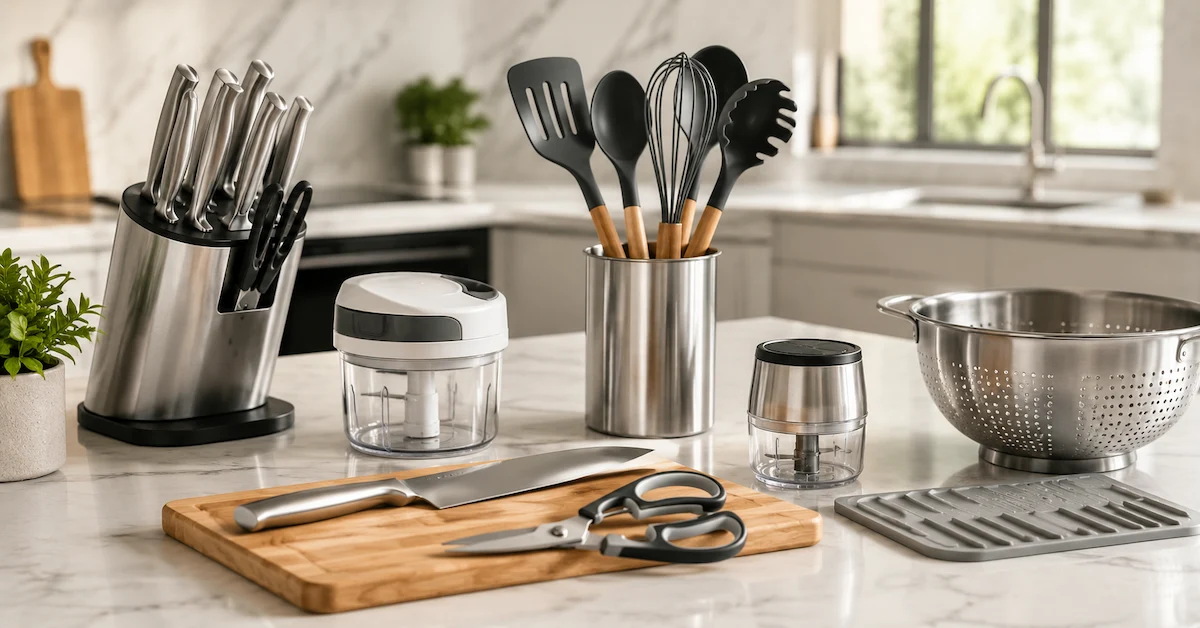
The original product image shows a countertop kitchenware assortment: a knife block set, utensil holder, manual food choppers, colander, cutting board, scissors, knives, and a drying or drain mat. This type of range is useful for buyers because it shows how different kitchen products can be presented as one family.
It also highlights sourcing complexity. Stainless-looking items may involve forming, polishing, edge finishing, and assembly. Clear chopper containers and lids point to molded plastic parts and fit checks. Cutting boards or wood-look handles introduce another material stream. A supplier that manages these categories well should be able to explain how each product is made, inspected, packed, and protected during shipping.
For retail programs, the coordinated appearance can help customers understand the line quickly. For hospitality or food-prep buyers, the more important test is daily usability: stable storage, comfortable handling, clean edges, tight lids, and practical cleaning routines.
How to Screen a Yangjiang Kitchenware Factory
Before asking for a full quotation, buyers should clarify the role of the supplier. Is the factory producing the main items in-house, coordinating partner factories, or acting mainly as a trading supplier? None of these models is automatically wrong, but each requires a different level of verification.
Ask practical questions early:
- Which products in the assortment are made directly by the supplier?
- Which parts or finished items are purchased from partner facilities?
- What material choices are available for each product category?
- Can the supplier provide pre-production samples that match the final packaging plan?
- How are cosmetic defects, sharp edges, loose parts, and poor fit handled during inspection?
- What information is needed for OEM branding, private-label packaging, or carton marking?
Good answers should be specific. If a supplier only says that everything is available, continue asking until the production route and responsibility are clear.
Supplier Comparison Checklist
A simple comparison table can keep the sourcing process focused. Use it when reviewing several Yangjiang kitchenware suppliers or when comparing a factory with a trading company.
| Evaluation Area | What to Check | Why It Matters |
|---|---|---|
| Product coverage | Knives, utensils, choppers, colanders, boards, storage items | Confirms whether one supplier can support the full line or only selected SKUs |
| Material clarity | Ask for material options and written confirmation before sampling | Prevents assumptions about metal, plastic, handle, or board materials |
| Sample accuracy | Check whether samples represent normal production, not only display pieces | Reduces surprises after tooling, artwork, or order confirmation |
| Fit and finish | Inspect edges, polish, handle feel, lid fit, blade alignment, and stability | Small defects often drive returns or complaints in kitchenware |
| Packaging plan | Review retail box, inner packing, master carton, protection, and labels | Coordinated sets can be damaged or visually inconsistent if packing is weak |
| OEM process | Ask about logo placement, artwork approval, sample sign-off, and change control | Helps private-label buyers keep the range consistent across SKUs |
Sample Review Points Buyers Should Not Skip
Kitchenware samples should be handled like working tools, not photographed and approved too quickly. For knives and scissors, inspect edge finishing, handle comfort, balance, and safe storage. For a knife block, test whether the base sits steadily and whether the slots or inserts align properly. For utensils and colanders, check rims, seams, polishing consistency, and whether any edges feel rough.
Manual food choppers need special attention because user experience depends on several parts working together. Check the bowl rim, lid fit, internal blade movement, locking or seating points, and ease of cleaning. If a clear container looks attractive but cracks, loosens, or stains too easily during normal use, it may not suit your target channel.
For cutting boards, ask the supplier what material options are available and inspect the finish, surface condition, edges, and packaging protection. Do not assume a material grade, coating, or construction unless the supplier states it clearly and backs it with appropriate documentation for your market.
Packaging and Private-Label Questions
Many buyers approach a kitchenware assortment as a private-label or retail program. That means packaging is not a secondary detail. A coordinated line can lose impact if box sizes, colors, product names, and logo positions vary too much from item to item.
Before placing a purchase order, prepare a clear packaging brief. Include desired retail format, artwork responsibilities, barcode placement, warning or care text requirements, carton marks, and photo or render needs. Ask whether the supplier will provide dielines, pre-production packaging samples, and final artwork confirmation. If your market has specific labeling or compliance requirements, confirm them with qualified professionals and ask the supplier what documentation they can provide, without assuming certifications that have not been verified.
Common Buyer Mistakes
One common mistake is treating all stainless-looking kitchenware as the same. A utensil holder, knife, colander, and scissors have different risk points. Surface finish, edge safety, strength, and assembly quality must be checked by product type.
Another mistake is focusing only on the hero item, such as the knife block, while overlooking accessories. In a set, the weakest item can affect the customer’s impression of the whole range. Manual choppers, lids, drain mats, and boards all need the same purchasing discipline as the more visible products.
A third mistake is requesting a quote before defining the use case. A giftable starter set, value retail range, hospitality prep kit, and restaurant back-of-house tool group may require different durability expectations, packaging, and replacement planning.
FAQ
Is Yangjiang only suitable for knife sourcing?
No. Yangjiang is strongly associated with knives, but many buyers also look there for broader kitchenware, including utensils, prep tools, cutting accessories, and storage products. Buyers should still confirm each supplier’s actual production scope.
Can one supplier handle a full kitchenware range?
Sometimes, but buyers should ask which items are made in-house and which are sourced through partners. The key is clear responsibility for quality, packaging, and final inspection.
What should I ask before ordering samples?
Ask for material options, available finishes, production method, packaging choices, branding process, sample lead time, and which details may change in mass production.
How should I compare two similar quotations?
Compare the quoted product construction, packaging, inspection scope, branding support, and commercial terms. A lower price is not useful if it removes protection, consistency, or required features.
What is the safest next step with a new supplier?
Start with representative samples and a written specification sheet. Review the complete assortment before confirming packaging artwork or a larger purchase order.
Final Sourcing Advice
When evaluating a Yangjiang kitchenware manufacturer, treat the first discussion as a technical and commercial screening. Ask about product categories, material choices, production responsibility, sample process, packaging control, and OEM workflow. Then test samples according to how the products will actually be used.
The best supplier for your program is not simply the one with the broadest catalog. It is the one that can keep a coordinated kitchenware range consistent from sample approval to production, packaging, and delivery.
