




A dependable all purpose scissors manufacturer should do more than supply a sharp-looking pair of scissors at a competitive wholesale price. The manufacturer should help B2B buyers select the right cutting-tool structure, define measurable performance requirements, approve a representative sample, customize the product for its sales channel, and maintain the same standard across production batches.
For importers, private-label brands, wholesalers, supermarket chains, and e-commerce sellers, all-purpose scissors are particularly demanding because the product promises versatility. A customer may expect one pair to cut wrapping paper, packaging film, labels, string, light cardboard, and selected craft materials. Yet those materials behave differently between two moving blades.
The most reliable way to source all-purpose scissors is to evaluate cutting performance across a defined group of materials, confirm blade and handle construction, and establish a repeatable quality standard before mass production.
A supplier's ability to explain blade geometry, heat treatment, grinding, pivot adjustment, ergonomic design, and production inspection is therefore more important than a broad claim of superior quality.
This guide explains how to assess those details and build a sourcing program that supports retail performance, OEM customization, and long-term replenishment.
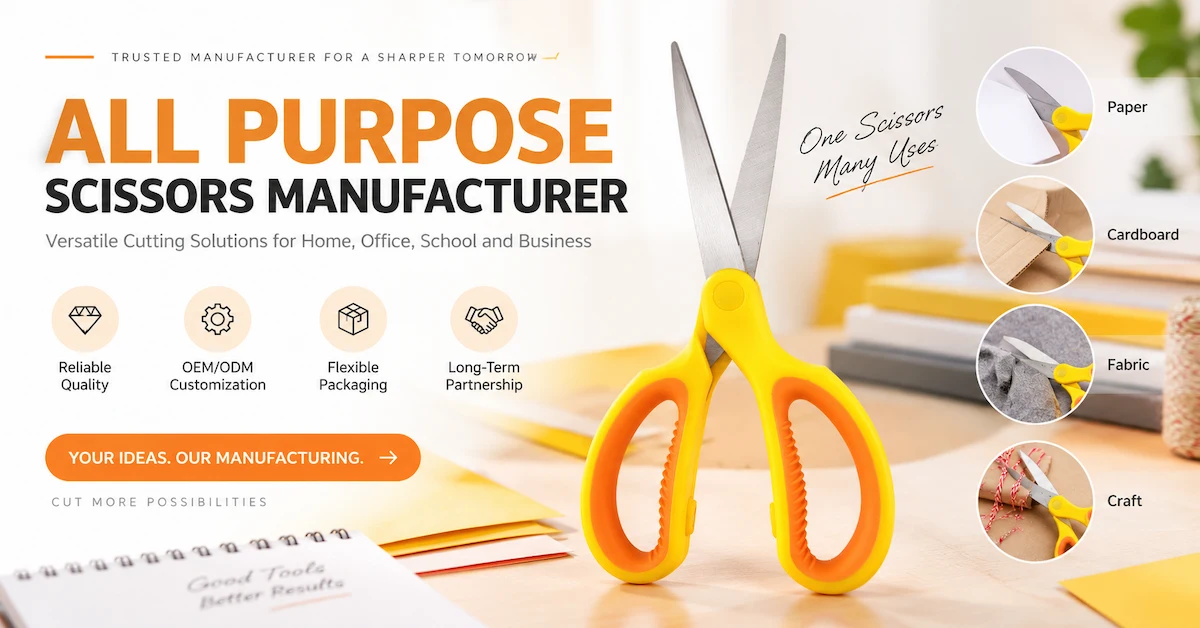
What Is an All Purpose Scissors Manufacturer?
An all purpose scissors manufacturer produces cutting tools intended for several everyday applications rather than one narrowly specialized task.
Typical applications include household organization, office work, packaging, light crafts, school supplies, gift wrapping, and selected utility tasks.
The defining characteristic is not the number of additional tools integrated into the product. It is the ability to perform a useful range of cutting operations with predictable results.
For example, a general-purpose pair may need to cut both thin paper and moderately thick packaging. Those tasks place different demands on blade contact, cutting force, and edge geometry.
A useful product must balance:
-
Cutting versatility: Suitable performance across the intended material range.
-
Blade alignment: Consistent interaction between the two blades.
-
Edge quality: Clean cutting without excessive snagging or folding.
-
Pivot stability: Smooth operation without excessive looseness.
-
Ergonomics: Comfortable handling for the target users.
-
Durability: Performance appropriate to the intended service conditions.
-
Safety: Suitable blade-tip design, handling, and storage.
-
Manufacturing consistency: Repeatable results between production units.
A company capable of manufacturing all-purpose scissors should be able to discuss these factors individually rather than treating “sharp stainless steel blades” as a complete technical specification.
Buyers can begin by examining BONET's all-purpose scissors product category and broader scissors portfolio to understand available product directions.
Why All-Purpose Scissors Require a Different Sourcing Strategy
The term “all-purpose” creates an important commercial challenge: customers often interpret it more broadly than manufacturers intend.
A product described as general purpose may be suitable for paper, light packaging, and household tasks, but that does not automatically make it suitable for heavy textiles, sheet metal, thick wire, poultry bones, or demanding industrial applications.
This distinction affects both product quality and marketing.
If packaging promises more than the scissors can reliably perform, the product becomes vulnerable to complaints, returns, and poor reviews.
A buyer should therefore identify two boundaries before approving the design.
The intended-use boundary defines the materials and tasks the product is expected to handle.
The excluded-use boundary identifies applications that require specialized scissors or stronger cutting tools.
For example, a general household scissors program could reasonably focus on office paper, labels, gift wrap, string, and light packaging.
A separate kitchen-scissors program may require food-preparation functionality, additional cleaning considerations, serration, or specialized blade structures.
An outdoor multi-tool may incorporate bottle opening, nut cracking, or other mechanisms.
These products can belong to a manufacturer's broader scissors assortment without sharing the same performance specification.
For B2B buyers, clearer product positioning leads to better sample testing, more accurate quotations, and fewer disagreements during quality inspection.
Who Buys All-Purpose Scissors in the B2B Market?
The same general-purpose scissors model may serve several commercial channels, but the purchasing priorities are not identical.
Private-Label Household Brands
Private-label brands want products that can become recognizable parts of their household-tool collections.
Their requirements often include custom handle colors, logo application, packaging design, controlled product specifications, and coordinated appearance across multiple SKUs.
A brand may also want a protective cover, distinctive grip texture, or an upgraded blade finish to differentiate its products from generic scissors.
The main purchasing risk is maintaining brand consistency across repeat orders.
Office-Supply Importers
Office-supply buyers generally prioritize practical cutting performance, ergonomic comfort, standard sizes, convenient packaging, and predictable replenishment.
They may need scissors suitable for paper, envelopes, labels, packaging, and general desk tasks.
For these buyers, smooth cutting and consistent pivot resistance can matter more than decorative features.
Supermarkets and Chain Stores
Supermarket buyers evaluate scissors as retail products.
They need products with understandable benefits, appropriate price positioning, visible differentiation, and packaging compatible with shelf or hanging displays.
A suitable manufacturing partner must understand that retail packaging, product dimensions, carton configuration, and barcode accuracy are part of the purchasing specification.
Wholesalers and Distributors
Distributors often need a broader assortment.
They may require several sizes, handle styles, colors, and price levels for different customers.
A manufacturer that can support a coordinated product range may be more valuable than a supplier offering only one attractive model.
E-Commerce Brands
Online sellers need products that photograph clearly, communicate benefits quickly, and arrive undamaged.
Soft-grip handles, distinctive colors, protective covers, and practical cutting demonstrations can strengthen product listings.
However, the product must still meet the claims shown in those demonstrations.
Craft and Hobby Retailers
Craft-oriented buyers may place more emphasis on precise cutting, tip control, hand comfort, and performance on selected paper or fabric materials.
A general-purpose model may be appropriate for light crafts, but specialized textile or precision-craft applications may need a different design.
Promotional Product Buyers
Promotional distributors may prioritize logo visibility, colors, packaging, and order-specific branding.
They still need dependable cutting performance. An inexpensive promotional product that feels uncomfortable or cuts poorly can reflect negatively on the brand printed on it.
Match the Scissors Design to the Sales Channel
A useful purchasing strategy begins with the market rather than the factory catalog.
| Buyer Segment | Primary Product Requirement | Customization Priority | Main Procurement Risk |
|---|---|---|---|
| Household brands | Everyday cutting versatility | Handle color, logo, packaging | Inconsistent brand quality |
| Office suppliers | Smooth paper and packaging cutting | Sizes, grip, retail packs | Poor cutting consistency |
| Supermarkets | Recognizable benefits and price fit | Shelf-ready packaging | Packaging or replenishment issues |
| E-commerce sellers | Visible features and dependable function | Color, branding, protective packs | Returns and negative reviews |
| Distributors | Multiple suitable SKUs | Assortment and carton options | Supply inconsistency |
| Craft retailers | Control and selected material performance | Blade design, handles, finishes | Material snagging |
| Promotional buyers | Brand presentation at planned cost | Logo and color | Weak perceived quality |
For example, an office-supply importer may prefer a straightforward 7-inch model with comfortable handles.
A supermarket program may need two or three sizes that share a consistent visual identity.
An e-commerce brand might prioritize a protective-cover model and packaging suitable for individual parcel shipping.
None of these strategies is automatically better. Each serves a different buyer.
Which All-Purpose Scissors Types Should Buyers Consider?
All-purpose scissors are not one fixed design.
Understanding the main product structures makes supplier comparisons more meaningful.
Standard General-Purpose Scissors
These products emphasize familiar cutting performance.
They are commonly positioned for paper, light packaging, string, labels, and everyday household tasks.
Their commercial advantage is simplicity.
A basic model with reliable cutting, comfortable handles, and suitable packaging may offer better value than a complicated design with unnecessary features.
Soft-Grip Scissors
Soft-grip models use handle structures intended to improve comfort.
Depending on the design, the handle may combine a rigid plastic structure with a softer gripping material.
This can be attractive for office, household, and hobby applications.
However, ergonomic performance should be verified through actual handling rather than assumed from the presence of soft material.
Precision-Oriented General Scissors
Some buyers need a product that performs especially well on paper and light craft materials.
These scissors may emphasize blade contact, cutting control, and tip precision.
They should still be tested against the intended material range before being described as suitable for broader household use.
Protective-Cover Scissors
A protective cover can improve storage convenience and protect the cutting edges.
However, the cover becomes an additional component requiring inspection.
The buyer should confirm that it fits securely, can be removed conveniently, and remains in place during ordinary packaging and transport.
Decorative or Coated Scissors
Special finishes and colors can differentiate a product in retail displays.
The commercial benefit depends on finish consistency and how the coating performs under the intended conditions.
The buyer should not assume that a decorative coating automatically improves durability or cutting performance.
Multi-Functional Utility Scissors
Some products integrate opening, gripping, or other utility functions.
These may be commercially attractive, but they belong to a more complex product-development category.
A buyer seeking straightforward general-purpose cutting should not automatically add extra mechanisms.
For specialized integrated functions, explore BONET's scissors product range before selecting the most appropriate platform.
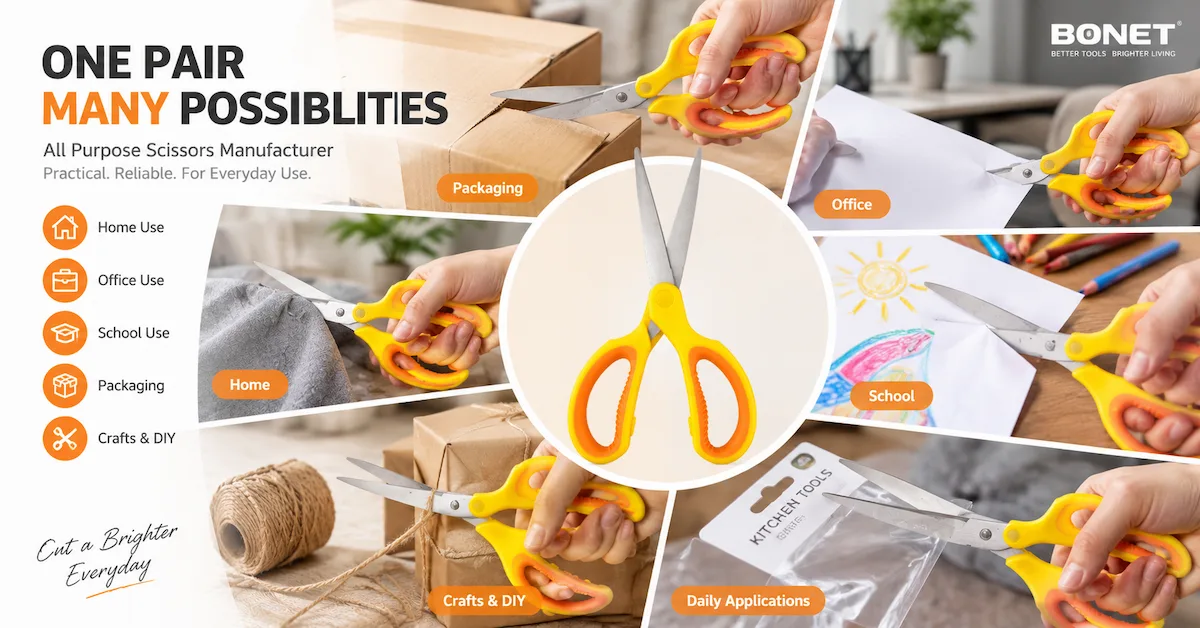
What Materials Should an All Purpose Scissors Manufacturer Offer?
Material selection affects manufacturing, cutting performance, durability, appearance, and cost.
However, B2B buyers should avoid evaluating scissors solely by the name of the blade material.
Stainless Steel Blades
Stainless steel is widely used in household and office scissors because it provides a useful combination of manufacturing practicality and corrosion resistance.
BONET's published product specifications identify 420 stainless steel in several scissors models.
For example, the company's SST248 office scissors list 420 stainless steel blades and PP+TPR handle material.
However, 420 stainless steel is not a complete cutting-performance specification.
Actual results depend on factors such as:
-
Material condition and composition within the specified grade.
-
Blade thickness.
-
Heat-treatment process.
-
Cutting-edge geometry.
-
Grinding quality.
-
Blade alignment.
-
Pivot adjustment.
-
Intended cutting materials.
A manufacturer should be prepared to discuss the relationship between material selection and the finished cutting tool.
PP Handles
Polypropylene, commonly abbreviated as PP, is used in molded handle structures.
It offers design flexibility for creating finger loops, ergonomic profiles, and different handle shapes.
For B2B buyers, important inspection areas include dimensional consistency, molding finish, structural fit, and color accuracy.
PP+TPR Handles
Some scissors use PP combined with thermoplastic rubber, or TPR.
The rigid and softer materials can be combined to create a more comfortable gripping experience.
However, the quality of the handle depends on more than material choice.
The buyer should inspect the shape, soft-grip placement, surface texture, molding quality, and fit between materials.
Decorative Finishes and Coatings
A coating may serve decorative or functional purposes depending on its specification.
Buyers should confirm the actual coating type and avoid making unsupported claims about corrosion resistance, non-stick performance, or durability.
Any such claim should be supported by appropriate product information or testing.
Real Product Specifications: What BONET's Models Show
A useful manufacturer comparison begins with actual published product specifications rather than broad catalog descriptions.
The following examples illustrate different design directions shown on BONET's website.
| Product Model | Published Size | Metal Material | Handle Material | Application Direction |
|---|---|---|---|---|
| SST248 | 6", 7", 8.25" | 420 stainless steel | PP+TPR | Office and everyday cutting |
| SHO062-6 | 6.5" | 420 stainless steel | PP+TPR | Household and light craft applications |
| G2004 | 19 × 9.5 × 1 cm | 420 stainless steel | PP | Kitchen-oriented multifunctional scissors |
These are published catalog specifications, not independent performance-test results.
The models also demonstrate why an all-purpose scissors inquiry should begin with intended use.
SST248 and SHO062-6 provide references for everyday cutting applications.
G2004 represents a different, kitchen-oriented multifunctional direction and should not automatically be treated as interchangeable with an office or household model.
Actual dimensions, features, materials, production availability, and customization feasibility should be reconfirmed against the selected product before quotation.
The goal is not to select a model simply because its size or material appears attractive.
The goal is to identify which structure best matches the intended retail proposition.
Why Blade Geometry Matters More Than Many Buyers Expect
Scissors are not simply two small knives joined by a screw.
They operate through the controlled movement and contact of two cutting blades.
That relationship makes geometry critical.
Blade Straightness
If the blades are not correctly formed and aligned, they may fail to maintain effective cutting contact.
A customer may experience paper folding, fabric snagging, or incomplete cutting.
A buyer should test cutting along the full usable blade length, not only near the pivot.
Blade Curvature and Contact
Scissor blades may use designed curvature or contact geometry to maintain appropriate interaction during closing.
The correct arrangement depends on the model.
Buyers should judge the final cutting result and ask the supplier how the chosen geometry is controlled during manufacturing.
Tip Performance
Some scissors perform adequately near the pivot but struggle at the tip.
This can be especially noticeable during precise paper cutting or craft tasks.
For products marketed around precision, tip performance deserves a separate test.
Cutting-Edge Geometry
Edge shape affects the way scissors engage different materials.
A configuration suited to thin paper may not be the ideal choice for thicker cardboard or slippery packaging film.
This is why a general-purpose product should be evaluated against several representative materials rather than one impressive demonstration.
How Are All-Purpose Scissors Manufactured?
Understanding manufacturing processes helps buyers identify where variation can enter the finished product.
BONET publishes a multi-stage manufacturing process that includes stamping, straight adjustment, heat treatment, rough grinding, water grinding, polishing, injection molding, ultrasonic cleaning, setting and assembly, quality inspection, final cleaning, and packing.
These stages provide a useful framework for evaluating a scissors supplier.
1. Stamping: Creating the Blade Form
Stamping forms the initial metal component according to the selected design.
Dimensional consistency matters because later manufacturing stages depend on the geometry established during forming.
For an OEM project, a buyer should confirm whether the selected model uses existing tooling or requires new tooling.
That decision can influence development cost, sampling, and production planning.
2. Straight Adjustment: Controlling Blade Alignment
After forming, blade straightness may require adjustment.
This process is particularly relevant to scissors because the two blades must work together throughout the closing movement.
If alignment is inconsistent, users may experience uneven cutting behavior.
A manufacturer should be able to explain how blade straightness is checked or corrected.
3. Heat Treatment: Managing Material Performance
Heat treatment is used to develop the required material properties.
BONET's manufacturing documentation identifies hardening, tempering, and annealing as relevant processes.
For buyers, the important consideration is consistency.
If a project requires a specific hardness range, testing procedure, or documented acceptance value, that requirement should be agreed during specification development.
The published website does not establish one universal hardness value for all scissors models, and buyers should not assume one.
4. Rough Grinding: Establishing Basic Blade Geometry
Rough grinding removes material and prepares the blade for finer finishing.
Variation at this stage may influence later edge formation.
For B2B procurement, the supplier's ability to maintain a repeatable process matters more than the appearance of any single grinding machine.
5. Water Grinding: Refining the Cutting Edge
BONET identifies water grinding as a precision process used in knife and scissors production.
Water-assisted grinding can help control friction and heat while refining the edge.
For finished scissors, buyers should evaluate cutting performance rather than relying only on process descriptions.
6. Polishing: Improving the Surface Finish
Polishing contributes to appearance and surface refinement.
In retail products, visible finishing defects can affect perceived quality even when basic cutting performance is acceptable.
Buyers should approve acceptable surface appearance through representative samples.
7. Injection Molding: Producing the Handle
Handle molding creates the grip structure.
Potential issues include flashing, uneven surfaces, inconsistent color, poor component fit, or uncomfortable edges.
These are especially important for private-label programs because handle appearance is often a major part of brand identity.
8. Cleaning: Removing Manufacturing Residues
BONET's process includes ultrasonic cleaning.
Removing relevant residues helps prepare metal parts for subsequent operations and final product presentation.
For finished goods, buyers should inspect cleanliness and ensure any processing residues are controlled appropriately.
9. Setting and Assembly: Bringing the Components Together
Scissors assembly is a critical performance stage.
Two individually acceptable blades may still function poorly if the pivot and blade contact are not adjusted correctly.
The assembled scissors should open smoothly and maintain appropriate cutting contact.
10. Quality Checking: Confirming Product Requirements
Inspection should cover the characteristics defined in the project specification.
These may include appearance, dimensions, cutting performance, pivot operation, handle finish, accessories, branding, and packaging.
11. Final Cleaning and Corrosion Protection
BONET also identifies drying and anti-rust treatment in its production workflow.
The relevant treatment and cleanliness requirements should be confirmed for the specific product and intended market.
12. Packing and Shipment Preparation
Packing should protect the scissors and present them correctly for the buyer's distribution channel.
Incorrect packaging can undermine otherwise acceptable manufacturing quality.
A professional manufacturer should therefore connect production specifications with the final packaging requirements.
How Should B2B Buyers Test All-Purpose Scissors?
Sample testing is the most practical way to compare products intended for several cutting tasks.
However, the testing method must reflect the application.
A sample that cuts office paper well may perform differently on thin plastic film, string, or light cardboard.
An effective evaluation should use a repeatable set of materials and record the results.
Test 1: Standard Paper
Paper provides a useful starting point for checking cutting smoothness and blade interaction.
Observe whether the material cuts cleanly or folds between the blades.
Test from the blade base toward the tip.
Test 2: Thin Packaging Film
Thin flexible film can expose weaknesses in blade contact that may be less obvious with paper.
Observe slipping, folding, or inconsistent cutting.
Use a clearly defined film material rather than changing the test material between suppliers.
Test 3: Light Cardboard
Cardboard introduces greater cutting resistance.
It can help buyers understand whether the product is appropriate for light packaging tasks.
However, do not use material beyond the intended capability of the model.
Test 4: String or Twine
String cutting helps evaluate how the blades engage a narrow, flexible material.
The sample should cut rather than repeatedly push the material along the edge.
Test 5: Selected Craft Materials
For scissors intended for hobby or craft applications, include suitable representative materials.
These may include paper sheets, lightweight decorative materials, or selected fabrics.
Do not assume that satisfactory light-craft performance proves suitability for professional tailoring.
Test 6: Repeated Opening and Closing
Repeated operation helps reveal changes in pivot feel, resistance, and component stability.
The test duration or number of cycles should be determined according to the project requirement.
Test 7: Handle Comfort
Evaluate the product through actual use.
Consider different hand sizes and the intended user group.
An apparently attractive handle may create pressure points during repeated cutting.
Test 8: Packaging Inspection
Inspect the product after packing and handling.
Check whether the blades, handles, logo, coating, and accessories remain properly protected.
Create a Repeatable Scissors Test Matrix
A professional purchasing team should use the same materials and test method when comparing suppliers.
The following is a suggested evaluation framework, not a claim about laboratory tests already performed by BONET.
| Test Material or Function | What to Observe | Example Acceptance Principle |
|---|---|---|
| Standard office paper | Clean cut, no folding | Cuts consistently along intended blade length |
| Thin plastic film | Slipping or folding | Performs within the agreed application standard |
| Light cardboard | Cutting resistance | Cuts without unacceptable distortion |
| String | Cutting engagement | Severs material without repeated slipping |
| Lightweight fabric | Snagging and control | Meets agreed craft-use requirement if advertised |
| Blade tip | Precision and blade contact | Produces controlled cuts |
| Pivot movement | Smoothness and looseness | Matches approved reference |
| Handle | Comfort and grip | No unacceptable pressure points |
| Protective cover | Retention and convenience | Fits according to approved specification |
| Packaging | Damage and movement | Protects product during specified handling |
For stronger comparisons, buyers should test more than one sample from each candidate supplier.
A single carefully selected specimen may not reveal normal manufacturing variation.
The acceptance criteria, sample quantity, and test procedure should be agreed for the project rather than presented as universal industry limits.
How to Evaluate Scissors Ergonomics
Handle comfort has a direct relationship with consumer experience.
A scissors model may cut satisfactorily but feel unpleasant during repeated use.
Several ergonomic characteristics deserve attention.
Finger-Loop Geometry
The shape and size of the finger loops affect hand placement.
A design suitable for one hand size may feel cramped or unstable for another.
Buyers should evaluate the intended user group rather than assuming one handle fits everyone equally well.
Surface Texture
Textured surfaces can improve grip in some applications.
However, overly aggressive textures or poorly finished molding edges can reduce comfort.
Weight Distribution
The balance between the blade assembly and handles influences perceived control.
For repeated household or office use, comfort may be more important than a heavy, premium-looking construction.
Soft-Grip Placement
A PP+TPR handle should place the softer material where it provides practical value.
Soft material applied only for appearance may contribute little to comfort.
Left-Handed and Right-Handed Use
This is frequently overlooked.
A symmetrical handle does not automatically make scissors equally functional for left-handed and right-handed users.
Blade arrangement and visibility also matter.
Buyers considering ambidextrous positioning should physically evaluate the product with appropriate users and avoid making unsupported universal-use claims.
BONET discusses this distinction in its article about right-handed and left-handed scissors.
OEM All Purpose Scissors: What Can Be Customized?
OEM customization should be divided into levels because not every modification has the same development cost or manufacturing complexity.
Level 1: Logo and Packaging
This is often the least complex form of private labeling.
Potential options include logo printing, laser marking, retail labels, barcode placement, color boxes, and branded packaging.
The feasibility of each method depends on the selected product and marking surface.
Level 2: Handle Colors and Appearance
Custom colors can help a brand create a recognizable product family.
Buyers should establish a controlled color reference and approve physical samples.
A color viewed on a computer screen should not be treated as a definitive production standard.
Level 3: Grip and Finish Changes
Changes to grip texture, material combinations, or surface finish may require additional sampling.
If the modification affects the handle structure or manufacturing process, the supplier should identify any tooling implications.
Level 4: Product Configuration
A project may request different sizes, blade designs, protective covers, or accessory combinations.
The buyer should determine which options already exist and which require development.
Level 5: Structural Development
New blade geometry, handle architecture, or mechanical components may require ODM support.
BONET's OEM/ODM services include production based on drawings or samples, material customization, colors, logo application, packaging, concept development, structural optimization, and sampling.
For buyers, the important question is not simply whether customization is available.
It is which modifications can be implemented using an existing product platform and which require new engineering, tooling, or verification.
OEM vs ODM: Which Approach Is Better for Your Scissors Project?
The difference depends on how much product development has already been completed.
Choose OEM When the Product Is Defined
OEM is generally suitable when the buyer already has an existing sample, drawing, dimensions, material specification, branding requirements, and packaging direction.
The manufacturer is responsible for producing the agreed product according to those requirements.
This approach can be appropriate for importers and established brands with mature product specifications.
Choose ODM When Development Support Is Needed
ODM is more relevant when the buyer has a concept but needs help defining the structure.
For example, a brand may want a family of ergonomic all-purpose scissors for household and office use but have no finished drawings.
The development discussion may involve product selection, material recommendations, handle design, sample iterations, feasibility, and packaging development.
Neither approach is automatically superior.
The right choice depends on the buyer's development stage, project budget, desired differentiation, and required technical support.
Packaging Requirements for Different Retail Channels
Packaging directly affects product presentation, transport protection, storage, and distribution cost.
Supermarket Packaging
Supermarket packaging should communicate the product's main benefits quickly.
Important information may include size, intended use, comfort features, and storage accessories.
The packaging should also be compatible with the planned retail display.
E-Commerce Packaging
Individual parcel distribution exposes products to different handling conditions from palletized retail shipments.
Packaging should control movement and protect the blades, handle, and any coated surfaces.
Buyers should evaluate package dimensions as well as protection.
An oversized package can increase shipping inefficiency without improving the customer experience.
Wholesale Packaging
Wholesalers may prioritize standardized quantities, clear SKU identification, carton efficiency, and warehouse handling.
Premium Brand Packaging
Premium household-tool brands may prefer gift-style packaging or more distinctive printed boxes.
However, presentation should match the intended retail price and customer expectations.
A carefully designed simple package may be more effective than expensive packaging that adds little practical value.
What Affects MOQ for All-Purpose Scissors?
Minimum order quantity should be evaluated against the full product specification.
There is no meaningful universal MOQ for every all-purpose scissors program.
Factors that may affect MOQ include:
-
Existing versus newly developed models.
-
Standard versus custom handle colors.
-
Plastic and soft-grip material requirements.
-
Surface treatments.
-
Logo methods.
-
Retail packaging print quantities.
-
Protective covers or accessories.
-
Tooling requirements.
-
Component supplier minimums.
-
Production setup and order configuration.
An existing model with a simple logo may have very different commercial requirements from a newly developed structure with custom handles and packaging.
Therefore, buyers should request MOQ after defining the actual customization scope.
A better purchasing question is:
“What is the MOQ for the selected 7-inch model with our approved handle color, logo application, individual retail packaging, barcode label, and export-carton requirements?”
That produces a more useful quotation than asking for the lowest possible MOQ without defining the product.
What Determines Wholesale All-Purpose Scissors Pricing?
Wholesale scissors cost includes several layers.
Material Cost
Blade material, handle materials, additional components, and product size influence cost.
Manufacturing Complexity
Stamping, heat treatment, grinding, polishing, handle molding, assembly, and special finishes contribute to production requirements.
Product Dimensions
Different sizes can use different quantities of material and require different packaging configurations.
Customization
Color matching, logos, coatings, tooling, and other modifications may create additional costs.
Packaging
Retail cards, printed boxes, protective covers, inserts, labels, and export cartons can change the complete unit cost.
Quality Requirements
Project-specific inspections and tests may also affect the quotation.
Order Volume
Volume can influence material purchasing and production efficiency, although the effect varies by project.
For B2B buyers, unit price should not be evaluated in isolation.
Consider landed cost, including agreed manufacturing price, packaging, freight, duties, relevant inspection costs, and other importing expenses.
A product with a slightly lower factory price may become less attractive if packaging is inefficient, shipment damage is frequent, or the product requires excessive handling.
How to Compare All-Purpose Scissors Suppliers
A supplier evaluation scorecard helps purchasing teams make decisions based on consistent evidence.
| Evaluation Area | What to Verify | Potential Warning Sign |
|---|---|---|
| Product range | Available sizes and application types | Limited understanding of intended use |
| Blade material | Grade and component specification | Vague material descriptions |
| Manufacturing | Ability to explain critical processes | Generic claims without technical detail |
| Cutting performance | Results on agreed test materials | Demonstration on only one material |
| Ergonomics | Comfort and suitability for target users | No practical handling evaluation |
| Sampling | Approval and revision control | Undocumented sample changes |
| OEM support | Customization scope and feasibility | Every request accepted without review |
| Packaging | Channel-specific protection | Packaging considered only at shipment |
| Quality control | Defined inspection criteria | No clear defect classification |
| Reorders | Specification and change control | Previous orders not properly documented |
| Commercial terms | MOQ, lead time, quotation inclusions | Unclear price assumptions |
A supplier that identifies genuine design or production limitations can be more valuable than one that agrees to every request immediately.
The strongest manufacturing relationships involve clear technical discussion, realistic feasibility assessment, and documented decisions.
Quality Control: What Should Be Inspected Before Shipment?
Quality control should begin with the specification, not with final inspection alone.
A practical all-purpose scissors QC plan can be divided into several categories.
Incoming Materials
Confirm that the supplied components match the approved material requirements.
If a specific blade material or handle formulation is essential, the buyer should agree on appropriate evidence and verification.
Dimensions
Check dimensions relevant to the model, including overall length, critical blade measurements, handle geometry, and component fit where specified.
Appearance
Inspect blade finish, scratches, stains, molding defects, color consistency, and logo placement.
Cutting Performance
Use an agreed functional test with representative cutting materials.
The test should identify unacceptable folding, snagging, incomplete cuts, or inconsistent blade interaction.
Assembly
Check pivot stability, opening and closing behavior, and handle assembly.
Packaging
Check the correct SKU, artwork, barcode, labels, accessories, product protection, carton quantity, and shipment markings.
Defect Classification
For formal wholesale or retail programs, buyers should agree on critical, major, and minor defects before inspection.
For example, an exposed hazardous defect might be treated differently from a small cosmetic mark that does not affect function.
The final classification must reflect product risks, customer requirements, and the agreed inspection plan.
It should not be improvised after defects are discovered.
Certifications and Compliance: What Should Buyers Confirm?
Supplier certifications and product compliance are related but different matters.
BONET's company profile identifies ISO9001, BSCI, and Sedex-related information.
Buyers can use this as a starting point for factory evaluation, while confirming the current status, scope, and supporting documents where necessary.
A factory-level management or social-compliance credential does not automatically establish that every scissors model satisfies all requirements in every destination market.
Depending on the product and market, buyers may need to review relevant material documentation, product-safety considerations, labeling requirements, importer obligations, or customer-specific tests.
Products marketed specifically for children may involve different considerations from ordinary adult household scissors.
A specialized kitchen product may also raise application-specific material and care questions.
Do not assume that a general-purpose designation eliminates the need to identify the intended market and applicable requirements.
How to Prevent Quality Problems on Repeat Orders
A first production order is only the beginning of a private-label program.
Repeat orders introduce risks because suppliers, materials, packaging, personnel, or production conditions may change.
The best protection is an approved master specification.
It should identify:
-
Product model and version.
-
Blade material.
-
Critical dimensions.
-
Handle material.
-
Handle color reference.
-
Surface finish.
-
Logo artwork and location.
-
Protective accessories.
-
Packaging artwork version.
-
Barcode and labeling requirements.
-
Carton configuration.
-
Approved reference samples.
-
Inspection criteria.
-
Relevant change approvals.
Before placing a repeat order, the buyer should ask whether anything has changed since the previously approved production.
A significant change may require additional sample review.
This process protects the buyer's brand identity and helps the manufacturer understand which characteristics must remain unchanged.
What Should Be Included in an All-Purpose Scissors RFQ?
A structured request for quotation makes supplier responses easier to evaluate.
| RFQ Requirement | Information to Provide |
|---|---|
| Product category | All-purpose, household, office, light craft |
| Intended application | Paper, packaging, labels, string, selected crafts |
| Target market | Country or region |
| Buyer channel | Retail, supermarket, e-commerce, wholesale |
| Reference product | Model, sample, photo, or drawing |
| Size | Required length or preferred options |
| Blade material | Required grade or supplier recommendation |
| Handle | PP, PP+TPR, or another specified structure |
| Ergonomics | User group and grip requirements |
| Color | Standard or custom reference |
| Surface finish | Polished, matte, coated, or other |
| Branding | Logo method and position |
| Accessories | Protective cover or other requirements |
| Packaging | Retail card, box, bulk pack, etc. |
| Order quantity | Initial order and forecast |
| Testing | Required functional and inspection criteria |
| Compliance | Destination-market or retailer requirements |
| Delivery | Target schedule and destination |
A buyer can also include the following concise enquiry:
We are sourcing all-purpose scissors for a private-label household and office product range. Our target market is [market], and the main applications are [materials and tasks]. We are considering [size/model] with [blade and handle requirements]. Please review our logo, color, packaging, initial quantity, and expected reorder volume. We would like confirmation of available models, sample arrangements, MOQ, quotation details, inspection requirements, and estimated production timing.
This gives the supplier a clear commercial and technical starting point.
How to Build an All-Purpose Scissors Product Range
A single scissors model may not satisfy every retail customer.
For brands and distributors, a coordinated assortment can be more useful.
For example, a collection might include:
-
A compact model for small household tasks.
-
A standard model for daily home and office use.
-
A larger model for selected packaging applications.
-
A soft-grip version for comfort-focused buyers.
-
A protective-cover version for storage convenience.
-
A craft-oriented option for selected hobby applications.
The goal is not necessarily to offer as many models as possible.
Each SKU should perform a distinct commercial role.
A compact entry-level model may support price-sensitive retail channels.
A standard soft-grip model may serve as the core product.
A more distinctive finish or packaging option may support a premium private-label tier.
This approach creates a clearer assortment and simplifies discussions about production, packaging, and replenishment.
Common Sourcing Mistakes B2B Buyers Should Avoid
Mistake 1: Assuming “All Purpose” Means Unlimited Cutting Capability
No single scissors model is appropriate for every material.
Define the intended-use range and test accordingly.
Mistake 2: Choosing by Steel Grade Alone
Material matters, but blade geometry, heat treatment, grinding, and assembly also affect cutting performance.
Mistake 3: Testing Only Paper
A sample that cuts paper well may behave differently on plastic film or string.
Test the materials relevant to the intended product claims.
Mistake 4: Ignoring the Pivot
A loose or overly tight pivot can undermine otherwise acceptable blades.
Mistake 5: Treating Handle Comfort as a Cosmetic Feature
Grip geometry affects real user experience.
Evaluate comfort through practical handling.
Mistake 6: Approving a Sample Without Recording Its Version
Sample revisions should be documented.
The approved sample must be identifiable during production and future reorders.
Mistake 7: Finalizing Packaging Too Late
Packaging affects cost, protection, retail presentation, labeling, and logistics.
Develop it alongside the product.
Mistake 8: Comparing Prices Without Matching Specifications
Two quotations may include different materials, packaging, finishes, or inspection requirements.
Compare equivalent specifications.
Mistake 9: Assuming Certifications Cover Every Requirement
Confirm current company documentation and product-specific obligations separately.
Mistake 10: Neglecting Repeat-Order Control
The same approved product should remain identifiable and reproducible after the first shipment.
Why BONET Is Worth Evaluating for All-Purpose Scissors Projects
BONET HOUSEWARE CO., LTD. is based in Yangjiang, China, a manufacturing region associated with knives and scissors.
Its website presents product categories covering all-purpose scissors, kitchen tools, kitchen knives, cutting boards, multifunctional kitchenware, and related products.
For a B2B scissors project, several published capabilities provide a useful starting point for evaluation.
Product Selection
BONET publishes multiple scissors designs serving different applications.
This gives buyers an opportunity to compare product structures before deciding whether an existing model can meet their requirements.
Manufacturing Knowledge
The company's manufacturing process describes metal forming, blade adjustment, heat treatment, grinding, polishing, handle production, assembly, cleaning, inspection, and packing.
These processes are relevant to discussions about cutting performance and production consistency.
OEM and ODM Customization
BONET publicly describes support for drawings, samples, materials, colors, logos, surface treatments, packaging, product development, and mass production.
This is useful for buyers considering either existing models or more customized product programs.
Retail and Export Packaging
The company's OEM/ODM page lists retail packaging, color boxes, gift boxes, barcode labels, and export cartons among its customization options.
These can be important for supermarkets, branded retailers, and e-commerce businesses.
Project-Specific Evaluation
Public capabilities should not be confused with a confirmed quotation.
The appropriate MOQ, available customization options, sampling arrangements, inspection requirements, and production schedule depend on the selected model and project details.
A productive next step is to submit a clear specification rather than request an undefined lowest price.
Buyers can use BONET's contact page to discuss product references, target markets, customization, quantities, packaging, and quality expectations.
FAQ: All-Purpose Scissors Manufacturing and Wholesale Sourcing
1. What is an all purpose scissors manufacturer?
An all purpose scissors manufacturer produces scissors designed for several everyday cutting tasks, such as paper, light packaging, string, labels, and selected household or craft applications.
The manufacturer may also support material selection, ergonomic handles, logo customization, packaging development, sample approval, quality control, and repeat production.
Buyers should evaluate the supplier against the intended product specification rather than the broad category name alone.
2. Are all-purpose scissors the same as multipurpose scissors?
Not necessarily.
All-purpose scissors generally emphasize cutting versatility across different everyday materials.
Multipurpose scissors may include additional functions such as opening, gripping, or other utility features.
Because manufacturers use these terms differently, buyers should define the required cutting tasks and additional functions in the RFQ.
3. What blade materials are used in all-purpose scissors?
Stainless steel is commonly used in many household and office scissors.
BONET's published specifications list 420 stainless steel for several relevant models.
However, buyers should evaluate blade material together with geometry, heat treatment, grinding, pivot construction, and actual cutting performance.
A material grade alone does not establish the quality of the finished product.
4. Which scissors size is best for wholesale retail programs?
There is no universal ideal size.
The choice depends on the target user, intended cutting tasks, packaging format, and retail price segment.
Some buyers prefer a compact model, while others need standard or larger general-purpose scissors.
A coordinated assortment may include several sizes rather than one model intended to satisfy every customer.
5. Can I customize all-purpose scissors for my own brand?
Yes, depending on the product platform and manufacturing feasibility.
Customization may include logo printing, laser engraving, handle colors, soft-grip materials, surface finishes, accessories, and retail packaging.
More extensive changes to blade geometry or handle structure may require development work or new tooling.
The selected specification should be reviewed before confirming MOQ and cost.
6. What should I test before approving an all-purpose scissors sample?
Test cutting performance across representative materials, including paper, thin packaging film, light cardboard, and string where relevant.
Also inspect blade alignment, tip performance, pivot resistance, handle comfort, appearance, accessories, branding, and packaging.
Use a consistent evaluation method for competing samples and retain the approved version as a production reference.
7. What affects the MOQ for OEM all-purpose scissors?
MOQ can be influenced by the selected model, handle color, material requirements, coating, logo method, custom packaging, accessories, tooling, and production setup.
An existing model with simple branding may have different minimum requirements from a structurally customized design.
Ask the supplier to quote MOQ against the exact specification.
8. How can importers compare all-purpose scissors manufacturers?
Compare product suitability, published specifications, sample performance, manufacturing knowledge, customization feasibility, quality-control arrangements, packaging capability, commercial terms, and repeat-order procedures.
A supplier scorecard can help ensure that every candidate is evaluated against the same purchasing requirements.
Avoid selecting a supplier solely because of the lowest initial unit price.
9. How can brands prevent quality changes between repeat orders?
Maintain an approved product specification containing materials, dimensions, colors, finishes, logo artwork, packaging versions, critical inspection requirements, and reference samples.
Before placing another order, confirm whether any components, processes, materials, or packaging details have changed.
Relevant changes should be reviewed and approved before production.
10. How can I request an OEM all-purpose scissors quotation from BONET?
Prepare the target market, application, preferred size, reference product, blade and handle requirements, customization details, packaging, quantity, destination, and quality expectations.
You can then submit these details through BONET's contact page.
A structured enquiry helps the manufacturer assess suitable models, sampling needs, customization feasibility, commercial terms, and production planning.
Conclusion
Choosing an all purpose scissors manufacturer requires matching the product to real cutting applications, then verifying blade performance, ergonomics, customization, packaging, and production consistency. B2B buyers should prioritize representative sample testing, documented specifications, and reliable repeat-order controls over unit price alone.
BONET offers all-purpose scissors, documented manufacturing capabilities, and OEM/ODM services. To evaluate a private-label or wholesale project, contact BONET with your target market, product requirements, packaging preferences, and expected order quantity for a project-specific quotation.
