




Quick answer: A reliable bamboo cutting board manufacturer should be evaluated on the construction of the board—not merely its bamboo appearance. Overseas buyers should verify strip and lamination configuration, adhesive documentation, moisture management, machining quality, approved finishing systems, food-contact evidence relevant to the destination market, and repeatable inspection controls. The purchasing objective is a board that looks consistent, remains suitably stable under its stated care conditions, is accurately labeled, and can be reordered to the same approved specification.
For kitchenware importers, supermarket purchasing teams, private-label brands, and distributors, those requirements are practical commercial safeguards. A visually attractive bamboo board can still create complaints if the edges become rough, glue lines separate, its surface changes shape during storage, or its packaging makes unsupported environmental claims. The strongest request for quotation therefore combines product specifications, evidence requests, sampling methods, and release criteria rather than asking only for a price per piece.
Supplier disclosure: BONET HOUSEWARE CO., LTD. publicly describes OEM/ODM kitchenware services that include cutting boards and lists bamboo among materials that may be considered for customized kitchenware projects. At the time of this review, its public chopping-board category identifies a specific PP plastic board, but does not establish a separately verified bamboo cutting board model. Consequently, the bamboo configurations in this guide are buyer specification examples, not confirmed BONET catalog products. Buyers should ask BONET to verify current bamboo-board feasibility and availability before treating any concept as an offered item.
Five points to remember:
- Construction matters: solid-looking boards may actually contain glued bamboo strips or multiple laminated layers.
- Adhesive identification and finished-product evidence matter more than unsupported labels such as “non-toxic glue.”
- Moisture, temperature, machining, and packaging together determine the risk of warping, cracks, and open joints.
- Sample checks should include the underside, handle cutouts, groove walls, and glue lines—not just the presentation face.
- A strong wholesale contract identifies the approved sample, material specification, inspection plan, and exact change-control procedure.
1. Who Should Source Bamboo Cutting Boards—and Who Should Reconsider?
A bamboo cutting board program is most relevant to homeware retailers, specialty kitchenware brands, importer-distributors, gift-set companies, online marketplaces, and hospitality presentation suppliers that want a natural-looking food-preparation or serving product. Its merchandising advantage is visual: a neutral bamboo grain can fit contemporary home kitchens, cheese-board collections, and gift displays without an elaborate printed design.
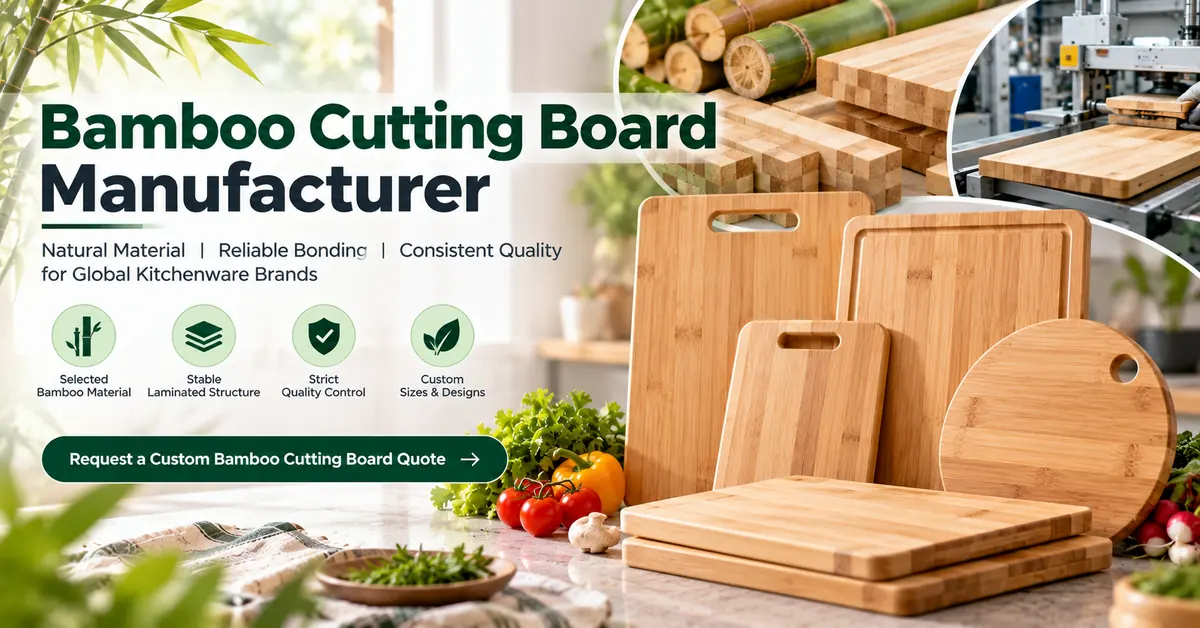
For a supermarket buyer, the biggest question may be whether a board looks consistent in a crowded shelf range and survives routine handling. For an Amazon or independent e-commerce seller, the concern may be whether the correct care instructions reduce negative reviews and whether the pack prevents abrasion and corner damage. For a private-label brand, the issue is whether the factory can reproduce the approved natural appearance within a realistic variation standard.
Not every use case suits the same bamboo construction. A purchaser seeking intensive wet commercial-kitchen cleaning, high-temperature dishwasher treatment, or continuous contact with water should not assume that a laminated bamboo board is appropriate. The cleaning tolerance and durability of a specific assembly must be validated. Likewise, a buyer whose entire brand proposition depends on an independently certified forestry or environmental claim should not proceed until that claim can be traced through an acceptable evidence chain.
Treat the application, care method, price point, and evidence requirement as one decision. This prevents an attractive sample from being positioned in a market where the final product is difficult to maintain or describe accurately.
2. What Are You Actually Buying: Bamboo, Laminated Bamboo, or Another Construction?
In retail language, “bamboo cutting board” often sounds like a single material. In manufacturing, the term can describe noticeably different assemblies. Bamboo culms are cut into usable strips; those strips may be processed, arranged, glued, pressed, machined, sanded, and finished. The position of the strip faces and the number of layers can influence the appearance of glue lines, surface grain, edge profile, and dimensional stability.
Horizontal or face-oriented strip layouts tend to display broader strip faces across the work surface. Vertical or edge-oriented layouts show narrower strip features. Some designs incorporate multiple bonded layers, while decorative serving boards may combine more than one visible pattern. These are descriptions of possible constructions, not proof of how a particular supplier manufactures a board.
| Construction direction | Visual and commercial effect | Questions for the manufacturer | Main buyer risk |
|---|---|---|---|
| Face-oriented strips | Wider visible grain and a familiar natural look | Strip dimensions, joint location, surface consistency | Color and joint variation |
| Edge-oriented strips | Narrower linear pattern | Lamination layout, edge finish and board flatness | Exposed joint lines and uneven machining |
| Multi-layer laminated panel | Opportunity to build thickness from layers | Layer arrangement, adhesive and press control | Delamination or movement between layers |
| Shaped board with groove and handhold | More gift or serving appeal | Groove geometry, internal sanding and structural clearance | Rough cutouts or weak local sections |
| Mixed-material decorative concept | Distinctive merchandising | Every component, coating, adhesive and test scope | Unverified composition or claims |
Ask for the actual cross-section photograph or construction drawing. A product shot cannot reveal the internal layering, glue system, or whether decorative surface pieces differ from the load-bearing body. A procurement specification should use the material description confirmed by the supplier—not the appearance inferred from the sales photo.
3. Bamboo Input Selection: Strip Quality, Color and Lot Control
A competent bamboo cutting board manufacturer should be able to explain how incoming material is classified and controlled. The key information includes the bamboo input description, strip dimensions, visible defects, discoloration policy, cleanliness, and the records that associate finished boards with raw-material or panel lots. If bamboo is supplied as pre-laminated panels, ask who makes the panels and how incoming acceptance is performed.
Natural bamboo does not produce perfectly uniform tone or grain. Depending on processing, some products may have a paler appearance while others look darker. A darker sample should not automatically be described as stronger, more environmentally friendly, or better protected against bacteria. Require the supplier to state how the appearance is achieved and whether the buyer has approved the resulting finish and product claims.
For retail consistency, the brand team can create a visual acceptance board showing a light acceptable specimen, a dark acceptable specimen, and examples of unacceptable marks, stains, cracks, open joints, or machining burns. This is often more useful than a vague sentence such as “natural color acceptable.” It also prevents routine natural variation from being confused with a real defect.
Traceability should reach the level agreed by the parties. An importer may request supplier lot references, date or shift information, panel batch identification, and records of rejected inputs. Such systems are not assumed to be offered by BONET for bamboo boards; they are questions to include in a project-specific supplier review.
5. Moisture Stability: Why Boards Warp or Crack During Distribution
A bamboo cutting board manufacturer should manage moisture as a production variable: bamboo is a plant-based material, so dimensions can respond to exposure and environmental changes. Bonded construction adds another variable: the strips and adhesive layers must perform together. A board can be flat after final sanding yet later bow, twist, open at an end joint, or develop raised edges when stored in an unsuitable environment or used contrary to its care instructions.
The correct question is not “Is your bamboo waterproof?” It is “How is moisture managed from input inspection through finished-product storage, and how is performance validated under the expected transport and consumer-use conditions?” Ask which moisture-measurement method is applied, when it is measured, how sampling is performed, and how out-of-specification lots are handled. Do not impose a random universal moisture percentage copied from an unrelated wood product.
Production and logistics controls should work together. For example, a manufacturer might manage incoming strip conditioning, in-process storage, pressing and curing conditions, final board equilibration, and packing-room conditions. An importer might control container protection, warehouse humidity exposure, and handling guidance. The specific controls should be verified rather than assumed.
A useful test scenario is a buyer-defined conditioning comparison: document each sample's flatness and visible joints before exposure; subject samples to the agreed environmental cycle; allow a defined recovery period; then inspect again. Record actual measurements rather than announcing that boards have “zero warping.” The aim is predictable performance within mutually agreed limits, not a physically unrealistic promise of no movement at all.
6. Dimensions, Edges, Grooves and Handles: Details That Reveal Workmanship
Bamboo cutting board sourcing is unusually tactile. Customers run their fingers along corners, lift the board by a handle, examine the surface grain and sometimes use it as a serving tray. This means the drawing should specify more than length, width and thickness.
Buyers should identify usable cutting area, edge radius or chamfer, maximum permissible surface roughness or workmanship reference, groove width and depth, handle opening, minimum remaining material around cutouts, flatness requirements, and acceptable natural appearance variation. If a board is designed for hanging, confirm whether the feature is intended to carry the full product weight safely. Where engraving is used, request a proof that does not compromise the food-contact surface or create hard-to-clean recesses.
A groove may look premium but is not always a functional improvement. The groove removes some cutting area, introduces additional corners to clean, and can reveal rough machining or glue-line defects. A shallow decorative groove should not be advertised as a liquid-containment feature unless its intended performance is verified. Similarly, a deep oval handhold can improve merchandising while weakening the narrow edge if poorly placed.
Request dimensioned drawings, product photographs from both faces and edges, and a physical sample. For a completely new design, obtain tooling or machining feasibility confirmation before presenting the requested dimension as an existing standard SKU.
7. Surface Sanding, Oil, Coatings and Consumer Care Claims
A beautiful bamboo cutting board should have a surface suitable for its intended food-preparation or serving role. Yet “smooth finish” is subjective until defined. Inspect the top and underside, perimeter edges, groove walls, handle opening, and corner transitions. Check for splinters, rough fibers, uneven sanding marks, residual dust, sticky spots, strong unexpected odor or patchy coating.
Finishing options should be discussed at the level of actual composition and finished-product performance. A supplier may suggest an oil, wax, coating or other treatment. The buyer must ask what is used, whether it is suitable for the relevant food-contact scenario, how the finish behaves after the approved cleaning routine, and what care information is supported. Do not describe all finishes as edible, naturally antibacterial, food-grade or dishwasher safe.
For many laminated bamboo boards, consumer guidance may involve hand-washing, prompt rinsing, thorough drying and avoiding long immersion or high-temperature dishwashing. However, the final label must reflect the actual product and validated instructions. USDA food-safety guidance notes that laminated boards may crack or split in dishwashers, making blanket dishwasher-safe advertising particularly risky. This is a useful external reference, but it is not a BONET-specific performance test.
When asking for a sample, request the proposed care card at the same time. Packaging and customer service teams should review its wording before artwork approval. A product that performs well under ordinary care can still earn poor reviews if the label suggests unsupported handling conditions.
8. Food-Contact Evidence: Separate the Bamboo, Adhesive and Finish
A bamboo kitchen board is a finished assembly, not simply an untreated plant. Depending on construction, it may contain bamboo strips, adhesives, surface treatments, printed elements, feet or other accessories. Material safety review must therefore focus on the complete article and the intended conditions of use, not a raw-bamboo brochure alone.
For the European Union, the European Commission's food-contact guidance identifies Regulation (EC) No 1935/2004 as the general safety framework and Regulation (EC) No 2023/2006 as the good-manufacturing-practice framework for food-contact materials. Non-plastic materials may also be subject to applicable national measures; the harmonized plastic-specific rules should not be casually treated as a universal certification system for a bamboo board. The importer should determine the precise legal scope with a qualified compliance specialist.
For the United States, do not treat the presence of an FDA logo in sales material as proof that the board is “FDA certified.” Instead, request a defensible evaluation of the actual food-contact components and their intended use, including any applicable regulatory basis, supporting supplier statements, and product-specific testing as appropriate. A laboratory report on one adhesive formulation may not cover a different coating or future substitution.
For any destination market, ask for the document's product identity, tested construction, dates, issuing entity, use conditions, and limits. Reports must be relevant to the shipped version. A short marketing claim that the product is “safe for food” is not enough to support all possible food types, temperatures and cleaning conditions.
The same caution applies to sustainability. Bamboo is a fast-growing plant, but that does not by itself substantiate carbon neutrality, biodegradability of a glued and finished article, FSC certification, or a specific environmental footprint. Use supply-chain evidence and applicable claim substantiation before publishing environmental language.
9. A Practical Manufacturing Route to Discuss With Suppliers
The exact production sequence varies by panel supplier, adhesive system and board design. Nevertheless, a sourcing team can organize its technical discussion around the following typical control points. They are industry process considerations rather than verified details of a BONET bamboo-board line.
- Material and panel sourcing: identify bamboo input or panel source, grade, batch identification and acceptance checks.
- Conditioning and preparation: confirm the incoming moisture and strip condition needed for the planned bonding route.
- Strip arrangement and adhesive application: confirm construction orientation, adhesive identity, preparation instructions and assembly control.
- Pressing and curing: identify the documented process and finished-panel release criteria appropriate to the chosen adhesive.
- Machining and shaping: verify overall dimensions, corners, grooves, handles and control of chipped or exposed edges.
- Sanding and surface preparation: inspect all faces, cutouts and groove walls to the agreed appearance and tactile standard.
- Approved surface treatment: confirm finish composition, uniformity, application method and any required evaluation.
- Final conditioning, inspection and packaging: confirm flatness, joint integrity, appearance variation, labeling and protection before shipment.
A factory tour or manufacturing video is useful only if the buyer can connect the footage to the actual manufacturing route and products being quoted. Ask whether panels are produced internally, sourced from a qualified partner, or made through a combination of operations. Outsourcing is not automatically a problem; lack of disclosure and control is the real procurement risk.
10. Technical Specification Sheet: Turn Quality Language Into Acceptance Rules
A mature request for quotation includes a specification sheet before final pricing. The table below gives a buyer-defined template, not established specifications for a BONET bamboo product.
| RFQ field | What should be specified | What evidence closes the item |
|---|---|---|
| Product description | Laminated bamboo board; exact intended function | Confirmed construction and approved drawing |
| Size and shape | L × W × T, corners, groove and cutouts | Dimensioned drawing and sample measurements |
| Material identity | Bamboo components, panel source and other materials | Material description and component list |
| Bonding system | Adhesive type and change-control requirement | Appropriate support documents and qualification plan |
| Moisture and stability | Defined measurement and conditioning approach | Records and approved test method |
| Appearance | Grain/color range, sanding and defect limits | Golden sample plus visual boundary samples |
| Food-contact evidence | Destination-market requirements and intended use | Relevant product documentation and test scope |
| Packaging | Unit pack, care card, carton and protective method | Approved packed sample and carton specification |
| Inspection | Sampling, defect classes, methods and release rules | Written inspection plan and signed report |
| Commercial terms | MOQ, tooling, price, trade terms and schedule | Project-specific quotation and agreement |
This level of detail allows buyers to compare quotations consistently. Otherwise, Supplier A may price a finished board with a premium sleeve while Supplier B prices an unfinished blank; those are not comparable proposals. For an existing BONET inquiry, begin with its publicly listed chopping-board category to understand the current catalog, then separately ask whether a bamboo configuration is feasible.
11. Sample Plan: Compare More Than a Showroom Piece
A useful bamboo-board sample plan has three stages: concept verification, pre-production approval and production-lot verification. A single hand-selected specimen rarely exposes manufacturing variation. Where feasible, request several samples from the same proposed construction and compare them under consistent lighting and environmental conditions.
At concept verification, inspect material description, grain orientation, board geometry, ergonomic features and expected consumer position. At pre-production approval, establish one or more signed golden samples, approve care language and packaging, and agree which variations are acceptable. At lot verification, draw samples from the actual production shipment using an agreed inspection plan.
Inspect the board on a known flat surface and document the method. Run a dry hand around cutouts and grooves for roughness; examine all edges and glue lines; compare visible color and grain; check whether printed or engraved branding is legible and appropriately placed. If conditioning or cleaning trials are important, record before-and-after measurements and photographs rather than relying on memories of how the board looked.
The sampling plan should explicitly recognize natural variation. Not every different grain mark is a defect. Conversely, a visible open bond line, splinter, unapproved coating or incorrect label should not be dismissed as “natural.” Good buying teams separate aesthetic variation from functional and safety-related nonconformity.
12. Bamboo Versus PP: Why the Buyer May Need Different Product Paths
Bamboo and PP plastic boards can coexist in one retailer's assortment but should not be marketed or inspected as equivalent. A natural-look laminated board may offer serving and gift appeal, while a compact PP board may better suit certain entry-level, lightweight household collections. Specific cleaning performance and food-contact documentation must be checked for each finished product.
| Procurement factor | Requested bamboo-board concept | BONET's published PP reference |
|---|---|---|
| Public product status | Specific bamboo model not verified in current catalog | PP board publicly listed |
| Known dimension | Must be established by project | 24.8 × 14.8 × 0.8 cm |
| Main construction | To be confirmed: strips, lamination and adhesive | Listed as polypropylene (PP) |
| Central QC concern | Glue-line integrity, splinters, moisture-related movement | Molded dimensions, surface and material consistency |
| Typical merchandising direction | Natural-look preparation or serving range | Compact everyday household kitchenware |
| Critical care question | Moisture exposure and approved cleaning method | Approved cleaning and temperature limitations |
| Custom options | Feasibility and quotation required | Feasibility and quotation required for changes |
There is no legitimate basis for declaring one material universally “better.” A distributor supplying a natural kitchen gift range may prioritize appearance and storytelling. A supermarket buying an everyday prep board may prioritize package economics, a consistent surface and straightforward replenishment. For buyers already exploring BONET's kitchenware product catalog, the two categories can be considered within a wider product plan, but the supplier must separately confirm which versions can be supplied.
13. Failure Modes and What an Inspection Report Should Capture
For a bamboo cutting board manufacturer, the point of inspection is not to produce a report full of checked boxes. It is to detect the failure modes most likely to affect customers and create expensive returns or claims.
| Potential defect | How it may appear | Buyer response |
|---|---|---|
| Delamination | Separation between strips or layers | Record location and reject according to agreed functional criteria |
| Bowing or twist | Board rocks or no longer rests acceptably flat | Measure by defined method against agreed limit |
| Cracked ends | Hairline or open cracks at edges | Distinguish cosmetic marks from structural defects |
| Splintering / rough machining | Raised fibers around grooves or handles | Check tactile standard and finishing process |
| Uneven or unsuitable finish | Sticky patches, streaking, unexpected odor | Stop unapproved claims; identify finish and retest if needed |
| Excessive visual variation | Out-of-range tone or pattern | Compare with approved boundary samples |
| Incorrect branding | Wrong logo, position, barcode or language | Verify artwork version, repair or replace as agreed |
| Transit damage | Chipped corners, scuffs or wet cartons | Investigate unit packing, carton protection and handling |
Ask the inspector to include lot identification, sample-selection method, photographs, measurements where relevant, and clear defect classifications. Acceptance criteria should be agreed before production. Any fixed defect percentage, moisture figure or flatness tolerance introduced without reference to the approved design can create confusion rather than quality control.
14. Packaging for Humidity, Handling and Retail Presentation
Bamboo boards may travel through several different environments before they reach a shelf: a finishing area, packing room, export warehouse, container, port, regional warehouse and retail distribution center. A good packaging specification protects the product while avoiding unsupported environmental or food-safety claims.
Individual sleeves or protective wraps can reduce abrasion, but the packaging strategy should not trap unwanted moisture against inadequately conditioned products. The manufacturer and buyer should agree the product's release condition and the packaging materials that suit storage and transit. Cartons must be strong enough for the selected pack count and route, with clear product identification and suitable handling marks.
For supermarkets, prioritize barcode accuracy, shelf presentation, size labeling, care information and consistent pack orientation. For e-commerce, prioritize handling protection, individual shipping dimensions, and a presentation that survives parcel movement. For gift programs, consider a quality sleeve or box, but ensure any printed claim about sustainability, certification or lifetime durability has evidence.
A physical packed sample should be part of approval. A digitally approved box file does not reveal rubbing between boards, inadequate corner protection or how the product sits after unpacking. Include packed samples in transport trials if the order's risk profile warrants it.
15. Real Purchase Cost: Why Quality Issues Can Erase a Low Quote
A low unit price has little value if the product later requires repacking, replacement, additional testing, or retailer credits. For bamboo boards, potential hidden costs include rejection of poor bonding, excessive natural appearance variation, unapproved finishes, damaged gift sleeves, separate testing of adhesives or coatings, and storage or returns associated with warping complaints.
A quote comparison should include board construction, finish, packaging, any development or tooling costs, sample/test expenses, inspection, transport, duties, and anticipated saleable yield. Prices should be compared under the same Incoterms rule and named place. The importer must use its own freight and tariff inputs rather than a generic “landed cost” promise.
Do not confuse a manufacturer's production MOQ with a retailer's economical order size. A custom groove, premium laser marking, special carton, or new panel construction may change the quote and minimum quantity. The supplier should confirm what is standard, what is customization, and whether any setup costs recur on subsequent orders.
Importers can use a simple decision gate: approve the technical sample first, approve claims and artwork second, then compare full commercial offers for that same approved specification. This preserves negotiation leverage without weakening essential quality requirements.
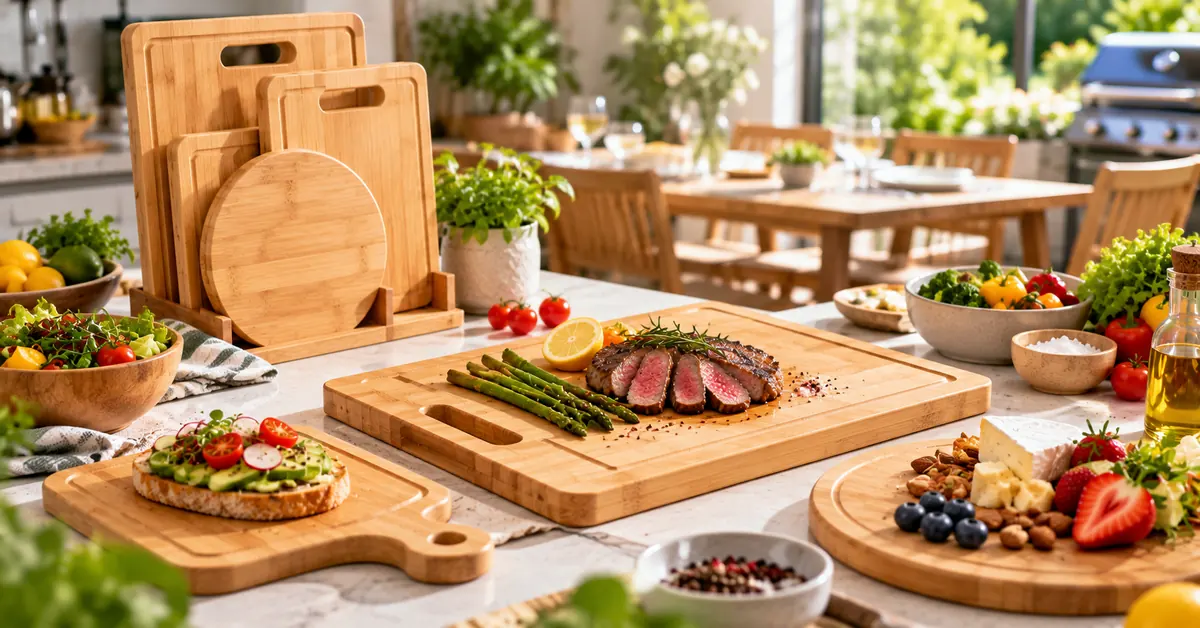
16. How to Evaluate a Bamboo Cutting Board Manufacturer Before an OEM Order
A useful manufacturer review is more specific than asking, “Are you a factory?” Instead, ask who controls the bamboo panel, who applies the surface treatment, who handles food-contact documentation, and who signs off the final release. Production can involve qualified partners, but responsibilities should be visible.
Nine questions deserve clear answers:
- What exact construction and bamboo input are quoted, and who supplies the bonded panel?
- Which adhesive and surface finish are used, and what documentation supports the intended food-contact use?
- How are incoming strips or panels inspected, conditioned, and identified by batch?
- What controls are used to reduce glue-line separation, cracking and unacceptable movement?
- Can the supplier show representative samples from more than one production lot?
- What limits apply to grain and color variation, surface roughness, flatness and visible joints?
- What is the process for approving changes to adhesive, material source, design or finishing method?
- What packaging, inspection and documentation can be included in the final quotation?
- What MOQ, sample schedule, production capacity and delivery assumptions apply to this exact project?
A supplier that identifies limitations clearly is often easier to work with than one that says every requested feature is immediately available. The answers should lead to an RFQ, a documented sample plan and a realistic commercial proposal—not merely another catalog image.
17. Using BONET's OEM/ODM Framework Without Assuming an Unlisted Bamboo Model
BONET HOUSEWARE describes OEM/ODM support for kitchen tools, cutting boards and related housewares. Its website includes material customization with wood and bamboo, logo and packaging options, sampling, production coordination, quality inspection and export delivery support. Those published capabilities make BONET's OEM/ODM page a relevant first stop for a proposed bamboo-board project. They do not, however, independently establish that a particular laminated bamboo construction is stocked or manufactured in-house.
The company's described six-stage collaboration flow can be used as a sensible project framework:
- Requirement discussion: share the exact intended product, reference image or drawing, destination market, buyer channel, quantities and quality expectations.
- Design and sampling: request confirmation of feasible bamboo construction, dimensions, finish, logo and packaging; obtain a sample or development plan.
- Quotation and confirmation: agree on what is included, any MOQ or setup charges, required testing, lead time and approved specifications.
- Mass production: release only the agreed revision and track any approved changes.
- Quality inspection: examine the agreed failure modes, packaging and shipment identification against written acceptance rules.
- Packaging and delivery: verify packing documents, carton configuration and shipment arrangements.
The first question to BONET's team should be direct: “Can you supply or develop this specified bamboo cutting board, and which stages would you control directly or through qualified partners?” Ask for current examples and written technical confirmation. That makes the inquiry professional and avoids implying product availability that has not yet been shown publicly.
18. RFQ Template: What to Send for a Bamboo Board Quotation
An effective RFQ to a bamboo cutting board manufacturer reduces unnecessary back-and-forth while allowing the supplier to identify feasibility constraints early. Buyers can copy and customize the following brief:
Project: OEM/ODM bamboo cutting board for [retail / e-commerce / hospitality presentation / gift range]. Market: [country or region]. Intended use: [food preparation / serving / both]. Reference: [approved sample, photographs, or engineering drawing]. Construction: [face-oriented / edge-oriented / multi-layer / supplier recommendation, subject to confirmation]. Dimensions: [length × width × thickness, with units and tolerances]. Features: [handle, groove, hanging feature, edge details]. Finish and care: [requested appearance, supplier-recommended finish, wash-care expectations]. Branding: [logo method and location, artwork reference]. Packaging: [individual sleeve/box, barcode, care card, master carton]. Evidence: [material, adhesive, finish, food-contact and sustainability documentation required for the destination market]. Quantity: [pilot order and forecast reorder range]. Commercial terms: [quote currency, Incoterms rule and named place, target delivery window]. QC: [sample plan, agreed checks and buyer's inspection requirement].
Ask the supplier to respond in three columns: confirmed standard capability, possible customization pending review, and not currently supported. For each proposed configuration, request actual sample availability, price basis and any one-time costs. This is much safer than treating a visual concept as a published product.
19. Building a Repeatable Bamboo Product Program
A good first shipment from a bamboo cutting board manufacturer is only the beginning of a profitable bamboo cutting board program. Repeat orders introduce their own risks: changes in natural material tone, panel suppliers, adhesive formulations, finish appearance, packaging stock, handling conditions and demand by sales channel. A brand should keep enough records to tell a normal visual variation from an actual manufacturing change.
Maintain an approved golden sample, drawing revision, materials list, relevant evidence, finish specification, packaging artwork and release inspection report. For each repeat purchase order, ask whether the bamboo input, panel maker, adhesive, processing route, finish or care label has changed. If an important variable changes, decide whether a fresh sample or additional evaluation is needed before release.
Track customer feedback by issue type rather than relying only on total returns. Separate complaints about flatness, rough edges, glue-line separation, odor, packaging damage, natural color expectations and misuse. These issues require different corrective actions. A careful root-cause process can protect retailer relationships and improve the next iteration without making unsupported performance promises.
For a buyer evaluating BONET, the most productive next step is an inquiry with a complete brief and a request for current bamboo-product capability evidence. A relevant manufacturer or sourcing partner should be able to identify which questions are answered by existing products and which require development work.
20. Frequently Asked Questions About Bamboo Cutting Board Manufacturing
1. How do I choose a bamboo cutting board manufacturer for wholesale orders?
Evaluate the precise board construction, bonded-panel source, adhesive and finish documentation, moisture-related controls, sample consistency, relevant food-contact evidence, packaging, and change management. Compare proposals only after suppliers have quoted against the same product requirements. Ask for a sample and current technical proof rather than relying on staged photographs.
2. Does BONET HOUSEWARE publicly list a bamboo cutting board model?
Its OEM/ODM information mentions bamboo as a customizable kitchenware material and includes cutting boards in its business scope. However, the publicly verifiable chopping-board product reference is a PP plastic board, not a confirmed bamboo SKU. Ask BONET directly for current bamboo-board options, samples, capacity and the actual manufacturing route.
3. Why are glue lines so important in bamboo cutting boards?
Many bamboo boards are assembled from strips or layers, so the adhesive bonds form part of the structure. Bond quality can affect the board's response to moisture and use. Request the adhesive specification, relevant food-contact documentation, finished-board qualification and agreed inspection criteria for separation or cracking.
4. What moisture content is acceptable for bamboo boards?
There is no single percentage that should be copied into every sourcing specification without considering construction, measurement method, conditioning process, intended climate and actual performance testing. Ask the supplier to propose and justify its control range, then validate the finished product under a documented buyer-approved method.
5. Are bamboo chopping boards dishwasher safe?
Do not assume so. Laminated constructions can be vulnerable to cracking or splitting under unsuitable dishwasher conditions. Care language must be based on the specific adhesive, finish and board design. Where evidence is unavailable, avoid a dishwasher-safe claim and request manufacturer-confirmed hand-washing and drying instructions.
6. What certifications should bamboo cutting board importers request?
Ask for evidence relevant to the actual finished product and market, not a generic badge list. This may include applicable food-contact documentation for bamboo, adhesives and coatings, manufacturing records, laboratory reports when needed, and substantiation for any sustainability claim. Any FSC or other third-party certification should only be mentioned when the exact certified scope and chain of custody can be verified.
7. Can a bamboo board have a custom logo and retail gift packaging?
Potentially, depending on the board's construction, finish and supplier's capabilities. Engraving, printing, sleeves, gift boxes and barcodes should each be evaluated for feasibility and food-contact implications. BONET describes logo and packaging customization at a general OEM/ODM level; a specific bamboo-board method requires project confirmation.
8. What defects should a pre-shipment inspection focus on?
Prioritize open or separating glue lines, cracks, unacceptable warping, splinters, rough groove or handle surfaces, unapproved finish variation, visible contamination, wrong dimensions and incorrect packaging. Define acceptance criteria before production and request a report tied to the actual shipment lot.
9. Is bamboo always more sustainable than plastic or wood?
Not automatically. The environmental profile of a finished article depends on sourcing, panel processing, adhesive, finish, manufacturing, transport, lifespan and end-of-life handling. A bamboo label alone does not prove biodegradability, carbon neutrality or a certified chain of custody. Use evidence for each public environmental claim.
10. What should I send BONET to request a bamboo cutting board quote?
Share the product sketch or reference, desired size, construction preference, intended use, country of sale, quantity range, logo, packaging, required documentation and expected timing. Ask BONET to confirm whether it can supply or develop the requested bamboo board, who controls its manufacture, and what samples, MOQ and lead-time assumptions would apply. Use the BONET contact page for a project-specific response.
Conclusion
Choosing a bamboo cutting board manufacturer is fundamentally a quality-and-evidence decision. Attractive bamboo grain is valuable for retail presentation, but long-term sourcing depends on material identity, strip construction, glue-line reliability, moisture management, smooth machining, a suitable finish, relevant food-contact documentation and a repeatable inspection plan. Buyers who define these points before placing an order are better positioned to compare true product value, prevent avoidable defects and build a stable kitchenware range.
BONET HOUSEWARE offers an established public inquiry route for OEM/ODM kitchenware and lists bamboo among its possible customization materials. Because a specific bamboo cutting board model is not currently verified in its public product catalog, the commercially responsible step is to request a feasibility assessment rather than assume an off-the-shelf option. Review BONET's OEM/ODM services, explore its existing chopping-board category, and send your bamboo cutting board specifications for a tailored response. A clear drawing, application brief and evidence checklist will make that conversation faster, more precise and more useful for procurement.
