




Choosing the Right Knife Sharpener Supplier for Your Needs
Selecting a knife sharpener supplier is not only about finding a product that can restore a blade edge. For retailers, distributors, commercial kitchens, workshops, and purchasing teams, the supplier decision affects product consistency, user safety, after-sales support, packaging, and repeat availability. A compact kitchen sharpener may be suitable for home and retail shelves, while a more durable option may be needed for high-frequency professional environments.
The original product example, the TurboSharp Kitchen Knife Sharpener, is described as having a vibrant green grip, dual-stage sharpening slots, a compact build, and a non-slip grip. Those are useful selection points, but buyers should still verify all commercial, technical, and compliance details directly with the supplier before placing a bulk order.
Key Takeaways
- Match the sharpener type to the use case: home kitchens, retail resale, workshops, butchery, or food service.
- Ask suppliers for clear details on materials, packaging, replacement policy, lead time, and quality control process.
- For wholesale knife sharpeners, request samples before confirming a large order.
- Do not rely only on appearance; evaluate grip stability, sharpening stages, instructions, and durability.
- For professional use, confirm whether the supplier can support consistent repeat orders and documentation needs.
Start With the Intended Use
A good supplier conversation begins with the application. A home user may want a simple manual sharpener that stores easily in a drawer. A reseller may need a product that is compact, visually clear, and easy to explain on packaging. A restaurant group may focus on safe handling, repeat performance, and easy staff training. A workshop or industrial buyer may care more about durability under frequent use.
When discussing a product such as the TurboSharp Kitchen Knife Sharpener, the dual-stage sharpening slots are an important point to clarify. Ask what each stage is intended to do, which knife types it is suitable for, and whether any knives should not be used with it. The supplier should be able to explain practical use in plain language, not only provide promotional claims.
What to Check in a Knife Sharpener Supplier
Supplier reliability matters as much as the sharpener itself. A buyer should look for clear communication, stable product information, and a willingness to answer technical and commercial questions. If the supplier cannot explain basic product details before the sale, support after the sale may also be limited.
Important questions include: What materials are used in the body, grip, and sharpening slots? Are product samples available? Can the supplier provide packaging options? What is the typical production or fulfillment lead time? How are defective units handled? Are instructions included for safe use? If the product is intended for resale, can the supplier provide product photos, barcodes, carton information, or labeling support if needed?
A buyer should avoid assuming that a supplier has certain certifications, testing reports, or factory capacity unless those details are provided in writing. For regulated markets or large retail programs, documentation should be reviewed before purchase approval.
Comparing Home, Wholesale, and Industrial Needs
The phrase “knife sharpener supplier” can mean different things depending on the buying situation. A small retail buyer may need mixed cartons and attractive packaging. A distributor may need predictable inventory and private-label discussions. A professional kitchen may prefer a simple tool that staff can use consistently. Industrial buyers may require more demanding durability, but they should verify whether a specific model is designed for that level of use.
| Buying Scenario | Main Priority | Supplier Questions to Ask |
|---|---|---|
| Home and retail kitchen use | Ease of use, compact size, clear instructions | What knife types are suitable? Is safe-use guidance included? |
| Wholesale resale | Consistent quality, packaging, repeat supply | Can samples, carton details, and packaging options be provided? |
| Commercial kitchens | Grip stability, staff training, daily convenience | How should the sharpener be cleaned, stored, and used safely? |
| Workshop or heavy-use settings | Durability and suitability for frequent sharpening | Is the model intended for heavy-duty use, and what limits apply? |
Product Features Worth Evaluating
For a manual kitchen sharpener, small design details can make a major difference in actual use. A non-slip grip, such as the one described for the TurboSharp model, helps the user hold the tool more securely. A compact design can support easier storage and retail display. Dual-stage slots may help users separate sharpening and finishing steps, depending on the design.
However, buyers should test the product rather than judge only from a catalog image. During sample evaluation, check whether the sharpener feels stable on a flat surface, whether the grip is comfortable for different hand sizes, and whether the sharpening slots are clearly marked. Review the instruction sheet for clarity. If the product will be sold to consumers, confusing instructions can lead to poor reviews even when the product itself is acceptable.
- Request a physical sample before bulk purchasing.
- Test the sharpener with the knife types your customers are most likely to use.
- Check the grip, base stability, and hand position during sharpening.
- Review packaging for warnings, instructions, and product claims.
- Ask the supplier how quality is checked before shipment.
Wholesale Knife Sharpeners: Buying in Bulk
Wholesale knife sharpeners can be attractive for resellers, promotional programs, kitchenware distributors, and multi-location businesses. Bulk buying may reduce unit handling costs and simplify inventory planning, but it also increases risk if the product has not been tested carefully.
Before placing a wholesale order, ask whether the supplier can maintain the same design, color, packaging, and product configuration across repeat shipments. If the green grip or dual-stage slot layout is important for your listing or retail display, confirm whether those details are fixed or subject to change. Buyers should also ask about carton packing, labeling, inspection options, and how shortages or damaged goods are handled.
For OEM or private-label discussions, do not assume customization is available. Ask what branding, packaging, or color options can be supported, what minimum order requirements apply, what artwork files are needed, and whether pre-production samples are available for approval.
Practical Supplier Evaluation Checklist
A structured checklist helps purchasing teams compare suppliers fairly. Instead of choosing based on the lowest quotation alone, assign weight to product suitability, communication, sample quality, and delivery reliability.
- Product fit: Does the sharpener match the target user and sales channel?
- Documentation: Are instructions, product descriptions, and packaging details available?
- Sample quality: Does the sample match the photos and written description?
- Commercial clarity: Are lead time, payment terms, packing details, and defect handling explained?
- Consistency: Can the supplier support repeat orders without unexpected product changes?
- Support: Does the supplier respond clearly to technical and logistics questions?
Use and Care Guidance for End Users
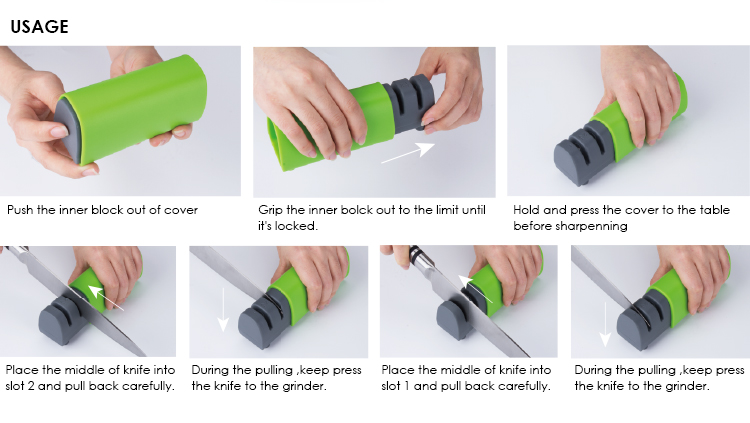
If you are buying knife sharpeners for resale, clear use-and-care guidance can reduce customer confusion. Users should place the sharpener on a stable surface, hold the grip securely, and draw the knife through the correct slot according to the instructions. They should avoid excessive pressure, because heavy force can damage blades or reduce control.
After use, the sharpener should be cleaned according to the supplier’s instructions. It should be stored dry and away from children. Buyers should also confirm whether the product is suitable for serrated knives, ceramic knives, scissors, or specialty blades before making claims in a product listing.
FAQ
What makes a reliable knife sharpener supplier?
A reliable supplier provides clear product information, responds to technical questions, offers samples when appropriate, explains packaging and lead time, and is transparent about what the product can and cannot do.
Should I choose a wholesale knife sharpener supplier based on price?
Price matters, but it should not be the only factor. Compare sample quality, packaging, consistency, defect handling, and communication before confirming a bulk purchase.
Is a compact kitchen sharpener suitable for industrial use?
Not always. A compact sharpener may work well for kitchen or retail use, but heavy-duty environments require confirmation from the supplier about intended use, durability, and limitations.
What should I ask before ordering OEM knife sharpeners?
Ask about customization options, minimum order requirements, artwork needs, sample approval, packaging choices, lead time, and whether any product design changes affect performance or safety guidance.
How can buyers reduce risk before a large order?
Request samples, test the product with realistic users, verify packaging and instructions, clarify commercial terms, and document all agreed product details before payment or production.
