




Quick Answer: What Makes a Reliable Cooking Utensil Set Manufacturer?
A reliable cooking utensil set manufacturer should connect the approved set contents to individual component specifications, confirm which factory or partner produces each part, validate functional and food-contact requirements where applicable, and prove that every packed unit includes the right pieces, color, artwork, barcode and instructions. The buyer should approve a complete packed sample and agree on kitting checks, defect handling and change control before production—not just approve an attractive collection photograph.
1. Why a Cooking Utensil Set Is Different from Individual Tools
A single spatula can pass dimensional, appearance and functional inspections yet still disappoint a customer when it arrives in a five-piece collection. Perhaps the promised whisk is absent, the enclosed spoon has a different handle shade, or the box advertises six tools while the supplier counts a holder as one of the six. These failures are not always defects in the utensils themselves. They arise at the point where multiple components become one saleable SKU.
Manufacturing a set therefore adds responsibilities beyond molding, forming and finishing individual products. Someone must own the final component list, identify accepted alternatives, synchronize incoming pieces, check accessory counts, stage packaging materials, confirm the artwork version and reconcile finished boxes with the production order. A perfect utensil does not cure a wrong assortment.
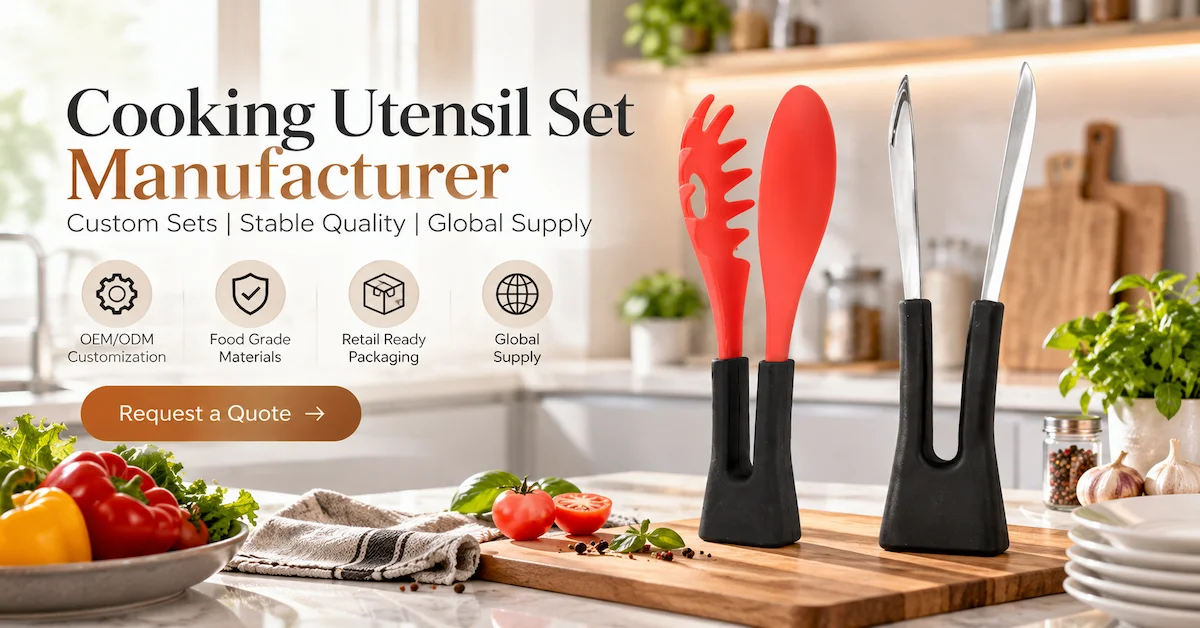
When selecting a cooking utensil set manufacturer, ask what the company actually controls: individual tool production, set design, sourcing of extra pieces, final kitting, packing, inspection or export coordination. The answer can legitimately involve more than one production site. The important point is accountability for the complete retail unit. One purchase order should not obscure five separate manufacturing decisions and an unowned final packing operation.
BONET HOUSEWARE CO., LTD in Yangjiang, China, publishes a utensil collection and describes OEM/ODM services for kitchen tools and housewares. It also presents manufacturing and packing operations. Those public pages establish a useful basis for inquiry, while the precise route, current stock and packout capabilities for your proposed set still require project-specific confirmation.
2. Choose a Set Architecture That Fits the Buyer, Not a Catalog Photo
A buyer for a discount supermarket, a premium cookware brand and a specialty e-commerce seller may all request “cooking utensil sets,” but their approval criteria differ. A supermarket usually needs a straightforward headline piece count, low handling complexity and reliable case quantities. A cookware brand may prioritize the relationship between a utensil head and its pan surfaces. A gift buyer may assign more value to coordinated presentation, while an online seller needs secure parcel-ready packaging and clear product-listing imagery.
Define the customer problem before finalizing the set. A compact first-apartment assortment might prioritize stirring, scraping and serving. A baking collection could place a spatula, scraper and whisk ahead of a pasta server. A countertop organization set may need a holder and tools that sit upright without crowding or tilting. A professional-use program requires a separate evaluation of cleaning frequency, loading and durability rather than simply changing the retail label.
Distinguish a core set, which can be sold repeatedly, from limited-edition additions. The core set deserves the strongest specification control because later promotions and replenishment will depend on its consistency. If a promotional bundle includes an extra specialty tool, create a separate SKU and pack list. Otherwise, the factory may apply an old carton label to a revised product, and the warehouse may count the two versions as interchangeable.
Keep the first assortment small enough to qualify properly. An attractive twelve-piece selection can contain repeated functions that add little value, increase sourcing dependencies and complicate inspection. Function, cost and usability should justify each component before branding and retail photography determine the final mix.
3. Define Exactly What “5-Piece,” “7-Piece” or “12-Piece” Means
Before requesting prices, create a written interpretation of the piece count. Does a holder count? Are measuring cups included individually or as a linked stack? Is a pair of tongs one piece? Is a removable head counted separately? These are not academic questions: shoppers, marketplace platforms, auditors and warehouse workers all need the same answer.
For an illustrative, not BONET-listed six-piece kitchen starter set, a buyer could specify one serving spoon, one spatula, one turner, one ladle, one set of tongs and one holder. That means five cooking tools and one holder—not six loose cooking tools. If a recipe card is added, the buyer should state whether it is promotional literature or a counted accessory. The supplier should repeat the agreed statement word for word in the packing specification.
Use two lists. The marketing contents list explains what customers receive; the factory packout list identifies every component and packaging item needed to construct one sellable unit, including protective sleeves, inserts, printed cards and barcodes. Every retail set SKU should map to one current version of both lists.
Agree on component substitutions at the same time. A spoon of the same nominal length may not be equivalent if it has a different working-end material, profile or color. A different holder may alter package fit. Prohibit silent substitutions and require approval of revised photographs, test evidence and artwork whenever the change affects what customers receive.
4. Turn the Set Contents into a Bill of Materials That Can Be Inspected
A set-level bill of materials, or BOM, is the simplest tool for preventing disputes about the product ordered. It should connect the sellable SKU to exact subcomponents, quantities, revision codes and responsible suppliers. A BOM that says only “six kitchen utensils” cannot guide assembly, inspection or claims investigation. A practical version identifies every constituent line item and its acceptance evidence.
| Illustrative component | Quantity per sellable set | Specification to control | Evidence to retain |
|---|---|---|---|
| Serving spoon | 1 | Drawing/revision, food-contact parts, finish, color | Approved sample and material file |
| Spatula | 1 | Working-edge shape, length, acceptable flex | Functional sample and inspection criteria |
| Turner | 1 | Head geometry, edge condition and handle attachment | Drawing and assembly acceptance |
| Ladle | 1 | Bowl dimensions, intended load and handle reach | Task test and dimension check |
| Tongs | 1 pair | Tip alignment, spring movement and joint condition | Operating test and reference sample |
| Storage holder | 1 | Footprint, stability, color, capacity | Stability review and packed-sample approval |
| Retail box, inserts, instructions, barcode | Per approved pack design | Artwork version, fit, labels, print and protection | Signed pack reference and artwork proof |
This BOM illustrates a recommended purchasing control format. The example is not a published BONET set, and none of its quantities, materials or pack details is a factory quotation.
Give each component a stable code. The set SKU can stay commercially recognizable while the subcomponent revisions change under approval. Note which items are standard and which require new color, material or packaging arrangements. When suppliers calculate MOQ, they should refer to the same BOM instead of a different composition shown in an earlier proposal.
Ask for the packaging BOM as well as the utensil BOM. Missing leaflets and incorrect barcode stickers can prevent retail acceptance as surely as a missing spoon. Agree who releases the current BOM, who prints the packaging instructions and who stops production when conflicting versions are found.
5. Which Real BONET Products Can Anchor a Set-Level Inquiry?
Published product examples help both teams discuss known shapes, construction and use cases. BONET's Kitchen Utensils category includes individual silicone tools, while some multifunctional products offer further reference points for planned collections. However, a buyer should not assume that any arbitrary group of catalog items is already available as an approved ready-packed set.
| Verified BONET reference | Published details | Role in set design | Still to confirm |
|---|---|---|---|
| U101 kitchen utensil selection | Page describes a four-tool arrangement; specification fields list 420 stainless steel and nylon, with size 26.4 × 5.5 × 6 cm. | Example of a coordinated mixed-material concept. | Exact saleable count, each component material, holder inclusion, current packout and quoted configuration. |
| U103 multifunctional utensil | 27.5 × 8 × 4 cm; listed 420 stainless steel and nylon. | Alternative functional item for comparing specialized tools. | Current function, actual construction, accessory inclusion and whether set integration is offered. |
| G2008 silicone spatula | 20 × 3 × 1 cm; product material fields list carbon steel and silicone. | Compact spatula reference for a task-based selection. | Component drawing, packaging compatibility, color and usable conditions. |
| G2009 silicone spoon | 27 × 6.5 × 1.5 cm; material fields list carbon steel and silicone. | Serving/stirring reference for a utensil family. | Final specification, handle support, care information and batch matching. |
| G2007 cooking utensil | 27.5 × 6.5 × 1.5 cm; listed carbon steel and silicone. | Further comparison for working-end geometry. | Construction, exact function and set-level compatibility. |
The distinction between published product descriptions and an approved order matters. U101's page discusses a four-tool collection, but its dimensions and material fields are not a detailed finished-set BOM. Likewise, the G-series silicone references explicitly list carbon steel in the metal-material field; they must not be renamed as stainless-core utensils without confirmation. Request the component-level construction before publishing material claims or negotiating a mixed-product package.
Use the official listings to build a shortlist, then ask BONET for the exact obtainable assortment, available samples, acceptable branding options and packout responsibilities. If a tool requires new tooling or sourced accessories, distinguish that from stock or existing-product customization. A supplier's quotation should resolve the composition—not leave it implicit in a lifestyle photograph.
Build a Set Around Verified Product References
Share the BONET product codes you like, preferred piece count, retail channel, quantities and packaging direction. Ask which tools can be combined and what material, MOQ or tooling details still need approval.
6. Verify Materials and Retail Claims for Every Component
Mixed-material sets often combine silicone, nylon, stainless steel, carbon steel, wood, coatings or separate joining parts. One uniform-looking collection may contain several material and manufacturing systems. The correct question is not “Is this set food-grade?” but “Which parts touch food, what are they made from, under what use conditions, and what evidence applies to the exact finished article?”
A silicone spoon may have a metal part that is not obvious from the photograph. A wire whisk can have a different metal or finish from a turner. A nylon working end and a metal working end may have different use instructions. The buyer should maintain a component matrix showing the head, core, handle, joint, coating and intended use, with a specific materials file tied to the approved revision.
For U101, the site's material fields name 420 stainless steel and nylon. That is not a statement that every component is stainless or that nylon has one universally approved heat limit. For G2007, G2008 and G2009, the metal field is carbon steel and the polymer field is silicone. The construction of any hidden core, the color system and the intended cleaning conditions should be confirmed from supplier documentation. Do not silently replace those facts with preferred marketing terms.
FDA food-contact principles in the United States and the European Union's food-contact framework illustrate why intended use matters. Applicable requirements can depend on material identity, food type, temperature, duration and destination jurisdiction. Ask an appropriate qualified professional or laboratory to determine the specific compliance route. Do not advertise an entire mixed-material set as “FDA approved,” “LFGB certified,” “dishwasher safe,” “scratch-proof,” or suitable to a certain temperature without evidence supporting the actual products and statement.
Where the brand promises compatibility with nonstick cookware, test the relevant tool against the cookware and use scenario. Where care instructions differ across pieces, either harmonize them through validated construction or write clear piece-specific guidance. A benefit printed on the outer box may reasonably be interpreted as applying to every included utensil, so label language must be scoped carefully.

7. Test Individual Functions Before Testing the Whole Set
Product sampling should verify that each tool performs its advertised role in the environment for which the set is sold. A spoon must scoop and stir under a defined load; a spatula should scrape its intended bowl; a turner needs workable entry angle and sufficient rigidity; a tong must grip, release and align. These tasks require appropriate test conditions, not just an attractive demonstration video.
Define a repeatable test method using representative cookware, ingredients or safe simulants and agreed observations. If head flex is important, capture where and how force is applied and what deviation is acceptable. If a tool will contact hot food, state exposure duration and temperature. A laboratory test may be needed for certain claims, but it should not be confused with an informal product-manager trial.
Now test the set as a system. Do the tools interfere with one another in a holder? Are handle lengths coordinated enough for intended storage? Does an assembled set have sharp edges that rub adjacent parts? Are items difficult to remove from the box without damaging them? Can customers identify a cooking tool and its intended use from the contents list?
For a mixed-material set, do not approve one “hero item” and extrapolate its quality to the rest. A strong spatula does not prove that a nylon spoon has acceptable temperature guidance or that a spring-loaded tong will survive the defined use cycle. Keep individual evidence and a set-level acceptance record. This distinction makes the manufacturing decision traceable when a retail buyer or consumer later reports a problem.
8. Approve Color Harmony, Handle Geometry and Holder Fit
Coordinated kitchen sets are purchased partly because they look intentional. Consumers see the colors and finishes together, not spread across separate supplier tables. A small difference in sheen may be acceptable in an individual spatula but obvious when placed next to five other tools. Buyers should therefore evaluate matched samples from the actual proposed materials, not rely on image editing or a single color swatch.
Agree on master color references and allowable visual variation. Compare the components under consistent lighting, with attention to whether silicone, nylon, painted metal and any wood-look surfaces can realistically achieve the same appearance. Their different manufacturing routes may require separate standards. If the match cannot be guaranteed, designing a complementary palette may be more reliable than demanding identical color from dissimilar materials.
A countertop holder adds engineering questions. Does it remain upright when all tools are inserted? What happens when a customer removes the heaviest item first? Is its base suitable for the intended counter surface? Can moisture accumulate inside, and can the user clean the container effectively? Where stability or cleaning performance is marketed, support the wording with appropriate evaluations.
Also check overall stored height and space requirements. An overfilled holder may be difficult to use; an oversized holder can increase freight and retail-package volume. A smaller, carefully chosen collection may work better than simply selecting the highest possible tool count. When comparing holder-based and boxed-only versions, quote and inspect them as separate sellable SKUs.
9. Use Four Approval Gates Instead of a Single “Sample OK” Message
The word “sample” may describe anything from an initial appearance mockup to a complete production-intent retail pack. Make every approval conditional on its purpose. A preliminary photograph can settle color direction without proving the actual material formulation. A functional sample may validate a handle or working edge while the production tooling and packaging are still unfinished.
Gate A — Configuration approval
Agree on the exact contents, internal component codes, counted pieces, optional accessories and the proposed set-level revision. This is where the brand decides what customers are buying and where the factory establishes which operations and suppliers the collection requires. Do not defer the count until box artwork is created.
Gate B — Individual product approval
Approve each utensil against the relevant drawing, material breakdown, finish and use condition. Record whether it is an existing catalog model, a color modification or a new development. Retain physical reference samples for critical tactile and visual characteristics and document objective test criteria wherever possible.
Gate C — Complete packed sample approval
Build one actual saleable pack using the proposed contents, retail insert, protective materials, artwork and barcode. Check ease of removal, protection against abrasion, clear handling of sharp or stiff components, and whether the box can close without forcing the products into damaging positions. Photograph the final arrangement, but keep a physical reference where feasible.
Gate D — Production-release approval
Before bulk packing, verify that production components match the agreed revisions, labels are correct, all required checks are assigned and the assembly line has an unambiguous packout work instruction. If any condition changes, pause and request a revised approval rather than letting a verbal promise override the documented sample.
A well-managed approval system is not bureaucracy for its own sake. It makes the first production order safer and lowers the cost of repeating the same set months later. The release record should say what was approved, by whom and for which material, artwork, location and quantity assumptions.
10. Prevent Missing Pieces with Packout Controls, Not Guesswork
Missing-piece complaints are among the most preventable set-level failures, but the solution depends on how the collection is packed. A checklist completed after boxes are sealed is weak if the contents cannot be seen. Better packout control makes the correct configuration easy to assemble and a wrong configuration easier to detect before shipment.
Start with a visual work instruction showing the approved pack layout, the counted components and the orientation of each tool. Allocate space for each utensil in an inner tray or insert where appropriate. A vacant cavity can make a missing piece visible; separate staging locations can help workers avoid selecting a spoon from the wrong color batch. The exact method should match production scale and practical handling needs.
Use an appropriate combination of first-pack sign-off, in-process counting, packing-stage spot checks and finished-pack verification. Some lines may benefit from check-weighing if the components have sufficiently distinct and stable weights. Others may require a visual or barcode-based verification step. A weight difference cannot reliably reveal every error when two utensils have similar mass, and a scanner does not prove the correct item is physically inside unless the workflow is designed to do so.
Define a response plan for a failed check. Which lots are held? How far back does the factory review packed units? Who authorizes rework and resealing? What record ties the corrected stock to the shipment? These decisions are more valuable than an unsupported statement that inspection is “100% accurate.”
Practical packout rule: one current BOM + one visual packing reference + one identified packed-unit SKU + one documented response to discrepancies. The exact inspection frequency and technology should be agreed for the project and validated against the real failure risks.
Do not overlook extras. A missing instruction leaflet, incorrect barcode, surplus accessory or wrong gift-message card can make a commercially complete cooking set unsaleable in its target channel. The packing standard needs to account for customer-visible contents and the less visible labels and inserts.
11. Match the Box, Barcode and Online Listing to the Approved Contents
A retailer needs the same product definition in the factory record, the artwork, the purchase order and the online listing. If the factory packs five tools plus a holder but the sales listing says “six cooking utensils,” the discrepancy can become a complaint even when the packout was performed perfectly. Claims control begins with one approved marketing contents statement.
Review all consumer-facing artwork against the current BOM. Check the title, number of tools, role descriptions, materials and care text. The photograph should show the actual configuration and not add a whisk or accessory merely for composition. If a packaging designer uses a concept photograph, label it as non-final until the physical contents and production appearance match it.
Barcodes and internal SKUs serve different purposes. A retailer's unique sellable configuration may need its own barcode even when it shares most components with another variation. Confirm the retailer's barcode rules, product identifier ownership and label location. Make sure case labels, packing lists and outer carton quantities use the same version, while respecting any country-specific marking requirements applicable to the destination market.
Instructions must be tied to actual product capabilities. Do not apply the cleaning guidance for one silicone utensil to a set containing wood, metal or nylon without reviewing the whole composition. If the packaging promises heat resistance, dishwasher cleaning or cookware compatibility for the entire set, verify the scope of the claim across each relevant piece. Product-specific evidence is better than marketing shorthand.
Approve retail packaging in production form. A digital proof can validate wording and layout but not whether the chosen board stiffness protects the goods, whether a hang hole tears or whether internal parts rub each other in transit. The signed packaging file should contain artwork revision, material or structural specification and a completed reference pack.
12. Design Packaging for Shelf Handling, Parcel Delivery and Import Cartons
A cooking utensil set often contains long handles, broad heads and parts with different stiffness. During transit, the set can move internally even when the outer carton remains intact. This creates scratches, crushed corners, dented holders, broken hang tabs and poor presentation. Packaging review should therefore begin with the complete packed product, not with a standalone empty box.
Map the likely journey: factory handling, palletizing, port or transport transfer, warehouse storage, retail replenishment or individual parcel delivery. A set intended for e-commerce may experience a different handling pattern from a master carton delivered to one store. Ask a packaging specialist to select suitable transport tests and acceptance criteria for the real distribution route; do not assume an arbitrary drop height is a universal standard.
Examine the internal restraint system. Can the metal whisk touch a painted handle? Can a rigid holder press against the flexible head of another utensil? Will the tissue or sleeve remain in place after vibration? Does the set need individual cavities, dividers, corrugated pads or a molded insert? The answer may differ by price tier and channel. More packaging is not always better if it increases cost and volume without reducing meaningful damage.
Record finished retail pack dimensions, gross and net weights, carton quantity, master-carton dimensions and packing method. Use measured figures from a production-intent pack. Avoid calculating international freight from concept sketches or a box that has not been finalized, because small packaging changes can affect case count, container utilization and shipping costs.
For claims investigations, retain packaging photographs and the shipment or pallet identification. Decide in advance whether the factory will replace a damaged tool, the whole set or its retail package. The best resolution depends on what can be reworked without compromising traceability and consumer presentation.
13. Build Quality Control Around Both Items and Complete Sets
The factory's inspection plan should separate component defects, assembly defects and final packout errors. An ordinary appearance inspection may identify a rough utensil edge but miss a missing booklet. Counting the pieces may confirm completeness while overlooking a loose handle or unsupported heat claim. These are different risks and should not be merged into a vague “passed QC” statement.
| Inspection stage | Failure to prevent | Suggested control | Decision record |
|---|---|---|---|
| Incoming components | Wrong model, color, material or revision | Check item identity and relevant supplier documents | Accepted lots, deviations and status |
| Individual utensil inspection | Rough finish, unstable joint or wrong function | Dimensional, visual and agreed functional tests | Sampled results and defect classification |
| Kitting and assembly | Omitted, duplicated or incorrectly colored piece | Visual work instruction, piece count and verified setup | First-pack and in-process check evidence |
| Retail packaging | Wrong insert, artwork or barcode | Compare packed set with current approved master | Artwork revision and complete-pack result |
| Transport-ready cartons | Damage or incorrect case quantity | Case count, sealing, marking and approved pack review | Carton/release and shipment references |
Agree on inspection severity and sampling rules before placing the order. Where the parties use AQL-based sampling or another agreed acceptance plan, specify the actual applicable method, defect categories, lot definition and decision rules. Do not imply that AQL means a factory is permitted to ship a fixed percentage of defective goods or that a sample proves every unit is perfect.
Some characteristics may require stricter control than ordinary cosmetic variations. A missing critical tool, sharp unintended edge, unsupported safety statement or failure of an important joint can affect acceptance differently from minor print scuffs. Classify these issues with the buyer's QA team and define the corrective-action and reinspection pathway in the purchase contract.
Ask for traceable inspection records that identify the set SKU and BOM revision. A document about a generic spoon is not evidence for the entire mixed-material assortment. The goal is to connect materials, tested parts, actual packout and released cartons into one intelligible quality history.
14. Understand MOQ at Component, Color and Set Levels
There is no universally reliable minimum order quantity for all cooking utensil sets. A factory may have an MOQ for a particular molded head or metal component, another threshold for a custom color, and a separate minimum for printed gift boxes. An entire package can be viable only when those quantities can be synchronized—or when a commercially sensible stock and carryover plan is approved.
Consider a hypothetical retailer ordering 1,000 six-piece sets across two colors. That means 500 complete sets per color, but the same plan requires 500 pieces of each utensil per color, plus 500 corresponding holders and matching packaging. If a component supplier requires a higher minimum for one color, the buyer needs to decide whether excess components will be held, whether a shared neutral color works or whether the set composition needs revision. The total volume of 1,000 does not automatically satisfy every component requirement.
Ask for a quotation that shows the set-level MOQ, the binding component-level MOQ and the retail-packaging MOQ. Separate tooling or color-setup charges from recurring unit costs. If the manufacturer proposes using a standard reference model, confirm whether it can be ordered at a lower quantity than a newly developed shape, and whether the finished product remains identical to the approved image.
Avoid ordering many colors solely to create attractive listing variations. Each additional color adds forecasting, stock and quality-control complexity. A focused launch may allow better reorder predictability and cleaner packaging decisions. The right number of variations is driven by customer demand and production feasibility, not by a theoretical catalog maximum.
15. Compare the Cost of Saleable, Correctly Packed Sets
A quoted utensil price is not the same as the economic cost of a retail-ready set. Buying several good components may still produce an expensive program if packaging is oversized, inspection is repeated, transit damage is high or extra stock is required to satisfy variant-level minimums. A useful cost model follows the completed SKU from approved components to delivered, saleable inventory.
For illustration only, not as a BONET quotation: Supplier A offers 1,000 packed sets for a total delivered program cost of $11,000 and 970 arrive saleable. The result is about $11.34 per saleable set. Supplier B's program costs $11,200 and 995 units arrive saleable, yielding roughly $11.26 each. Under these hypothetical assumptions, the higher invoice produces the lower usable-unit cost.
When comparing quotations, request the same set BOM, material revision, finish, pack design, test scope and delivery basis. One supplier may include sample revisions or printed retail boxes while another quotes only the tools in plain cartons. A manufacturer may also propose a better nesting method that reduces freight volume without affecting the retail presentation. Compare both the direct price and the consequences of each packing route.
Budget for tools or samples that become obsolete after design changes. If the project uses custom molds or proprietary packaging dies, determine who owns and stores them. These are one-time costs that should be separated from the ordinary reordered set price. Freight, import duties and taxes are destination dependent and should be estimated using current specialist information rather than a general percentage borrowed from another market.
Finally, cost and risk should be assessed together. If a higher-quality insert reduces scratched goods or a simpler set prevents repeated missing-piece claims, that may justify a more expensive packaging line. Validate such benefits from appropriate test data and actual return experience rather than asserting a guaranteed margin improvement.
16. Plan Production Timing Around the Slowest Component
Set manufacturing is a scheduling problem as well as a product-design problem. A spatula may be ready for packing while the matching holder, printed sleeve or branded gift carton is delayed. If the purchase order is priced and dated only as “utensil sets,” it may conceal the separate approvals and supply dependencies that determine the real shipping schedule.
Build the timetable backward from the required arrival period. Define when the set BOM freezes, when individual product samples are approved, when packaging artwork is finalized, when any destination-market evidence is due, when production begins and when the first complete packed sets are inspected. Add sensible time for revisions and hold-point decisions. A nominal manufacturing lead time is not necessarily the time from first inquiry to final delivery.
Ask the supplier to identify the critical path. New tooling, a special pigment, an outsourced handle, a printed insert or regulatory documentation may require attention before ordinary production starts. If the order has two retail pack designs using the same utensils, control the component stock and packaging release separately. Shared components can be useful, but they also create a risk of the correct tool entering the wrong sellable SKU.
Keep the calendar attached to named approvals and realistic assumptions. Written milestone dates should specify whether they represent sample dispatch, production completion, factory release, shipping departure or delivery at an agreed place. When delays occur, the buyer needs to know which components are affected and whether partial shipment would create a retail or inventory problem.
17. OEM/ODM Customization: Protect the Set Configuration During Changes
Private-label production may involve a current utensil design with a logo and new box. OEM work may follow a buyer-defined product specification, while ODM development can involve supplier-supported product concepts, structural improvements or packaging development. The terminology is less important than a signed division of responsibility and a clear approved configuration.
On its OEM/ODM service page, BONET describes production from drawings or samples and services that can include materials, colors, logo printing or engraving, sample development and retail packaging. The same page outlines a sequence from requirement communication through design, quotation, mass production, quality control and delivery. Treat these as described service categories; actual compatibility, tooling, MOQ, pricing and dates should be confirmed for each proposed set.
When designing a new utensil set, make approval dependencies explicit. A longer handle could require a larger holder and box. A change from nylon to another polymer may alter the applicable test file or cleaning guidance. A new hanging-card format may no longer protect an exposed utensil edge. Before allowing any substitution, review whether the whole set still functions, packs and sells as originally approved.
For proprietary designs, discuss drawing ownership, custom tool access, artwork files and permitted product use. A printed brand mark on an existing model does not confer ownership of the underlying shape. The buyer and manufacturer should agree separately on confidentiality, tooling responsibility and any rights restrictions appropriate to the development project.
Ask for at least one proposal that minimizes unnecessary changes: a tested existing product family may be a better launch path than a completely bespoke ten-piece set. Conversely, a unique packaging layout or redesigned working end may be justified when it solves a genuine customer problem. Record the trade-offs so both parties understand why the chosen route fits the target business.
Need a Private-Label or OEM Cooking Utensil Set?
Discuss your preferred pieces, colors, branding, storage format and delivery destination with BONET. Request a quotation that separates standard product options from new tooling, sample work and custom retail packaging.
18. Make Reorders Follow the Same Approved Product File
The first shipment often receives the most attention. Reorders are where quiet changes can accumulate: a discontinued color, a new subcomponent supplier, revised packing tissue, a different holder mold or printed artwork that still uses an older photograph. Each adjustment can seem minor in isolation. Together they can turn a stable SKU into inconsistent customer experiences.
Use a set master file containing the sellable SKU, current BOM revision, individual drawing references, material records, visual sample IDs, permitted claims, packaging artwork revision, case quantities, carton specifications and acceptance requirements. Store the approved physical pack in a controlled location where feasible. When a reorder is placed, cite the master file and explicitly state whether changes are permitted.
Require an engineering or commercial change notice for relevant modifications. The record should explain what is changing, why, which finished SKUs are affected and what new tests, cost implications or artwork reviews are required. An equivalent alternative may be acceptable, but its equivalence must be assessed against the original functional, material and retail requirements rather than asserted by a sales representative.
For a multi-country program, consider whether the same set uses different instruction languages, barcode rules or retail labels. One common tool BOM with separate destination-specific packaging BOMs may simplify production, provided the packout system can prevent cross-market mixing. Keep the inventory and shipment identifiers sufficiently clear to trace the correct release version if a customer complains.
Finally, review actual field feedback. Missing pieces, bent tools, color mismatch or damaged holders may indicate different corrective actions. A high number of complaints about packout should not trigger an unnecessary redesign of a perfectly serviceable utensil. Use a cause-based approach and maintain evidence that the corrective action was implemented before subsequent shipments.
19. How to Evaluate a Cooking Utensil Set Manufacturer Before Committing
Supplier selection should move from marketing claims to evidence. Begin with a product reference and a draft set BOM. Ask the prospective manufacturer to identify which tools it produces, which parts it purchases, where final assembly and kitting will occur and who owns the overall quality decision. A broad catalog demonstrates range, not necessarily end-to-end control of a particular collection.
Request a representative approved-set workflow and discuss how a packing operator knows that the right contents are present. Review how in-process inspection works when an ingredient or color is changed and who approves the new version. Where relevant, ask to inspect sample logs, calibration status, incoming component checks and finished pack references. Protect confidential information while evaluating whether the supplier can explain a credible control plan.
BONET publishes a manufacturing overview covering operations including stamping, injection, assembly, quality checks and packing, with several processes focused on knives and scissors. For your utensil set, ask which of those steps truly apply. A silicone working head will not automatically pass through a blade heat-treatment or grinding route simply because those operations appear on the company website.
The company also provides a public company overview and contact page. These are starting points for identifying the business and discussing capabilities, not substitutes for project-specific material documents, verified certification scopes or a signed order specification. Treat unverified capacity, lead-time and performance statements as open questions until supported by the appropriate evidence.
Comparing manufacturers on the same final pack and acceptance criteria is more meaningful than comparing a few attractive photographs or informal unit prices. A useful supplier should explain limitations plainly, propose feasible alternatives and document the exact configuration it is agreeing to manufacture.
20. Copy-Ready RFQ: Cooking Utensil Set Manufacturer Brief
Send one concise technical and commercial request rather than a message that says “Please quote your best kitchen set.” The template below helps the supplier identify what is confirmed and what remains undecided. Replace the placeholders with your own project information and attach any existing drawings, brand files and packaging specifications.
Project: OEM/private-label cooking utensil set for [brand] sold in [destination market and channel]. We request a complete finished-set quotation, not only prices for loose utensils.
Proposed sellable SKU and piece count: [SKU name]; [exact number of counted tools and accessories]; list every utensil separately and state whether a holder, storage accessory or instruction card counts as a marketed piece.
Reference products: [BONET U101, U103, G2007, G2008, G2009 or other preferred references, where relevant]. Please clarify which are existing products and which require modifications. Do not assume all references can be packed together without a feasibility review.
Component details: Specify food-contact and non-contact materials, construction, colors, finishes, dimensions, intended applications, care limits, required tests and proposed substitutes by item.
Branding and packaging: Logo position and method, artwork and language, exact printed piece count, barcodes, packed layout, shelf or online format, product and shipping carton dimensions, quantity per case and transport protection.
Market and validation: Intended food-contact use, destination-country evidence requirements, proposed product claims, buyer approval stages, supplier or laboratory tests and acceptance criteria.
Opening order: [number of complete sets per color/variation]; planned pilot quantity; forecasted reorders; ask for separate component, color, tooling and packaging MOQs.
Manufacturing and kitting plan: Identify production responsibilities, purchased components, packout location, first-piece approval, content-count checks, traceability and defect-response process.
Commercial proposal: Itemized finished-set pricing, sample and tooling charges, custom packaging costs, testing and inspection responsibilities, quotation currency, Incoterms rule and named place, proposed milestones and quote validity.
Documents requested: Approved BOM, product drawings, component material evidence, proposed QC matrix, packed reference sample, artwork proof and reorder change-control arrangement.
In the RFQ meeting, ask BONET to label every assumption. If a selected color is not feasible for one component, request an explicit alternative and revised cost. If the quoted lead time excludes artwork approval or material availability, show that exclusion in the schedule. A clear response makes purchasing faster because the buyer can compare proposals rather than repeatedly discovering hidden conditions.
Frequently Asked Questions
1. What does a cooking utensil set manufacturer need to provide?
Beyond individual utensils, a qualified supplier should agree on the final sellable-unit BOM, material and function requirements, finished packaging, piece-count controls, inspection records and reorder procedure. Ask which activities are handled directly and which involve approved component or packing partners. The contract should identify who is responsible for the entire set.
2. Can BONET produce OEM or private-label utensil sets?
BONET describes OEM production, ODM development, logo methods, material and color options, sample support and custom packaging services on its website. Whether a specific proposed tool combination is commercially and technically feasible must be confirmed through a project RFQ. Do not infer a fixed set-level MOQ or available color palette from a general service description.
3. Is U101 a complete, pre-approved cooking utensil set?
Its official product page describes a four-tool arrangement and lists material fields including 420 stainless steel and nylon. Those details provide a real product reference, but they do not substitute for a complete current BOM, exact packed configuration, approved retail contents statement or quotation. Ask BONET to confirm what is sold under the requested variant.
4. How should a manufacturer count pieces in a utensil set?
Agree on the counted contents in writing before creating retail artwork. Clarify whether holders, accessories, measuring pieces or removable parts are included in the marketed count. Give each item a component code and quantity, and make sure the packaging, online listing, purchase order and packout work instruction all match.
5. Can silicone and metal kitchen utensils be packed in one set?
Yes, mixed-material collections are commercially possible, but each component needs an accurate material description and appropriate function, care and food-contact review. Contact and abrasion between different surfaces also need attention in packaging. Do not copy a single temperature or cleaning claim onto every utensil without verifying that it is applicable.
6. Are BONET G2007, G2008 and G2009 solid silicone?
The published pages list silicone in the plastic-material field and carbon steel in the metal-material field. They do not, by themselves, provide a detailed cross-section of the finished product. Ask the supplier for a component drawing before describing the presence or type of an internal core. Do not mislabel the published carbon steel as stainless steel.
7. How can buyers prevent missing pieces in bulk orders?
Use an approved set BOM, unambiguous visual packing instruction, first-pack sign-off, appropriate in-process checks and a clearly defined response to discrepancies. A cavity insert, check-weighing or scanning system may help in some designs, but each method has limitations and needs validation against the actual error types.
8. What MOQ should I expect for OEM kitchen utensil sets?
No universal number is defensible. A set order may depend on item-level, color, tooling and packaging minimums that differ from the final boxed quantity. Request BONET's actual MOQ for the selected BOM and quote each variation separately. Ask whether using existing product designs changes the commercial requirements.
9. How should a complete utensil set be sampled?
Approve the proposed contents, review individual functional and material evidence, inspect a complete production-intent packed sample and confirm the release specification before bulk packing. A visual mockup alone should not approve material claims, a new tooling design or retail-package protection. Retain revision-controlled references for later comparison.
10. Does an AQL inspection guarantee no missing parts?
No sampling plan guarantees the absence of every defect. Agree on a lot definition, appropriate inspection plan, defect classification and response to a failure. Kitting accuracy may require dedicated process checks in addition to final sampling. Use the chosen method's limits transparently rather than treating an acceptable sample as perfect proof of the whole lot.
11. What raises the delivered cost of utensil sets?
Relevant drivers include component materials, printing, mold or color setup, the retail box and internal protection, size and packing density, testing, freight, destination charges and unusable stock. Compare complete saleable units under the same configuration and shipment assumptions. Avoid evaluating only the price of loose utensils.
12. What should be reconfirmed before a repeat order?
Check the current set BOM, component revisions, materials, approved colors, artwork, barcode, care statements, inspection controls, pack dimensions and case quantity. Request notification and written approval of relevant substitutions. Reorders are safer when they explicitly reference the same controlled master file as the previously accepted shipment.
Conclusion
A dependable cooking utensil set manufacturer does more than supply attractive spoons and spatulas. It helps the buyer define one exact retail unit, verify its individual parts, control how those parts are assembled and packed, and protect the approved configuration through every reorder. The practical priorities are a current BOM, product-specific evidence, functional sampling, accurate retail claims, packout controls and transparent costs.
BONET HOUSEWARE provides published utensil references, an OEM/ODM service framework and a direct inquiry route for discussing project feasibility. Send your target set composition, market, expected quantity and packaging brief to request a proposal based on the actual product and approval requirements—not an unsupported promise that any group of catalog items can ship as a ready-made set.
Develop a Set Buyers Can Reorder with Confidence
Send BONET your proposed contents list and packaging requirements. Ask for a set-level quotation with model-specific details, BOM and sample-approval milestones.
