




Quick answer: A reliable custom chopping board manufacturer should be able to take a buyer's intended use, drawing and material requirements through a defined design-for-manufacturing (DFM) review, sample approval and controlled production release. For a board, the most important decisions are not limited to length, width and color. Working-area geometry, thickness, handle openings, surface texture, edge treatment, material identification, tolerance methods, food-contact documentation and packaging all influence whether a design can be manufactured consistently at its target cost.
For OEM procurement teams, the safest route is to establish one approved specification and a measurable inspection plan before a tooling decision or production purchase order. BONET HOUSEWARE lists a compact PP board and describes OEM/ODM assistance for kitchenware; any proposed new shape, material, mold, performance claim or production schedule must still be confirmed for the specific project.
Decision in one minute: Define the board's job; choose a technically supportable material; distinguish existing-tool customization from new-tool development; approve drawings and prototypes; verify market-specific documentation; lock the golden sample and acceptance criteria; then request a revision-controlled production quotation.
1. Who Needs an Engineering-Led Custom Chopping Board Manufacturer?
A custom chopping board manufacturer becomes valuable when a standard board no longer fits the buyer's geometry, performance, cost, brand architecture or channel requirements. Kitchenware brands may need a particular footprint to match a knife set. Supermarket category managers may need the product to fit an approved shelf system. Importers may require consistent dimensions across repeated orders. Hospitality distributors may prioritize handling, practical cleaning and storage. E-commerce brands may need a product that functions well while avoiding unnecessary weight or fragile projecting features.
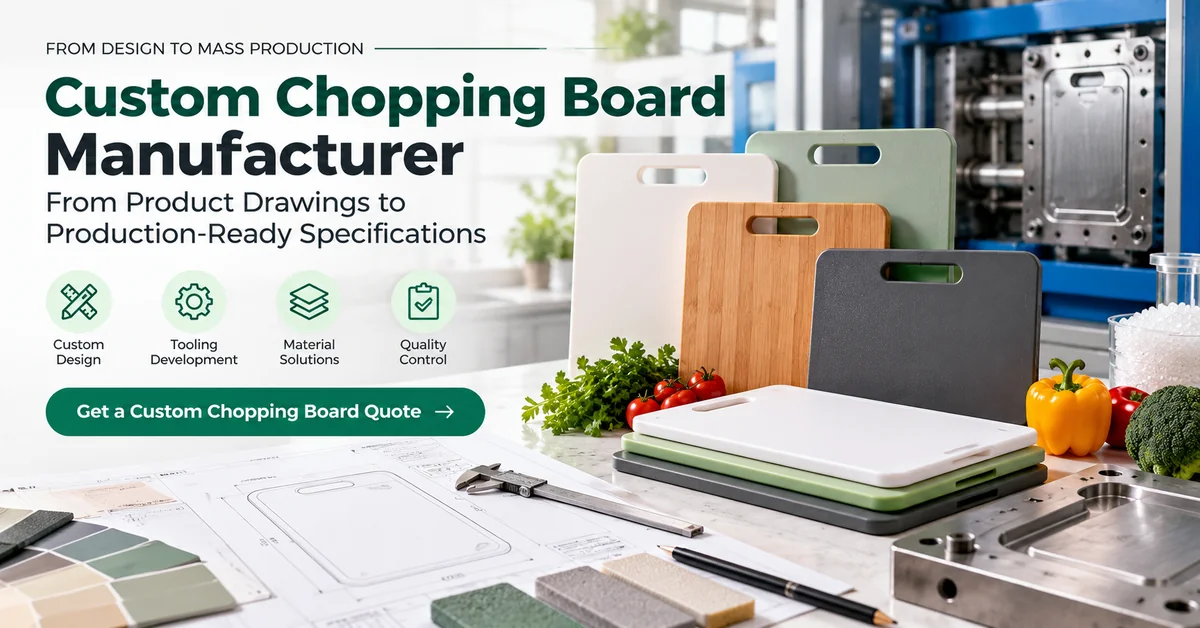
These buyers share one technical problem: a drawing is not automatically a production specification. A shape can look attractive in a rendering while containing a weak handle opening, a sharp transition, an expensive molding requirement or an inspection criterion that no two parties interpret the same way. Engineering-led sourcing converts those uncertainties into documented questions and decisions.
This guide is particularly useful for sourcing directors, product developers, industrial designers, technical purchasing managers and quality-assurance teams. It is not a substitute for a laboratory evaluation of finished food-contact materials, an engineering warranty, or a claim that a consumer PP board meets professional food-service requirements. Buyers seeking a very thick commercial butcher block, a specific composite formulation, or a certified heat-resistant surface must establish those requirements independently and verify supplier capability before proceeding.
A useful first meeting with a factory should end with more than a catalogue and a price. It should produce a list of feasible design directions, unresolved risks, sample deliverables and commercial assumptions. That is the distinction between simply buying a board and developing one for dependable repeat manufacture. For broader supplier due diligence rather than product engineering, see BONET's OEM chopping board supplier selection guide; the present article concentrates on transforming a design into an inspectable production file.
2. Start With a Verified BONET Product, Not an Imagined Product Range
BONET HOUSEWARE, based in Yangjiang, China, lists a PP Plastic Cutting Board for Kitchen Prep & Serving on its Chopping Board category. Its public description specifies PP (polypropylene) and overall dimensions of 24.8 × 14.8 × 0.8 cm for a compact household-oriented board. The listing is a credible baseline for a technical inquiry. It is not evidence that every requested color, dimension, material or feature is already available from stock.
BONET's OEM/ODM manufacturing page describes drawing/sample-based manufacturing, conceptual development, structural optimization, material suggestions, sampling, logo options, packaging support, mass-production coordination and quality inspection. These are company-stated service categories, not an unconditional promise that all possible designs are feasible or that all processes are performed in one factory.
| Specification item | Published reference | Required decision for a custom project |
|---|---|---|
| Product reference | PP Plastic Cutting Board for Kitchen Prep & Serving | Keep reference design or create a new version? |
| Material | Polypropylene (PP) | Exact resin grade, additives, pigments and documentation? |
| Overall size | 24.8 × 14.8 × 0.8 cm | New target dimensions, drawing revision and tolerances? |
| Working surface | Household kitchen preparation and appropriate serving | Intended foods, cleaning conditions and user environment? |
| Handle, grooves, feet and texture | Exact options not confirmed by the published reference | Are new features feasible; which require tooling? |
| Color, logo and packaging | OEM/ODM services described by BONET | Availability and suitability for this particular board? |
| MOQ, tooling charge and delivery | No universal board-specific terms confirmed | Project quotation and approval milestones required |
| Regulatory evidence | Not established by the public size listing | Market-specific review of finished product and claims |
Treat this table as a source-to-specification bridge: the left-hand facts can be referenced, while the right-hand questions must be answered before a contract. Buyers comparing different manufacturers should apply the same discipline. An attractive digital rendering is not proof of a validated manufacturing design.
3. Five Documents Every OEM Chopping Board Project Should Have
The most efficient development programs use a small set of controlled documents. When those documents agree, a custom chopping board OEM project becomes easier to quote, inspect and repeat. When they conflict, even a capable supplier can deliver a board that technically follows one file but disappoints the buyer.
A. Product Design Brief
Write down the intended consumer, selling market, channel, tasks, storage constraints, planned retail positioning and non-negotiable features. Separate must-have requirements from nice-to-have ideas. For example, a board may need an accessible handhold and a particular maximum footprint, while a distinctive surface pattern may be optional if it adds tooling cost or creates difficult-to-clean areas.
B. Revision-Controlled Technical Drawing
Record nominal length, width and thickness; edge radii; slot coordinates; hole or groove profiles; critical clearances; surface zones; datum references; and a visible revision number. A dimensioned 2D PDF is often easier to review for procurement, while a 3D CAD file can help assess the shape. Confirm with the supplier which file format and tolerance standard can be used. Do not treat the rendering as an approved dimensional authority.
C. Material and Claim Register
Identify the declared polymer or natural material, all relevant components and pigments, the intended food-contact use, proposed care instructions, supporting documents and claims not yet approved. This prevents marketing teams from adding 'dishwasher safe' or 'antimicrobial' language during packaging production before the evidence exists.
D. Approved Sample and Inspection Plan
Define how a sample becomes the golden reference: which team signs off, which version it represents, how dimensions will be measured, what cosmetic variation is acceptable and what tests are required. Record inspection stages, sampling rules, defect classifications and the action to take if a limit is exceeded.
E. Production and Packaging Release Sheet
Freeze the bill of materials, product drawing, label artwork, barcode allocation, individual packing, carton configuration, shipping marks and purchase-order reference. This final document is the handoff from development to manufacturing. A late artwork change should not quietly rewrite the board specification; a change to the board material should not proceed without assessing documentation and claims.
For new projects, ask a custom chopping board manufacturer which of these files its team provides, which the customer owns and who signs each approval. Clarity here often matters more than promotional promises of complete turnkey service.
4. Geometry: Design the Working Area Before Styling the Outline
A board's visual shape and its usable cutting surface are related but not identical. An elegant side indentation or oversized handle may reduce the area where a knife can safely operate. A decorative groove may interrupt cleaning or trap debris. A very thin projecting tab may be vulnerable during packing or everyday handling. Good design for manufacturing starts with the user's actual task and then works outward to the final profile.
Set the working zone
Define the minimum flat preparation area and identify the placement of openings, grooves, raised features and edge treatments. A product designed for peeling fruit on a small apartment countertop needs different proportions from a board intended for broad vegetable prep. For a serving item, the visual frame may matter more, but customers still need practical handling and cleaning access.
Engineer handles and slots
A handhold should provide enough grip for the intended user without creating a narrow ligament of material prone to breakage or distortion. Specify slot width, corner radii, distance to the outer edge and surface finishing expectations. A drawing should also identify whether the slot is meant for carrying, hanging or both. A hanging feature can change the product's load orientation and therefore its validation needs.
Decide whether a juice groove is functional
If a groove is requested, define its function before its appearance. Width, depth, corner shape and distance from the perimeter affect usable cutting area and how the board can be cleaned. Ask whether the chosen manufacturing route can create a consistent groove without unacceptable burrs, rough regions or distortion. Grooves are not necessary on every compact board, and a purely decorative channel should not be marketed as a proven liquid-containment system.
Treat edges and corners as specifications
Rounded corners and softened edges improve perceived finishing quality, but the exact radius and consistency should be documented. 'Smooth edges' can mean different things to different inspectors. Agree on a visual reference and a tactile acceptance method when numerical measurement would not reasonably capture the issue. Avoid creating deep crevices around added feet or inserts that consumers cannot clean as instructed.
Consider stability and storage
A flat board should lie acceptably on the intended surface under representative use, but the measurement procedure matters: where it sits, how long it has conditioned after molding or transport, and which points are checked. Distinguish reversible packaging deformation from persistent warp. Vertical storage, hook display, nested sets and stacked shipping can influence allowable geometry, carton dimensions and product support during transit.
Share your reference product, drawing, quantities and destination market for a project-specific feasibility discussion.
5. Select Materials With Evidence, Not Just a Trend Label
Material selection changes the manufacturing route, appearance, expected care instructions, surface response and evidence required for product claims. A custom chopping board manufacturer should discuss the full construction, not simply tick 'plastic' or 'wood' on a quotation form. The published BONET board is PP; the company's general customization page also mentions plastic, wood, bamboo and other materials. That broader statement does not establish a stocked chopping-board model in each material.
| Material or construction direction | Why buyers consider it | Engineering and documentation questions | What is publicly verified for BONET? |
|---|---|---|---|
| PP / polypropylene | Compact household kitchenware; adaptable molded forms | Grade, colorants, molding feasibility, dimensional stability, food-contact evidence | A compact PP board is listed |
| HDPE / polyethylene | Alternative plastic-board designs and surface feel | Exact grade, part thickness, fabrication route, permitted contact conditions | No specific HDPE board model confirmed here |
| Bamboo laminate | Natural-looking presentation and gift programs | Species/strip construction, adhesive, finish, moisture response, care | Bamboo appears among general customization materials; board model to confirm |
| Solid or laminated wood | Premium visual character and serving concepts | Species, assembly, routing, finish, stability, care | Specific board specification must be confirmed |
| Mixed-material board | Distinctive grip, visual or functional features | Every component, joint, surface, traceability and cleanability | Feasibility must be assessed project by project |
PP does not describe the whole formulation
Polypropylene is a polymer family. The exact grade, additives, pigments and any attached components determine which evidence may be required for the finished board and its intended use. Ask for material identification tied to the approved formulation, not just a generic PP label. The buyer should also document whether adding recycled content, a new pigment, or an overmolded grip changes the regulatory analysis. Do not make recycled-content or food-contact claims before the necessary facts have been verified.
Natural materials require their own controls
If a buyer requests bamboo or wood, review moisture-related behavior, construction and adhesives, species or material identification, sanding, edge and cutout finishing, and recommended care. A photographed grain pattern does not prove bamboo, a specific hardwood species or a particular lamination method. A manufacturer might source components or complete boards externally; agree who performs each operation and who supplies supporting materials documentation.
Avoid universal claims
No material automatically makes a board 'antibacterial', 'non-toxic', 'eco-friendly', 'knife friendly', 'heatproof', 'dishwasher safe' or fit for every food-processing environment. These terms require definitions, relevant testing or evidence and appropriate market-specific wording. Good product copy communicates what has been demonstrated, not what sounds attractive on a label.
6. Manufacturing Route Determines Tooling Feasibility
The same outline might be produced differently depending on material, expected volume and functional details. Before asking for a tooling estimate, ask the supplier to explain its proposed production route and whether that route is suitable for the dimensional and surface requirements. Never assume that BONET already owns a particular chopping-board mold or uses a specific cutting-board molding machine; the public information does not establish that detail.
Injection molding: geometry has process consequences
For an injection-molded plastic concept, nominal thickness, transitions, corner radii, draft, gate and ejector positions, cooling, sink and warpage risk may influence feasibility. If a design includes a deep groove, thin web, complex grip or undercut, the factory should discuss tool construction and sample risk. The buyer does not have to prescribe every mold feature, but should require a design review that identifies external marks and visible surfaces before approving tooling.
Machining or cutting from plastic sheet: flexibility can have limits
For some plastic board concepts, shaping an approved sheet stock and finishing the edges may offer an alternative to a new injection mold. However, availability of suitable sheet material, achievable texture, slot finishing, repeatability, cost and final regulatory documentation must be checked. A route that supports a small pilot efficiently may not have the same economics at higher volumes.
Wood and bamboo routes: finishing is a major variable
Natural or laminated material designs may involve machining, routing, edge shaping, sanding, surface finishing and assembly, depending on construction. Buyers should identify acceptable visual variation, handle-slot smoothness, groove quality and conditions affecting stability. This is an industry design consideration, not a statement that BONET performs every listed operation for its current board.
Ask for a concise DFM assessment that marks features as approved as drawn, approved with recommended modification, or subject to prototype/tooling evaluation. That simple distinction helps prevent a technically unrealistic concept from moving into a purchase order disguised as a standard product.
7. Set Dimensional Tolerances That an Inspector Can Measure
A common error in custom chopping board development is writing 'accurate dimensions' without defining a measurement method. Precision is useful only when it is connected to the board's function and verified through a repeatable test. A tolerance that is unnecessarily tight can add cost; one that is too loose may produce poor retail-pack fit, unreliable stacking or a board that rocks on the countertop.
Use a drawing to identify critical-to-quality (CTQ) dimensions. For example, a handle opening may be more important than a decorative border location; thickness consistency may matter more than a nonfunctional logo offset. Not every visual feature needs the same inspection burden. Buyers and manufacturers should agree a tolerance table after material and process feasibility review, rather than copying a generic industry figure onto an untested design.
| CTQ item | Why it matters | Recommended inspection approach | Acceptance limit |
|---|---|---|---|
| Overall length and width | Shelf, packaging and user workspace | Caliper / suitable gauge at agreed locations | Buyer and supplier to define after sampling |
| Thickness | Feel, weight, rigidity and packing | Defined measurement points, conditioned sample | To be agreed for actual material/process |
| Flatness / rocking | Stability in use | Agreed flat reference, positions and observation method | Functional pass/fail rule to be signed off |
| Handle opening | Grip and stress around cutout | Gauge or caliper; inspect inner-edge finish | Dimensions and cosmetic criteria to be agreed |
| Edge profile | Comfort and appearance | Radius gauge where appropriate; visual/tactile master | Drawing plus approved reference sample |
| Groove profile | Usability and cleanability | Profile gauge, representative cross section or approved master | Feature-specific limit, if groove is included |
| Logo or artwork | Brand consistency | Approved art, placement gauge and contrast sample | Revision-linked visual and location criteria |
| Package fit | Damage and merchandising | Pack-out test with approved carton and insert | Verified packed-sample approval |
The table deliberately contains no invented numerical tolerances. A ±0.2 mm rule that is sensible for one small feature might be impractical for another process or product size. Ask the manufacturer to propose achievable limits and demonstrate them through samples or process data. Store the method alongside each limit so quality personnel in different countries reach the same conclusion.
8. Match the Design to the Actual Use Environment
A custom board intended for a compact home kitchen needs different compromises from a presentation board or a product sold in a multi-piece set. Evaluate the user journey: retrieving the board, handling it, preparing food, cleaning, drying, storing and eventually replacing it. These moments reveal useful engineering requirements that a hero photograph will not show.
Household preparation: prioritize appropriate working area, accessible lifting, edges that feel comfortable and care instructions appropriate to the tested product. Verify stability on representative countertops. A compact board can be a sensible format when space is limited, but not necessarily a replacement for a larger preparation surface.
Retail kitchenware collections: prioritize consistent external dimensions, fit inside sleeves or cartons, predictable colors and a coherent design system with adjacent BONET kitchen knives or utensils. Ensure the complementary items are actually available and suitable before advertising a set.
Serving and presentation: consider lifting ergonomics, appearance, food-contact conditions, wiping and cleaning, and whether any routed pattern is functional or merely decorative. A serving-oriented concept should not automatically be described as a heavy-use cutting surface.
Restaurant and institutional procurement: ask the buyer to define its own operational cleaning procedures, dimensions, sanitation requirements and applicable procurement standards. BONET's publicly described household PP board should not be represented as meeting specialized commercial requirements without separate validation.
E-commerce and export: design around packed dimensions, abrasion protection and the expected shipping pathway. A projecting handle that photographs well may increase carton size or vulnerability in transit. Test a fully packed sample before approving the commercial version.
9. Tooling Economics: Separate One-Time Decisions From Unit Costs
A custom profile can require a new mold, cutting fixture, routing program, sample setup or finishing method, depending on the proposed production route. The buyer should request a clear explanation of each cost rather than assume 'customization included' means all development work is free. Color changes, small artwork updates and a new structural feature can involve very different effort.
Ask your custom chopping board manufacturer to quote (1) existing-platform modification, (2) a new-design option and (3) any alternative lower-tooling route that meets the same use case. Require a line-item description of tooling or setup, prototype iterations, validation, packing development and unit-production price. Clarify ownership, storage, maintenance, change requests and the conditions for future transfer of dedicated tooling if applicable.
For comparison, a simple internal formula is:
Total approved program cost = one-time development/tooling + approved samples/testing + unit cost × order quantity + packaging + inspection/logistics costs assigned to the order.
Do not divide one-time tooling by a speculative high annual volume to make a proposal appear cheap. Compare a realistic pilot volume and one or more credible reorder scenarios. If design changes after tool approval, ask which work must be repeated. Many costly sourcing errors occur when a buyer signs an attractive product price without defining who pays for the first design revision.
10. Prototype Approval: Use Three Distinct Questions
A prototype should answer more than 'Does it look right?' Organize sample development into three reviews, even if one physical sample contributes to more than one. The goal is to stop aesthetic approval from accidentally becoming full production approval.
Appearance and ergonomic sample
Does the shape, size, grip, color concept and surface feel serve the target buyer? Test handling with representative users. Look at the underside, inner slot walls and corners—not just the hero-facing surface. This stage may use a nonproduction sample, so label it clearly if materials or surface characteristics are not identical to final production.
Engineering sample
Does the proposed material/process combination achieve the agreed geometry? Review critical dimensions, flatness method, finishing, integration of any added component and likely manufacturability. Ask whether changes in gate location, machining path, finish or compound are expected before production. The engineering sample should establish what technical uncertainties remain.
Pre-production / golden sample
Does the final sample represent the exact product revision that will be supplied? Verify material identification, drawing, color standard, artwork, claims, care label, packaging and relevant test documentation. Retain an approved sample and an approval record with photographs where helpful. Do not approve a sample while simultaneously negotiating unrecorded changes in material or geometry.
If samples disagree, the solution is a documented revision, not an oral promise. A factory cannot control a target that keeps moving. This is particularly relevant to private-label buyers whose design, marketing and purchasing teams may approve different versions of the same product.
Share your reference product, drawing, quantities and destination market for a project-specific feasibility discussion.
11. Test Real Function Without Inventing Performance Results
For product development, design a validation plan around foreseeable consumer use. This need not mean overengineering a basic household board, but it should include the performance claims that will appear on the retail pack. Each test should state the sample condition, method, acceptance criterion, responsible reviewer and record to be retained.
Practical checks may include whether the board sits acceptably on a reference surface, whether handles are comfortable, whether edges have sharp flash or splinters, whether the surface remains acceptable after the intended cleaning sequence, whether labels adhere, and whether unit packaging protects the board in distribution. Additional tests may be needed if the design includes applied grips, bonded inserts, grooves, hanging features or a multi-part assembly.
Where the buyer wants to market dishwasher suitability, temperature resistance, stain resistance, drop resistance, antibacterial properties or a specific lifetime, request an appropriately designed test and documented result before publishing the claim. A material data sheet alone is not an automatic warranty for the final article. Likewise, a one-time demonstration with a kitchen knife does not prove long-term knife-edge compatibility.
A custom chopping board manufacturer that discusses failure modes and realistic limits can be more useful than one that guarantees every proposed feature. The aim is not to collect impressive labels; it is to make the design's intended performance measurable and defensible.
12. Food-Contact Evidence: Validate the Finished Article and Intended Market
A chopping board's food-contact role makes documentation important, but compliance cannot be inferred from the name of the resin or from a generic statement that a company works with kitchenware. The review must reflect the final material formulation, any added components, the intended foods and conditions of use, and where the product will be placed on the market.
For European Union sales, the European Commission describes Regulation (EC) No 1935/2004 as the general food-contact framework. Regulation (EU) No 10/2011, with its amendments, addresses plastic food-contact materials and articles; Regulation (EC) No 2023/2006 addresses good manufacturing practice for food-contact materials. A buyer should check what declaration, material traceability and test evidence are appropriate for its exact board and current destination-market rules. The references establish regulatory context, not that BONET's listed PP board has a particular certification or declaration.
For United States sales, 21 CFR §177.1520 covers certain olefin polymers, including defined polypropylene materials, subject to the provision's specifications and limitations. That is a legal starting point, not a blanket approval of every PP formulation, color additive or finished board. Review the specific components, use conditions and applicable provisions with a qualified compliance specialist where necessary.
Buyers should keep a traceable evidence pack that links reports to the actual formulation or product revision. Review the issuer, test methods, date, sample identification, conclusions and scope. If a recycled polymer, surface coating, colorant or nonplastic grip component is proposed, reassess the evidence rather than carrying an old compliance claim forward unchanged.
Source context for verification (plain-text references): European Commission, Food Contact Materials—Legislation; European Food Safety Authority, Food Contact Materials; and U.S. Code of Federal Regulations, 21 CFR §177.1520. These are independent regulatory references for buyers to consult; they are not external commercial hyperlinks in this article, and no product-specific BONET compliance claim is made here.
13. Build a Factory QC Plan Around Critical Features
A thoughtful quality-control plan begins before mass production. In a technical RFQ, tell the supplier what would cause a retailer or end user to reject the board. Then assign each requirement to an appropriate inspection stage. Cosmetic inspection alone cannot establish dimensional conformity, and measurements alone cannot capture a rough inner handle or incomplete print.
| QC stage | Board-specific question | Practical evidence to request | Decision owner |
|---|---|---|---|
| Material receipt | Is the supplied resin or board stock the approved type? | Material identity or traceability records appropriate to the project | Factory QA / buyer quality team |
| First article or early production | Is the approved geometry achievable? | Measurements of critical dimensions, photos, initial functional checks | Engineering + QA |
| In-process | Are size, texture and finish staying consistent? | Agreed process checks and nonconformance records | Production + QA |
| Cosmetic/functional | Are slot walls, edges, groove and flatness acceptable? | Agreed inspection sheet and reference sample | Factory QC / buyer inspector |
| Product claims | Is the product evidence aligned with labeling? | Approved documentation linked to product revision | Buyer compliance team |
| Packing | Does every unit use approved artwork and protection? | Pack-out sample, carton counts, barcode scan checks | Packaging QA |
| Pre-shipment | Does the production lot meet release conditions? | Inspection report and disposition of exceptions | Agreed release authority |
Acceptance quality limit (AQL) methods may be useful for lot sampling, but do not declare a universal AQL level without a written contract and applicable inspection plan. Define defect severity: for example, unsafe sharp edges, unacceptable deformation, wrong material identification, mislabeling or minor cosmetic marks should not automatically share the same acceptance category. Decisions depend on product design, the buyer's requirements and the market.
BONET's OEM/ODM process states that quality inspection includes appearance, function, assembly, packaging and overall consistency. That supports discussing inspection coordination; it does not prove a particular in-house laboratory, inspection sample size, process capability value or product-specific certification. Request the actual documents you need rather than converting a general service description into an unsupported guarantee.
14. Keep Repeat Production Matched to the Approved Revision
A design handoff is successful only when the next order produces the same approved product or an explicitly authorized revision. Many problems appear not in the launch batch but in the second or third purchase order, when personnel change, packaging is updated or a component supplier proposes a substitution.
Establish a revision convention for the drawing, bill of materials, color reference, artwork, inspection plan and packaging file. The purchase order should point to the released package rather than attaching an old drawing with a new marketing mockup. If an engineering change is requested, classify it: cosmetic artwork only; dimensional or tooling change; material or component change; or change affecting claims and testing.
Each category requires a different review. A new barcode may affect artwork and carton labels but not the polymer. A new pigment may require additional material and food-contact review. A handle opening change may affect tooling, function and inspection gauges. Record who proposed the change, why, which documents changed, whether resampling is required, and the effective purchase-order date.
Before placing a repeat order, compare the latest approved file against the previous shipping records and confirm that no unauthorized substitution is planned. This disciplined process makes a custom chopping board manufacturer relationship more scalable, particularly when a brand sells the same geometry in multiple countries or under several retailer labels.
15. Get a Meaningful Quotation: MOQ, Lead Time and Cost Drivers
MOQ, unit price and delivery period should be calculated for the actual approved route, not guessed from a generic 'manufacturer' claim. Ask for separate prices when the concept requires a new mold, an existing platform adaptation, a new color, extra surface treatment, added components, or more complex packing. A different development route may change the minimum economic quantity and sampling schedule.
A complete quotation should identify the referenced drawing revision, resin or construction, production process, sample and tooling costs, quantity breaks, individual packaging, master cartons, inspection/test responsibilities, price currency, trade terms and named place, and the validity of assumptions. If export freight is included, request a clear division of costs under the chosen Incoterms rule rather than casually using 'FOB price' without a named port or specifying what is included.
Lead time has several components: design clarification, feasibility review, prototype or tooling work if needed, sample approval, documentation/testing, production scheduling, manufacture, inspection and shipping. A published promise of 'fast delivery' does not establish the actual critical path. Ask which steps can run in parallel and which require formal sign-off. An overambitious commercial launch date should not eliminate sample or claim review.
| Cost driver | Potential impact | Best RFQ question |
|---|---|---|
| Existing vs new geometry | Tooling and sampling effort | Can the baseline product be used without structural change? |
| Material and pigment | Material sourcing and evidence | Which exact grade and color systems are proposed? |
| Special grooves or grips | Processing complexity, finish and inspection | Can these features be produced repeatedly and cleaned as intended? |
| Dimensional requirements | Yield, gauges, process selection | Which limits are demonstrably achievable? |
| Branding and pack | Setup, proofs, carton cube | What is included and who approves files? |
| Testing and inspection | Direct cost and schedule | Which tests are mandatory, optional or buyer-arranged? |
| Shipment configuration | Freight and damage | What are approved pack counts, carton measurements and gross weights? |
Avoid comparing prices across materially different specifications. A low-cost quote for a standard compact PP board and a higher quote for a newly tooled specialty shape are not contradictory; they are different products with different risk and capital requirements.
Share your reference product, drawing, quantities and destination market for a project-specific feasibility discussion.
16. Move Through the BONET OEM/ODM Workflow With Clear Approval Gates
BONET HOUSEWARE describes a six-stage collaboration sequence. Apply it to a custom board project with a tangible deliverable at each handoff. This is a suggested buyer management method mapped to the company's public process; individual team assignments and production capabilities should be confirmed with BONET directly.
Stage 1 — Requirement communication. Provide intended use, product sketch, destination, target material, estimated demand, packaging environment and quality needs. Ask BONET to identify the published board reference and any changes that would require development work.
Stage 2 — Design and sampling. Agree which party supplies CAD or other drawings. Request design feedback and samples that separate appearance validation from engineering approval. Capture unresolved questions in a revision log.
Stage 3 — Quotation and confirmation. Obtain a quote that references the approved scope and identifies MOQ, development/setup, tooling if applicable, planned timing, packing, inspection and commercial exclusions. Verify decisions before authorizing expenditures.
Stage 4 — Mass production. Release the drawing, material description, golden sample and packaging documents as one controlled package. Agree how engineering changes and nonconforming output will be reported.
Stage 5 — Quality inspection. Check critical dimensions, finish, approved components, print/artwork, carton configuration and any required test reports under the documented inspection plan. Decide how exceptions will be accepted, reworked or rejected.
Stage 6 — Packaging and delivery. Approve final pack-out, master-carton identification and shipping documents. Retain the production revision so the next order starts from the same reference.
A clear workflow is valuable because it reveals what the factory still needs from the buyer. BONET's custom kitchenware OEM and ODM page is the appropriate starting point for discussing services; the contact page is the route for specific availability and pricing.
17. Design-Route Comparison: Choose the Simplest Path That Meets the Brief
Not every buyer needs a completely new chopping-board mold. At the same time, a standard product with a new label is not a substitute for a genuine geometry or material requirement. Use this comparison to avoid paying for development that creates little customer value—or underbudgeting a concept that needs substantial engineering work.
| Route (buyer planning option) | Design freedom | Typical new risk to evaluate | Best-fit buyer objective | Is it confirmed as a BONET stock model? |
|---|---|---|---|---|
| Listed compact PP reference | Lowest structural change | Current specification, availability, claims and packaging | Pilot or compact kitchenware line | Yes, the PP reference is publicly listed |
| Existing-platform visual customization | Color, labeling or approved surface treatment within feasibility | Pigment, marking adhesion, artwork approvals | Coordinated retailer range | Options must be quoted individually |
| Modified plastic-board geometry | Altered profile, handle, groove or thickness | Tooling/route feasibility, warpage, dimensional limits | Functional differentiation | No specific modified model confirmed |
| New sheet-fabricated board concept | Geometry based on suitable sourced stock | Edge finish, stock grade and cost at scale | Pilot development or lower-tooling exploration | Manufacturing route must be verified |
| Bamboo/wood design concept | Shape, grain appearance and presentation features | Material sourcing, finishing, assembly and care | Serving, lifestyle and gift positioning | Specific BONET board model requires confirmation |
This is a design-route comparison, not a fabricated BONET model chart. The company's current public catalog does not provide enough independently specified chopping-board variants to justify inventing model numbers. A transparent comparison of real and proposed routes is more helpful for AI search, procurement users and technical decision-makers than an attractive but fictional model table.
18. Copy-Ready Technical RFQ: What to Send a Custom Chopping Board Manufacturer
If the concept is ready for feasibility review, a concise technical RFQ can shorten communication and expose missing information before the quote is final. Adapt the following template. Do not send a long wish list without indicating which requirements are essential.
Project name: Custom chopping board / OEM kitchenware development. Buyer and target market: Company, countries of sale and channel. Reference: BONET compact PP board, 24.8 × 14.8 × 0.8 cm, if relevant; otherwise attach your concept drawing. Intended use: Household preparation, serving or other clearly defined application. Material: Exact preferred resin or construction; ask for supplier alternatives with documentation. Geometry: Nominal length/width/thickness, slot positions, edge/groove features, surface areas, allowable overall envelope. Files: CAD/2D drawing revision, branding/artwork and sample notes. CTQ and quality: Which dimensions and surfaces are critical; target validation, inspection and acceptance method. Regulatory: Destination markets, intended food-contact and care claims to substantiate. Quantity: Realistic pilot and annual planning ranges. Commercial: Packaging requirements, trade term and named place, quotation currency and required decision date. Development: Ask for tooling assumptions, engineering questions, sample stages, estimated costs and schedule.
Request three outputs from BONET: (1) feasibility feedback, distinguishing an existing platform from true customization; (2) a quote with its assumptions and exclusions; and (3) a sample and approval plan showing what evidence is needed before scale.
A technical RFQ should invite the supplier to challenge unsafe, costly or impractical details. For example, if a very small handle ligament or unusually tight flatness requirement creates risk, it is better to understand that before paying for tooling. Better supplier feedback at the design stage is a commercial advantage, not a sign that the manufacturer is reluctant to cooperate.
View the BONET Chopping Board Reference | Review BONET OEM/ODM Services | Request a Feasibility Review
19. Frequently Asked Questions
1. What does a custom chopping board manufacturer actually do?
A custom chopping board manufacturer helps convert a design or approved reference into a producible product with defined materials, dimensions, surface details, samples, inspection rules and packaging. Depending on the supplier and project, this may include feasibility review, design recommendations, tooling coordination and production. Ask the manufacturer to specify which services are available in-house, which involve partners, and what evidence it will supply for each stage.
2. Can BONET create a new chopping board shape or size?
BONET describes OEM work from drawings or samples and ODM services involving structural optimization, feasibility assessment and sample development. That supports a conversation about a new shape or dimension, but does not confirm that any requested geometry is already approved or can be produced with existing tooling. Send drawings and ask BONET to confirm feasibility, costs, tooling and lead time for that exact version.
3. What is the publicly confirmed BONET chopping board specification?
The public chopping-board category lists a compact PP Plastic Cutting Board for Kitchen Prep & Serving, with polypropylene (PP) material and dimensions 24.8 × 14.8 × 0.8 cm. Other features, tolerances, available custom colors, food-contact reports, MOQ and lead time require confirmation against the current product and project requirements.
4. Should I use injection molding or machining for a custom plastic board?
The decision depends on shape, material, functional features, order volume, finish and tooling economics. A molding route can demand attention to thickness transitions, cooling, tool layout and possible distortion. A machining route may permit a different development path, but stock grade and edge finishing must be reviewed. Ask the supplier to propose feasible routes; do not assume that one process is already used for BONET's listed PP model.
5. What tolerance should I set for board thickness or flatness?
There is no universal numeric tolerance appropriate for every material and geometry. Identify critical features, choose a repeatable measurement method, then agree achievable limits with the manufacturer after feasibility evaluation and prototype review. A thickness tolerance, flatness test and cosmetic acceptance standard should be explicitly written into the approved drawing or quality plan.
6. Can a custom board include a handhold, juice groove or non-slip feature?
These are plausible design requests, not automatically available standard options. Their feasibility depends on the chosen material, part shape, production method, tooling and cleaning requirements. Request an engineering review and a sample before making a product-page promise. Added components may also change food-contact evidence and quality checks.
7. How do buyers verify food-contact suitability for the EU or US?
Review documentation for the finished article and its actual materials, relevant contact conditions and destination-market rules. For the EU, start with Regulations (EC) No 1935/2004, (EU) No 10/2011 as amended for plastics, and (EC) No 2023/2006 for GMP. For the US, provisions including 21 CFR §177.1520 may be relevant to qualifying polypropylene materials. None of these references establishes compliance for a specific BONET product without appropriate evidence.
8. How much does a newly designed chopping board cost to manufacture?
There is no reliable flat price. Costs depend on existing versus new tooling, material, part complexity, finish, sample revisions, quantity, inspection, documentation and packaging. Ask for separate one-time development charges and per-unit prices at realistic quantities. Compare quotes only after the scope and trade terms are aligned; the lowest nominal price may omit essential work.
9. What documents should be approved before mass production?
Approve the product drawing and revision, bill of materials, material and claim register, golden sample, CTQ measurements, inspection plan, branding/packaging artwork, carton configuration and commercial production release. Ensure the purchase order references the same version. The exact set may expand when special materials, added components or market-specific requirements apply.
10. How can I request a custom chopping board quote from BONET?
Visit BONET's contact page and provide the drawing or reference board, application, destination market, material, critical dimensions, estimated quantity, packaging brief and testing expectations. Ask for feasibility feedback, approved standard versus custom options, sample stages, tooling requirements, quotation assumptions, MOQ and timeline. You can also review the OEM/ODM service scope before sending the RFQ.
Conclusion
The right custom chopping board manufacturer is not simply the factory willing to accept the most design requests. It is the partner that can turn a user's intended function into a credible production route, clarify which requirements are feasible, link the chosen material to appropriate documentation, and establish a consistent way to inspect finished boards. A revision-controlled drawing, engineering sample, claim register and measurable quality plan protect buyers from expensive misunderstandings long before the first shipment.
BONET HOUSEWARE offers a documented PP chopping-board starting point and describes drawing/sample-based OEM, ODM development, sampling, packaging and quality-inspection support for kitchenware. Any new shape, material, tooling route, performance claim, MOQ or lead time should be reviewed and confirmed for the exact project rather than assumed from general service descriptions. Explore BONET chopping board products, read its OEM/ODM capabilities, and send your technical RFQ to BONET to discuss a design that can be approved, manufactured and reordered with confidence.
