




A custom handle kitchen knife manufacturer is not just selling a blade and a piece of wood. In most sourcing conversations, the real product is feel: how the knife balances in the hand, how confidently it moves through vegetables and protein, and whether it looks at home in a working kitchen or a retail display case. That is why buyers who are comparing custom kitchen knives usually need more than a pretty photo. They need a practical read on blade geometry, handle construction, finishing quality, and the amount of customization that is actually possible without sacrificing usability.
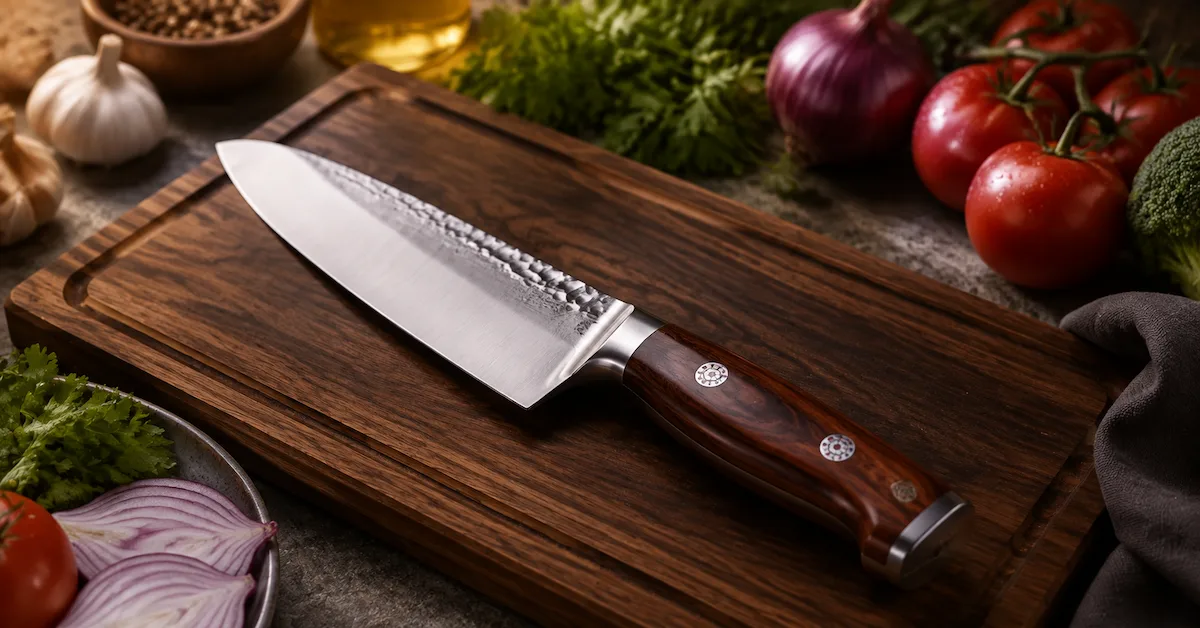
The knife described here is a useful example. It has the proportions of a chef’s knife or general-purpose prep knife, with a pointed tip, a broad belly for rocking cuts, a satin-polished cutting face, and a textured upper blade section near the spine. The dark brown wooden handle, two visible pins, metal bolster, and end cap give it a traditional, finished look. From an engineering or sourcing standpoint, that combination tells you something important: this is the kind of knife that can be positioned as both a functional kitchen tool and a handcrafted presentation piece.
What buyers are really asking for when they source a custom knife
In the kitchen knife category, “custom” can mean several different things. Sometimes it means a fully bespoke blade shape. More often, it means a manufacturer can adapt the handle material, handle profile, blade finish, surface texture, or decorative details while keeping the core geometry familiar. For many buyers, that is the smarter route. A good chef knife already has a proven shape. The opportunity lies in tuning the handle, the balance point, and the visual language around it.
This matters because the handle is not a side detail. It affects grip security, fatigue, and perceived quality. It also affects how the knife is washed, stored, and used over time. A handle that looks refined in a catalog can still be awkward in daily prep if the contour is too flat, the bolster is clumsy, or the finish becomes slippery. Buyers who evaluate custom knife handles carefully tend to make better long-term sourcing decisions.
Why the handle changes the knife more than many people expect
On paper, a blade does the cutting. In practice, the handle decides whether the knife feels precise or tiring after twenty minutes at the board. That is especially true for chef-style knives, where users rock the blade through herbs, dice onions, and make repetitive prep cuts. A handle with the wrong diameter or balance can turn a sharp knife into a nuisance.
Balance and control
A wooden handle with a bolster and metal end cap, like the one visible here, often gives the knife a more traditional weight distribution. Some users prefer a little handle weight because it stabilizes the motion. Others prefer a lighter handle for faster wrist movement. A manufacturer that offers customization should be able to discuss that tradeoff instead of treating every handle as cosmetic.
Cleaning and durability
Wood handles bring warmth and texture, but they also require more care than some synthetic options. That is not a defect; it is a design choice. Buyers should ask how the wood is sealed, how it behaves under repeated washing, and whether the finish will resist staining and swelling in real kitchen use. A beautifully polished handle can still be the wrong choice if the end customer expects heavy, wet, commercial-style use.
What the visible knife design suggests
Even without identifying the exact steel grade, the visible knife gives a number of useful clues. The blade has a bright, polished surface and a hammered or textured upper zone near the spine. That textured area may be hand-forged or hand-finished, but it would be a mistake to claim that from the image alone. From a buyer’s perspective, the safer reading is simpler: the finish is intentionally mixed, with a refined cutting face and a more rustic upper area for visual character.
The profile is also important. This is not a narrow slicer or a small paring knife. It has the broad belly and long working edge associated with a chef knife, so it suits chopping, slicing, mincing, and general prep. That makes it a practical candidate for home kitchens, culinary retail, gifting, or brand programs that want a knife with everyday utility rather than a niche specialty tool.
The handle construction is equally telling. Two visible rivets suggest a stable assembled handle rather than a purely decorative wrap. The metal bolster, transition piece, and butt cap make the knife feel more finished and more substantial. Those details are often important to buyers because they influence both appearance and perceived value. In a retail environment, they can make the difference between an item that feels handmade in a good way and one that looks unfinished.
Manufacturing routes buyers should understand
Custom kitchen knives are commonly produced through forging or stock removal, followed by grinding, polishing, and handle assembly. Each route has its own advantages. Forging can create a more artisanal identity and may help with the look of texture or transition around the blade. Stock removal often gives tighter control over consistency and repeatability. Either approach can work well if the maker understands heat treatment, edge geometry, and finish quality.
For sourcing teams, the right question is rarely “Is it forged?” and more often “Does the manufacturing method support the final use case?” A display knife for premium retail can tolerate more visual character. A kitchen knife intended for frequent service needs predictable balance, a secure handle, and a finish that holds up under use. The best manufacturers understand that distinction and can adapt the build accordingly.
How to evaluate custom kitchen knives before you place an order
Buyers should start with the basics: blade length range, handle dimensions, handle material options, bolster style, and finish style. From there, move to practical details. How is the tang constructed? Is the handle full tang, hidden tang, or a different assembly method? How is the blade ground? What kind of edge profile is being offered? You do not need every technical detail to be visible in the product photo, but the manufacturer should be able to answer clearly.
For custom knife handles, ask about moisture behavior, sanding and polishing levels, and whether the wood species can be selected or only approximated by appearance. Many buyers focus on color first and regret it later. Grain structure, sealing method, and repairability matter more over the life of the product. A handle that can be refinished or replaced cleanly is often more valuable than one that simply looks premium on day one.
It is also worth asking for a sample or pre-production reference if the order is large enough to justify it. Small differences in handle contour or blade finish can feel substantial in the hand. What looks symmetrical on a screen sometimes feels too thick, too slim, or slightly off balance in real use. That is a common and very ordinary mistake in knife sourcing.
Where handmade kitchen knives fit in the market
Handmade kitchen knives occupy a useful middle ground. They are often bought for cooking, but they are also purchased as gifts, specialty retail items, collector pieces, or brand statement products. The knife in this example fits that profile well because it combines utility with visible craft cues: polished steel, visible rivets, a traditional wooden handle, and a textured blade section that adds character.
For sourcing managers, the key is to match the product story to the customer. A home-cook audience may care about comfort and versatility. A culinary gift buyer may care more about the finish and presentation. A professional user will usually care most about edge stability, grip, and clean handling. The same knife can sometimes work across these segments, but the messaging should not pretend all buyers want the same thing.
Common mistakes when buying custom kitchen knives
One common mistake is over-specifying the appearance and under-specifying the ergonomics. Another is assuming a wooden handle automatically means premium. It does not. Wood can be excellent, but only if the grain selection, sealing, and assembly are done carefully. A third mistake is overlooking the blade profile. If the knife is meant for chopping and slicing, the belly, tip shape, and spine thickness matter more than decorative features.
Another quiet problem is inconsistent language between buyer and manufacturer. One side says “chef knife,” the other interprets that as a narrower prep knife. One side says “custom,” the other assumes only handle color changes. These misunderstandings are easy to avoid early. Put dimensions, finish expectations, handle material preferences, and intended end use in writing before the sample stage.
Practical questions to ask a manufacturer
If you are evaluating a custom handle kitchen knife manufacturer, start with a short list of direct questions:
Can the handle shape, material, and color be adjusted?
What blade profile is recommended for slicing, chopping, and mincing?
How is the handle assembled and sealed?
Can the finish be made more refined or more rustic?
Is the knife intended for retail display, daily kitchen use, or both?
Those questions are plain, but they expose a lot. A capable manufacturer will answer them without drifting into vague marketing language. If the answers are uncertain, that is useful too. It usually means the product has not been fully engineered for the intended market yet.
FAQ
Is a hammered blade texture only decorative?
Not always. It can be decorative, functional, or both. In this case, the texture is visible near the spine, but the exact purpose cannot be confirmed from the image alone.
Are wooden handles a good choice for kitchen knives?
Yes, when they are well sealed and well assembled. They offer a classic look and comfortable grip, though they may need more care than some synthetic handles.
What makes a knife suitable for both use and display?
A balanced blade profile, clean finishing, visible craftsmanship, and a handle that feels substantial without becoming bulky. The knife should look intentional, not overworked.
Next step for buyers
If you are planning a custom knife program, ask for a sample reference based on the intended use case rather than the photograph alone. Specify the handle style, preferred finish, and whether the knife is meant for home kitchens, culinary retail, gifting, or professional prep. That brief conversation will usually reveal whether the maker understands practical knife design or only decorative detailing. For custom knife handles and handmade kitchen knives, that distinction matters more than most buyers expect.
