




If you are comparing a custom handle kitchen knife manufacturer, the real question is not only who can put a logo on a blade. It is who can build a knife that feels right in the hand, holds up in daily prep, and fits the buying intent behind the product. For a sourcing manager, that may mean a private-label line with a recognizable handle profile. For a product team, it may mean a custom chef knife that combines a traditional look with sensible production choices. Either way, the handle is not decoration; it is part of the tool.
A chef’s knife is still the workhorse in most kitchens. It handles slicing, chopping, dicing, and mincing across vegetables, herbs, and boneless proteins. That broad use is exactly why handle design matters. A knife that looks attractive on a page can still disappoint if the grip is slippery, the balance feels nose-heavy, or the bolster gets in the way during a long prep shift. Buyers often discover this only after samples arrive, which is why the manufacturer conversation should begin earlier than many teams expect.
Why custom handle work changes the buying decision
On paper, many chef knives look similar: a long blade, a curved belly for rocking cuts, a pointed tip, and a handle that allows a secure grip. In practice, the handle is where the user notices differences fastest. Shape, contour, material, ferrule design, and the way the handle meets the blade all affect control. A custom handle kitchen knife manufacturer can adjust those details to suit a brand position, a target market, or a specific use case.
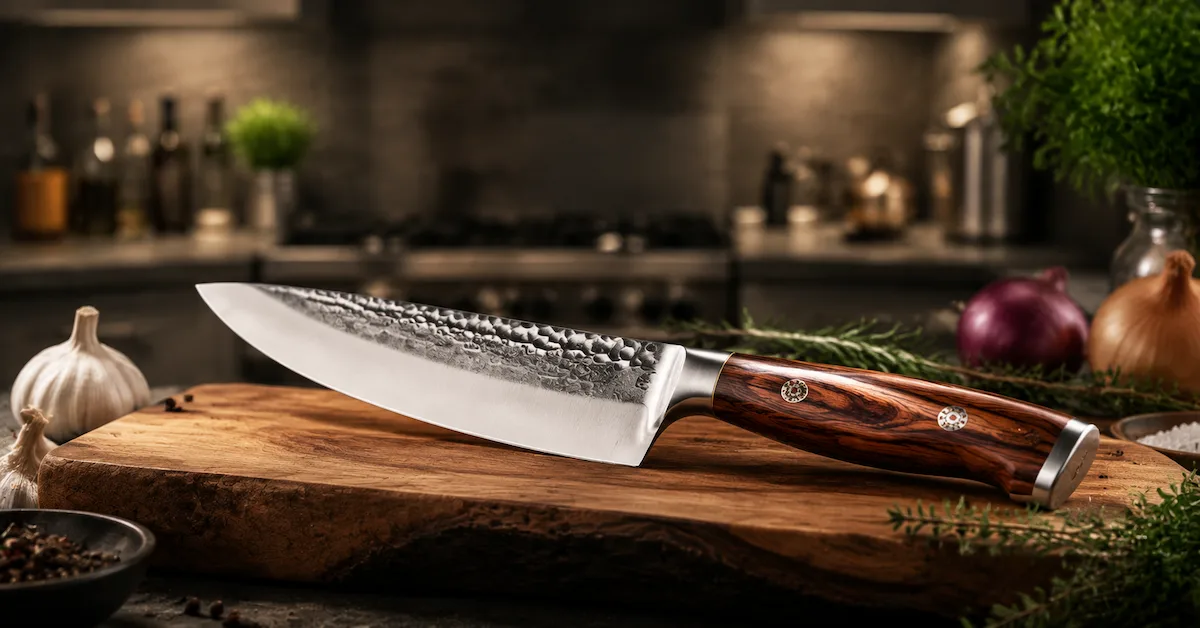
That customization can be practical rather than cosmetic. A dark-stained wood handle with visible grain, paired with a metal bolster and end cap, sends a traditional signal that many buyers still trust. Decorative pins can reinforce the handmade impression, even when the production method is more standardized. The blade may have a hammered or forged-style texture on the upper portion and a polished cutting edge, which creates a familiar premium look for retail, hospitality, or demo kitchens. None of that guarantees performance by itself, of course, but it helps define the product story.
What the visible knife details tell a buyer
The knife details supplied here suggest a classic full-size chef-knife profile. The blade appears to be metal, likely stainless steel or a steel alloy, though the exact grade is not visible. The shape has a curved belly, which supports rocking cuts, and a pointed tip for finer work. The upper blade shows a hammered texture, while the cutting edge is polished. The handle appears to be wood, likely a dark-stained hardwood, with a natural grain pattern. A metal bolster and end cap are also visible.
That combination points toward a forged or forged-style kitchen knife, though the actual process cannot be confirmed from the image alone. For a buyer, the main takeaway is simpler: the design sits somewhere between practical prep knife and presentation piece. It could work well for home kitchens, food prep stations, cooking demonstrations, or branded merchandise aimed at customers who still prefer a traditional wood-handled look.
Quick buyer read on the sample style
- Traditional chef-knife geometry for general prep work
- Hammered upper blade for a handcrafted visual cue
- Wood handle with metal accents for a more classic finish
- Contoured grip that may appeal to users who want a fuller hand feel
How to judge a kitchen knife supplier beyond the sample photo
Many teams start by searching for a kitchen knife supplier with strong product imagery. That is reasonable, but images are only the first filter. The real evaluation should move into consistency, customization depth, and the maker’s ability to keep the knife stable from sample to sample. A supplier can show a beautiful demo piece and still struggle with handle repeatability, finish consistency, or packaging quality once volume starts.
Ask how the handle is built. Is it natural hardwood, stabilized wood, or a wood-look composite such as pakkawood? The answer matters because appearance, moisture response, and long-term dimensional stability can vary. The provided data does not confirm which material is used, so this is a question to settle during sampling. Also ask how the handle is attached, whether the decorative pins are structural or mainly visual, and how the bolster transitions into the blade. Small gaps or uneven joins are the kind of flaw that buyers often notice after the first production run.
The blade side deserves equal attention. Since the exact steel grade is not visible, a buyer should request the material specification, heat-treatment approach, and finish method in writing. Even a visually attractive knife can underperform if the edge geometry is too thick, the polish is inconsistent, or the forging marks are only decorative. If the product will be positioned as a custom chef knife, the supplier should be able to explain how the shape supports general kitchen prep, not just how it photographs.
Selection criteria that matter in real sourcing work
When a custom handle kitchen knife manufacturer is being evaluated for a launch or line extension, the best criteria are often the unglamorous ones. Not because design does not matter, but because the unglamorous points decide whether the product survives in daily use.
- Handle ergonomics: The contour should support a secure, repeatable grip for multiple hand sizes.
- Balance: The knife should not feel blade-heavy or awkward at the bolster.
- Material stability: Wood looks excellent, but moisture behavior and finish quality need attention.
- Edge geometry: A chef’s knife should support slicing, chopping, and rocking cuts without feeling clumsy.
- Finish consistency: Hammered texture, polish, and metal accents should match across the batch.
- Customization flexibility: Handle color, grain appearance, logo placement, and packaging should be discussable before tooling or mass production.
It is easy to overfocus on the blade profile and ignore the hand feel. That is a common mistake. In kitchen tools, comfort is not a luxury feature. If a knife is intended for repeat prep work, hand fatigue and control matter more than a dramatic product shot.
What to ask before placing an order
A buyer does not need to interrogate a supplier like a lab auditor, but a few direct questions save time later. Start with the basics: what exact blade material is used, what handle material is available, and whether the product can be built with a consistent wood tone across the run. If the handle is custom, ask for sample variations rather than assuming the first approved sample will be the only option.
It also helps to ask how the knife will be used in the target market. A home cook may want a stylish handle and moderate weight. A catering team may care more about grip and easy cleaning. A demo chef may want a knife that looks traditional on camera and still feels balanced during repeated use. Those are not identical requirements, and a good manufacturer should be able to distinguish between them.
One practical warning: do not let presentation details hide functional questions. A hammered finish can look premium, but buyers still need to know whether the edge is suitable for repeated prep tasks and how the handle finish behaves with routine kitchen use. The same caution applies to wood. It is attractive, but it should be discussed as a working material, not just a visual one.
Common mistakes buyers make with custom kitchen knives
The first mistake is treating every knife as though it is mainly a branding exercise. A knife is a hand tool. Branding matters, but users will judge it by feel first. The second mistake is approving a sample without checking whether the handle scale suits the intended audience. A handle that feels substantial in one market can feel bulky in another.
The third mistake is assuming all forged-style knives are built the same way. They are not. Hammered surfaces, polished edges, bolsters, and end caps can be done well or poorly. The visual language may be similar, but the actual construction quality can vary a lot. Buyers should ask for process details rather than relying on appearance alone.
Another quiet issue is over-customization. A custom handle kitchen knife manufacturer may be able to change everything, but changing too much at once makes it harder to control cost, consistency, and lead-time planning. Often the smarter route is to fix the blade profile, lock the handle geometry, and vary finish or branding only where it adds value.
Practical advice for sourcing and product teams
If the goal is a marketable, usable knife rather than a one-off showpiece, begin with the end user. Decide whether the product should read as classic, professional, artisanal, or giftable. That positioning will guide the choice of wood tone, metal accents, and blade finish. A traditional dark wood handle with visible grain will signal a different market response than a bright, modern synthetic handle, even if the blade is similar.
Keep sample review simple but disciplined. Check the grip in dry and lightly damp conditions, inspect the alignment of the bolster and blade, and look closely at the transition around the ferrule and end cap. Small asymmetries are not always deal-breakers, but they do tell you something about the manufacturer’s control. For a kitchen knife used in general prep, that control matters more than people often admit.
If you are comparing suppliers, ask whether they can support a branded range rather than a single hero SKU. A credible kitchen knife supplier should be able to discuss handle variants, blade finish options, and packaging that matches the channel. Retail, foodservice, and promotional channels rarely want the exact same thing.
FAQ for first-time buyers
Is a custom handle mainly cosmetic?
No. It affects grip, balance, comfort, and brand perception. Cosmetics matter, but they sit on top of function.
Can a forged-style appearance guarantee quality?
No. Hammered texture and a polished edge can suggest craftsmanship, but buyers still need material and process details.
What if the exact steel type is not visible?
Then ask for it. Do not assume. Steel choice influences how the knife behaves in daily prep and how the product should be positioned.
Is wood always the right choice for a custom handle?
Not always. Wood offers a classic look and a warm feel in hand, but the right answer depends on the market, use case, and finish stability.
Next step for serious buyers
If you are narrowing down a custom handle kitchen knife manufacturer, use the sample to start a deeper technical conversation rather than ending it. Confirm the blade material, handle construction, finish consistency, and customization boundaries before you move into volume planning. The best result is a knife that looks intentional on the shelf and feels dependable at the cutting board. That is what separates a true custom chef knife program from a decorative product with a sharp edge.
