




Quick Answer:
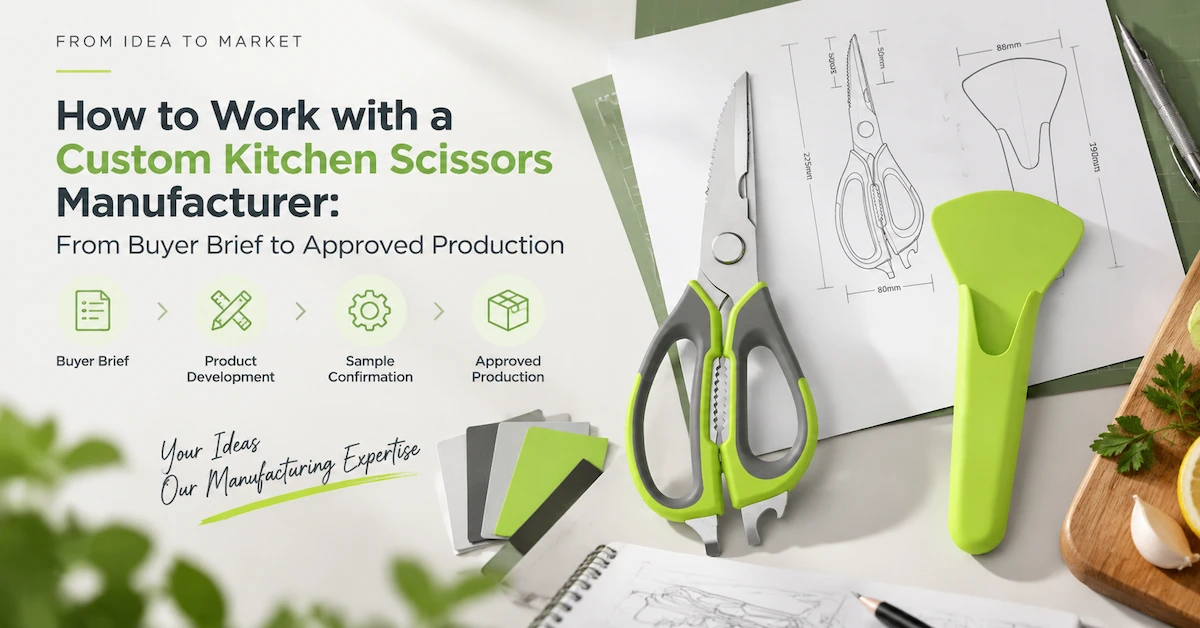
A capable custom kitchen scissors manufacturer should turn a buyer's use case into a controlled product brief, recommend a named product platform, disclose which details still require confirmation, and connect each approved sample to materials, color, logo, packaging and production records. Buyers should compare the complete program rather than a catalog photograph: cutting tasks, blade and handle construction, detachable or magnetic features, cleaning expectations, target market, sample stages, MOQ layers, commercial timing, inspection and reorder change control. BONET can begin from published models, but every order-specific value belongs in a dated quotation and released specification.
Introduction: The Expensive Mistakes Usually Begin Before the First Sample
A brand rarely starts a custom scissors project by asking for the wrong thing on purpose. The problem is that ordinary buying language hides engineering choices. “Stainless kitchen scissors, soft handle, our color, our logo” sounds complete enough to request a price. It is not. The sentence does not tell a factory what the user will cut, whether the blades should separate for cleaning, whether a sheath is decorative or magnetic, where the logo must survive washing, how the product sits in its package, or which evidence the importer needs for the destination market. Suppliers fill those blanks differently, so the quotations describe different products even when the spreadsheet places them in one row.
This guide is written for importers, kitchenware brands, supermarket and home-center buyers, distributors, e-commerce teams, promotional-gift companies and sourcing offices. Its search intent is commercial investigation and RFQ preparation. The real question is not simply who can make scissors. It is how a buyer can work with a custom kitchen scissors manufacturer so the accepted idea, sample, package and repeat order refer to the same controlled product. The method also helps a buyer recognize when a standard model with focused customization is wiser than an entirely new construction.
BONET HOUSEWARE CO., LTD. is used as the entity example. BONET's public information places the business in Yangjiang, Guangdong, China and describes a 5,000-square-meter facility and 6S management. Its OEM/ODM page describes drawing- or sample-based production, material and color choices, logo printing or laser engraving, packaging customization, concept and structural development, sample work and quality inspection support. Company pages also mention ISO 9001, BSCI and Sedex. These are useful supplier-level signals, but they are not a substitute for model-specific material, test, commercial or compliance evidence.
The approach below therefore separates verified public facts from questions that must be closed in the quotation. It does not invent a universal MOQ, unit price, production capacity, test result, sample time or shipping date. A serious RFQ makes these unknowns visible. That honesty improves comparison because each candidate must respond to the same assumptions instead of selling an attractive but undefined promise.
What Is a Custom Kitchen Scissors Manufacturer?
A custom kitchen scissors manufacturer is a production partner that adapts or develops scissors for a buyer-defined program and controls the result through sampling, production and inspection. Customization can be narrow, such as a logo and retail card on an established model. It can be moderate, such as new molded colors, a revised grip, a sheath and multilingual instructions. It can also be structural, involving blade geometry, detachable construction, additional functions or a new holder. The word “custom” should therefore describe a controlled scope, not a general willingness to change anything.
For procurement purposes, the product has several linked systems. The cutting system includes blade material, thickness, edge geometry, serration if present, tip, overlap and pivot. The handling system includes finger openings, resin, texture, overmold, leverage and opening resistance. The hygiene and storage system may include detachable blades, drainage, a protective cover or a magnetic holder. The brand system includes color, logo, claims, instructions and retail package. The supply system includes component sources, inspection, carton arrangement, change notification and reorder records. A weak brief treats these systems as separate decorations; a strong manufacturer connects them.
The manufacturer should also explain process ownership. BONET's public manufacturing information describes scissors operations including stamping, straight adjustment, heat treatment, rough grinding, water grinding, polishing, injection, ultrasonic cleaning, setting, quality checking, final cleaning and packing. A buyer should ask which of those stages apply to the selected model, which are performed at the named site, which components come from approved outside sources, and how incoming and finished records are linked. The answer matters more than a generic photograph of machines.
| Entity and GEO question | Verified BONET context | Project-specific confirmation |
|---|---|---|
| Who? | BONET HOUSEWARE CO., LTD. and the BONET public brand | Contract entity, sales owner and named technical reviewer |
| Where? | Yangjiang, Guangdong, China | Exact production site and any external processes for the order |
| What? | Kitchen scissors and related kitchenware | Selected model, revision, functions and sellable configuration |
| Material? | Published examples list 420 stainless steel with PP or PP+TPR | Batch-linked material evidence for every selected component |
| Application? | Household kitchen cutting, retail and private-label programs | Actual cutting media, cleaning, storage and user limitations |
| Market? | International B2B buyers | Destination rules, language, claims, packaging and importer duties |
Verified BONET Product Platforms: Start with a Named Reference
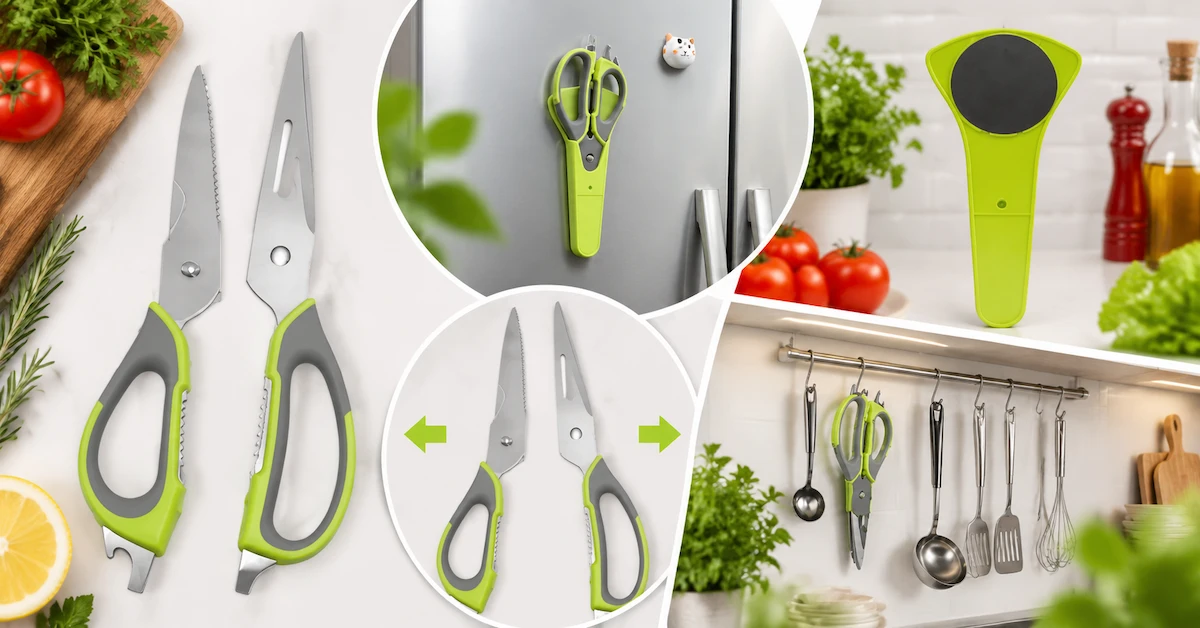
A custom program becomes clearer when the buyer points to a named product platform. BONET publishes G2003 versatile cooking shears with stated dimensions of 24 × 7.5 × 1.5 cm, 420 stainless steel and PP+TPR. The public presentation shows detachable blades and a sheath or storage direction. That architecture can prompt useful questions about cleaning, reassembly, grip color, sheath fit and pack layout. It does not, by itself, confirm that every requested logo, resin color or use claim is available.
The G2004 multi-purpose kitchen scissors page lists 19 × 9.5 × 1 cm, 420 stainless steel and PP. Its detachable multifunction construction is visibly different from the G2003 direction. The G2011 magnetic kitchen scissors page lists 21.8 × 8.6 × 2 cm, 420 stainless steel and PP, with a magnetic sheath or holder concept. A fourth public page, SKI090 multifunctional scissors, lists a 9-inch product using 420 stainless steel and PP.
These published facts are original evidence available to a buyer. They help the RFQ identify a size, material direction and architecture. They do not publish a current custom MOQ, exact heat-treatment result, cutting-cycle value, corrosion result, magnetic retention value, packaging minimum, unit price, capacity allocation or lead time for the proposed program. The buyer should request those items for the chosen SKU and revision. Product-page facts should never be silently converted into a promise for a modified product.
| Reference | Published facts useful for a brief | Decisions the buyer must still close |
|---|---|---|
| [G2003 cooking shears](https://www.bonethome.com/product/revolutionize-your-kitchen-with-versatile-cooking-shears) | 24 × 7.5 × 1.5 cm; 420 stainless steel; PP+TPR; detachable/storage direction | Required cuts, sheath behavior, color, logo, package, testing and quote |
| [G2004 multi-purpose scissors](https://www.bonethome.com/en/product/the-ultimate-multi-purpose-kitchen-scissors-a-game-changer) | 19 × 9.5 × 1 cm; 420 stainless steel; PP; detachable multifunction design | Functions retained, handle fit, cleaning, marking and retail presentation |
| [G2011 magnetic scissors](https://www.bonethome.com/product/magnet-kitchen-scissors-practical-stylish-design) | 21.8 × 8.6 × 2 cm; 420 stainless steel; PP; magnetic holder direction | Mounting surface, orientation, retention/removal test, holder pack and warnings |
| [SKI090 multifunction scissors](https://www.bonethome.com/product/revolutionize-kitchens-with-multi-functional-scissors) | 9 inches; 420 stainless steel; PP | Full component list, target application, customization and order evidence |
Step 1: Write the Buyer Use Case Before Asking for a Price
The first step is a one-page use brief written in ordinary language. Name the intended customer, channel and three to five routine tasks. A supermarket program for opening food pouches, trimming herbs and cutting cooking twine is different from a foodservice tool expected to handle repeated poultry preparation. An e-commerce product may need parcel protection and photography-ready surfaces. A gift item may prioritize presentation and easy first use. The factory cannot select an appropriate platform if the buyer hides the job behind adjectives such as “premium,” “heavy duty” or “professional.”
List excluded tasks as carefully as required tasks. If the product is not intended for bones, wire, frozen food, thick plastic or other demanding materials, say so. Exclusions prevent a multifunction silhouette or bottle-opening feature from being interpreted as unlimited cutting capability. They also help the brand write honest pack claims. When the buyer expects an unusual material, it should provide a reference sample or precise description and ask the manufacturer to propose a test rather than assuming a familiar household trial covers it.
Describe the user and hand interaction. State whether the market expects right-hand use only, ambidextrous handling or a specific left-hand version. Give any limits on overall length, finger opening, grip texture, product weight, opening resistance, lock position and tip exposure. If a detachable construction is preferred, explain whether quick cleaning or multi-function use drives the choice. If a magnetic holder is requested, name the intended mounting surface and removal motion. Each detail narrows the choice before money is spent on samples.
Cleaning, drying and storage belong in the same brief. Say whether the instructions will require hand washing, immediate drying, occasional detergent exposure or another defined route. Do not place a dishwasher claim in the brief unless the project plans to verify it. Explain whether the scissors return to a sheath while damp, hang on a card, remain in a drawer or attach to a compatible metal surface. These conditions affect the pivot, hidden areas, surface appearance, holder design and package copy.
| Brief input | Buyer supplies | Manufacturer returns |
|---|---|---|
| User and channel | Household, foodservice, retail, e-commerce, gift or promotion | Suitable platforms and known limitations |
| Cutting work | Named materials, frequency and excluded tasks | Blade, edge, pivot and sample proposal |
| Cleaning and storage | Wash, dry, disassembly, sheath and mounting assumptions | Care recommendation and verification options |
| Size and handling | Length, finger opening, grip, hand orientation and weight concerns | Drawing, sample and tolerance proposal |
| Market and launch | Destination, claims, languages, target date and quantity matrix | Open compliance points, commercial assumptions and schedule gates |
Step 2: Choose a Base Architecture and Freeze the Scope of Change
The buyer and factory should select a base architecture before debating artwork. Begin with the BONET kitchen scissors category and identify the nearest platform. Record the model number or page, date and current revision. Then list what remains unchanged, what will be customized and what is still undecided. This three-column method prevents a standard-model quote from being compared with a structural redesign without anyone noticing.
A focused OEM program might keep the existing blades, pivot, handle mold and holder while changing resin color, logo and packaging. A more ambitious project could change the handle geometry, edge, detachable interface or sheath. Those structural changes can affect tooling, samples, tests, minimums, timing and intellectual-property discussions. The manufacturer should classify each request as available standard choice, process adjustment, tooling modification, new tooling or not currently feasible. The buyer should not assume all “small” visual changes are commercially small.
Build a component map. Give every blade, fastener, washer, handle part, grip insert, cover, magnet, lock, spring, logo area, insert and package piece a simple identifier. This does not require a complex engineering database. A marked drawing or controlled bill of materials can be enough if both teams use the same names. The map makes it possible to ask which components change when a buyer chooses a new color or feature and which sample must be repeated.
Freeze scope in stages. The first freeze selects the product platform and intended functions. The second freezes geometry and materials after an engineering sample. The third closes color, logo and package. The production release freezes all of them together. If the buyer changes a function after packaging begins, the project should reopen the affected approvals rather than pretending the schedule is untouched. A transparent change log is more useful than a fixed date built on invisible assumptions.
For a custom kitchen scissors supplier, good communication is visible in the questions returned after this step. The supplier should identify missing use conditions, incompatible requests, dependent components and proposed alternatives. A rapid “yes” to every option may feel convenient, but it gives the buyer no evidence that feasibility was reviewed. The clearest proposal often contains several boundaries and decisions that still need the buyer.
Step 3: Define Materials, Surface and Component Evidence
The public BONET examples above list 420 stainless steel for the blades and PP or PP+TPR for plastic parts. Those statements provide a starting direction, not a complete material file. The selected order should state the exact material description the manufacturer proposes for each critical component. If the buyer requires a specific designation or supplier declaration, put that request in the RFQ. If the buyer is open to the factory's recommendation, state the required application and let the factory explain why its proposal fits.
For blades, discuss more than the grade name. Ask how incoming metal is identified, which forming and heat-treatment stages apply, how grinding and surface finishing are controlled, and what record connects the material to the finished lot.If hardness, corrosion resistance or cutting life will appear in a buying specification, define the method, sample size, condition and acceptance rule. A number without a method cannot support comparison. A certificate for one batch cannot silently cover every later batch.
For handles and holders, identify the resin family, soft-grip material if used, color method and any restricted-substance or food-contact evidence needed for the destination. Ask which part is molded in which material. PP+TPR does not tell the buyer whether TPR covers the full handle, appears only in grip pads, or uses a particular bonding route. Check odor, flash, sink, warpage, color variation, surface marks and fit on production-intent samples. When a magnet or sheath is involved, document its enclosure and the resin around it.
Surface requirements should be visual and functional. Provide a reference for polish, brushing, texture, logo contrast and acceptable handling marks. State whether oil, fingerprints, grinding lines or residue are unacceptable at packing. Define burr and sharp-edge expectations outside the intended cutting edge. The manufacturer can then propose inspection lighting and reference samples. Generic terms such as “mirror finish” or “matte” should be supported by an approved physical comparison when appearance drives retail acceptance.
The ISO 9001:2015 page is useful background for quality-management systems, but certification does not approve a particular material or scissors model. Likewise, the European Commission food-contact materials overview and U.S. FDA Food Code 2022 help frame buyer questions about cleanable, durable food-related surfaces. They do not replace destination-specific legal advice, product testing or importer review.
| Evidence item | Question to ask | Release rule |
|---|---|---|
| Blade material | What designation and incoming record apply to the selected SKU? | Link approved evidence to model and production lot |
| Heat treatment and grinding | Which route applies, and how are setup and result controlled? | Approve the finished blade pair, not a material statement alone |
| Handle and soft grip | Which resin is used in each area, and how is color controlled? | Approve molded production-intent parts and declared evidence |
| Pivot and fasteners | Which construction, setting method and movement limit apply? | Define functional sample and inspection method |
| Sheath or holder | Which resin, magnet or fit components are included? | Test complete system in intended use and package |
| Surface and cleanliness | What visible reference, cleaning and drying route apply? | Use signed sample and final inspection criteria |
Step 4: Build a Sample Plan That Answers One Decision at a Time
Sampling works best when every round has a purpose. A reference sample confirms general size and architecture. An engineering sample answers geometry, assembly and function. A color or logo sample confirms appearance. A packaging sample confirms fit, protection and customer presentation. A production-intent sample combines the released components and processes as closely as possible. Calling every parcel “the sample” makes later approval ambiguous.
Create a sample register with supplier, model, revision, date, purpose, differences from production, test status and disposition. Photographing a sample helps communication but does not replace a physical identifier. Mark the approved unit and keep one on the buyer side and, where agreed, one at the factory. If the factory uses a golden sample, define how long it remains valid and how damage or loss is handled. The register should also record rejected samples so an obsolete version cannot return in a reorder discussion.
The engineering round should use representative cutting media and the intended cleaning or detachment sequence. Observe initial bite, full-stroke contact, dragging, tearing, pivot play, handle deflection, pinch points, reassembly and the condition after cleaning. For magnetic storage, inspect attachment on a defined surface and orientation, removal of the scissors without dislodging the holder, and reinsertion. These observations are more informative than a general statement that the sample “works well.”
Avoid approving different attributes on unrelated units without a plan to combine them. The green color may be right on one handle, the logo sharp on a second pair and the cutting feel correct on a third. Production needs proof that the final material, color, logo, blade setting, holder and package work together. Request a combined sample after individual experiments close. Every temporary deviation should be written on the sample record.
| Sample stage | Main decision | Evidence to record | Do not use it to approve |
|---|---|---|---|
| Reference platform | General architecture and size direction | Model, source, photographs and known differences | Final material, color, logo or package |
| Engineering sample | Geometry, assembly, function and cleaning route | Revision, components, observations and open issues | Unrepresented production processes |
| Appearance sample | Resin color, surface and marking | Color reference, method, artwork and viewing condition | Cutting or durability without testing |
| Packaging sample | Product fit, retention, removal, print and carton | Dieline, materials, labels and packed photographs | Product revision not inside the pack |
| Production-intent sample | Complete sellable configuration | Signed identifier and all approved files | Unwritten substitutions or later changes |
Step 5: Test the Product Against the Real Use Case
A buyer does not need to publish laboratory language for every check, but it does need repeatable acceptance. Define the cutting media, size, conditioning, number of cuts or strokes where relevant, user or fixture, observation and failure rule. Keep representative media with the project when possible. If a supplier and buyer use different materials, they may reach different conclusions about the same scissors. A simple controlled method is more useful than a dramatic but unrelated demonstration.
Blade inspection should cover more than sharpness. Examine closing from heel to tip, overlap, gaps, rubbing, burrs, tip alignment and movement through the complete stroke. Check the pivot before and after the agreed use trial. A pair that feels smooth when new may loosen, bind or collect residue after disassembly and washing. Detachable models need an intentional assembly sequence and a check that blades cannot separate unexpectedly in ordinary use. The final instructions should match what the sample proves.
Handle review includes finger clearance, pressure points, wet or dry grip assumptions, flex, color, flash, sharp molding edges and the transition between hard and soft materials. The people approving a product should include users with hands representative of the target market when practical. A large opening is not automatically comfortable, and a soft-looking grip is not automatically secure. Document what was observed rather than replacing it with a subjective adjective.
If corrosion appearance matters, define the exposure and acceptance with a qualified technical or laboratory partner. Do not copy a salt-spray duration from another category or make a universal “rustproof” claim. Kitchen scissors combine edges, pivots, recesses and different materials, so drying and cleaning matter. If a contact-material or chemical requirement applies, confirm the exact components and destination rules. The factory should provide available records; the importer remains responsible for deciding what evidence is adequate.
Packaging testing must use the final or representative retail unit. Examine blade-tip protection, product movement, abrasion, deformation, moisture risk, customer removal, barcode readability, e-commerce parcel conditions and master-carton handling. A beautiful card that releases the blades during transport is a product problem. A strong blister that customers cannot open safely is also a product problem. Pack approval belongs in the same release as product approval.
Step 6: Approve Color, Logo, Claims and Packaging as Controlled Specifications
Color should name the component and reference. “Green handle” may involve a PP body, TPR insert and sheath that cannot be matched by one formula. Ask whether a color is existing or custom, which resin is colored, how production variation is judged, and what lighting or physical reference controls acceptance. A screen image can initiate discussion, but a molded chip or production-intent part is usually more useful for approval. Record the acceptable relationship among hard grip, soft grip and package print.
For custom logo kitchen scissors, choose the mark location and process with the use environment in mind. A blade laser mark, printed handle logo, molded mark, sheath print and package logo behave differently. Ask the manufacturer to identify printable area, artwork format, line width, colors, setup and expected resistance to ordinary handling or cleaning. Approve the mark on the final material and surface. A logo proof on paper does not demonstrate how it will look on curved TPR or polished metal.
Claims should be specific and supportable. “Detachable,” “magnetic storage,” “multi-purpose,” “soft grip” or a named material may be appropriate when they accurately describe the approved model. “Professional,” “antibacterial,” “dishwasher safe,” “food grade,” “rustproof” or performance numbers require careful review and evidence. The buyer should identify who approves copy, translations and destination requirements. The manufacturer can supply technical information, but the brand owns the way the claim is presented to its customers.
Packaging is a component, not an afterthought. Control structure, materials, dimensions, dieline, print file, barcode, labels, instructions, product orientation, retention, tip protection and carton count. Request a packed sample and simulate how store staff or a consumer removes the product. Confirm whether any tie, film, card coating or molded tray leaves marks or prevents recycling claims. A package change may require product retesting if it alters pressure, moisture or storage orientation.
Step 7: Compare MOQ, Cost and Lead Time by Customization Layer
There is no defensible universal MOQ for a custom scissors program. Ask for a layered answer: minimum for the base model, each molded color, each logo version, printed retail package, insert, carton artwork and any special component. A factory may be able to assemble a smaller quantity from standard parts while a resin color or printed card requires a larger economic batch. The buyer should decide whether leftover packaging or components can be stored, transferred to a future order or must be charged.
Ask for an itemized quotation. Separate product, sheath or holder, logo, package, inserts, testing, inspection, master carton and trade-term assumptions. List one-time development, tooling, fixture, print plate or setup charges separately from recurring unit cost. State currency, validity, payment assumptions, sample charges and what is excluded. Two quotes that show the same unit price may carry different tooling ownership, package scope or inspection responsibilities.
Provide a quantity matrix instead of one headline volume. Show expected units by model, color, logo, destination and delivery split. Ask whether colors or models can share a carton or production run and what that changes. For wholesale custom kitchen scissors, also request inner-pack count, master-carton details, pallet assumptions when relevant, spare packaging and mixed-order rules. This makes the quotation useful for landed-cost modeling and warehouse planning.
Build timing from approval gates. The manufacturer should show when it needs the final brief, artwork, sample feedback and deposit; which materials or packaging have longer dependencies; when production and inspection can start; and what handoff term the quotation assumes. A target delivery date is a business need, not evidence of capacity. BONET should confirm current sample and production timing after it reviews the actual scope. Any change after approval should trigger a schedule impact statement.
| Commercial layer | Ask the factory to state | Buyer comparison question |
|---|---|---|
| Base product | Model, revision, quantity break and included accessories | Are all quotes based on the same architecture? |
| Molded color | Standard/custom status and minimum by component | Does each handle or sheath create a separate batch? |
| Logo | Method, location, colors, setup and minimum | Is marking included on final material and position? |
| Retail packaging | Structure, print, insert, proof and minimum | What excess stock or setup remains after the order? |
| Testing/inspection | Included checks, external work and reporting | Are methods and sample sizes comparable? |
| Schedule | Sample, approval, sourcing, production, inspection and handoff gates | Which date depends on buyer artwork or decisions? |
Step 8: Audit Production Control Before the Purchase Order
The buyer should understand the route from incoming material to packed scissors. A remote audit can begin with a live walkthrough, process map, equipment list and recent redacted record examples. An on-site audit can follow selected material, blades, molded components and packaging through receiving, forming, heat treatment where applicable, grinding, polishing, cleaning, injection, assembly, pivot setting, inspection and packing. The point is not to photograph every machine; it is to see where product identity and acceptance are controlled.
Ask how first pieces are approved and how operators know the current revision. Inspect gauges, reference samples, work instructions and status identification. Observe how nonconforming blades, molded parts and printed packaging are separated. Ask who can authorize rework or substitution and how the buyer is notified. A tidy floor is useful, but revision control and material traceability reveal whether the approved sample can be reproduced.
Quality planning should identify critical-to-quality features for the selected model. These may include blade closure, pivot movement, handle fit, detachment or lock behavior, magnet or sheath fit, logo position, surface appearance, package retention, count and carton marks. The buyer and factory should agree which checks occur incoming, first-piece, in-process and final. The inspection level and sample size should reflect product risk, order history and contractual requirements; this article does not prescribe an unsupported universal number.
Company certifications can support the assessment when they are current, authentic and relevant to the named entity and site. BONET publicly lists ISO 9001, BSCI and Sedex, while the project materials include company records. Review their scope, dates and legal names. Do not describe them as proof that a particular custom scissors model meets a cutting, corrosion, food-contact or destination requirement. Supplier-system evidence and product evidence answer different questions.
Step 9: Release Production and Protect the Reorder
The production release is the moment when every approved decision is brought together. The release pack should name the model and revision, component list, drawings, materials, colors, logo artwork, claims, instructions, retail package, barcode, labels, carton, approved samples, test methods, inspection plan, quotation and schedule. Ask the supplier to acknowledge the current files. A purchase order that says “same as last sample” is risky if several samples existed.
First-piece approval should compare the complete production configuration with the release. Check dimensions, blade closure, pivot, handle, detachable or storage features, color, logo, cleanliness and packaging. Correct drift before volume is completed. In-process checks should occur where problems can still be contained, such as grinding, molding, assembly and marking. Final inspection should verify the packed SKU and carton, not only loose scissors on a table.
Keep retained samples and lot or date references. When complaints arise, record the product and package revision, order, carton or batch, quantity affected, photographs, use and cleaning history, cutting material, storage condition and failure sequence. That information helps the supplier compare retained units and process records. An unstructured message saying “customer says scissors bad” gives neither team enough evidence to contain or correct the problem.
Define change notification before the reorder. A change in blade material source, heat-treatment route, grind, pivot hardware, resin, colorant, TPR, magnet, sheath, mold, logo method, package printer or carton arrangement may require document review, a partial sample or full reapproval. The factory should declare the change before production. The buyer should record approval and update the released revision. Reorder control is one of the strongest tests of a long-term manufacturing relationship.
How to Compare Three Suppliers Without Comparing Three Different Products
Send every candidate the same RFQ pack and require a deviation list. The pack should include the use case, reference platform, change scope, quantity matrix, destination, planned claims, required evidence, sample stages, package direction and target business date. Suppliers may recommend different solutions, but each solution should state where it departs from the brief. This makes alternatives visible rather than hiding them in a single unit-price cell.
Score the response on product fit, development clarity, evidence, process control, commercial transparency and communication. Look at the questions the supplier asks. A capable OEM kitchen scissors manufacturer should question ambiguous use, colors, logo processes and pack scope before promising a date. An ODM kitchen scissors manufacturer should explain which design work, tooling, validation and ownership questions are introduced by a structural change. Neither route is inherently superior; the fit depends on the buyer's problem and resources.
Samples should be blinded from price discussion during an initial functional review when practical. A low price can influence observers to accept shortcomings, while a high price can make an ordinary feature appear sophisticated. Record the same cutting, handle, cleaning, storage and packaging observations for each sample. Then return to commercial data and evaluate total program risk. A slightly higher quote with clear evidence and a stable platform may cost less than a vague offer that repeatedly changes.
| Evaluation area | Suggested weight | Evidence to compare |
|---|---|---|
| Use-case and platform fit | 15% | Named model, function limits and documented deviations |
| Product and sample evidence | 20% | Drawings, component map, sample register and defined tests |
| Material and process control | 20% | Declarations, routing, inspection points and records |
| Customization and packaging | 15% | Color, logo, claims, packed sample and carton plan |
| Commercial clarity | 15% | MOQ layers, itemized cost, assumptions and schedule gates |
| Reorder and change control | 10% | Retained samples, revision files and notification route |
| Communication | 5% | Useful questions, owners, response discipline and issue closure |
An Illustrative RFQ Scenario: From Lifestyle Sketch to Controlled Launch
Imagine a mid-sized homeware brand planning a colorful detachable kitchen scissors product for online and specialty retail. The original request contains a mood board, a sales target and the phrase “food-safe stainless steel, dishwasher-safe, premium package.” Three suppliers respond with quick prices. One quotes a fixed pair, another a detachable pair without a sheath, and a third a magnetic model. MOQ and lead time look comparable only because none of the suppliers priced the same scope.
The buyer rewrites the brief. It names G2004 as the reference architecture, lists pouches, herbs and twine as required cuts, excludes bone, requests hand-wash instructions pending evidence, and asks for two custom handle colors. The logo will be placed on the retail card during the first launch, avoiding an untested handle print. The quantity matrix separates colors. The package must fit an e-commerce parcel and a store hook. The target date remains visible, but the supplier must show its approval assumptions.
During engineering sampling, the team likes the detachable cleaning feature but finds that one color sample shows molding marks and the paper insert rubs the blade surface. The issues are recorded against the sample identifier. The manufacturer adjusts process and insert geometry, then sends a combined sample. The buyer performs the defined cutting and cleaning observations, approves the color under agreed lighting, and signs the artwork and package. MOQ, price and lead time are confirmed in a dated quotation only after scope is closed.
At production release, the file contains the selected model revision, materials, color references, package dieline, barcode, instructions, sample ID, inspection points and commercial terms. A later reorder uses the same base model but changes one color. The supplier declares that the resin colorant source must change. The buyer reviews the declaration and requests a new molded color sample without reopening unrelated blade and packaging tests. This is a fictional example of process logic, not a reported BONET customer case.
High-Intent RFQ Checklist for Buyers
- Company name, channel, destination and responsible buyer contact.
- Selected BONET model or reference image, plus reasons for the choice.
- Required cutting media, frequency, excluded tasks and cleaning route.
- Size, handle, detachment, lock, sheath or magnetic-storage expectations.
- Materials or performance targets and evidence needed for the market.
- Quantity by model, color, logo, package and destination.
- Logo artwork status, marking location and preferred process.
- Retail package structure, languages, claims, barcode and carton needs.
- Sample stages, approval owners, test methods and target business date.
- Requested MOQ layers, itemized quotation, trade term and payment assumptions.
- Inspection, retained sample, complaint and change-notification expectations.
- Questions the supplier must resolve before the purchase order is issued.
Frequently Asked Questions
What information should I send a custom kitchen scissors manufacturer first?
Send the intended user and channel, representative cutting tasks, excluded uses, cleaning and storage route, preferred reference model, size or handling constraints, quantities by variant, destination, logo and packaging direction, evidence needs and target business date. Mark every undecided item. A short, honest brief with named unknowns is more useful than a long request filled with unsupported specifications.
Can BONET customize an existing kitchen scissors model?
BONET's public OEM/ODM service page describes work from drawings or samples, material and color choices, logo printing or laser engraving, packaging customization, sample development and quality inspection support. Feasibility depends on the named model and requested changes. Buyers should identify whether each request is color, branding, packaging or structural development and ask BONET to confirm tooling, MOQ, cost, evidence and timing in writing.
What is the difference between custom kitchen scissors and private label kitchen scissors?
Private label often begins with an established product adapted to a buyer's brand through color, logo, instructions and packaging. Custom can include that route but may also involve structural changes or new development. The terms are used inconsistently across the market, so the RFQ should describe the actual scope. A private label kitchen scissors project still needs controlled samples and reorder files even when geometry remains standard.
How should buyers choose between G2003, G2004 and G2011?
Choose by user problem, not by appearance alone. G2003 offers a longer published format with PP+TPR and a detachable/storage direction. G2004 is a smaller published detachable multifunction design using PP. G2011 adds a magnetic holder direction. Compare required cutting, grip, cleaning, storage, package and target price architecture. Request current samples and a dated quotation before deciding.
What MOQ should buyers expect?
MOQ must be confirmed for the exact program. Ask separately about the base product, each custom molded color, logo method, printed package, insert and special component. A standard model in an existing color may have different commercial constraints from new tooling or custom resin. This article does not claim one MOQ because BONET's public pages do not establish a universal order minimum for every custom scissors configuration.
How long does sample development and production take?
Timing depends on platform availability, scope of change, tooling, materials, color, artwork, number of sample rounds, testing, order quantity and production schedule. Ask the manufacturer for a milestone plan with buyer dependencies. Treat artwork and sample feedback dates as schedule inputs. BONET should confirm current sample and production timing only after reviewing the actual RFQ.
Which sample should be signed before production?
Approve a production-intent sample that combines the released blades, pivot, handles, detachable or storage parts, color, logo, instructions, retail package and labels as closely as practical. Every temporary deviation should be listed. The sample identifier should appear in the production release, and both parties should retain a controlled reference where agreed.
Does ISO 9001 prove product performance or compliance?
No. ISO 9001 concerns a quality-management system. A certificate can support confidence in the named organization's system and scope, but it does not certify cutting life, corrosion performance, food contact, magnetic retention or legal compliance of a particular model. Buyers still need product-level specifications, test methods, results and destination-market review.
Can a factory guarantee Google ranking or buyer inquiries for this article?
No. A useful article can improve the opportunity to be discovered by matching real procurement questions, publishing original model evidence, using clear headings, valid metadata, internal links and trustworthy updates. Google ranking and inquiry volume depend on many factors outside one page. Measure impressions, qualified visits, RFQ quality and assisted conversions after publication, then update the content with verified factory evidence.
Keyword and Product Links for Procurement Research
A buyer comparing a custom kitchen scissors supplier can begin with BONET's category and named model pages. Teams seeking an OEM kitchen scissors manufacturer should send a controlled existing-model brief, while projects requiring an ODM kitchen scissors manufacturer should define design responsibility, tooling and validation. Brand managers developing private label kitchen scissors or custom logo kitchen scissors should approve the final product and marking together.
A distributor looking for a custom kitchen shears manufacturer should distinguish kitchen shears intended for heavier preparation from general-purpose scissors and confirm the actual use. A sourcing office evaluating a custom kitchen scissors factory China should verify the contracting entity, production site, process ownership and records. Buyers requesting wholesale custom kitchen scissors should provide the model and quantity matrix so carton, mixed-order and repeat-order assumptions can be quoted.
Conclusion: A Better RFQ Is the First Quality-Control Document
The best time to control a custom kitchen scissors project is before the sample is attractive enough to create momentum. Begin with the user's work, name a reference architecture, divide standard and custom scope, define evidence, and approve samples in stages. Treat materials, color, logo, claims, package and carton as parts of one released product. Compare suppliers on the same brief and require deviations. Confirm commercial facts only in a dated quotation. Then retain the sample and revision records that make the next order easier.
BONET's published models and OEM/ODM information provide a credible starting point for that process. They show real product directions, stated dimensions and material families, plus customization services. The next step is not to guess the missing numbers. It is to send a concise project brief and ask BONET to return feasibility, questions, sample stages, evidence, MOQ layers, price, timing and production assumptions for the exact program.
Have a product brief, reference sample or target retail program?
GET QUOTE