




Custom Kitchen Tools Supplier Guide for Coordinated Sets
Sourcing from a custom kitchen tools supplier is more complex than choosing colors for a spatula set. A coordinated collection may include turners, spoons, whisks, measuring tools, boards, a storage holder, and other prep items. Each piece must work on its own, but the set also has to feel consistent in the hand, on the counter, in packaging, and in retail presentation.
For B2B buyers, the real sourcing question is not whether a sample looks attractive in a photo. It is whether the supplier can translate a design concept into repeatable production, clear specifications, stable packaging, and practical use. This guide explains what to define, what to verify, and which questions to ask before placing an OEM, ODM, wholesale, or private-label order.
Key Takeaways
- Start with intended use, not decoration. Heat, moisture, cookware type, storage, and cleaning habits should guide material choices.
- Ask for set-level samples, not only individual utensils. Fit, balance, finish consistency, and packaging are easier to judge as a complete bundle.
- Do not assume material grades, coatings, compliance status, or test results. Request written confirmation and supporting documents from the supplier.
- Clarify what is included in the supply scope: utensils, measuring pieces, boards, crock, packaging, inserts, labels, and spare parts if needed.
What a Coordinated Kitchen Tool Set Needs to Solve
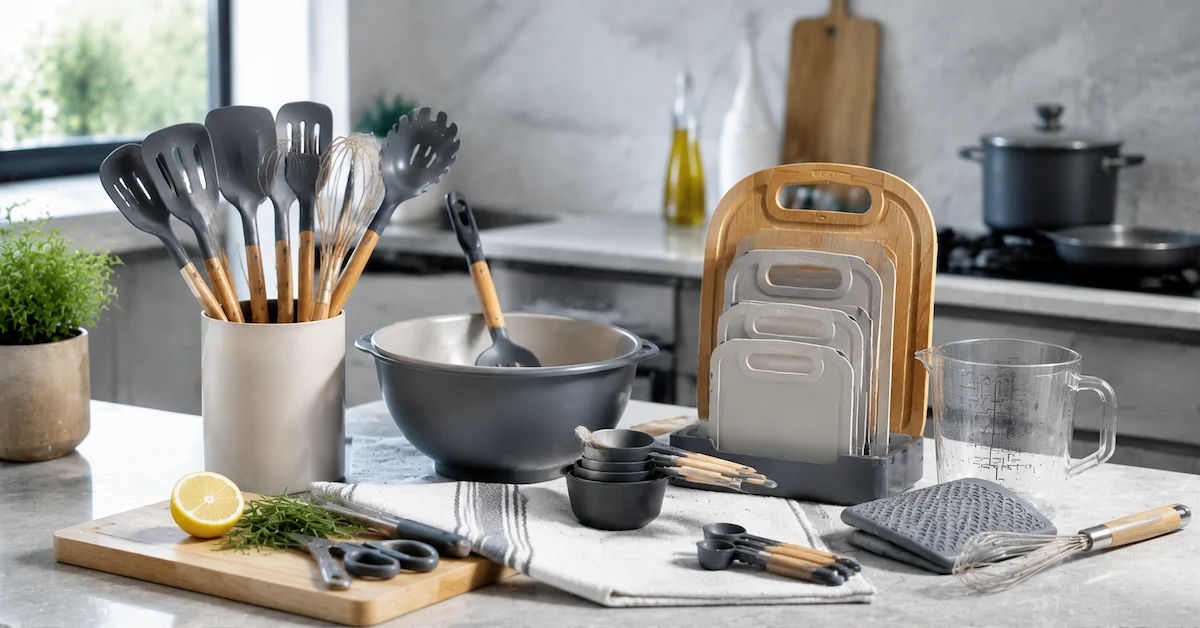
A coordinated kitchen tool collection is not just a matching group of objects. It is a workflow package for preparing, measuring, mixing, turning, serving, and storing. The original product image suggests a countertop arrangement with utensils, measuring items, a bowl, boards or trays, and a compact holder. The exact materials and specifications are not confirmed by the image, so buyers should treat visual clues as a starting point rather than a specification sheet.
For retailers, a consistent collection can create a cleaner shelf story. For hospitality, gifting, and promotional programs, it can make a bundle look deliberate instead of assembled from unrelated items. For private-label brands, it helps build a recognizable design language across multiple SKUs. The challenge is that every added item increases coordination risk: color matching, surface finish, handle profile, nesting fit, weight, packaging protection, and production timing all need attention.
Material Choices Affect Performance, Cost, and Risk
Common kitchen tool sets may combine metal heads, coated or silicone-like surfaces, wood or bamboo-style handles, clear measuring vessels, and boards with visible grain or wood-like appearance. However, a buyer should not claim or market any specific material unless the supplier confirms it in writing.
Different materials solve different problems. Metal can offer rigidity and thin working edges, but it may not be suitable for all cookware. Silicone or coated heads may support flexible use, but seam quality, odor, staining, and coating wear should be checked. Wood or bamboo handles can create a warmer visual presentation, yet they require careful review of surface finish, moisture exposure, and care instructions. Boards and trays add another layer because edge smoothness, warping resistance, nesting behavior, and food-contact suitability must be verified.
What to Include in an OEM or ODM Brief
A useful brief gives the supplier enough detail to quote, sample, and evaluate feasibility without guessing. Instead of saying “premium kitchen set,” define the practical requirements. A sourcing brief should include:
- Target channel: retail, wholesale, hospitality, promotional gifting, e-commerce, or foodservice.
- Included items: exact utensil types, measuring pieces, boards, holder, packaging, and accessories.
- Use conditions: hot pans, nonstick cookware, wet prep, dry serving, dishwasher expectations, or hand-wash positioning.
- Design direction: handle shape, finish sheen, color range, storage footprint, and logo placement areas.
- Commercial questions: MOQ, lead time, tooling charges, sample cost, packing method, carton details, and available quality documents.
The brief should also ask the supplier to identify which parts are standard catalog items and which require customization. This matters because tooling, color matching, and component sourcing can change cost and lead time.
Supplier Comparison Checklist
Use a structured review when comparing a custom kitchen utensils supplier. A clear table helps engineering, procurement, and brand teams discuss the same risks.
| Evaluation Area | What to Check | Questions to Ask the Supplier |
|---|---|---|
| Set architecture | Whether all pieces belong together visually and functionally | Are all items made in-house, outsourced, or sourced from partner factories? |
| Materials | Confirmed composition, finish, care guidance, and food-contact suitability | Can you provide written material details and any relevant documentation? |
| Assembly quality | Joints, ferrules, handle fit, seams, edges, and balance | What inspection points are used for mixed-material utensils? |
| Storage and packaging | Holder stability, nesting fit, scratch protection, and shipping durability | Can we review a complete packed sample before approval? |
| Customization | Logo method, color tolerance, tooling needs, and artwork limits | Which decoration methods are compatible with each surface? |
Sample Review: Test the Set, Not Just the Hero Item
Many sourcing problems appear only when the full set is handled. A spatula may look good alone, but the collection can still fail if the measuring pieces feel flimsy, the boards rub in the holder, or the packaging allows scratches during transit. Request a complete set sample and evaluate it under normal use conditions.
Check grip comfort with dry and slightly wet hands. Place the tools in and out of the holder several times. Look for sharp edges, uneven finish, loose joints, color variation, wobbling, and surfaces that mark easily. If the set is meant for e-commerce, ask for a packed sample and perform a realistic packaging review. If the product will carry a private label, confirm the logo position on every relevant part before approving mass production.
Common Mistakes When Buying Bespoke Kitchen Tools
The first mistake is allowing style words to replace specifications. Terms such as “natural,” “matte,” “modern,” or “premium” are useful for direction, but they are not enough for production control. Define color references, surface expectations, dimensions, and acceptable variation.
The second mistake is treating a mixed set as one simple product. Utensils, boards, measuring tools, and storage containers may involve different processes and inspection standards. Buyers should ask how the supplier manages component consistency across the full order.
The third mistake is delaying packaging decisions. A coordinated set often has multiple contact points where items can rub, chip, dent, or scratch. Packaging should be reviewed during product development, not after the purchase order is ready.
Practical FAQ for B2B Buyers
When should I choose a custom kitchen tools supplier instead of catalog items?
Choose custom sourcing when you need a specific set structure, color palette, storage format, logo program, or material combination that standard items cannot provide. If the goal is only a basic utensil at a low price point, catalog sourcing may be simpler.
What supplier details should I verify before ordering?
Ask about product scope, materials, available documentation, sample procedure, tooling needs, production lead time, MOQ, packing method, inspection process, and whether components are produced internally or sourced externally.
Are mixed-material kitchen tool sets risky?
They are not automatically risky, but they require closer control. Moisture exposure, heat contact, seam quality, handle attachment, finish consistency, and packaging protection all deserve review.
Should I approve production from photos?
No. Photos are useful for communication, but they cannot confirm balance, edge quality, grip feel, fit in the holder, or transit protection. Approve from physical samples whenever possible.
Next Steps for a Better Sourcing Round
Before contacting suppliers, prepare a function-first brief and a checklist for sample evaluation. Define the intended use, included items, material questions, storage format, decoration needs, packaging requirements, and inspection expectations. Then compare suppliers based on how clearly they answer practical questions, not only on how attractive the initial sample looks.
A reliable custom kitchen tools supplier should be able to discuss trade-offs honestly: what can be customized, what requires tooling, which materials need care limitations, and where packaging protection is necessary. The clearer the sourcing brief, the easier it becomes to control quality, cost, and user experience across the full coordinated set.
