




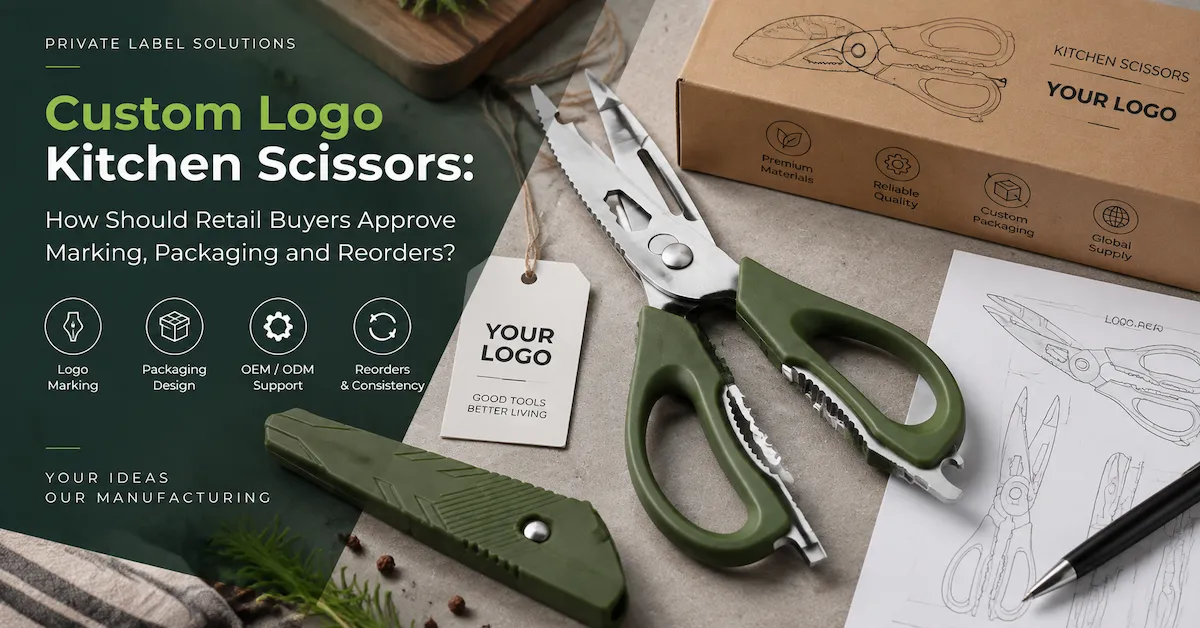
For custom logo kitchen scissors, choose the product and the logo surface together. A laser mark on a metal blade, a print on a plastic handle, a molded mark, and a logo on the retail pack have different space, appearance, cleaning, cost, and approval requirements. Buyers should send the intended scissors model, artwork, quantity by variant, destination, package concept, and use conditions to the manufacturer. Ask for a marked production-intent sample and a written acceptance method before confirming an order. BONET's public OEM/ODM information lists logo printing and laser engraving, but feasibility, MOQ, price, lead time, and test evidence must be confirmed for the selected project.
Introduction: A Logo Is Small, but the Buying Decision Is Not
A purchasing manager sees a blank spot on a pair of kitchen scissors and asks for the company logo. That apparently small request can change the sampling route. The print may need to stay legible after handling and washing. A laser mark may be too close to the cutting edge, a pivot, or a textured zone. A broad logo can look clear on a flat artwork proof yet distort across a curved handle. A packaging designer may enlarge the mark until it competes with safety instructions or the product photograph. The supplier may quote only the marking setup while the buyer assumes a complete private-label retail unit.
This guide serves brand owners, importers, retailers, promotional buyers, distributors, and sourcing teams that need to decide how to brand a kitchen-scissors SKU. The search intent is commercial investigation with a clear RFQ action: determine the appropriate model, mark surface, method, validation, and package before comparing offers. The question is not merely "Can you put our logo on scissors?" It is "Which marking route will preserve product use, brand presentation, order identity, and repeatability at the volume and market we actually serve?"
BONET HOUSEWARE is the public-facing brand used in this article. The company website places its business in Yangjiang, Guangdong, China and describes kitchen scissors, OEM/ODM support, drawing- or sample-based production, color options, logo printing or laser engraving, packaging customization, sampling, and quality inspection support. Project-supplied company records identify a scissors production and sales quality-management scope and a dated site audit. The precise relationship between the website company name and the certificate's legal entity should be confirmed by BONET before a public company profile combines them.
The article uses published product pages as evidence, not imaginary factory case studies. It does not insert a universal MOQ, laser power, ink specification, wash-cycle count, scratch result, shipment date, unit price, or customer testimonial. Those details belong in the model-specific sample report and dated quotation. This distinction is essential because a buyer's finished logo program is the combination of scissors, process, artwork, pack, and market, not a generic promise on a service page.
What Are Custom Logo Kitchen Scissors?
Custom logo kitchen scissors are kitchen scissors supplied in a buyer-defined branded configuration. A logo can appear directly on the blade, handle, sheath, or another component, or be carried by the retail card, box, insert, and master carton. The product may otherwise use an existing factory platform, or a broader custom program may alter color, grip, storage, and packaging. The defining feature for this guide is a controlled, repeatable brand mark, not a claim that every underlying tool is a newly engineered design.
The mark serves several jobs. It identifies the brand to the end user, helps warehouse and retail teams distinguish an approved SKU, and can visually connect the product to its package. It may also be exposed to abrasion, detergents, water, gripping, light, heat during processing, or contact with the packaging insert. A brand mark is therefore both a design element and a product-control feature. Buyers should describe its intended visibility and expected condition over time, then ask the supplier which process is suitable.
In procurement language, "custom logo" should not be confused with exclusive product ownership. A private-label package around an existing scissors platform can be commercially distinctive without giving the brand rights over the factory's base mold or blade design. If exclusivity, tooling, trademark use, or artwork ownership matters, define it in the commercial agreement. A logo proof by itself is not a legal agreement or a production specification.
BONET's public G2003 cooking shears page lists 420 stainless steel and PP+TPR with a detachable and storage-oriented presentation. Its G2004 multifunction kitchen scissors page lists 420 stainless steel and PP with a detachable format. The G2011 magnetic kitchen scissors page lists 420 stainless steel and PP with a magnetic-storage direction. These are real model references, not proof that an arbitrary logo method is feasible on every visible surface.
| Entity question | Public evidence for this guide | Buyer must still confirm |
|---|---|---|
| Who and where? | BONET HOUSEWARE public brand; Yangjiang, Guangdong, China | Contracting entity, named reviewer, exact production site |
| What product? | G2003, G2004, and G2011 kitchen-scissors directions | Selected model, revision, accessories, and sellable SKU |
| Manufacturer role? | Public OEM/ODM and scissors manufacturing information | Internal/external marking process and responsible quality owner |
| Material? | Product pages state 420 stainless steel with PP or PP+TPR | Exact marked surface, component declaration, and order-linked evidence |
| Application? | Household kitchen preparation and retail or private-label programs | Intended cuts, cleaning, grip, storage, and user limitations |
| Market? | International B2B sourcing context | Destination, language, claims, labeling, importer obligations |
A Useful Distinction: Product Mark, Brand Package, or Both?
A logo on the tool remains visible when the customer removes the package. That can matter for repeat recognition, gifting, and range consistency. It also creates technical questions about placement and durability. A logo on the package gives the designer more space for color, language, claims, and retail navigation, but it disappears when the card or box is discarded. Some buyers need both; others need only packaging and can avoid an unnecessary product-marking step.
Decide based on where the brand must be recognized. A foodservice distributor may need a mark that helps identify inventory after unpacking. A supermarket private-label line may place the strongest brand cue on a hanging card while keeping the scissors visually quiet. A promotional buyer may want the recipient to see the mark on the handle immediately. An online brand may prioritize product photography and the first-use experience. Each route changes artwork, sample review, cost layers, and the evidence needed to support a claim about lasting appearance.
The most common avoidable mistake is approving a beautiful mockup without asking what the mark will touch. The blade passes through product and may be washed or wiped. The handle is held by wet or oily fingers. A sheath can rub the logo each time it is inserted. A retail tie can press against print during transit. The final logo location should be approved in the same configuration in which it will be sold and used.
| Branding route | Main advantage | Main question | Approval evidence |
|---|---|---|---|
| Metal blade mark | Remains on the tool and can be visually restrained | Is there a suitable noncritical area and compatible finish? | Marked blade sample, location drawing, appearance review |
| Plastic handle print | Color can match brand artwork | Does curvature, texture, grip, and cleaning affect legibility? | Printed final-material handle and relevant handling check |
| Molded handle logo | Part of component geometry rather than a surface ink layer | Does a mold change or new tooling affect cost and ownership? | Molded production-intent sample, drawing and tool record |
| Sheath or holder mark | Visible during storage and sometimes on shelf | Will insertion, removal, and pack contact wear it? | Complete system sample and use-condition review |
| Retail package only | Large, flexible message area | Does brand identity remain clear after unboxing? | Final print proof plus packed product |
| Product and package | Consistent brand across touchpoints | Are artwork revisions linked on both surfaces? | One complete, signed sellable SKU |
Step 1: Define the Buyer Problem and the Branding Outcome
Start with a sentence that describes the commercial decision. For example: "A homeware retailer needs a two-color kitchen-scissors line that stays recognizable after the hanging card is discarded, while the first order uses an existing product platform." That sentence points toward a product mark but does not prejudge laser, printing, or molding. A different buyer may say: "An event buyer needs a branded kitchen gift that photographs well for a short campaign, with no requirement for a permanent mark on the tool." That suggests a packaging-led route.
Add the actual user and product use. State whether the scissors will cut herbs, food pouches, twine, light household materials, or a more demanding buyer-provided reference. Exclude tasks that are not intended. Describe hand washing, drying, detachable cleaning, storage in a sheath or magnetic holder, and whether the customer will handle the marked surface. These facts shape where a logo can go without compromising comfort, hygiene, or product function.
Next, define the visibility outcome. Should the logo be visible in a closed retail package, in a hero photograph, while the scissors hang in storage, during use, or only after unboxing? Does it need a specific orientation for right-hand use? Is the brand mark a word, symbol, lockup, certification-like graphic, or trademark with minimum clear space? Never ask a supplier to recreate a low-resolution screenshot; supply an authorized vector master and identify the approved colors and usage rules.
Give the market and channel. A retailer may require multilingual care copy, a particular barcode position, peg-hook dimensions, and carton labels. An e-commerce seller may need product photographs and a package that protects the logo from scuffs during parcel shipment. A distributor may need plain bulk packing with an inner-pack identifier. The marking choice can be identical across channels while packaging differs, but the quote should say so.
The RFQ should identify what the buyer knows, what it prefers, and what it wants the factory to recommend. An experienced custom logo kitchen scissors manufacturer can use a named product reference to discuss feasible mark surfaces. The linked product page is evidence of a scissors format; it is not an approval of the buyer's proposed mark. Ask BONET to return a placement recommendation with any restrictions and sample requirements.
| RFQ field | Buyer input | Useful supplier response |
|---|---|---|
| Commercial purpose | Retail, distribution, online, foodservice, or promotion | Suitable model and branding route |
| Recognition point | Package, stored product, in-hand product, or all three | Candidate location and expected visibility |
| Use and care | Cutting tasks, cleaning, storage, user | Surface/process limitations and evaluation plan |
| Artwork | Authorized vector, color, minimum size, exclusions | Print or mark proof dimensions and process proposal |
| Quantity | Units by model, color, artwork, destination | Separate product, color, logo, and print minimums |
| Destination | Country, languages, claims, label rules | Open documentation and artwork questions |
Step 2: Select a Real Scissors Platform and Map Marking Surfaces
Select the scissors before placing the logo. G2003, G2004, and G2011 do not have the same handles, storage parts, or product silhouettes. A mark that fits the relatively open space on one model might overlap a grip insert, pivot, or sheath on another. The buyer should identify the model, page reference, image, revision if supplied, and the exact components included. If a modified blade or handle is contemplated, the project may no longer be a straightforward existing-platform logo job.
Ask for a placement map showing two or three candidate zones. Mark the visible orientation, dimensions, edge clearance, curvature, material, texture, and any assembly contact. On a blade, keep the proposal away from the cutting edge and from places where marking could interfere with function or cleaning. On a handle, show where the fingers actually press. On a sheath, check the insertion path. The map should not imply that a visually open space is technically available until the manufacturer reviews it.
For detachable scissors, inspect each blade as a separate part and as an assembled pair. A mark should not make the two pieces confusing to reassemble or cover a functional feature. If the scissors include an opener or gripping feature, treat that area as functional, not a spare billboard. A logo that is only visible when the blades are separated may not achieve the buyer's brand objective.
For a magnetic storage concept such as G2011, distinguish the scissors from the holder. A mark on the holder may be prominent on the kitchen wall while one on the scissors is visible during use. If the retail package displays both, decide which mark is primary and how the package describes the storage limitation. A generic promise of attachment to every metal-looking surface would be inappropriate without model-specific evidence.
Create one controlled surface decision per SKU. If the same brand sells orange and green variants, decide whether the mark uses the same process and location on both. Color contrast can change. A dark logo on charcoal PP can disappear, while a light ink may show wear more readily. Ask for actual samples of each material and color combination rather than approving one photograph for a range.
| BONET reference | Published material/architecture direction | Marking decision to investigate |
|---|---|---|
| G2003 cooking shears | 420 stainless steel, PP+TPR, detachable/storage direction | Distinguish hard and soft handle zones; check sheath contact |
| G2004 multifunction scissors | 420 stainless steel, PP, detachable multifunction form | Check blade versus handle visibility and functional clearances |
| G2011 magnetic scissors | 420 stainless steel, PP, magnetic-storage direction | Choose scissors, holder, or both; test insertion and pack contact |
Step 3: Turn Artwork into a Production-Controlled Specification
Provide a vector logo in a usable format agreed with the factory, plus a readable proof. A raster image can help explain visual intent but should not be the sole production master. Identify the brand owner, approved version, color codes or physical color references, minimum size, exclusion zone, orientation, and whether the mark can be simplified at small scale. A detailed crest that looks excellent on a computer may turn into an indistinct spot on a narrow handle.
Ask the supplier to return a marked-up drawing or photograph with a proposed mark box, not just a floating logo pasted into a product image. The proof should show distance from blade edge, pivot, handle seam, grip texture, or sheath contact. If the mark appears on both sides, specify whether the orientation changes. If it appears on only one side, identify which side faces the customer in retail presentation and typical use.
Color and contrast deserve separate approval. An ink or laser result can look different on polished metal, brushed metal, translucent plastic, solid PP, or soft-touch TPR. Even if the artwork color is exact on paper, it may not be reproducible in the selected process. Ask for a physical appearance reference and define acceptable variation in practical terms. The final mark should remain legible under normal viewing and product photography conditions without requiring an unrealistic studio light.
Create a revision code that connects product marking to packaging. For example, a project file can identify a model revision, logo artwork revision, location proof revision, and packaging revision. It should also identify who approved them and when. This prevents a factory from using the newest logo on the box but an older logo on the product. A purchase order should refer to the approved set, not to an image buried in a message thread.
For a custom logo kitchen scissors supplier, the key sign of control is the ability to explain which file goes to which operation. A supplier may use a specialist marking process; that is not automatically a problem. Ask who approves the process, how parts are identified in transit, and how the finished mark is inspected when components return. The buyer needs a reliable route, not a claim that every stage must be inside one building.
Step 4: Compare Laser Marking, Handle Printing, Molding, and Packaging Print
Laser engraving can produce a restrained mark on a suitable metal area, and BONET's public OEM/ODM page lists laser engraving as a service direction. That statement does not establish the exact laser process, mark depth, contrast, cost, or durability for G2003, G2004, or G2011. The supplier should test the selected blade finish and mark position. A mark must not introduce a burr, damage a functional surface, create a corrosion or cleaning problem, or confuse inspection. Ask what appearance changes after normal handling and whether the process requires a different finish.
Printing on a PP handle can provide color and support a larger graphic when space allows. Its success depends on material, texture, curvature, print chemistry, surface preparation, placement, and use. A grip zone receives abrasion and possibly detergent exposure. A hard, flatter handle patch may be a better candidate than a soft, textured area. This is a design and trial question; the article does not assert that a particular BONET handle accepts a specific ink. The manufacturer should show a sample made with the proposed production route.
A molded logo becomes part of the component shape. It can be attractive when a buyer expects a long-running program and has sufficient volume to justify tooling review. It may require modifying an existing mold or building new tooling. Confirm who pays for and owns any tool, who may use the mark, what happens if the brand changes, and whether the geometry creates dirt-trapping recesses or discomfort. "Permanent" should not be used as a blanket claim; molded features can still wear, distort, or become less visible depending on location and use.
A logo on a sheath or magnetic holder can create a strong storage impression. It is not necessarily the easiest route. A holder can rub during insertion, face a refrigerator side panel, collect moisture, or sit partly hidden behind the scissors. Identify the actual storage orientation and surface before choosing mark placement. If the holder is a separate component, decide whether a missing or mismatched holder makes the sellable SKU nonconforming.
Packaging print offers the widest creative area. It can carry a colored logo, product name, usage instructions, material statements, barcode, and legal information. The printed package still needs approval: color, registration, legibility, die cut, hanging hole, product retention, tip protection, pack removal, carton arrangement, and online parcel protection. A package can rub a beautifully marked handle or hide the product logo in the display window. Approve the packed sample, not only a flat proof.
For OEM logo kitchen scissors, the most efficient route may be a verified base model with a modest mark and well-designed package. But "efficient" is not a promise of a particular MOQ or lead time. It means fewer structural changes need to be evaluated than a new handle or blade design. If the buyer needs a different shape to make the logo visible, classify it as a product-development change and quote it separately.
| Route | Typical design strength | Main evaluation | Commercial question |
|---|---|---|---|
| Laser mark on metal | Subtle tool-level identity | Surface condition, legibility, location, cleaning | Setup, per-unit mark, sample and any extra inspection |
| Print on PP handle | Color and graphic flexibility | Adhesion, abrasion, detergent, curvature, color | Print minimum, setup, each artwork and color variant |
| Molded mark | Integrated component appearance | Mold feasibility, comfort, cleaning, tool ownership | Tooling, amortization, minimum and change cost |
| Mark on sheath/holder | Visibility during storage | Insertion wear, orientation, component identity | Accessory inclusion and separate component minimum |
| Retail print only | Strong shelf communication | Print proof, product retention, pack scuff | Print-run minimum and leftover stock |
| Combined mark and pack | Consistent brand from shelf to use | Artwork synchronization and finished-SKU inspection | Total recurring and one-time cost by variant |
Step 5: Build an Approval Ladder for the Marked Sample
The first approval can be a digital location proof, but it should be called a proof, not a production sample. It verifies spelling, artwork version, approximate size, orientation, and position. The second stage uses a physical marked component to evaluate process appearance. The third uses complete scissors with the intended handle, blade, sheath or holder, and packaging. If production materials or processes differ from a prototype, record the difference and decide whether another sample is necessary.
Assign a unique sample ID and date. Record model, mark surface, method, artwork revision, component color, package revision, deviations, observations, and approval owner. Keep photographs from several angles under normal lighting, but retain a physical reference when practical. A buyer should not approve an entire order by writing "looks good" beneath a single close-up image. A close-up can hide whether the mark is visible on shelf or rubbed by the package.
Review legibility at intended scale. Put the scissors in a hand, then in the retail package, then in the intended storage orientation. An 8 mm symbol may be recognizable on a drawing but not on a dark handle when the product is hanging. The mark should not be enlarged without checking finger contact, edge clearance, and the relationship with other functional details. Sometimes the best answer is a smaller, cleaner product symbol and a full wordmark on the pack.
Carry the same mark through the real handling path. Check the surface after unpacking, repeated opening and closing, the agreed washing route, drying, insertion into the sheath, and contact with a package insert. The sample plan should define observations before the test. A cosmetic mark may not need an extreme lab trial, but a durability promise on the retail box requires a method and result that supports it. Do not set a universal cycle count merely because a competitor mentions one.
Make rejection useful. If a printed logo lifts at an edge, record where, after what condition, and on which material lot. If a laser mark is faint, record lighting, finish, and position. If packaging rubs the mark, record the contact point and transport configuration. The supplier can then propose a changed method, location, insert, or artwork. Without that information, both teams may repeat the same sample round.
Step 6: Verify Durability Without Inventing Performance Claims
Durability is not one test. A kitchen-scissors logo can be affected by dry finger abrasion, damp grip, mild detergent, wiping, blade cleaning, sheath contact, UV exposure in a retail window, or package vibration. Choose conditions based on actual use and intended claims. A promotional gift used briefly has a different evidence need from a supermarket item expected to remain recognizable through repeated household handling. The buyer should define what visual change is acceptable, not ask for the word "durable" alone.
Set an initial-condition reference. Photograph the mark in controlled lighting with a scale and approved color or appearance sample. Inspect registration, completeness, contrast, edge definition, location, surface defects, and any effect on the underlying product. Then run the agreed use or laboratory method. Record who performed it, sample quantity, conditions, results, failures, and whether the tested sample matches the intended production process. A passed result on a different resin or finish is not automatically transferable.
For metal marking, inspect the surrounding surface as well as the logo. Check for burrs or roughness, unwanted discoloration, cleaning difficulty, and any interaction with the cutting path or pivot. If a corrosion claim is contemplated, engage a qualified technical team to choose the method and acceptance. Do not treat 420 stainless steel as a guarantee that every finish or engraved surface will resist every environment. Care instructions should reflect verified use.
For handle printing, consider adhesion and abrasion on the exact molded part. A flat test plaque can help screen a process, but the curved handle may behave differently. Include contact from fingers, package ties, and normal cleaning. If the mark is on TPR rather than hard PP, test that material; do not extrapolate from PP. Check the print on every color variant that changes contrast or process setup.
For a molded or recessed logo, evaluate the complete component. Check whether edges are comfortable, whether recesses trap residue, whether the mark remains visually clear after normal use, and whether molding defects around the feature are caught by inspection. A logo should not reduce grip performance or cause a new cleaning concern. If a new mold is used, confirm production-intent trial parts rather than a hand-finished prototype.
The buyer's acceptance table can be short but precise. State the surface, method, sample identity, trial condition, pass/fail observation, owner, and record. If the brand wants to claim scratch resistance or permanent marking in marketing, the evidence burden rises. A project-specific claim needs a project-specific test. BONET's website listing of laser engraving and logo printing is a capability direction, not published proof of any particular durability threshold.
| Concern | Sample or method question | Record needed |
|---|---|---|
| Mark legibility | Can a normal viewer recognize it in the intended orientation? | Approved appearance photo and physical reference |
| Print adhesion | Does the selected ink remain on final material after agreed handling? | Method, condition, sample count, result |
| Package scuff | Does retail retention contact the mark during handling? | Packed sample and simulated route observations |
| Cleaning | Does the mark and surrounding surface behave under intended care? | Care method and post-cleaning inspection |
| Metal surface | Does the proposed mark affect finish or functional clearances? | Marked blade review and any required technical result |
| Reorder consistency | Is a later lot comparable to the signed sample? | Revision, lot, first-piece and final inspection record |
Step 7: Make the Package a Conversion and Quality-Control Tool
The package must answer the buyer's customer, not just carry the brand. It should show what kind of scissors are inside, which functions are actually present, how the customer removes them safely, and how to care for them. Keep claims proportional to verified evidence. A package promising heavy-duty poultry use cannot be justified by a generic scissors photograph. A magnetic-storage image should depict the actual included holder and an intended compatible surface, not imply universal attachment.
Consider the retail moment. A consumer has seconds to see the product, recognize the brand, understand the main use, and compare it with alternatives. Place the product logo where the package window does not hide it, or put the key brand cue on the card when the product mark is intentionally small. Use real product photography for commercial listings once the final sample exists. Generated editorial scenes in this draft illustrate sourcing decisions and must not be passed off as production photographs or product proof.
Specify the pack as a bill of materials: card or box, insert, tie or restraint, film if any, warning or care sheet, barcode label, inner pack, master carton, and artwork revisions. Ask whether all components are included in the quote and how separately printed pieces are counted. An unpriced extra insert can turn a supposedly comparable supplier quote into a different offer. Printed packaging may create a different minimum from the scissors themselves.
Check customer removal and return risk. The shopper should not need to touch an exposed tip to release the tool. A tight restraint can mark a handle print; a loose one can let the blades rub the card. A large window can show the product but reduce carton protection. E-commerce shipment can subject an otherwise attractive retail box to a second handling route. Sample the complete packaged unit, not only the unassembled parts.
For private label kitchen scissors with logo, decide which branding elements are shared across the range and which are model-specific.A shared brand grid may reduce artwork mistakes, but the product name, safety text, feature picture, and material statement must still match the actual SKU. One generic card used for several models can create false feature claims. The carton mark must lead warehouse staff to the correct model, color, logo, and destination.
Step 8: Compare MOQ, Price, and Lead Time as Separate Layers
Ask for the minimum by layer, not a single impressive headline. The base scissors model may have one production minimum. A custom handle color can have another because resin and molding are scheduled by color. A logo method can require setup. Printed retail cards may have a print-run minimum. Inner cartons, language versions, or separate destination labels may add more. A small finished order can still create leftover branded materials; decide who owns and stores them and how they are used or disposed of.
Request an itemized quote for the chosen SKU. It should name the model and revision, blade and handle material proposal, marking surface and method, one or two sided application, artwork count, accessory, retail pack, insert, labels, carton, inspection assumptions, currency, trade term, quote validity, and payment terms. Keep one-time sample, plate, fixture, tooling, or artwork setup cost apart from recurring unit cost. Ask what is excluded. A low unit price without the intended package or marking is not a comparable offer.
Send quantities by model, color, artwork, package language, and delivery destination. If a retailer wants 3,000 units split among three colors and two countries, the factory needs that matrix; 3,000 of one unmarked variant is a different job. Ask whether mixed-model cartons are permitted and how they are identified. For branded kitchen shears wholesale, state whether the buyer needs shelf-ready units, inner packs, or bulk shipment. The linked shears page is a product reference, while exact wholesale terms need a dated quote.
Build lead time from decisions, not a promise copied from another project. Artwork approval may precede a print proof; marking trials may precede production; new handle color can add a material or molding gate. The factory should state assumptions for samples, revisions, materials, production, inspection, and handoff. The buyer should identify its own decision deadlines. No current public source gives a universal BONET lead time for all logo programs, so this article publishes none.
Costs should be judged against failure risk. A cheaper print may require more careful handling and a different package insert. A laser route may have an appearance the brand dislikes. A molded mark can be economical over repeat orders but expensive to change when the brand identity evolves. The buyer should compare total landed and lifecycle cost, not just unit marking charge. Use conservative, expected, and higher-volume scenarios; keep uncertain demand visible.
| Quote line | What to request | Hidden comparison risk |
|---|---|---|
| Base scissors | Model, revision, components, quantity | Different blade, handle, or accessory |
| Mark | Surface, process, size, sides, setup | One supplier prices package-only branding |
| Color | Standard or custom, parts and minimum | Multiple molded pieces require separate batches |
| Package | Card or box, insert, print, labels | Print-run leftovers and missing restraint |
| Evidence | Samples, relevant tests, inspection report | Unpriced external or repeat trial |
| Timing | Approval, procurement, production, inspection | Buyer artwork delay omitted from promise |
| Reorder | Retained files, component stock, change rule | New price or appearance after source change |
Step 9: Release the Branded SKU and Protect the Next Order
Before production, collect the controlling files in one release pack. Name the scissors model and revision, component and material descriptions, mark surface and method, approved vector artwork, size and location proof, color reference, package artwork, barcode, instructions, carton, approved sample ID, test and inspection plan, and dated quote. Ask the factory to acknowledge the current revisions. A purchase order that says "same logo as before" can be ambiguous if several proofs existed.
First-piece review should examine a complete marked scissors pair, not just a loose printed handle. Check identity, cutting and pivot function, mark position, completeness, contrast, surface condition, color, accessories, and retail pack. In-process checks should catch drift while it can still be corrected. Final inspection should compare packaged units and carton marks against the released SKU. The buyer and factory should agree which attributes are checked on every unit and which are sampled.
Plan for defects that affect branding but not basic cutting. A missing logo, reversed logo, wrong artwork revision, off-center print, faint laser mark, scuffed handle, or mismatched box can make the finished item unsellable for a brand even if the blades cut. Define how each condition is judged, segregated, reworked if permitted, and recorded. Rework itself may create marks or require a new inspection; it should not be invisible.
Keep a retained approved sample and a change log. Material source, blade finish, resin, colorant, handle texture, mold, ink, print equipment, laser settings, sheath, packaging printer, or insert geometry can affect the mark or its presentation. The supplier should notify the buyer before relevant changes. The buyer decides whether document review, a new appearance sample, or a repeat test is necessary. A stable private-label program is judged by the second and third order, not only the launch sample.
When a complaint arrives, gather model, revision, lot or order, photographs before and after cleaning, reported use, affected quantity, and the product's package condition. Compare retained samples and production records. A complaint that "the logo faded" is difficult to investigate without knowing whether it was handle print or blade marking, what care was used, and which lot it came from. Make the feedback useful enough to improve the next order.
For custom logo kitchen scissors China sourcing, this release discipline is as important as geographic origin. Verify the contracting company, site, marking responsibility, component sources, and inspection records for the selected model. The product link offers a concrete reference. It does not prove that every logo method or destination requirement is already approved.
A Buyer Decision Matrix: Choose the Mark by Job, Not by Fashion
The best method changes with the job. A mark that needs to remain on an in-use tool may favor a verified metal or molded route. A campaign needing full-color artwork may favor package printing. A two-color retail range may need the same symbol in contrasting approved executions. A sheath-stored product may show its mark on the holder rather than the handle. Instead of asking which method is "best," score each against visibility, use, process feasibility, evidence, unit economics, inventory, and future brand changes.
Weight the decision in advance. A brand with uncertain volume may give flexibility and low setup cost greater weight. A retailer with proven recurring demand may favor repeatable appearance and tighter range consistency. A foodservice distributor may prioritize durable product-level identification and simple bulk packing. None of these priorities creates a universal factory value. Request comparable samples and quotations, then document why the selected route fits the buyer's program.
| Decision factor | Suggested question | Evidence before approval |
|---|---|---|
| Visibility | Where will the buyer or user actually see the mark? | In-hand, stored, and packed sample photographs |
| Process fit | Can the method work on this material and geometry? | Manufacturer feasibility and physical marked sample |
| Product use | Does the mark avoid functional and cleaning conflicts? | Use-case observation and technical review |
| Durability | What condition must appearance survive? | Defined method and result, not a generic claim |
| Presentation | Does the package protect and show it? | Signed packed production-intent sample |
| Commercial fit | Which minimum and setup apply to each variant? | Layered, dated quotation |
| Repeatability | What may change on a reorder? | Revision file, retained sample, change notification |
Illustrative RFQ Example: A Two-Color Retail Launch
Consider a hypothetical retailer introducing two colors of detachable kitchen scissors. The buyer initially emails an orange G2004 reference image and a high-resolution logo screenshot. It asks for "permanent logo, premium box, 2,000 pieces, fast delivery." The request cannot be priced or validated responsibly: permanent is undefined, the mark surface is missing, the two-color split is unspecified, and the package is not described. It is an example for procurement planning, not a BONET customer case.
The revised RFQ includes a vector master, model reference, quantity by color, destination, intended light household cutting, hand-wash care direction, two candidate mark locations, an unbranded paper insert concept, and a target business date. It asks the factory to recommend blade laser marking versus handle printing and to list each method's sample, cost, MOQ, timing, appearance, and validation assumptions. The buyer requests one combined sample per selected color and a printed package proof.
The first handle print looks strong on the orange sample but weak on a dark variant. The buyer considers a one-color product symbol on the blade with the full-color brand on the card. A packing trial reveals that the insert rubs near the blade mark, so the insert changes. Only after the revised packed sample is accepted does the buyer sign the artwork and quotation. The actual outcome in a real project might differ; the lesson is that logo method, color, and package must be approved together.
The reorder file records the chosen model, surface, method, artwork, component colors, package, inspection references, and retained sample. If the printer changes a year later, the factory notifies the buyer and submits a new package proof while the product mark remains controlled. This separates a localized change from an unnecessary redesign of the entire scissors program.
Frequently Asked Questions
Where should a logo go on kitchen scissors?
Choose a surface after identifying the model, how the user grips and cleans it, and how the package displays it. Blade, hard plastic handle, soft grip, sheath, and package have different constraints. Ask for a placement drawing and physical marked sample. Avoid cutting edges, pivots, uncomfortable grip areas, and surfaces rubbed by a sheath or insert unless the method is validated there.
Are laser engraved kitchen scissors always more durable?
No universal comparison is possible without knowing the metal finish, laser process, mark location, print chemistry, plastic material, cleaning route, and acceptance rule. Laser engraved kitchen scissors are a possible project route, not a verified specification of the linked model. Ask for final-material samples and agreed evaluation conditions.
Can BONET print a logo on a kitchen-scissors handle?
BONET's public OEM/ODM page lists logo printing and laser engraving among its customization directions. The selected model's handle material, texture, color, curvature, print process, size, position, durability, minimum, and cost require project review. Do not infer approval from a general service listing.
What artwork should I send for custom printed kitchen scissors?
For custom printed kitchen scissors, send an authorized vector logo, usage guidelines, color references, minimum size, intended orientation, and a visual proof. State whether the logo is for the scissors, holder, retail package, or all three. The linked model is a product reference, not evidence that any particular print works on it.
Can the same logo be used across G2003, G2004, and G2011?
The master brand artwork can be shared, but each model needs a placement and process review. Handle geometry, material, sheath contact, and display orientation differ. A scaled mark on one model may be unreadable or touch a functional area on another. Create a controlled proof and final sample for each SKU.
Does a molded logo require a new tool?
It may require tool modification, a new insert, or other development, depending on the existing mold and proposed geometry. BONET should assess feasibility and quote the exact scope. Discuss tooling ownership, access, maintenance, change rights, and sample acceptance before paying for a modification. Do not assume that paying for a tool grants every design or exclusivity right.
What is the MOQ for custom logo kitchen scissors?
No single MOQ applies to every model and brand configuration. Ask for minimums separately for the base product, each molded color, each mark process and artwork, printed retail package, insert, and any special component. Request a current dated quotation and an excess-material plan. This article does not publish an unsupported universal number.
How long do samples and bulk production take?
Timing depends on model availability, marking process, color, artwork readiness, package print, number of sample revisions, tests, quantity, and the factory's current schedule. Ask for approval gates and buyer input deadlines. A supplier should confirm actual lead time only after reviewing the full brief.
Does ISO 9001 certify the logo's durability?
No. The project-supplied ISO 9001:2015 certificate is relevant to the named entity's quality-management system and its stated scissors production and sales scope. It is not a test report for laser contrast, ink adhesion, cleaning, corrosion, cutting performance, or the destination market. Model-specific claims require relevant methods and results.
What should appear on the final RFQ?
Include model and revision, product use, destination, quantity by color and artwork, authorized logo files, candidate mark zones, preferred or open process, expected care, package structure, claims, sample stages, evidence needs, target business date, carton requirements, and trade term. Ask BONET to identify open questions, MOQ layers, price, timing, and which sample closes production release.
How do I know whether the product and package will match on a reorder?
Keep one release file with model, component colors, mark process and location, logo and package artwork revisions, barcode, signed packed sample, inspection method, and change-notification rule. Request a first-piece review for the later order. Photograph and record any deviation before shipment rather than relying on "same as last time."
Procurement Links and Next Action
The BONET kitchen scissors category gives a buyer several architecture directions. A custom logo kitchen scissors manufacturer inquiry can cite G2004 as a detachable reference. A custom logo kitchen scissors supplier inquiry can cite G2003 for a shears-and-sheath direction. OEM logo kitchen scissors should be quoted with a specific product and mark method rather than a generic service promise.
For private label kitchen scissors with logo, approve the mark and package as one sellable SKU. Consider laser engraved kitchen scissors or custom printed kitchen scissors only after technical feasibility and a marked sample. Branded kitchen shears wholesale buyers should specify carton and market needs. A custom logo kitchen scissors China sourcing project should confirm the contracting entity, production route, and evidence for the selected SKU.
Conclusion: Approve the Mark as Part of the Product
A successful logo program starts with a product the customer wants to use, not with a decorative mark. Define the user and channel, select a real scissors model, map marking surfaces, control artwork, compare feasible processes, test the marked sample in its care and package route, obtain an itemized quote, and protect the reorder with a release file. The product, logo, box, and carton should tell one consistent story.
Send BONET the reference model, use case, authorized artwork, quantities by variant, target market, desired product and package presentation, and required business date. Ask the team to identify a practical surface and method, show a marked sample, state the evidence and limitations, and quote all layers of the program. That inquiry gives both sides something concrete to solve.
