




Custom-Made Kitchen Tools: How to Choose a Set That Sells
For retailers, brands, importers, and sourcing teams, custom-made kitchen tools are not simply a way to add a logo to ordinary utensils. They are a practical route to building a coordinated product that fits a channel, a price position, and a customer use case. In a crowded kitchenware market, many spatula, spoon, whisk, and ladle sets look similar at first glance. The set that sells better is usually the one that feels more coherent, answers everyday cooking needs, and is presented clearly.
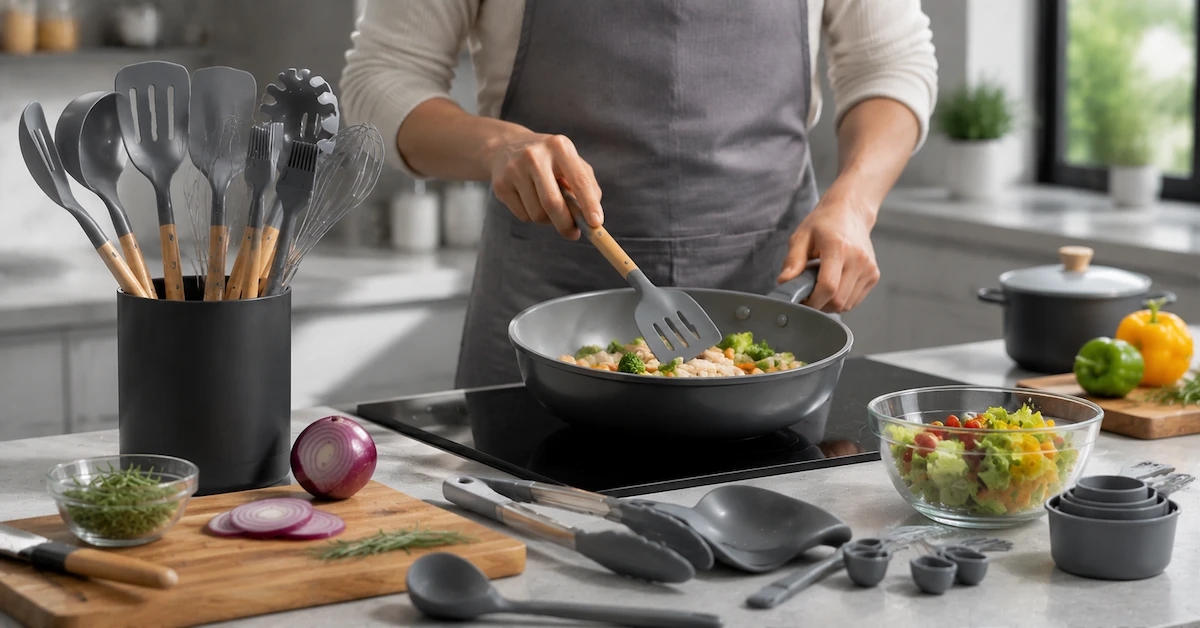
The original product image shows a coordinated utensil collection with matte gray working ends, light wood-look handles, metal whisk elements, and a black countertop holder. That format is familiar in retail and online marketplaces, which makes it a useful example for sourcing decisions. Buyers should look beyond the number of pieces and evaluate how the set is built, how it will be used, and how it can support private-label or wholesale positioning.
Key Takeaways
- A coordinated utensil set should be judged by use coverage, construction, presentation, and branding potential.
- Soft-looking heads, wood-look handles, wire whisks, and holders may involve different materials and production steps.
- Retail, private-label, hospitality, and promotional channels often need different assortment and packaging choices.
- Buyers should ask suppliers clear questions about customization limits, material composition, samples, packaging, and quality checks.
Why Custom-Made Kitchen Tools Matter in Wholesale Sourcing
Kitchen tools are everyday products, but that does not make them easy to source well. A consumer may compare several utensil sets in seconds, whether on a store shelf or a product listing page. Color, shape, handle finish, holder design, and visible tool variety all influence the first impression. At the same time, the product must perform in real kitchens: stirring sauces, turning food, serving, whisking, and mixing without feeling awkward or fragile.
For B2B buyers, the challenge is to balance appearance with repeatable production. A set may include molded heads, metal-wire components, handles, and a storage container. Each part affects cost, quality control, packaging, and after-sale satisfaction. Customization should therefore begin with a product brief, not only a design request. Define the sales channel, target customer, desired number of pieces, packaging style, and which elements truly need customization.
What Buyers Are Actually Selecting
A utensil set is a product family rather than a single item. The pictured format includes several cooking and serving tools plus a countertop holder. The visual value comes from coordination: gray working ends, similar handles, and a compact black container. The commercial value comes from whether that coordination supports the intended sales story.
When evaluating wholesale kitchen tools, buyers should separate the decision into four layers: the tool assortment, the material and finish choices, the handle and joint construction, and the packaging or display method. A ten-piece set may look more valuable than a six-piece set, but only if the pieces are useful and not repetitive. A holder can improve countertop display, but it should be stable, appropriately sized, and consistent with the rest of the design.
Comparison Checklist for a Sellable Utensil Set
| Decision area | What to check | Why it matters |
|---|---|---|
| Assortment | Spatula, spoon, ladle, turner, whisk, tongs, and other daily-use tools | Improves perceived usefulness and reduces duplicate pieces |
| Working ends | Actual material, stiffness, edge shape, and intended cookware compatibility | Affects performance, cleaning, and customer satisfaction |
| Handles | Real material, coating, wood-look finish, grip comfort, and joint strength | Influences appearance, durability, and care instructions |
| Holder | Size, weight, finish, stability, and whether it is included as standard | Supports retail display and countertop storage |
| Branding | Logo placement, color options, box design, insert card, and labeling area | Helps private-label and promotional programs feel intentional |
| Supplier response | Sample process, customization limits, lead time questions, and quality checks | Reduces sourcing risk before committing to an order |
Material and Construction Points to Confirm
The gray heads in the image appear to be a soft or coated working surface, but buyers should not assume the exact material without supplier confirmation. Ask what the head material is, whether it is molded or coated, how it performs under normal cooking conditions, and what care instructions should be communicated to the end user. If the product is intended for nonstick cookware, request clear information on compatibility and avoid making claims that have not been supported by the supplier.
The light handles have a wood-look appearance. That could indicate several possibilities, including real wood, bamboo, a printed finish, or a synthetic handle with a wood-style surface. Each option has different implications for moisture exposure, cleaning, color consistency, cost, and production repeatability. Buyers should ask for physical samples and review handle-to-head joints carefully, because weak connections can affect the whole set’s reputation.
Wire whisks add another layer. Unlike molded spoons or spatulas, whisks require wire forming and secure attachment to the handle. Check whether the wire shape is consistent across samples, whether the handle connection feels stable, and whether the finish visually matches the rest of the set.
Choosing a Set for Different Sales Channels
Retail buyers usually need fast visual communication. A coordinated set with a holder can work well because shoppers immediately understand what is included and how it will sit on a countertop. For this channel, compact packaging, clean front-facing presentation, and clear tool visibility may matter as much as the exact piece count.
Private-label brands often need the set to fit a broader product range. If a brand already uses muted colors, natural accents, or matte finishes, a gray-and-wood-look utensil collection may fit the visual system. However, the sourcing team should decide which custom elements are essential. Full handle redesign, exclusive colors, custom packaging, and logo placement can all affect tooling, sampling, cost, and timing. Ask an OEM kitchen tools supplier what can be changed using existing components and what requires new development.
Hospitality and promotional buyers may prioritize reliable utility and clear branding over complex customization. A simple, neatly finished set with consistent packaging can be more practical than an ambitious design that creates production uncertainty. For gift programs, the holder and packaging should work together so the set feels organized when opened.
Common Sourcing Mistakes to Avoid
- Choosing by piece count only. More tools do not always mean better value. Avoid filler pieces that do not support everyday cooking.
- Assuming materials from appearance. Confirm the actual head, handle, wire, and holder materials before writing product copy or packaging claims.
- Ignoring cleaning and care. Seams, joints, and textured surfaces should be reviewed for practical daily use.
- Reviewing only one sample item. Request a full set sample because mixed-material assortments can reveal inconsistencies between pieces.
- Over-customizing too early. Start with core function and channel fit, then decide which custom details justify added complexity.
Questions to Ask a Supplier Before Ordering
Before placing an order for private label utensils or wholesale custom kitchen tools, prepare specific questions. Ask which parts of the set can be customized, including head color, handle finish, holder style, logo placement, and packaging. Ask whether the holder is included in the standard set or treated as a separate accessory. Request clarification on material composition for each component and ask what care instructions are appropriate.
It is also wise to ask about the sample process, color matching method, packaging options, inspection steps, and how the supplier handles mixed components such as molded utensils and wire whisks. Do not assume minimum order quantities, certifications, production capacity, or test results unless the supplier provides documented details. If your market requires specific compliance documentation, ask the supplier what reports are available and verify them through your normal review process.
Practical FAQ
Are custom-made kitchen tools mainly for nonstick cookware?
They are often positioned for cookware-friendly daily use when soft working ends are involved, but exact compatibility depends on the confirmed material and construction.
Is a holder worth including in a wholesale set?
Often, yes. A holder can improve countertop storage and retail presentation, but buyers should check stability, size, finish quality, and packaging impact.
What is the best first customization step?
For many buyers, color coordination and packaging are lower-risk starting points than changing tool shapes. Confirm this with the supplier because every project is different.
Should a buyer order a full set sample?
Yes. A single spatula sample cannot show whether the whisk, tongs, holder, handles, and finishes are consistent across the complete assortment.
What should not be claimed in product copy?
Do not claim a material grade, heat resistance, food-contact compliance, dishwasher suitability, or nonstick safety unless the supplier provides reliable documentation for that exact product.
Final Sourcing Guidance
A sellable utensil set starts with a clear use case. Decide whether the product is meant for retail display, private-label range building, gifting, hospitality, or promotional use. Then choose the assortment, materials, finishes, holder, and packaging to support that channel. The coordinated set shown in the image demonstrates why visual consistency matters, but sourcing success depends on details that are less visible: joints, material confirmation, sample review, cleaning practicality, and supplier communication.
For buyers comparing custom-made kitchen tools, the strongest approach is simple: define the commercial goal, request complete samples, ask direct technical and packaging questions, and avoid unsupported claims. That process helps turn a familiar utensil format into a product that customers can understand, use, and keep in the kitchen.
