




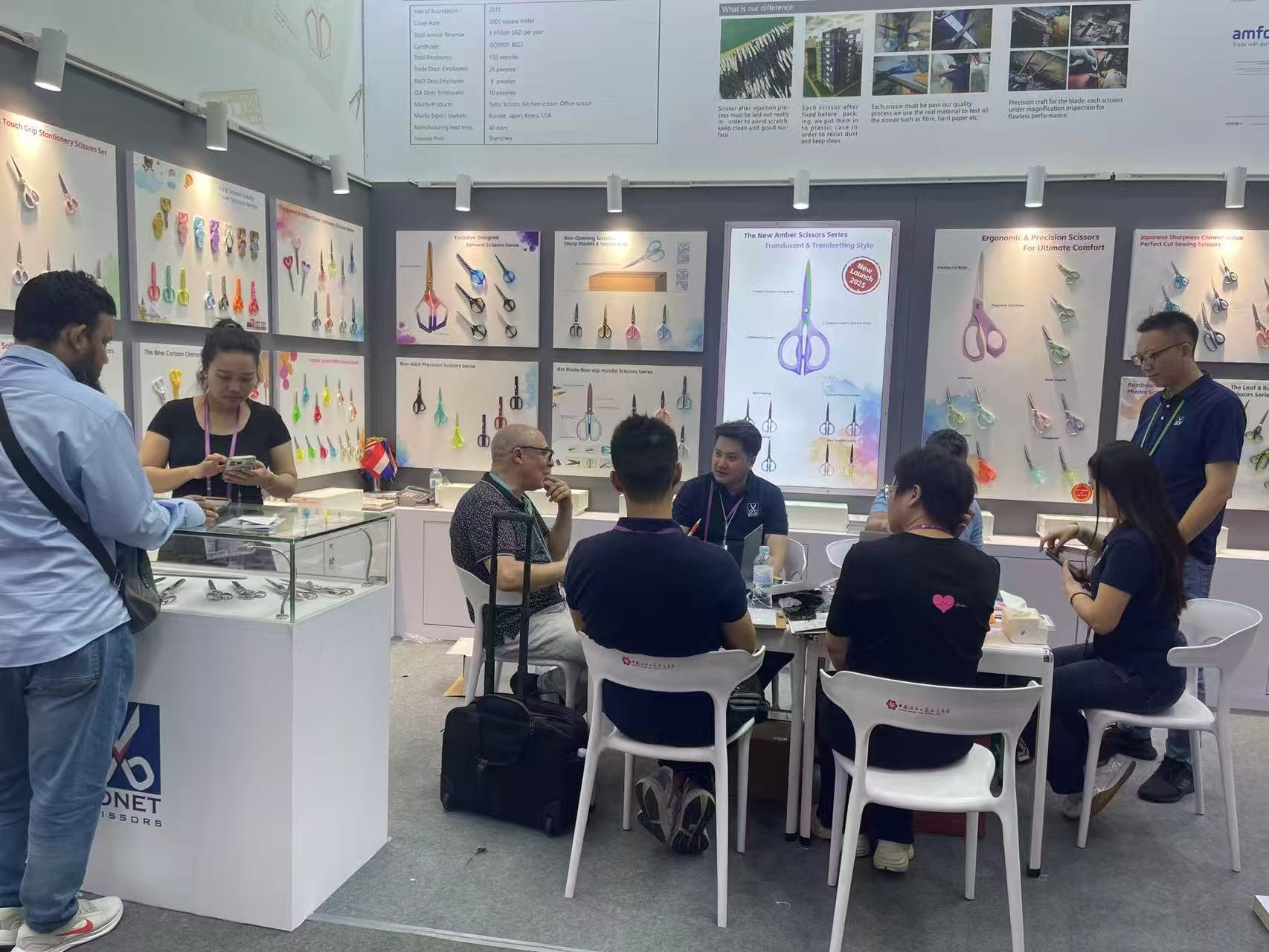
Discover Bonet Scissors in the Canton Fair Stationery Section
The Canton Fair stationery section is a useful stop for importers, wholesalers, office supply buyers, craft retailers, and private-label sourcing teams looking for everyday cutting tools. Scissors may look simple, but for B2B buyers they involve many practical decisions: blade sharpness, handle comfort, packaging, assortment planning, safety, consistency, and after-sales communication. Bonet scissors are presented in this context as stationery and daily-use cutting tools for professional, hobby, and household users. If you are visiting the fair or reviewing suppliers after the show, the goal should not be to choose the most eye-catching sample only. The better approach is to compare performance, confirm commercial details, and understand whether the supplier can support your market requirements.
Why Scissors Deserve Careful Sourcing
Scissors are a repeat-purchase product in many channels, including school stationery, office supplies, craft stores, household goods, and promotional assortments. Because they are handled often, small quality issues become noticeable quickly. A stiff pivot, uncomfortable grip, misaligned blade, or weak retail pack can lead to returns and poor customer feedback. At a trade fair, many products may appear similar from a distance, so hands-on checking is important.
The original Bonet article highlights practical use, precision, handle design, color options, and suitability for everyday users, professionals, and hobbyists. Buyers can use those themes as a starting point, then verify the details directly with the supplier. Ask what models are intended for office work, craft cutting, embroidery, kitchen-adjacent household use, or heavier materials. Avoid assuming that one scissor design fits every market segment.
What to Check at the Canton Fair Booth
When evaluating Bonet scissors or any scissors supplier at the Canton Fair stationery section, bring a simple checklist. Test several samples from the display rather than one selected piece. Open and close the scissors repeatedly, cut different paper weights, and check whether the blades meet cleanly from base to tip. If the supplier presents models with textured grips, non-slip handles, or ergonomic shapes, handle them long enough to judge comfort, not just appearance.
- Check cutting performance on thin paper, card, thread, and packaging material if samples are available.
- Inspect blade alignment, tip finish, pivot smoothness, and overall balance.
- Compare handle sizes for adults, students, left-handed users, or craft applications where relevant.
- Ask which colors, packaging formats, and assortments are currently available.
- Request written confirmation of materials, dimensions, and product claims before placing an order.
Product Range and Use Cases
The original article describes a range of Bonet scissors for different cutting needs, from precision tasks such as embroidery to heavier materials. For sourcing, translate that broad product range into clear SKUs. A buyer for a school stationery distributor may need blunt-tip or student-friendly designs, while a craft retailer may prefer pointed precision scissors, decorative colors, or smaller sizes. Office supply buyers often prioritize durable daily-use models with comfortable handles and consistent packaging.
Do not rely on category names alone. Terms such as “heavy duty,” “precision,” or “professional” can vary between suppliers and markets. Ask for sample sets and product data sheets that state size, intended use, material description, handle construction, packaging dimensions, carton quantity, and recommended care. If a product claim matters to your sales channel, make it part of your supplier questionnaire.
Comparison Checklist for Buyers
The table below can help structure conversations at the fair and during follow-up. It is not a substitute for testing, but it keeps the sourcing process focused.
| Evaluation Point | What to Look For | Questions to Ask the Supplier |
|---|---|---|
| Cutting performance | Clean cut, no tearing, smooth action from base to tip | Which materials was this model designed to cut? |
| Handle comfort | Grip shape, finger space, texture, stability during use | Are different handle sizes or colors available? |
| Blade and pivot | Alignment, tension, tip finish, easy opening and closing | How is consistency checked before shipment? |
| Packaging | Retail display suitability, barcode space, protection in transit | Can packaging be customized for wholesale or OEM orders? |
| Commercial terms | Clear SKU list, sample process, lead time, carton details | What are the MOQ, payment terms, and delivery options? |
| Compliance needs | Documentation appropriate to your destination market | Which test reports or declarations can be provided if required? |
OEM, Wholesale, and Private-Label Questions
If your interest is OEM or wholesale sourcing, prepare questions before the Canton Fair meeting. The original article mentions style, color variety, and practical design, which can be relevant for private-label assortments. However, buyers should confirm what customization is actually available. Do not assume logo printing, exclusive colors, custom handles, or special packaging are included unless the supplier confirms them in writing.
- Ask for the current product catalog and identify which models are regular stock and which require customization.
- Confirm the minimum order quantity for each model, color, and packaging type.
- Request sample costs, sample lead time, and whether pre-production samples are provided.
- Clarify carton packing, gross weight, shipping marks, and pallet requirements if applicable.
- Ask how quality issues are handled after delivery and what documentation is required for a claim.
For importers selling into regulated channels, also ask what compliance documents are available for your destination market. Avoid broad assumptions about certifications or approvals. If a test report is essential, request the report number, issuing laboratory, product scope, and validity information before confirming the order.
Balancing Design and Practical Performance
The original Bonet article emphasizes visual appeal, including colors ranging from simple monochrome looks to brighter shades. Attractive scissors can support retail shelf appeal, especially in stationery, craft, and household categories. Still, design should support use rather than distract from it. A colorful handle is valuable only if the scissor cuts well, feels stable, and matches the customer’s expected application.
When building an assortment, consider a good-better-best structure. Entry-level scissors may suit school or promotional channels. Mid-range models can serve office and household users. More specialized scissors may fit craft, embroidery, or hobby categories. Ask the supplier to explain the differences between models so your sales team can communicate them accurately.
Key Takeaways
- The Canton Fair stationery section is a practical place to compare scissors samples side by side.
- Evaluate Bonet scissors by cutting performance, grip comfort, packaging, and supplier communication.
- For OEM or wholesale orders, confirm MOQ, customization options, lead time, and documentation in writing.
- Do not rely on broad claims; ask for product data, samples, and market-specific compliance documents when needed.
Practical FAQ
What should I test first when viewing scissors at the Canton Fair?
Start with cutting performance and blade alignment. Cut thin paper, thicker paper, and any material relevant to your sales channel. Then check handle comfort and pivot smoothness.
Are Bonet scissors suitable for office, craft, and household assortments?
The original article positions Bonet scissors for professionals, hobbyists, and everyday users. Buyers should still match each model to a specific use case and verify the intended application with the supplier.
Can I request private-label packaging?
Possibly, but it must be confirmed with the supplier. Ask about packaging formats, artwork requirements, MOQ, sample approval, barcode placement, and carton packing before assuming private-label support.
What commercial details should buyers confirm after the fair?
Confirm the final SKU list, unit specifications, sample approval process, MOQ, lead time, payment terms, shipping terms, packaging details, and quality claim procedure.
How can I avoid over-ordering the wrong scissors model?
Order and test samples, compare several models, collect feedback from your sales or category team, and start with an assortment that reflects real customer needs rather than choosing only by appearance.
