




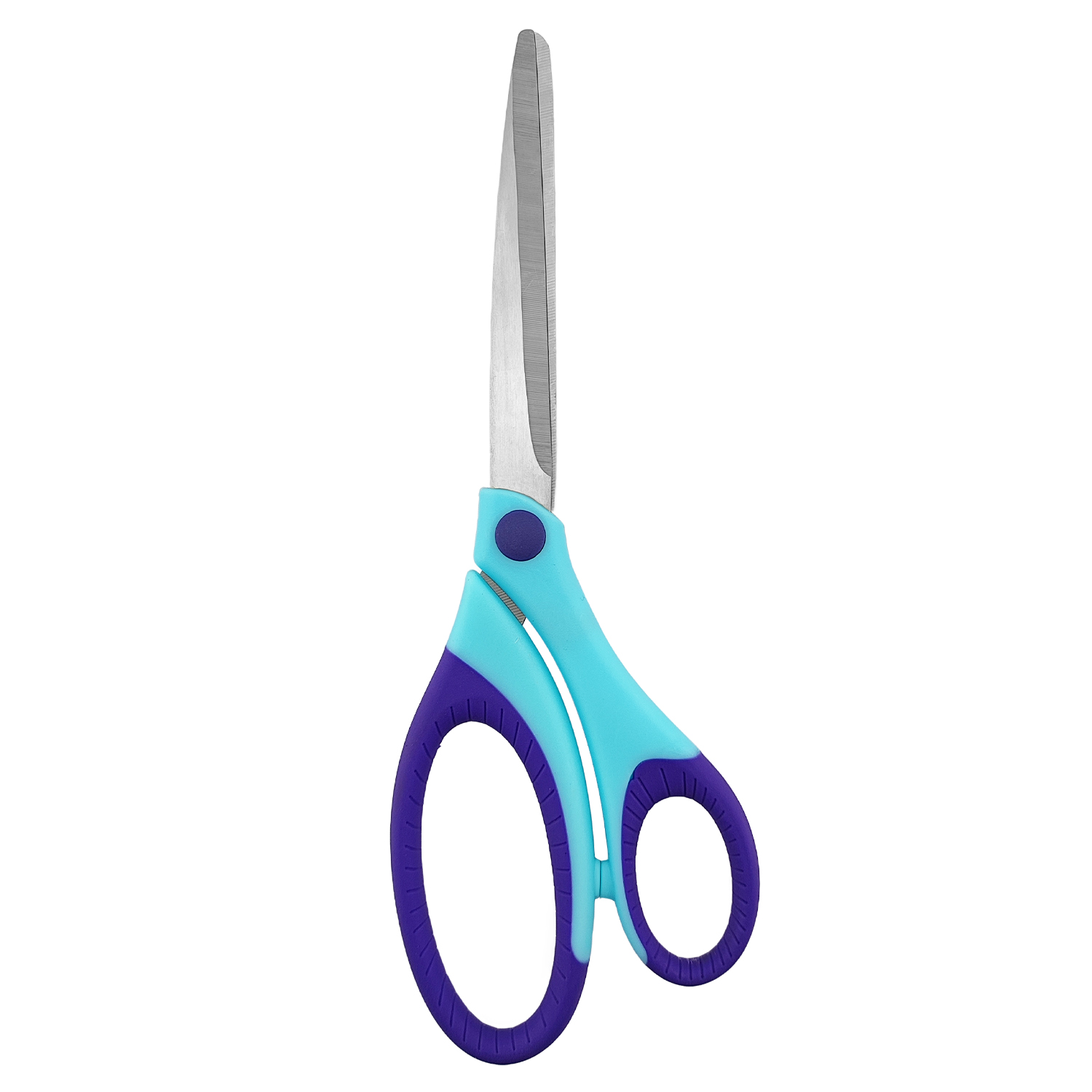
OEM Soft Grip Scissors: A Practical Sourcing Guide
OEM soft grip scissors are a common choice for household, office, school, craft, and promotional product lines because they combine everyday cutting utility with a handle design that can be adapted for different users and retail positions. For buyers, the important question is not only whether the scissors look comfortable, but whether the supplier can consistently deliver the right cutting feel, safe packaging, brand presentation, and quality control for the intended market.
The original product information highlights soft grip handles, ergonomic design, stainless steel blades, and bright turquoise and purple styling. Those details make the product suitable for general home use such as trimming paper, light craft work, and fabric-related tasks where appropriate. However, B2B sourcing decisions should go beyond a short description. Importers, wholesalers, and private-label buyers should confirm materials, dimensions, performance expectations, packaging, compliance needs, and after-sales responsibilities before placing an OEM order.

Key Takeaways
- Soft grip scissors are best evaluated by comfort, cutting feel, blade alignment, and repeatable quality, not appearance alone.
- For OEM projects, buyers should ask which handle colors, logos, packaging formats, and carton requirements can be customized.
- Stainless steel blades are mentioned in the source, but buyers should still request the exact grade, hardness range, and corrosion expectations.
- Samples should be tested with realistic materials such as paper, packaging film, thread, light fabric, or craft sheets based on the target user.
- Commercial details such as MOQ, lead time, certification, and inspection standards should be confirmed directly with the supplier.
What Makes Soft Grip Scissors Different?
Soft grip scissors are designed with a cushioned handle surface that helps reduce pressure on the fingers during repeated cutting. This is especially relevant for home users, office staff, craft hobbyists, teachers, and packing teams who may use scissors for longer sessions. The benefit is not that every user will cut faster, but that the handle can feel more stable and less harsh than a rigid plastic grip.
Ergonomic scissors design usually involves more than soft material. Buyers should look at finger hole size, thumb position, handle contour, balance between blade and handle, and whether the scissors suit right-handed or ambidextrous use. If the product will be sold to families, schools, or general retailers, comfort across different hand sizes becomes a practical selling point.
How to Evaluate Blade Performance
The original article mentions stainless steel blades, which is a useful baseline for household scissors. Still, stainless steel can vary widely, so sourcing teams should ask for the exact material grade, heat treatment process if applicable, blade thickness, edge angle, and expected corrosion resistance. Avoid assuming premium specifications unless the supplier provides documented confirmation.
In sample testing, evaluate whether the scissors open smoothly, close without blade crossing issues, and cut cleanly from the base of the blade to the tip. Test on the materials your customers will actually use. For general household scissors, paper, envelopes, thin cardboard, ribbon, yarn, and light packaging materials are realistic. If the product is promoted for fabric, test fabric specifically and confirm that the supplier agrees with that use case.
OEM Customization Points to Confirm
OEM soft grip scissors can often be tailored for different brands, but every customization should be verified before quotation. The source notes turquoise and purple colors, which may be useful for a bright consumer-facing range. Buyers should ask whether other handle colors are available, whether color matching can follow a Pantone reference, and whether there are additional costs for custom colors.
Logo placement is another key detail. Some scissors can support printing, pad printing, laser marking, or branded packaging rather than direct logo application. The best option depends on handle material, brand requirements, and durability expectations. Packaging should also match the channel: hanging card for retail display, blister card for visibility, color box for gifting, or bulk pack for institutional buyers.
Comparison Checklist for Buyers
| Item to Check | Why It Matters | Questions to Ask the Supplier |
|---|---|---|
| Handle comfort | Affects user fatigue and repeat purchases | What material is used for the soft grip, and can samples be tested in different hand sizes? |
| Blade material | Influences sharpness, durability, and corrosion resistance | What stainless steel grade is used, and can the specification be provided in writing? |
| Cutting consistency | Reduces complaints from end users | What in-process and final inspections are performed for blade alignment and sharpness? |
| OEM branding | Supports private-label retail programs | Which logo methods, color options, and packaging formats are available? |
| Compliance needs | Depends on market, age group, and sales channel | Which tests or documents can be supplied for the destination market if required? |
| Commercial terms | Controls project feasibility | What are the MOQ, sample cost, lead time, payment terms, and carton details? |
Quality Control Before Bulk Orders
Before approving production, request pre-production samples that match the final material, handle color, blade finish, logo, and packaging. It is common for early samples to look acceptable while final goods vary in color, sharpness, or assembly tightness. A clear sample approval process helps prevent misunderstandings.
For inspection, define practical criteria. Check handle surface defects, color consistency, logo placement, blade scratches, pivot tightness, opening and closing smoothness, tip alignment, packaging damage, and barcode accuracy if retail packaging is used. If the scissors will be sold through major retailers or online marketplaces, ask what documentation the supplier can provide and whether third-party inspection is supported.
Best-Fit Uses and Product Positioning
OEM soft grip scissors are well suited for product lines where comfort and visual appeal matter. They can fit household tool sets, office supply ranges, school supply assortments, craft kits, sewing accessory bundles, promotional gifts, and private-label homeware collections. The bright turquoise and purple appearance mentioned in the source can help the product stand out, but buyers should still align color choice with the target customer and brand identity.
For premium positioning, focus on smoother operation, better packaging, tighter quality checks, and clear usage guidance. For value positioning, prioritize reliable basic cutting, consistent assembly, and efficient packaging. In both cases, avoid overclaiming. If the scissors are intended only for general household use, do not market them as professional tailoring shears unless the supplier confirms performance and specifications for that use.
Supplier Questions for OEM Scissors Projects
- What exact blade material and handle materials are used in the quoted model?
- Can the supplier provide physical samples that match the final OEM design?
- Which handle colors, logo methods, and packaging structures are available?
- What are the MOQ, production lead time, sample lead time, and carton packing details?
- What quality checks are performed for sharpness, blade alignment, surface finish, and packaging?
- Can the supplier support the documents or testing required by the buyer's destination market?
Use and Care Guidance for End Customers
Clear use instructions can reduce returns and improve customer satisfaction. Recommend that users keep household scissors dry after cleaning, avoid cutting hard wire or materials beyond the intended use, and store the scissors safely away from children. If the scissors are packaged for craft or office users, include simple guidance on suitable materials and safe handling.
Buyers should also consider whether the final package needs warnings, age guidance, or market-specific labeling. These requirements vary by destination and sales channel, so they should be confirmed before artwork approval rather than after production.
FAQ
Are OEM soft grip scissors suitable for private-label brands?
Yes, they can be a practical private-label product when the supplier supports branding, packaging, color options, and consistent quality control. Buyers should confirm all customization details before ordering.
What should I test before approving a scissors sample?
Test handle comfort, opening smoothness, blade alignment, cutting performance, logo durability, packaging strength, and consistency across multiple samples rather than relying on one piece.
Can stainless steel blades be assumed to be rust-proof?
No. Stainless steel offers corrosion resistance, but performance depends on the grade, finish, storage conditions, and use environment. Ask the supplier for the exact specification and care guidance.
What packaging works best for retail scissors?
Hanging cards and blister packs are common for retail visibility, while color boxes may suit gift or set-based programs. Bulk packaging may be better for institutional or wholesale distribution.
What commercial details should buyers request?
Ask for MOQ, sample policy, lead time, payment terms, carton size, gross weight, inspection options, available documents, and responsibilities if defects are found after delivery.
