




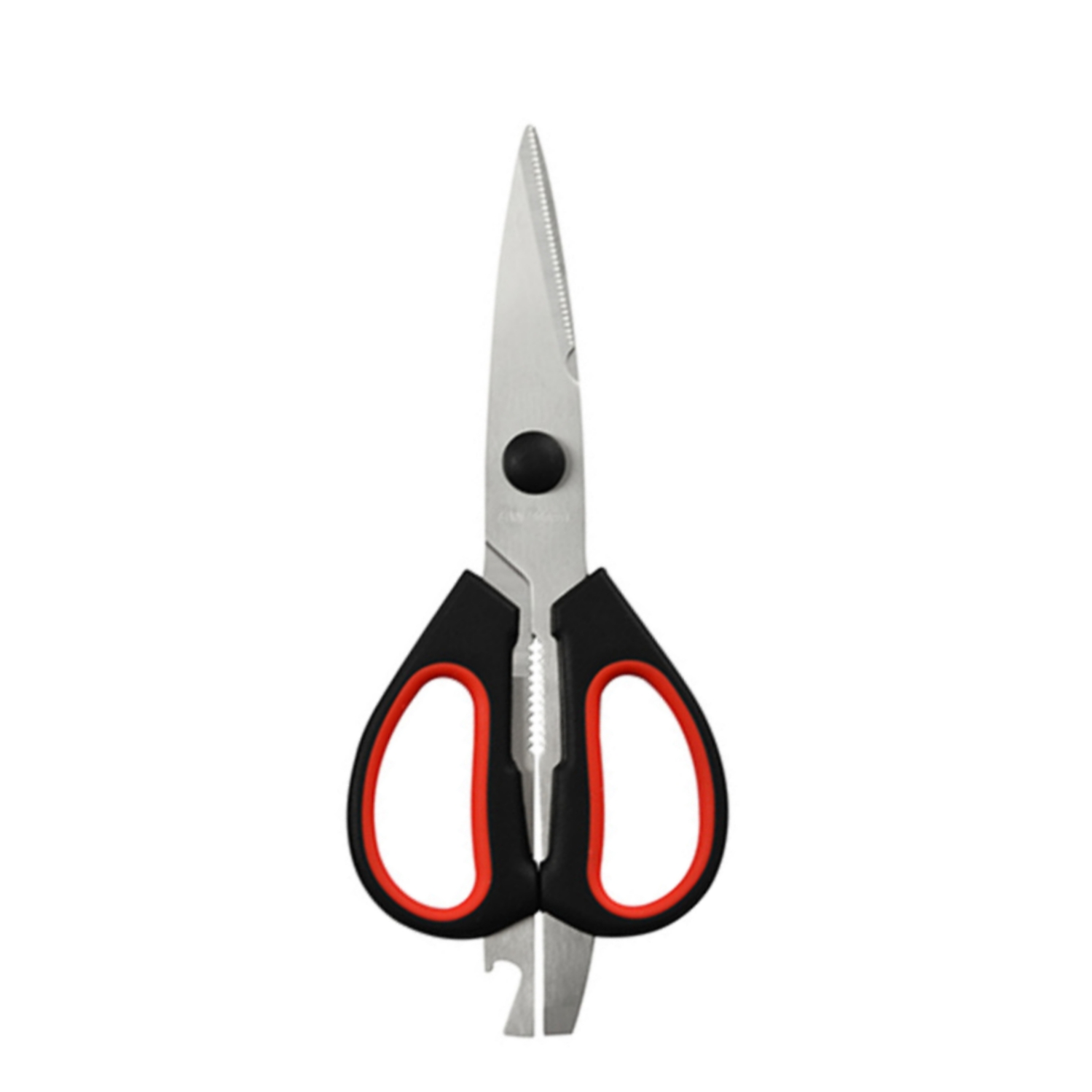
Discover Versatile OEM Kitchen Shears for Every Kitchen
OEM kitchen shears are a practical product category for brands, importers, distributors, and kitchenware retailers that want to add a compact, frequently used cutting tool to their range. Unlike a general pair of household scissors, kitchen shears are expected to handle food preparation, packaging, herbs, poultry trimming, and small utility tasks around the kitchen. For B2B buyers, the real question is not only whether the shears look appealing, but whether the supplier can consistently deliver the requested design, finish, packaging, and quality level.
The original product example highlights several useful features: stainless steel blades with micro-serrations, a soft-grip handle, a black and red dual-tone design, separable blades for cleaning, and handle functions that can work as a bottle opener and nutcracker. These details make the product a good reference point for discussing how to evaluate OEM kitchen shears before placing an order.
Key Takeaways
- OEM kitchen shears should be evaluated for cutting performance, cleaning convenience, handle comfort, and packaging suitability.
- Useful features may include micro-serrated blades, separable construction, soft-grip handles, and built-in opener or nutcracker functions.
- B2B buyers should confirm materials, dimensions, finish, testing, MOQ, lead time, and branding options directly with the supplier.
- Pre-production samples and clear inspection criteria help reduce quality disputes before bulk production.
Why OEM Kitchen Shears Are a Strong Product Category
Kitchen shears are used by both home cooks and commercial food preparation teams because they are fast, direct, and easy to control. They can cut herbs, trim meat, open food packaging, portion vegetables, and perform small preparation tasks that may feel awkward with a knife. For retail buyers, this makes them suitable for kitchenware sets, seasonal promotions, private-label programs, and replacement tool ranges.
From an OEM perspective, kitchen shears also offer room for customization. A buyer may request a particular handle color, retail card, gift box, logo placement, or combination of functions. However, customization should be handled carefully. A visually attractive design is not enough if the hinge feels loose, the blades do not align, or the handle is uncomfortable during repeated cutting.
Product Features to Evaluate Before Sourcing
The product described in the source includes stainless steel blades with micro-serrations. Micro-serrations can help the blade grip food surfaces and packaging during cutting, which is especially useful when working with slippery ingredients. Buyers should ask whether the serration pattern, blade thickness, hardness, and edge finishing can be confirmed in a technical sheet or sample review.
The source also mentions a soft-grip coating and a black and red dual-tone design. For retail products, handle feel and color are important because customers notice them immediately. For B2B buyers, the key is to confirm whether the handle material, color matching method, and surface texture will remain consistent across production batches. If the handle includes extra functions such as a bottle opener or nutcracker, buyers should check whether those functions are comfortable to use and do not interfere with normal cutting.
Comparison Checklist for OEM Kitchen Shears
| Evaluation Area | What to Check | Questions to Ask the Supplier |
|---|---|---|
| Blade design | Sharpness, alignment, micro-serrations, tip shape | What blade material and edge process are used, and can samples be reviewed? |
| Handle comfort | Grip shape, soft coating, opening width, hand fatigue | Can the handle color, texture, or logo position be customized? |
| Cleaning | Separable blades, food residue areas, hinge access | How should users separate, clean, dry, and reassemble the shears? |
| Multi-function use | Bottle opener, nutcracker, packaging cutting | Which functions are included in the standard model and which require tooling changes? |
| Retail readiness | Packaging, barcode area, instructions, warning text | What packaging formats are available and what artwork files are required? |
| Quality control | Cutting test, hinge tightness, surface defects | What inspection criteria will be used before shipment? |
Custom Kitchen Shears Manufacturing: What Buyers Should Clarify
Custom kitchen shears manufacturing can involve more than changing the logo. Depending on the supplier’s capabilities, customization may include handle color, blade finish, packaging, retail presentation, and accessory instructions. Buyers should avoid assuming that every design change is simple. Even a minor change to handle material or blade geometry can affect balance, grip, and production cost.
Before confirming an OEM order, prepare a short specification document. It should describe the target user, intended retail channel, desired functions, preferred color, packaging format, logo method, and any market requirements the buyer must meet. If the destination market has product safety, food-contact, labeling, or packaging rules, ask the supplier what documentation can be provided, but do not rely on verbal assurances. Confirm details in writing.
Factory and Supplier Questions for B2B Buyers
A kitchen scissors factory should be assessed on communication, sampling discipline, production consistency, and willingness to define quality standards. Buyers should ask practical questions early, especially if the order involves private label packaging or a new configuration.
- What standard kitchen shears models are available for OEM branding?
- Which features are already available: separable blades, micro-serrations, soft-grip handles, opener, or nutcracker?
- What parts can be customized without new tooling?
- What is the sample lead time, and is a pre-production sample available before mass production?
- What are the MOQ, production lead time, payment terms, and packing options?
- What quality checks are performed for blade sharpness, hinge stability, surface finish, and packaging?
- Can the supplier provide artwork templates for retail packaging?
- How are defective items handled if issues are found during inspection?
These questions help buyers compare suppliers fairly. The lowest quote is not always the best option if it does not include clear specifications, stable packaging quality, or reliable communication.
Use, Cleaning, and Care Guidance to Include with the Product
Good instructions can reduce customer complaints. Because the referenced product has separable blades, the packaging or insert should explain how to separate and reassemble them safely. Users should be advised to wash the blades after food contact, dry them thoroughly, and store them away from children. If the shears are used for raw poultry or meat, cleaning immediately after use is especially important to reduce residue buildup.
Care guidance should also be realistic. Kitchen shears may be durable, but they are still cutting tools. Users should avoid cutting hard materials not intended for kitchen use unless the supplier confirms that the product is designed for that purpose. Buyers should ask whether dishwasher use is recommended or whether hand washing is preferred for the handle coating and blade finish.
How to Inspect Samples Before Bulk Orders
Sample approval should not be based only on appearance. Test the shears with the same tasks your customers are likely to perform: cutting herbs, trimming meat, opening food packaging, and using the handle functions if included. Check whether the blades meet cleanly from pivot to tip, whether the hinge feels secure, and whether the grip remains comfortable after repeated cuts.
For private-label projects, also review the packaging sample. Confirm color accuracy, logo placement, barcode readability, instruction wording, carton strength, and any required labels. If the final product will be sold online, request product dimensions, package dimensions, and net/gross weight from the supplier rather than estimating them.
FAQ
What makes OEM kitchen shears different from regular scissors?
OEM kitchen shears are produced for a buyer’s brand or specification and are designed for kitchen tasks such as food preparation and packaging. They may include features such as micro-serrated blades, separable construction, or built-in handle functions.
Can kitchen shears be customized for private label sales?
In many OEM programs, buyers can request branding, packaging, color choices, or selected design adjustments. The exact options depend on the supplier, existing tooling, order quantity, and production process.
Are separable blades useful?
Separable blades can make cleaning easier because food residue is less likely to remain around the hinge area. Buyers should confirm the separation method and include clear user instructions.
What should buyers confirm before placing an OEM order?
Confirm material details, blade design, handle material, dimensions, packaging, logo method, sample approval process, MOQ, lead time, inspection standards, and any documentation required for the target market.
How should buyers compare kitchen scissors factories?
Compare sample quality, communication speed, customization options, packaging support, quality control process, and clarity of commercial terms. A reliable supplier should answer technical and production questions in writing.
