




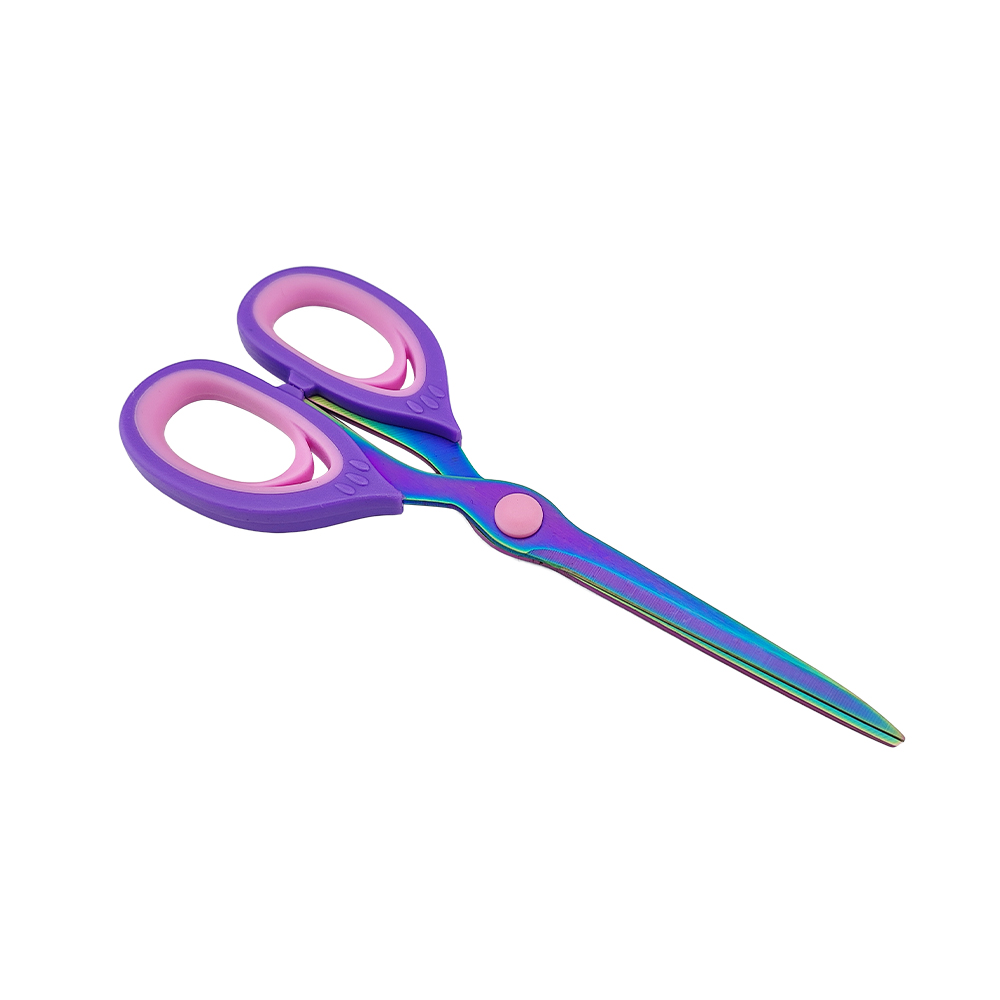
Experience Precision with Titanium Coating Scissors
Titanium coating scissors are often chosen for more than their colorful surface. The rainbow-like finish can give a pair of household or office scissors a distinctive look, while the coating is commonly associated with added surface protection on the blades. For buyers, craft users, stationery brands, and sourcing teams, the real question is not only whether the scissors look appealing, but whether they cut reliably, feel comfortable, and can be specified clearly for the intended market.

The original article highlighted an iridescent green and teal blade finish, a two-tone handle with a pink inner grip and purple outer shell, and use across crafting, sewing, office work, fabric, and cardstock. This updated guide keeps those useful points while giving a clearer framework for product selection, OEM discussion, and everyday care.
Key Takeaways
- Titanium coating scissors should be evaluated by cutting performance, handle comfort, blade alignment, and finish consistency, not appearance alone.
- For OEM office scissors or wholesale programs, confirm materials, coating process, packaging, quality checks, and compliance expectations before ordering.
- Ergonomic handles matter for repeated cutting tasks such as crafting, sewing, school projects, and office use.
- Careful cleaning, dry storage, and appropriate material use can help preserve the edge and surface finish.
What Titanium Coating Scissors Are Used For
Titanium coating scissors are general-purpose cutting tools with a coated blade surface. In consumer settings, they are commonly considered for home offices, craft rooms, classrooms, sewing kits, and stationery drawers. In B2B settings, they may be part of a private-label stationery line, an office supply range, a gift set, or a household tools collection.
The appeal is practical and visual. A bright iridescent finish helps the product stand out on a retail shelf or in an online listing. At the same time, buyers still need to confirm whether the blades are sharp enough for the target tasks. Cutting paper is different from cutting fabric, thick cardstock, packaging tape, ribbon, or laminated material. A sourcing brief should define the main use case before discussing handle colors or packaging design.
Blade Finish, Sharpness, and Cutting Feel
A titanium-style coating can create a polished, colorful surface, but the finish alone does not guarantee cutting quality. Cutting performance depends on the blade material, blade thickness, edge grinding, pivot tension, alignment, and final inspection. If the original sample is described as having stainless steel blades, buyers should still ask the supplier to confirm the exact material used for the production version rather than assuming every batch is identical.
When testing samples, cut several materials that match the intended use. For office scissors, test standard copy paper, envelopes, thin card, and packaging film. For craft or sewing use, test thread, ribbon, fabric scraps, and cardstock. The cut should feel controlled and smooth, with no chewing, slipping, or blade separation near the tip. Also check whether the coating remains even around the edges and pivot area after normal trial use.
Handle Design and Ergonomics
The original product description mentions a soft pink inner grip inside a purple outer handle. This kind of two-tone design can be useful because it separates the structural handle from the contact surface. A softer inner grip may improve comfort for longer sessions, especially when users are preparing craft projects, cutting classroom materials, or handling repetitive office tasks.
Comfort should be tested by more than one person. Finger openings that feel comfortable to one user may feel tight or loose to another. If a product is promoted for broad household or office use, buyers should check grip size, handle symmetry, and whether the scissors are intended for right-handed use, left-handed use, or ambidextrous use. The original article states that the scissors provide a smooth experience for right- or left-handed users, but for a sourcing order this should be verified with actual samples and supplier confirmation.
Comparison Checklist for Buyers
| Selection Point | What to Check | Questions to Ask a Supplier |
|---|---|---|
| Blade performance | Clean cutting on target materials without snagging | What materials were used in sample cutting tests? |
| Coating finish | Even color, no visible peeling, smooth blade surface | How is coating consistency inspected before shipment? |
| Handle comfort | Grip shape, finger opening size, pressure points | Can handle colors, grip texture, or mold details be customized? |
| Pivot and alignment | Smooth opening, stable tension, accurate blade meeting | What quality checks are used for blade alignment? |
| Retail readiness | Packaging, barcode area, warning text, display format | What packaging options are available for OEM or wholesale orders? |
| Commercial terms | MOQ, lead time, sample policy, inspection process | What are the current order terms and production timelines? |
OEM and Wholesale Sourcing Guidance
For a brand, distributor, or importer, titanium coating scissors should be treated as a specification-driven product. Avoid relying only on photos. Ask for physical samples, a written specification sheet, and confirmation of which details can be customized. This may include handle color, blade finish, logo placement, retail packaging, carton markings, and inner pack quantity.
Do not assume certifications, test reports, production capacity, or minimum order quantities unless the supplier provides them. Instead, prepare a question list: What blade material is used? What coating process is applied? Can the supplier provide pre-production samples? What inspections are performed during production? Are there packaging templates? What market-specific labeling or safety requirements does the buyer need to provide?
If you are comparing a custom scissors manufacturer with a general household scissors supplier, request the same information from each one. Consistent documentation makes it easier to compare quotations fairly. A lower unit price may not be the best option if the handle mold, coating finish, packaging quality, or inspection process does not match your retail positioning.
How to Use and Care for Coated Scissors
For end users, proper care helps maintain both cutting feel and appearance. Use the scissors for their intended materials. A pair designed for household, office, or craft use should not be used to cut wire, heavy plastic, or abrasive materials unless the supplier specifically states that it is suitable. After cutting adhesive tape, wipe the blades clean so residue does not build up near the edge or pivot.
- Keep the blades dry after cleaning to reduce the risk of staining or surface damage.
- Store scissors closed in a drawer, pouch, or holder to protect the tips and edge.
- Do not force the blades through material that feels too thick or hard.
- Check the pivot area if cutting starts to feel loose, tight, or uneven.
- Keep scissors away from young children unless supervised and age-appropriate.
When Titanium Coating Scissors Are a Good Fit
These scissors are a strong fit when visual differentiation matters and the product still needs everyday cutting utility. They can work well for stationery collections, craft assortments, school and office supply ranges, household tool displays, and branded promotional sets. The colorful finish gives the product a more recognizable identity, while ergonomic handle options can support comfort during repeated use.
They may not be the best fit if the buying brief is purely industrial cutting, heavy-duty workshop use, or the lowest possible commodity price. In those cases, blade strength, replaceable parts, or specialized cutting geometry may matter more than coating appearance. Matching the product to the real use case is the most reliable way to avoid complaints and returns.
Practical FAQ
Are titanium coating scissors the same as titanium scissors?
Not necessarily. The phrase usually refers to scissors with a titanium-style coating on the blade surface. Buyers should ask the supplier to confirm the blade base material and coating details.
Can coated scissors cut fabric and cardstock?
The original description mentions use on delicate fabric and thick cardstock, but performance should be checked with samples. Different blade thickness, edge grinding, and pivot tension can change the result.
What should OEM buyers confirm before placing an order?
Confirm blade material, coating appearance, handle colors, logo options, packaging, inspection standards, sample approval process, MOQ, lead time, and any market-specific labeling requirements.
How do I keep the coating looking clean?
Wipe the blades after use, especially after cutting tape or adhesive materials. Store the scissors dry and avoid abrasive cleaning pads that may scratch the surface.
Are these scissors suitable for left-handed users?
The source article says the scissors provide a smooth experience for right- or left-handed users. For commercial sourcing, verify this with samples and ask whether the design is truly ambidextrous.
