




Houseware Manufacturer China: What Buyers Should Check First
Choosing a houseware manufacturer China is not only a price comparison exercise. For retail buyers, importers, sourcing teams, and private-label brands, the main question is whether a supplier can deliver a coordinated kitchen assortment that looks consistent, works in daily use, and arrives in sellable condition.
A kitchenware bundle with utensils, mixing bowls, a colander, prep cups, and a countertop holder may look simple in a product photo. In practice, it involves several materials, finishes, assembly points, and packaging decisions. A set can appear attractive online but still fail during sample review if the handles feel loose, the bowls scratch easily, or the components do not match in color and finish.
Key Takeaways
- Ask whether the products are designed as one sellable bundle or only arranged together for photography.
- Confirm the actual material of every component, including utensil heads, handles, bowls, colander, prep cups, and holder.
- Review a complete sample set, not only one utensil or one bowl.
- Check packaging early because nested houseware sets can scratch or rattle if poorly protected.
- Do not assume heat resistance, dishwasher safety, or compliance claims unless the supplier provides clear documentation.
What This Type of Houseware Set Is Meant to Solve
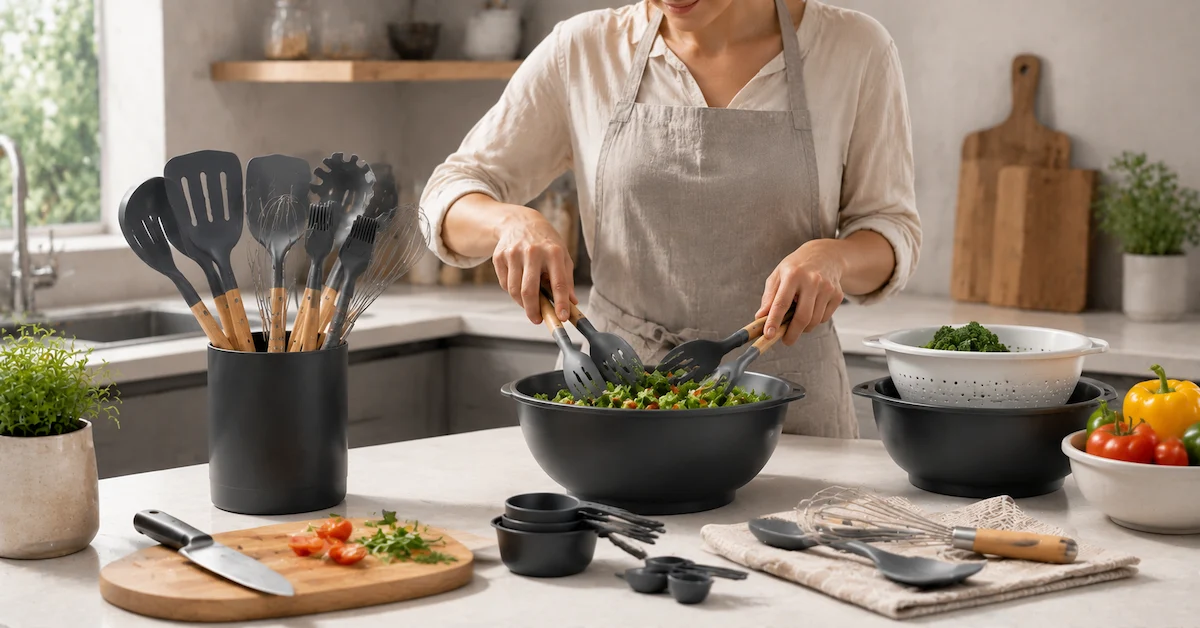
Coordinated kitchen sets are built around convenience and merchandising. Instead of sourcing each utensil, bowl, and storage piece separately, buyers can evaluate one unified assortment. The product category shown here combines cooking tools with prep and storage accessories: spatulas or turners, a whisk, serving tools, nested bowls, a perforated colander, small prep pieces, and a vertical utensil holder.
For retailers, this kind of bundle can create stronger shelf value than individual low-ticket items. For e-commerce brands, it helps tell a clearer product story: cooking, mixing, draining, organizing, and serving in one purchase. However, the bundle only works if every component supports the same quality level. One weak item can reduce customer confidence in the entire set.
Why Buyers Often Source Housewares from China
A China home goods manufacturer may be considered for this category because the supplier base is broad and can often support multi-item kitchenware assortments, decorative finishes, molded parts, mixed-material products, and private-label packaging. That does not mean every supplier is suitable for every project.
The useful sourcing question is not simply, “Can this factory make a spatula?” A better question is, “Can this supplier coordinate multiple product types into one consistent retail-ready set?” Buyers should look for evidence that the supplier understands color matching, surface finish control, assembly, nesting, packing, and carton protection across all components.
Material and Construction Questions to Ask First
The image shows dark working ends paired with lighter wood-look handles, plus matte bowls and storage pieces. From a buyer’s perspective, the exact materials should not be guessed from the photo. Utensil heads may look like silicone, nylon, coated plastic, or another material, but each option has different performance and compliance considerations. Handles may appear wood-like, but buyers should confirm the actual material, finish, and attachment method.
The bowls, colander, prep cups, and holder also require confirmation. Their base material affects weight, breakage risk, scratch resistance, stacking behavior, and packaging design. For the colander, buyers should inspect rigidity, perforation shape, drainage performance, and edge finishing. For small prep pieces, confirm whether they are functional measuring items or general accessory cups.
Before moving to a quotation, ask the supplier these questions:
- What is the material of each component in the set?
- How are the utensil heads attached to the handles?
- Are the finishes molded, coated, painted, plated, or otherwise applied?
- What cleaning and use instructions will be recommended on packaging?
- Which claims, if any, can the supplier support with documentation?
Supplier Evaluation Checklist
A practical checklist helps buyers compare factories more fairly. A low quote is not useful if it hides unclear materials, poor packing, or inconsistent samples.
| Check Area | What to Review | Why It Matters |
|---|---|---|
| Set consistency | Color, finish, shape language, and visual match across all items | A coordinated bundle must look intentional, not assembled from unrelated parts. |
| Materials | Confirmed material for utensil heads, handles, bowls, colander, cups, and holder | Material choice affects cost, use claims, durability, and compliance review. |
| Assembly | Handle fit, gaps, looseness, edges, and transition points | Weak assembly often appears after repeated handling or washing. |
| Surface finish | Scratch behavior, marks, cleaning response, and color variation | Matte finishes can photograph well but may show wear differently in real use. |
| Packaging | Nesting, inserts, carton strength, component protection, and retail presentation | Poor packing can cause rubbing, dents, scratches, or customer complaints. |
| Commercial details | MOQ, lead time, tooling needs, branding options, and replacement policy | These should be confirmed directly rather than assumed from a catalog image. |
Common Mistakes When Buying Houseware Bundles
One common mistake is treating a styled product image as proof of production quality. Photography can hide color variation, thin walls, rough edges, weak handles, or poor nesting. Buyers should request real sample photos, packed sample photos, and ideally a physical sample set before finalizing specifications.
Another mistake is overloading the bundle with too many pieces. More items can improve perceived value, but only when each piece has a clear purpose. If the assortment feels crowded or includes accessories with limited function, shoppers may see clutter rather than value.
Buyers also sometimes confirm branding and packaging before confirming materials. This creates risk. Usage statements such as heat resistance, dishwasher safety, food-contact suitability, or care instructions should be based on supplier documentation and applicable market requirements, not assumptions.
How to Prepare a Better RFQ
A strong RFQ should break the set into components. Instead of writing “kitchenware set,” list each utensil, each bowl, the colander, the prep cups, and the holder. Ask the supplier to quote the set as configured and to identify any options that change cost or performance.
Your RFQ should request:
- Component-by-component material confirmation
- Available color and finish options
- Branding and packaging possibilities
- Sample cost and sample lead time
- Production lead time and MOQ for the proposed configuration
- Carton packing method and estimated carton details
- Care instructions and any supporting documents for product claims
This structure makes supplier responses easier to compare. It also helps identify whether the manufacturer truly controls the full assortment or relies on several subcontracted sources. Subcontracting is not automatically a problem, but buyers need transparency when matching finish, fit, and packaging across multiple items.
Retail and Private Label Considerations
For private-label programs, a coordinated kitchen set can support several customer needs at once: meal preparation, countertop organization, and matching kitchen accessories. The holder gives the utensils a clear storage role, while the nested bowls and colander broaden the set beyond cooking tools.
For retail buyers, the most important decision is assortment logic. Decide whether the set is aimed at first-home buyers, gift shoppers, value-focused customers, or a more design-conscious audience. That decision should guide piece count, finish, packaging format, and acceptable cost range. For hospitality or food-service use, durability, replacement planning, and cleaning behavior may matter more than decorative appearance.
Practical FAQ
Is it better to source a coordinated set or separate items?
A coordinated set is often easier for merchandising and brand consistency. Separate sourcing can work, but it requires stricter control of color matching, packaging, and supplier coordination.
What should buyers confirm before requesting a final quote?
Confirm the set configuration, actual materials, assembly method, packaging format, branding requirements, MOQ, sample process, and any claims that need documentation.
Are matte black kitchenware sets always higher quality?
No. Matte finishes can look clean and modern, but quality depends on the base material, surface durability, consistency, and how the finish responds to use and cleaning.
Can this type of houseware set be used for private label?
Often, yes, but buyers should ask what branding methods, packaging formats, artwork requirements, and commercial terms the supplier can support.
What is the best first sample to request?
Request a complete sample set in proposed packaging. Single-item samples are useful, but they do not show whether the full assortment matches and packs correctly.
Final Sourcing Advice
When evaluating a household products manufacturer China for a kitchenware bundle, slow down before negotiating only on unit price. Ask for a full component breakdown, material confirmation, packed sample photos, and a complete physical sample where possible. The best supplier for this category is not just the one that can make individual tools; it is the one that can deliver a coherent, durable, well-packed set that matches your retail strategy.
