




How to Choose a Kitchen Prep Tools Supplier for Commercial and Private-Label Programs
Choosing a kitchen prep tools supplier is not simply a matter of comparing a knife, a mixing bowl, or a measuring set on a product page. The real decision is whether the supplier can provide the right combination of materials, useful designs, consistent production, and documentation for the intended market. A restaurant operator may prioritize cleaning and daily handling, while a sourcing manager building a retail assortment may care more about coordinated styles, packaging, minimum order quantities, and repeatability. This guide explains how to assess a preparation-tool range before placing an inquiry or approving a sample.
The purchasing problem: a broad category with very different requirements
Kitchen preparation tools cover many operations: washing, cutting, mixing, measuring, grating, seasoning, and serving. That breadth makes the category attractive for retailers and hospitality suppliers, but it also creates purchasing risks. A visually appealing assortment can still have unclear material grades, uncomfortable handles, unsuitable dimensions, or inconsistent finishing between products.
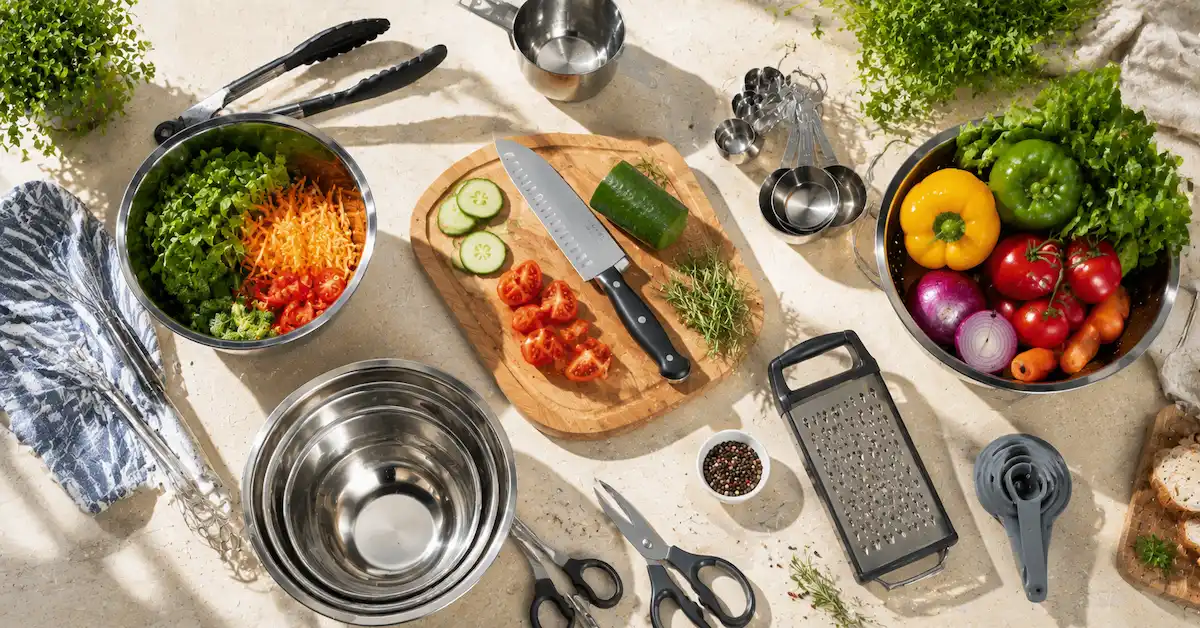
The visible assortment considered here includes stainless-looking mixing bowls, food tongs, a chef’s knife, a wood cutting board, a box grater, kitchen shears, measuring cups and spoons, and a peppercorn container. These products suggest a preparation-focused range rather than a single-purpose tool line. Several items could be sold separately, combined into a starter set, or developed as part of a private-label kitchenware program. The image alone does not establish whether they are one bundled set.
For buyers, the immediate question is not “Does this look complete?” It is “Can each item meet the use case, and can the supplier clearly define what is being offered?” That distinction matters when products will be used repeatedly in restaurants, catering operations, cooking schools, commercial food-preparation areas, or consumer kitchens.
Quick reference: what the assortment appears to cover
| Product type | Likely preparation role | Points to verify with the supplier |
|---|---|---|
| Nested mixing bowls | Mixing salads, batters, sauces, and ingredients | Capacities, nesting fit, material grade, rim design, and cleaning guidance |
| Chef’s knife | Cutting vegetables, herbs, meat, poultry, and other ingredients | Blade material, hardness, edge geometry, handle construction, and sharpening method |
| Cutting board | Chopping and portioning ingredients | Wood species, board thickness, surface treatment, care instructions, and size |
| Box grater | Grating cheese, vegetables, and similar ingredients | Perforation patterns, frame rigidity, handle comfort, and edge protection |
| Tongs and shears | Handling food and cutting ingredients | Hinge construction, grip shape, spring action, blade alignment, and handle material |
| Measuring cups and spoons | Portioning dry or liquid recipe ingredients | Exact capacities, markings, nesting or connecting design, and readability |
Material and construction questions that deserve attention
Stainless-looking components
The bowls, measuring tools, and some utensil bodies have a reflective stainless-steel appearance. Smooth metal surfaces are often practical in food preparation because they are relatively easy to wipe and clean, but appearance is not a material specification. A sourcing team should request the actual stainless-steel designation, thickness where relevant, surface finish, and any available food-contact documentation.
Do not assume that every bright metal component in a coordinated assortment uses the same grade. Bowls, measuring spoons, grater bodies, and knife blades may have different functional requirements and may be manufactured through different processes. The supplier should identify each material rather than provide one broad statement for the complete range.
Blades, perforations, and formed parts
The knife appears to have a broad stainless-looking blade and a dark handle with visible rivets. That construction may indicate a separate handle assembly, but the image does not confirm whether the handle is full tang, partial tang, or another configuration. Buyers should request a drawing or product specification covering blade length, thickness, hardness, edge profile, handle material, and assembly method.
The box grater has a metallic perforated body with multiple visible grating patterns. This is useful for an assortment because one tool can support different ingredient textures. Still, perforated sheet metal can vary considerably in sharpness, rigidity, and edge consistency. Ask how the holes are formed, how sharp edges are controlled, and whether the frame remains stable during use. These are small details, but they have a direct effect on user perception.
Polymer handles and wood boards
Tongs, shears, and the grater appear to use black or dark polymer components. Handle material, joining method, and grip texture should be confirmed before commercial approval. A handle that feels secure in a showroom may become uncomfortable during repeated preparation work. If the tools are intended for professional kitchens, ask about the expected cleaning environment and whether the handles contain joints or cavities that can retain food residue.
The cutting board appears to be wood, with a rounded rectangular profile and visible grain. Wood boards can provide a familiar cutting surface and attractive retail presentation, but care requirements are important. The supplier should identify the wood type, dimensions, surface finish, maintenance instructions, and any restrictions on soaking, heat, or cleaning methods. Avoid using the phrase “maintenance-free” unless the supplier can support it.
How a kitchen utensils supplier should support the buying process
A capable kitchen utensils supplier should make product definition straightforward. At minimum, the inquiry package should produce item-level information rather than only lifestyle images. Request a product list with dimensions, weights, capacities, material declarations, available colors or finishes, packaging options, and identification of items that are standard versus customizable.
For a coordinated range, consistency matters. Check whether the dark handles use a common design language, whether metal finishes match across bowls and measuring tools, and whether the visual scale of the products makes sense when displayed together. A retailer may want a compact starter kit, while a hospitality distributor may need individual replacement items. The supplier should be able to explain which sales formats are feasible without implying that every configuration is already available.
It is also sensible to separate product capability from compliance claims. Ask for relevant food-contact documentation, test reports, or declarations for the destination market when required. No such certification, dishwasher rating, oven suitability, temperature rating, corrosion-resistance specification, warranty, or durability result is established by the visible product information alone.
Selection criteria for professional prep tools for kitchen operations
Professional buyers should evaluate more than the number of pieces in a set. The following criteria usually have the greatest practical impact:
- Task coverage: Confirm that the range supports the actual workflow, from measuring and mixing through cutting, grating, and handling.
- Ergonomics: Review grip size, balance, hinge resistance, handle edges, and the effort required for repeated use.
- Cleanability: Look for smooth transitions, accessible surfaces, and clear instructions. Avoid assuming that a tool is dishwasher-safe without written confirmation.
- Storage: Nested bowls and grouped measuring tools can reduce storage space, but the buyer should verify nesting depth and whether pieces separate easily.
- Replacement strategy: A commercial operator may prefer individual item codes rather than a set that must be replaced in full after one component is lost or damaged.
- Brand presentation: Confirm logo placement, packaging format, labeling requirements, and whether the supplier can maintain the same finish across repeat orders.
Sample evaluation should be practical. Prepare common ingredients, measure with the cups and spoons, test the tongs with different food sizes, and inspect the grater after handling. Check the knife and shears carefully, but do not treat initial sharpness as proof of long-term edge retention. That requires a defined test method and agreed acceptance criteria.
Common buying mistakes
One frequent mistake is approving a range from photographs alone. Images can show geometry and general finish, but they cannot establish wall thickness, blade hardness, capacity accuracy, or how well a hinge works after repeated use.
Another mistake is treating “stainless steel” as a complete specification. It is not. The grade, thickness, finish, and forming quality all influence the final product. The same caution applies to “wood,” “metal handle,” or “non-slip grip.” These descriptions may be useful starting points, but they are not sufficient for a purchase specification.
Buyers also sometimes overlook assortment logic. A set with many pieces may look attractive but create slow-moving inventory if customers mainly need bowls, measuring tools, or one reliable knife. Build the range around actual users and replenishment patterns. For a restaurant or catering customer, robust individual tools may be more useful than a decorative collection.
Practical buyer checklist
Before moving to a quotation or purchase order, ask the supplier to confirm:
- Which products are included and whether the image represents a set or separate items.
- Exact dimensions, capacities, weights, and item-level materials.
- Blade construction, grater perforation details, and handle assembly.
- Care, cleaning, and storage instructions for metal, polymer, and wood components.
- Available samples, drawings, packaging formats, and private-label options.
- Applicable food-contact documents and market-specific labeling requirements.
- Whether the supplier can provide replacement pieces or separate item codes.
FAQ
Are these products suitable for commercial kitchens?
The assortment appears relevant to restaurants, catering operations, cooking schools, and other food-preparation settings. Suitability cannot be confirmed from appearance alone. Confirm material details, cleaning guidance, construction, and any required documentation with the supplier.
Do the bowls and measuring tools have confirmed capacities?
No exact capacities are visible in the supplied information. Request a dimensional drawing or item specification before using the products in a recipe-based or portion-controlled operation.
Can the assortment be developed for private label?
The product mix is compatible with a private-label discussion, particularly because it includes coordinated preparation items. Branding, packaging, customization, and order conditions must be confirmed directly rather than assumed.
What is the most useful next step?
Send the supplier a structured request covering intended market, target users, required items, materials, capacities, packaging, documentation, and sample expectations. Ask for an itemized specification sheet and review physical samples before approving the range. That process turns a visually attractive kitchenware assortment into a product decision that can be defended by engineering, sourcing, and product teams.
