




How to Choose a Meal Prep Kitchen Tools Supplier for Reliable Food Storage Programs
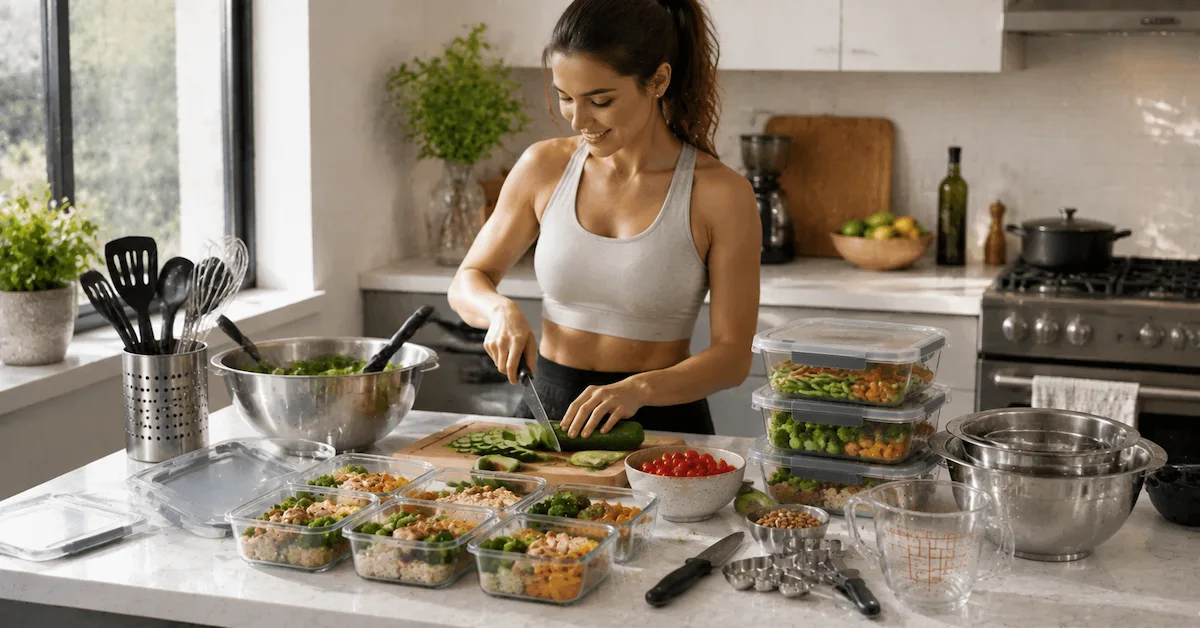
Choosing a meal prep kitchen tools supplier is not simply a matter of finding transparent containers at the lowest quoted price. The supplier must help you match container geometry, lid fit, material, production method, packing format, and intended food-service use. For sourcing managers and product teams, the real decision is whether a proposed container system will remain practical across repeated preparation, storage, transport, and handling—not just whether the sample looks suitable in a product photograph.
The containers considered here are transparent food-storage and meal-prep containers with fitted lids. The visible range includes rectangular containers with rounded corners and straight sidewalls, as well as additional round containers arranged in a stack. Some rectangular units appear to support portioned meals, and some may include multiple food sections, although fixed internal compartments cannot be confirmed from the available product information. That distinction matters when writing a specification or comparing quotations.
The sourcing problem: a container is part of a working system
Prepared-food businesses, nutrition programs, caterers, retailers, and household-focused brands often need more than a container that holds food. They need a repeatable system. Containers may be filled in batches, identified quickly in chilled storage, stacked in transport crates, handed to customers, and cleaned or discarded according to the operating model.
A clear container can make contents visible without opening the lid. A rectangular footprint can use shelf space efficiently, while stackability may help organize prepared meals vertically. These are useful design features, but they do not answer all the buyer’s questions. A transparent body could be made from plastic, glass, or a combination of materials. The exact capacity, dimensions, weight, temperature range, and food-contact suitability still need to be confirmed by the supplier.
This is where supplier evaluation becomes more important than image-based product selection. A visually similar container may have a different lid interface, wall thickness, material specification, or production limitation. Those differences can affect packing speed, storage density, breakage risk, and customer satisfaction.
Quick reference: what to verify before approving a sample
| Area | What the visible design suggests | What must be confirmed |
|---|---|---|
| Shape | Rectangular containers have rounded corners and straight sidewalls; round units are also shown. | Exact length, width, height, diameter, usable volume, and dimensional tolerances. |
| Lids | Separate low-profile transparent lids are shown. | Compatibility, closure method, sealing performance, interchangeability, and replacement availability. |
| Storage | Several containers are stacked vertically. | Safe stacking load, nesting or stacking height, stability, and performance when filled. |
| Visibility | Clear walls allow the contents to be seen without opening. | Material clarity, haze, scratch resistance, and appearance after repeated handling. |
| Compartments | Some products appear divided, but fixed internal sections are not confirmed. | Whether dividers are molded into the body, removable, or absent. |
| Manufacturing | Plastic injection molding or thermoforming may be relevant, but the process is not confirmed. | Material, process, tooling responsibility, quality controls, and production capability. |
Start with the operating workflow
The strongest specifications begin with the job the container must perform. A household meal-prep product may prioritize compact stacking and easy identification. A prepared-meal supplier may place greater emphasis on rapid filling, secure closure, consistent dimensions, and efficient case packing. A takeaway application may require a different balance between presentation, weight, and disposal practices.
Map the workflow from filling to final use. How will meals enter the container? Will ingredients be separated? Are portions standardized? Will containers be stacked in a refrigerator, a delivery tote, or a retail display? Will users open the lid once, several times, or not until the meal is consumed? These questions can expose requirements that are easy to miss in a generic request for “meal prep kitchen equipment.”
Container geometry deserves particular attention. Rectangular units generally support orderly shelf layouts and may reduce unused space compared with irregular shapes. Rounded corners can make the container easier to handle and may simplify cleaning, but the actual cleaning performance depends on the material, corner radius, surface condition, and operating method. Round containers may suit certain ingredients or serving formats, yet they may create different packing and storage behavior. A mixed range can be useful, but only if the lid and storage system are clearly managed.
Material and manufacturing questions
The product information does not establish whether these containers are plastic, glass, or a combination. Do not let a clear appearance become an assumed material specification. Ask the supplier to identify the body and lid materials, relevant grades, intended food-contact use, and any limitations associated with the selected material.
If the bodies are plastic, injection molding or thermoforming may be used, while lids would commonly be injection molded. These are reasonable manufacturing possibilities, not confirmed details for this product range. The process affects tooling, geometry, wall consistency, production volume, and the way design changes are handled. A buyer should ask which features are molded, which dimensions are controlled, and how samples relate to production parts.
For glass or mixed-material construction, weight, breakage handling, and lid compatibility become important questions. For plastic construction, the buyer may need to investigate clarity, stiffness, odor retention, deformation, and end-of-life considerations. None of these properties should be inferred from a product image.
Evaluate the lid as carefully as the container
In practical use, the lid is often the point at which a storage system succeeds or fails. A fitted lid may support organized transport, but “fitted” does not automatically mean airtight, leak-resistant, or suitable for pressure changes. The closure mechanism, mating surfaces, flexibility, and production consistency all matter.
Request samples of every relevant body-and-lid combination. Check whether lids are interchangeable across the proposed range, whether they remain secure when containers are filled, and whether the closure can be applied quickly by hand or on the intended packing line. If the product will be transported, test it in the orientation and movement conditions that resemble actual distribution. A short bench check is useful, but it is not a substitute for a documented application test.
Also confirm whether the lid is low profile by design or simply appears that way in the image. A low-profile lid can support stacking, but it may offer less room for a locking feature or a raised seal. The best choice depends on the required handling and storage conditions.
Common purchasing mistakes
Assuming visible clarity proves compliance
Transparent walls improve product identification, but clarity does not confirm food-contact compliance, chemical resistance, or temperature performance. Ask for the documents appropriate to your market and application rather than relying on appearance.
Approving dimensions without checking usable capacity
External dimensions do not tell you how much food the container holds. Wall thickness, lid geometry, corner radii, and any internal divisions reduce usable volume. Fill a production-representative sample and measure the result using the portion sizes that matter to your operation.
Ignoring stacking behavior
A photograph showing stacked containers demonstrates an intended arrangement, not a verified load rating. Test filled and empty units, examine stability, and consider how much force workers apply when placing one container on another. Slight dimensional variation can become noticeable in tall stacks.
Requesting “customization” without defining the boundary
Customization may mean a different color, logo, lid, compartment layout, dimension, or tooling change. These are not equivalent requests. State which features are fixed and which may change, then ask how each change affects tooling, minimum order quantities, samples, and production control.
What a capable meal prep tools supplier should provide
A credible supplier should be able to discuss the product as a manufacturing system, not only send a catalog image. At minimum, request a dimensional drawing, material identification, body-and-lid compatibility information, available shapes and capacities, sample procedure, packaging method, and quality inspection approach.
It is also sensible to ask how the supplier controls repeated production. Relevant topics may include inspection of critical dimensions, visual checks for molding defects, lid fit verification, packing protection, and traceability practices. The exact controls will depend on the factory and product, so avoid assuming that every supplier uses the same process.
When comparing a meal prep tools supplier with alternatives, make the comparison on an equivalent basis. One quotation may cover only the visible container, while another includes lids, packaging, tooling, or sample development. Normalize the specifications before discussing unit economics. Otherwise, the cheapest offer may simply be the least complete one.
Buyer checklist for the next supplier conversation
- Confirm body and lid materials rather than assuming plastic or glass.
- Record external dimensions, internal dimensions, usable capacity, and unit weight.
- Clarify whether compartments are fixed, removable, or not available.
- Confirm lid compatibility, closure design, and replacement options.
- Define the required storage, transport, and handling environment.
- Ask which temperature, appliance, cleaning, and food-contact claims are documented.
- Review samples filled with representative meals, not only empty samples.
- Check stacking stability and packing density in the intended storage format.
- Separate standard products from tooling-dependent custom designs.
- Request a written quotation that identifies what is included.
FAQ
Are these containers definitely plastic?
No. The available information confirms a clear, smooth appearance but does not reliably establish whether the bodies are plastic, glass, or a combination. Material must be confirmed by the supplier.
Can the containers be used in a microwave, oven, freezer, or dishwasher?
Those capabilities are unknown and should not be assumed. They depend on the body and lid materials, design, and validated application limits.
Do the rectangular containers definitely have compartments?
No. Some appear divided, but the presence of fixed internal compartments is not fully clear. Request drawings or production samples before specifying a divided format.
What is the most important first sample test?
Use a sample in the actual workflow: fill it with a representative meal, close the lid, stack it as intended, move it through the planned handling process, and inspect fit, stability, visibility, and usability. Add application-specific tests after the basic design is confirmed.
Make the next step a technical comparison
The right supplier decision comes from a controlled comparison, not from a polished image. Prepare a short requirement sheet covering shape, capacity, lid interface, material, compartment needs, stacking arrangement, intended use, and documentation. Then ask shortlisted suppliers to respond against the same points and provide representative samples.
For a product range built around transparent rectangular and round containers, that process can reveal whether the visible design matches the operational need. It can also identify early mismatches in material, closure, dimensions, or manufacturing scope—before those issues become tooling changes or customer complaints.
