




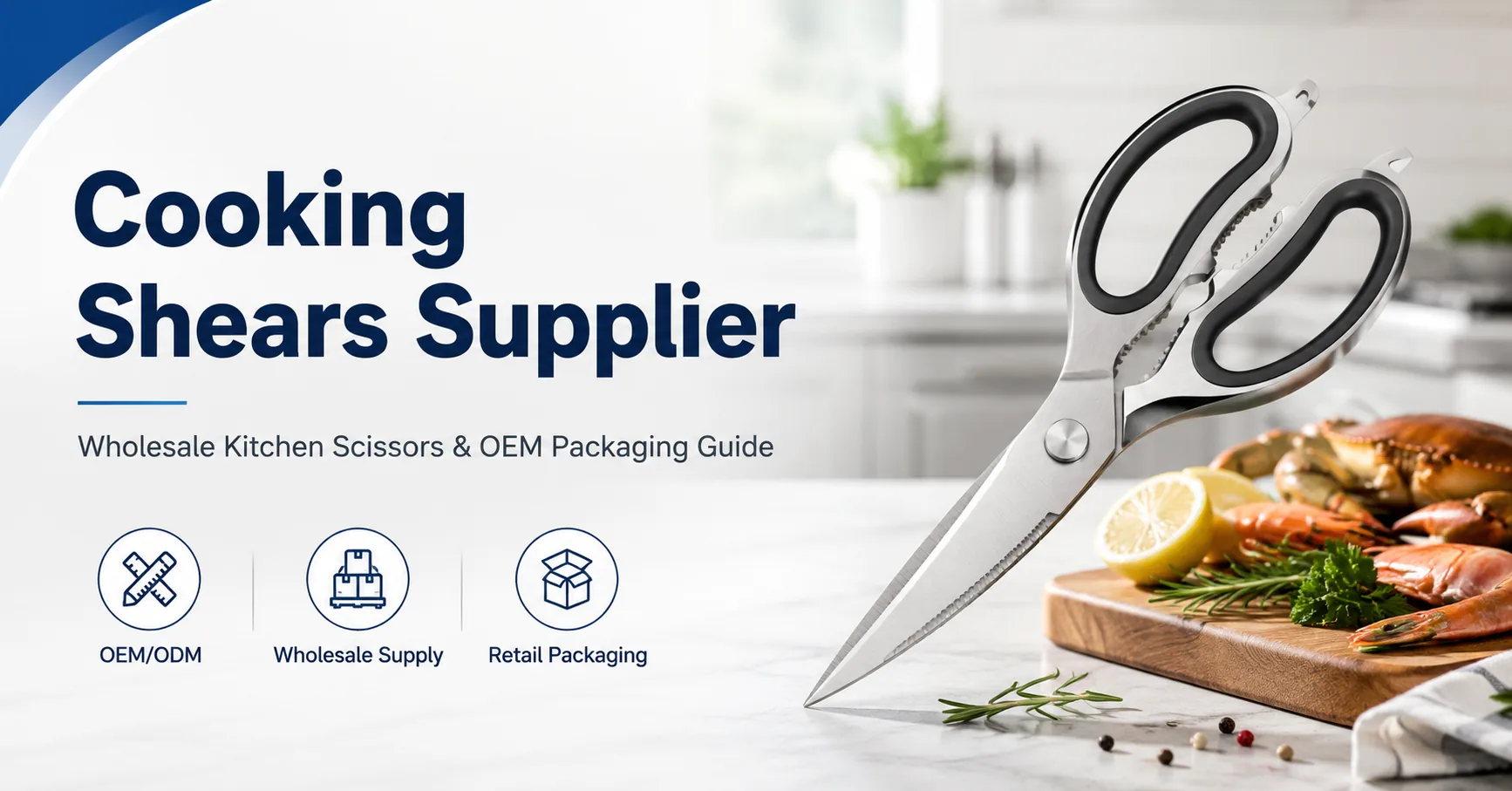
Cooking Shears Supplier: Wholesale Kitchen Scissors & OEM Packaging Guide
Choosing a cooking shears supplier is not only about finding a low unit cost. For importers, Amazon sellers, supermarket buyers, and kitchenware distributors, the better question is whether the supplier can provide consistent product quality, practical packaging choices, OEM support, clear communication, and dependable repeat supply.
Cooking shears are everyday kitchen tools used for cutting herbs, poultry, seafood, meat, vegetables, and food packaging. Because they may be used around food and washed frequently, buyers should review blade strength, handle comfort, hinge stability, cleaning convenience, and packaging durability before confirming a wholesale order.
Key Takeaways
- Cooking shears are suitable for supermarkets, online stores, distributors, and private label kitchenware ranges.
- Sample testing should check sharpness, hinge strength, grip comfort, packaging protection, and batch consistency.
- OEM projects should define logo position, handle color, packaging artwork, barcode labels, and carton requirements early.
- Buyers should ask suppliers about MOQ, lead time, replacement policy, inspection process, and export carton standards before bulk ordering.
Why Cooking Shears Work Well for Wholesale Channels
Cooking shears are strong wholesale products because they solve several food preparation tasks with one compact item. They can be sold as a single kitchen tool, bundled with knives or utensils, or positioned as part of a private label kitchen accessories line.
For retail shelves, the product is easy for shoppers to understand. For online channels, it is relatively compact and can be photographed with clear usage scenes. For distributors, kitchen shears can serve both entry-level and upgraded ranges depending on blade design, handle structure, packaging, and branding.
Useful wholesale advantages include:
- Broad household demand across many kitchen categories
- Suitable for supermarkets, e-commerce, promotional sets, and kitchenware stores
- Easy to combine with other kitchen tools for mixed orders
- Compatible with private label packaging and barcode labels
- Higher perceived value than basic household scissors when designed for kitchen use
What to Expect From a Cooking Shears Supplier
A reliable supplier should support more than product selection. Buyers need a sourcing partner who can explain model differences, provide samples, discuss packaging options, and help reduce risk before mass production or bulk shipment.
Before placing an order, ask whether the supplier can provide product photos, available packaging formats, sample timelines, carton details, and answers about customization. If a buyer is building a retail program, the supplier should also be able to discuss how the product will hang, stack, ship, and scan at the point of sale.
Helpful supplier support may include model recommendations, stainless steel blade options when available, OEM logo discussion, private label packaging coordination, sample preparation, mixed kitchen tool order planning, and export carton preparation. Buyers should confirm each service directly instead of assuming it is included.
Product Features Buyers Should Inspect
Cooking shears may look simple, but small details affect customer satisfaction. A sharp sample is not enough; buyers should test whether the product remains comfortable, stable, and practical through repeated use. If the shears are intended for heavier food prep, ask the supplier which model is suitable and what limitations the buyer should communicate to end users.
| Checklist Item | What Buyers Should Check | Why It Matters |
|---|---|---|
| Blade material | Confirm whether stainless steel is used and request details from the supplier | Affects sharpness, corrosion resistance, and perceived quality |
| Cutting edge | Check straight or serrated edge options if available | Serrated edges may help grip slippery food |
| Hinge structure | Open and close repeatedly; check looseness or friction | Influences cutting stability and service life |
| Handle comfort | Test grip size, pressure points, and left/right hand usability | Reduces complaints during daily kitchen use |
| Cleaning design | Ask whether the design is detachable or easy to rinse | Food prep tools must be practical to clean after use |
| Packaging strength | Review card, blister, box, and carton protection | Prevents damage during retail handling or parcel delivery |
Quality consistency matters more than a single attractive sample. Ask how pre-shipment inspection is handled, what defect standards apply, and whether approval samples can be kept as references for repeat orders.
Packaging Choices for Retail and Online Sales
Packaging should match the sales channel. Supermarket buyers often need hanging card or blister packaging that displays the product clearly and fits shelf systems. E-commerce sellers may prefer color boxes or protective packaging that reduces transit damage and presents well in product photography.
Common packaging options include blister card packaging, hanging card packaging, color box packaging, gift box packaging, bulk carton packing, barcode labels, and private label artwork. If the order is for Amazon or another marketplace, confirm size, barcode placement, warning text needs, and carton labeling requirements with the platform and the supplier.
Buyers should also ask practical packaging questions: Can the package hold the shears securely? Is the cutting edge protected? Is the barcode easy to scan? Is the carton strong enough for international shipping? Are inner cartons available? These details are often more important than decorative design alone.
OEM and Private Label Planning
OEM cooking shears projects should begin with a clear product brief. The buyer should define the target market, sales channel, expected price position, packaging format, artwork requirements, and whether the product will be sold alone or as part of a set.
Common customization topics include logo placement on the blade or handle, handle color, packaging design, barcode and label support, instruction text, and set combinations with other kitchen tools. The availability, cost, MOQ, and lead time for each option should be confirmed with the supplier before artwork is finalized.
For new brands, customized packaging is often the simplest way to create a recognizable product without changing the tool structure. For larger buyers, coordinated colors, multipack formats, or kitchen tool bundles may help differentiate the range. In all cases, request a sample or pre-production confirmation before approving bulk production.
How to Compare Suppliers Before Ordering
When comparing cooking shears suppliers, buyers should look at both product and service reliability. A supplier with clear answers, realistic timelines, and sample support is easier to manage than one that only provides a catalog and price list.
- Request samples from shortlisted models and test them with realistic kitchen tasks.
- Confirm available materials, handle designs, packaging choices, and customization limits.
- Ask about MOQ for standard items and OEM packaging separately.
- Clarify lead time for samples, packaging proofing, mass production, and repeat orders.
- Review export carton details, labeling requirements, and inspection arrangements.
- Keep approved samples and packaging files for future comparison.
Commercial details such as MOQ, pricing, payment terms, certifications, and testing requirements should be verified directly with the supplier for the buyer’s destination market. Do not rely on assumptions, especially when selling through supermarkets or regulated online marketplaces.
Practical FAQ
What are cooking shears used for?
They are used for cutting herbs, poultry, seafood, meat, vegetables, and food packaging. Some models may suit heavier tasks better than others, so buyers should test samples for the intended use.
Are cooking shears suitable for wholesale and private label?
Yes. They are practical, compact, and suitable for supermarkets, online sellers, distributors, and branded kitchenware programs when quality and packaging are managed carefully.
Should buyers request samples before a bulk order?
Yes. Samples help evaluate sharpness, hinge stability, handle comfort, cleaning convenience, packaging strength, and whether the product matches the target channel.
What packaging is best for cooking shears?
Hanging cards and blister packs are common for retail display, while color boxes may suit online sales or branded programs. The best choice depends on shelf display, shipping protection, and budget.
What should buyers ask an OEM supplier?
Ask about logo options, handle color availability, packaging artwork process, barcode support, MOQ, sample time, production lead time, inspection standards, and carton labeling.
Final Sourcing Advice
A good cooking shears sourcing decision balances product function, packaging practicality, customization needs, and long-term supply reliability. Instead of choosing only by price, buyers should compare samples, ask detailed production questions, and confirm how repeat orders will be controlled.
For additional product categories and sourcing information, buyers can review the kitchen scissors section at https://bonethome.com/scissors, browse related articles at https://bonethome.com/blog, or contact the supplier through https://bonethome.com/contact-us to discuss samples, packaging, and OEM questions.
