




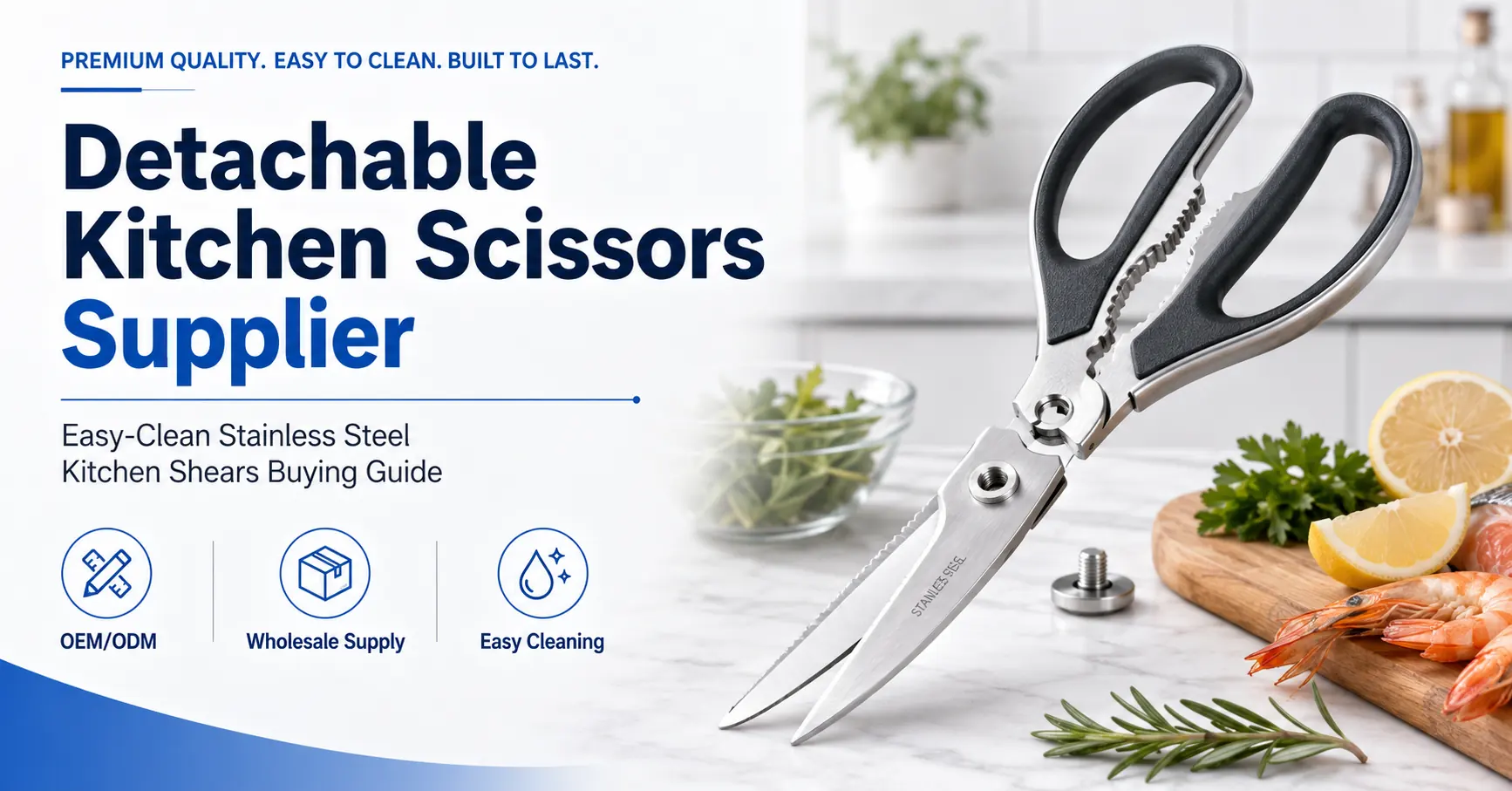
Detachable Kitchen Scissors Supplier: Easy-Clean Stainless Steel Kitchen Shears Buying Guide
Detachable kitchen scissors are a practical product for buyers who serve supermarkets, Amazon stores, kitchenware distributors, promotional channels, and private label brands. Their main advantage is simple: the two blades can be separated for more direct washing and drying after food preparation. For end users cutting poultry, herbs, seafood, vegetables, meat, or food packaging, this easy-clean design is more useful than a decorative feature.
For B2B sourcing teams, however, choosing a detachable kitchen scissors supplier is not only about finding a sharp pair of shears. Buyers should review the blade material statement, detachable joint stability, handle comfort, packaging format, sample process, OEM options, and shipment quality control. The goal is to select a product that is easy to explain to consumers and consistent enough for repeat wholesale supply.
Key Takeaways
- Detachable kitchen shears are valued because they are easier to clean around the blade joint.
- Sample testing should focus on sharpness, blade alignment, joint stability, and reassembly comfort.
- Stainless steel is commonly requested for kitchen scissors, but buyers should confirm the exact material with the supplier.
- Packaging should clearly show the detachable cleaning benefit for retail and e-commerce channels.
- Commercial details such as MOQ, lead time, logo method, and carton packing should be confirmed before placing a bulk order.
Why Detachable Kitchen Scissors Work for Wholesale
Generic kitchen scissors can be difficult to differentiate. Detachable kitchen scissors offer a clear consumer benefit because food residue often collects around the hinge after cutting meat, herbs, or seafood. When the blades separate, users can wash each side more thoroughly and dry the scissors before storage.
This makes the product suitable for several sales channels. Supermarket buyers can communicate the feature on hanging cards or blister packs. Online sellers can demonstrate blade separation in product images or short videos. Distributors can position the item as a higher-value option than basic household scissors. Private label brands can add cleaning instructions and packaging language that match their target market.
What to Check in the Detachable Blade Design
The detachable mechanism is the core feature, so it deserves close inspection before any order commitment. A good design should separate without excessive force, but it should not feel loose during normal cutting. Buyers should open, close, detach, clean, dry, and reassemble samples several times to understand the user experience.
| Checklist Item | What Buyers Should Review | Why It Matters |
|---|---|---|
| Blade separation | How easily the two blades come apart | Affects cleaning convenience and consumer satisfaction |
| Joint stability | Movement at the hinge during cutting | Loose blades can feel unsafe or low quality |
| Blade alignment | Whether edges meet evenly from base to tip | Impacts cutting performance on herbs, packaging, and food |
| Reassembly | How simple it is to put the blades back together | Reduces user frustration after washing |
| Cleaning gap | Whether residue can be reached around the joint | Supports the main hygiene selling point |
If the scissors are intended for marketplace sales, the detachable action should also be easy to explain visually. If it requires too much instruction, customer returns and negative reviews may increase.
Blade Material, Sharpness, and Cutting Performance
The original product positioning refers to stainless steel kitchen shears, and stainless steel is commonly preferred for kitchen scissors because it is suitable for frequent washing and food preparation. Buyers should still ask the supplier to specify the exact stainless steel type, thickness, surface finish, and any available test information rather than assuming a material grade.
During sample review, test the scissors on realistic tasks: herbs, flexible food packaging, fish fins if relevant to the market, poultry skin, and vegetable stems. The blades should cut smoothly without excessive hand force. If the product includes a serrated section, check whether it helps grip slippery food without tearing too aggressively.
Important inspection questions include:
- What stainless steel material is used for the blades?
- How is blade sharpness checked before shipment?
- Is the surface polished, brushed, or otherwise finished?
- How is rust resistance evaluated by the supplier?
- Can pre-production samples be approved before mass production?
Handle Comfort and Safe Daily Use
Kitchen scissors are often used with wet, oily, or cold hands, so the handle design matters. A strong detachable mechanism will not compensate for a handle that feels slippery or uncomfortable. Buyers should review the handle size, finger opening, edge smoothness, grip texture, and balance between blade and handle.
Common handle materials in the market may include PP, ABS, TPR, silicone grip components, or combinations of plastic and soft-touch materials. Do not assume which option is used in a specific model without asking the supplier. For retail programs, handle color can also help create product-line consistency, but comfort and durability should be evaluated before color selection.
Packaging Choices for Retail and E-Commerce
Packaging should make the detachable cleaning benefit obvious. If shoppers cannot understand the feature within a few seconds, the product may look like ordinary kitchen scissors. For supermarkets and houseware stores, hanging cards and blister packs can display the blade shape and handle design. For online sales, a color box may offer better protection during delivery and more space for usage instructions.
Buyers can discuss these packaging options with a supplier:
- Hanging card for pegboard retail display
- Blister card for visible product presentation
- Color box for e-commerce and private label programs
- Gift box when bundled with other kitchen tools
- Bulk carton packing for distributor or promotional orders
- Instruction card explaining detaching, cleaning, drying, and reassembly
Before finalizing packaging, ask about artwork requirements, barcode placement, carton dimensions, inner packing, drop protection, and whether the packaging supports your target sales channel.
OEM and Private Label Questions to Ask
OEM customization can help a buyer create a branded kitchen scissors line, but every customization detail should be confirmed in writing. Avoid assuming that all logo positions, colors, or packaging formats are available for every model. The practical approach is to request a customization sheet or quotation that separates product cost, tooling or setup needs, sample fees if any, packaging cost, and production lead time.
Useful supplier questions include:
- Can the logo be applied to the blade, handle, packaging, or instruction card?
- What file format is required for artwork?
- What is the MOQ for standard packaging and for custom packaging?
- Can handle color be customized, and does it affect lead time?
- Can the scissors be combined with peelers, slicers, knives, or other kitchen tools?
- Are samples available before bulk production?
Quality Control Before Shipment
Detachable kitchen scissors need more careful QC than standard scissors because both the cutting function and the detachable mechanism must perform properly. Buyers should agree on inspection points before production begins, especially for private label orders where packaging and product appearance directly affect brand reputation.
A practical QC plan may include blade sharpness checks, blade alignment inspection, opening and closing smoothness, detachable joint function, handle strength, surface appearance, packaging accuracy, barcode verification, and export carton condition. If a buyer has market-specific compliance requirements, those should be provided to the supplier early and verified through appropriate documentation or testing channels.
How to Select a Detachable Kitchen Scissors Supplier
A reliable supplier should help buyers compare models, understand material options, review samples, confirm packaging, and plan repeat orders. The best sourcing decision is not always the lowest unit price. Consider whether the supplier answers technical questions clearly, provides consistent samples, understands export packaging, and can support your sales channel requirements.
Before placing a bulk order, confirm the product specification, approved sample status, packaging artwork, MOQ, lead time, payment terms, inspection process, carton information, and after-sales handling method. These basic steps reduce the risk of receiving scissors that look acceptable but fail in daily use.
Practical FAQ
What are detachable kitchen scissors used for?
They are used for everyday food preparation tasks such as cutting herbs, poultry, seafood, vegetables, meat, and food packaging. The detachable design helps users clean around the blade joint more easily.
Are detachable kitchen scissors suitable for wholesale programs?
Yes, they can suit supermarkets, e-commerce sellers, distributors, and private label kitchenware brands because the cleaning benefit is easy to communicate.
Should buyers request samples first?
Yes. Samples allow buyers to test blade sharpness, joint stability, handle comfort, packaging quality, and the ease of detaching and reassembling the blades.
What blade material should buyers ask about?
The source article identifies stainless steel. Buyers should ask the supplier for the exact stainless steel specification, finish, and any available quality control information.
Can detachable kitchen scissors be customized?
Many suppliers may offer logo, handle color, packaging, barcode label, or instruction card options, but availability depends on the model, MOQ, and production process. Confirm details before ordering.
What packaging is best?
Hanging cards or blister packs work well for visible retail display, while color boxes are often practical for e-commerce and private label presentation.
