




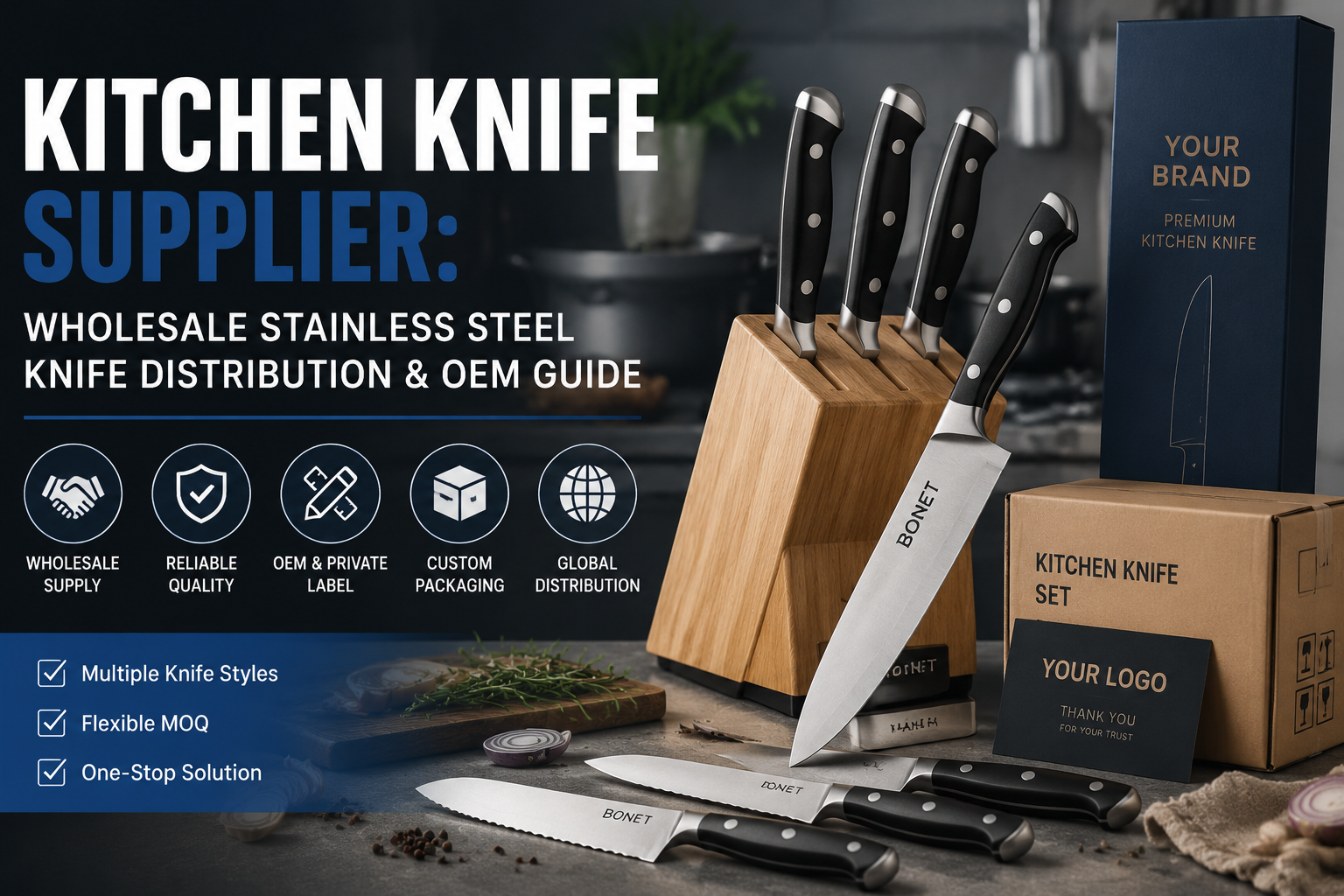
Kitchen Knife Supplier: Wholesale Stainless Steel Knife Distribution & OEM Guide
Choosing a kitchen knife supplier is a sourcing decision that affects product quality, packaging, delivery planning, and buyer confidence. For importers, wholesalers, retail chains, and e-commerce sellers, the right partner should do more than quote a unit price. A useful supplier helps buyers match knife styles, packaging formats, order quantities, and documentation needs to the intended sales channel.
This guide explains how kitchen knife supply works, what to check before ordering, and how to compare wholesale, OEM, and retail-ready options without relying on vague claims.
Key Takeaways
- A kitchen knife supplier may coordinate sourcing, packaging, labeling, export documents, and channel preparation.
- Buyers should confirm blade material, handle material, edge finish, packaging, MOQ, lead time, and inspection process before placing an order.
- Amazon, supermarket, wholesale, and private label channels often need different packaging and barcode requirements.
- Supplier selection should be based on samples, written specifications, communication quality, and repeat-order consistency.
What Does a Kitchen Knife Supplier Do?
A professional kitchen knife supplier acts as a bridge between manufacturing resources and global buyers. In some cases, the supplier may work directly with factories; in others, the supplier may consolidate models, packaging, and logistics from several production sources. The value is not only in the knife itself, but in making the product ready for the buyer’s market.
Common responsibilities include product sourcing, factory coordination, bulk order consolidation, packaging support, private label coordination, export documentation, and logistics communication. A supplier can also help buyers compare product options such as chef knives, santoku knives, utility knives, paring knives, and knife sets for retail bundles.
Before ordering, buyers should ask whether the supplier is a factory, trading company, distributor, or a combination of these roles. The answer affects pricing transparency, customization flexibility, and communication during production.
Wholesale Kitchen Knife Supply by Sales Channel
Different sales channels require different preparation. A product that works for a wholesale carton shipment may not be ready for an e-commerce warehouse or a supermarket shelf. Buyers should define the target channel first, then build the specification sheet around that channel.
- Amazon and e-commerce sellers: ask about barcode labeling, protective packaging, master carton information, and whether packaging can meet platform handling requirements.
- Wholesale distributors: focus on carton strength, mixed-SKU loading plans, stable item codes, and repeat-order consistency.
- Retail chains: review shelf display, hanging card, color box, gift box, and retail barcode needs.
- Private label brands: confirm logo placement, artwork file requirements, packaging proofing, and ownership of packaging files.
Product Range and Specification Points
The original product range often includes chef knives for all-purpose cutting, santoku knives for slicing and chopping, utility knives for daily preparation, paring knives for small detail work, and knife sets for bundled retail sales. Buyers should not rely on model names alone, because dimensions, blade thickness, handle shape, balance, and packaging can vary by supplier.
For each item, request a clear specification sheet. It should list blade material as stated by the supplier, handle material, overall length, blade length, blade thickness, weight, surface finish, edge style, logo method, packaging type, carton quantity, and carton size. If stainless steel grades are offered, ask how the grade is verified and whether the supplier can provide supporting documentation for the ordered batch.
Important quality questions include:
- How is edge sharpness checked before shipment?
- What inspection standard is used for visual defects, handle fitting, and packaging?
- How are knives protected against scratches during transport?
- What is the process if samples differ from mass production?
Packaging and OEM Private Label Planning
Packaging is a major part of kitchen knife sourcing because knives require safe handling and clear presentation. Common packaging options include retail color boxes, gift boxes, hanging card display packaging, bulk carton packing, and e-commerce-ready packaging. A supplier may also coordinate custom logo branding and package artwork, but buyers should confirm the process in writing.
For OEM or private label orders, ask what files are needed for logo and packaging artwork, whether a digital proof or physical pre-production sample is available, and how color differences are controlled. Buyers should also confirm who checks barcode readability, warning labels, language requirements, and market-specific claims. Do not assume the supplier’s standard packaging automatically fits every country or platform.
Supplier vs Manufacturer: Comparison Checklist
The words “supplier” and “manufacturer” are often used interchangeably, but they can describe different roles. The table below can help buyers decide what type of partner fits their order.
| Checklist Item | Supplier | Manufacturer |
|---|---|---|
| Main role | Coordinates products, packaging, orders, and export support | Focuses on production of specific items or processes |
| Product range | May offer chef knives, utility knives, paring knives, sets, and related tools | May specialize in fewer product types |
| Packaging support | Often stronger for retail, gift box, and private label coordination | Depends on in-house packaging capability |
| MOQ flexibility | Can sometimes consolidate mixed SKUs; confirm case by case | May prefer larger production runs; confirm case by case |
| Best for | Importers, e-commerce brands, distributors, retail programs | Buyers with fixed specifications and direct production needs |
MOQ, Samples, and Order Scaling
Minimum order quantity can vary widely depending on the knife model, packaging, logo method, and whether the buyer needs a standard item or a custom program. The original article referenced a broad market range from small test orders to larger wholesale and retail quantities, but buyers should treat any MOQ as negotiable only after the supplier reviews the exact product and packaging requirements.
A practical sourcing path is to start with samples, then place a pilot order, then scale to repeat wholesale orders after inspection results are acceptable. Ask whether mixed models can be combined in one shipment, whether packaging customization changes the MOQ, and whether reorder lead times differ from the first order.
How to Evaluate a Reliable Kitchen Knife Supplier
A reliable supplier should be able to answer detailed questions clearly. Instead of asking only for the lowest price, prepare a buyer checklist that covers product, packaging, quality control, and after-sales handling.
- Can the supplier provide complete product specifications before sampling?
- Are sample costs, sample lead time, and courier arrangements clear?
- Does the quotation separate product cost, packaging cost, logo cost, and shipping terms?
- How are pre-shipment inspections arranged?
- What happens if cartons arrive damaged or products do not match the approved sample?
- Can the supplier support repeat orders with the same model, packaging, and item codes?
For knives, safety and consistency matter. Stainless steel knives are generally corrosion-resistant, but they are not completely rust-proof. Buyers should ask for use-and-care wording that is accurate for the selected material and finish.
Practical FAQ
What is the difference between a kitchen knife supplier and a manufacturer?
A supplier usually focuses on sourcing coordination, packaging, order consolidation, and export support. A manufacturer focuses mainly on production. Some companies may perform both roles, so buyers should ask directly.
Can kitchen knives be customized for private label?
Many suppliers can coordinate logo and packaging customization, but available methods depend on the knife design, handle material, packaging type, and order quantity. Ask for artwork requirements and approval samples.
What MOQ should buyers expect?
MOQ depends on the product, packaging, and customization level. Standard items may allow smaller trial orders, while custom packaging or logo programs may require higher quantities. Confirm per SKU in writing.
Are stainless steel kitchen knives rust-proof?
Stainless steel is corrosion-resistant, not rust-proof. Care instructions, drying after washing, and storage conditions should be clearly explained to end users.
Do suppliers support Amazon or retail packaging?
Many kitchen knife suppliers offer e-commerce and retail packaging options, but buyers should confirm barcode placement, carton labels, protective packing, and platform-specific requirements before production.
Final Sourcing Advice
When sourcing wholesale stainless steel kitchen knives, focus on verifiable details: approved samples, written specifications, packaging proofs, inspection terms, and clear communication. A good kitchen knife supplier helps reduce uncertainty by making the product suitable for the intended channel, whether that is Amazon, wholesale distribution, supermarket retail, or private label. Before committing to volume, compare samples, ask precise questions, and document every requirement in the purchase order.
