


Silicone Kitchen Utensils Supplier: B2B Buying Guide
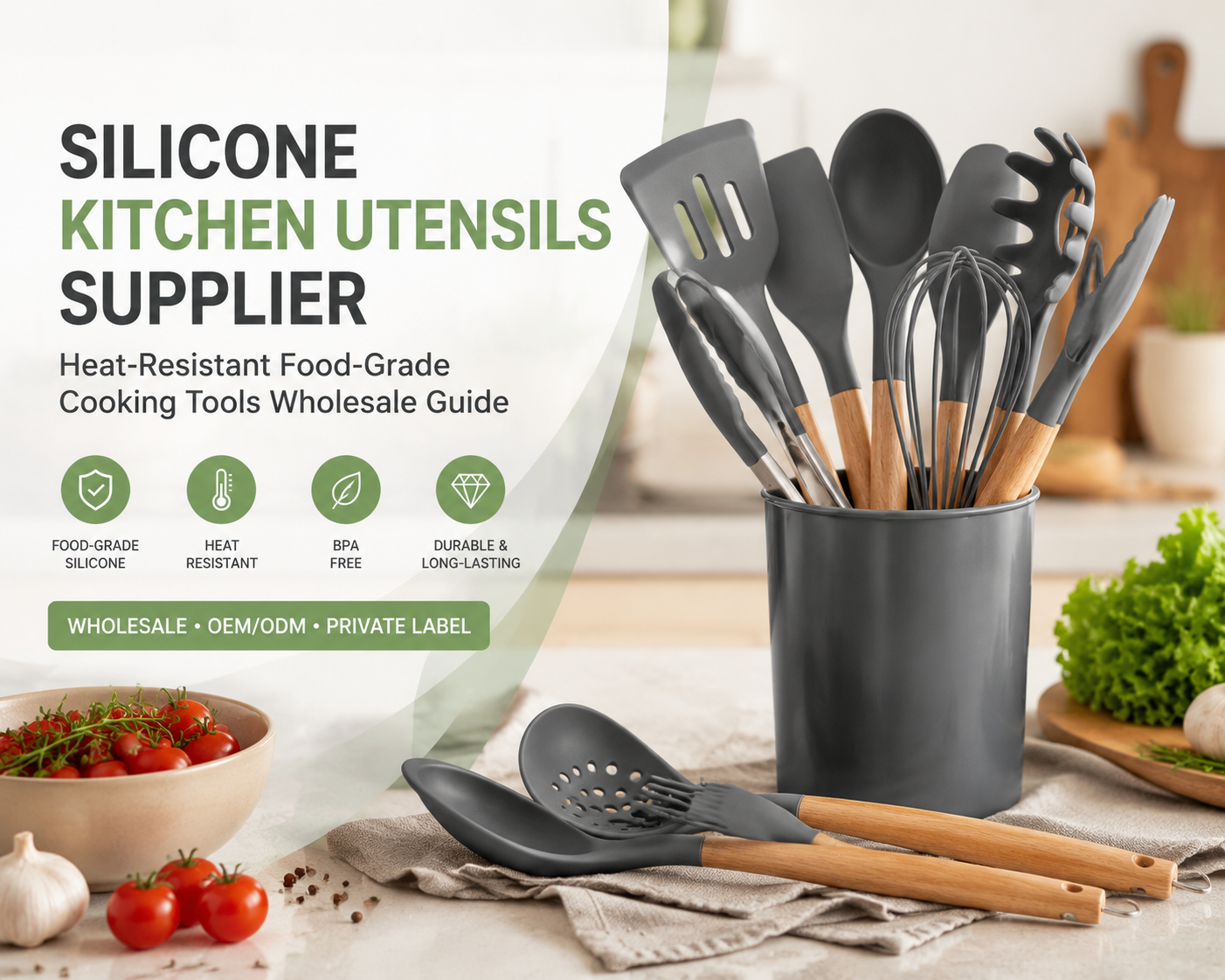
Quick answer: Select a silicone kitchen utensils supplier by checking the complete material record, set composition, samples, packaging, OEM scope, and repeat-order controls. The source covers silicone spoons, spatulas, turners, tongs, whisks, baking tools, and scrapers for wholesale or OEM programs. Exact silicone type, heat range, food-contact evidence, MOQ, lead time, and certifications are To be confirmed for each SKU; this page is supplier-selection guidance, not a claim about BONET certificates.
Define the utensil program
Decide whether the buyer needs single tools, a coordinated set, online fulfillment packs, supermarket hanging cards, gift boxes, or promotional bundles. The supplier brief should list every tool and quantity by SKU. See BONET kitchen utensil range for related BONET capabilities and product context.
Give every item a job
Assign a clear use such as stirring, scraping, turning, serving, baking, or gripping. Avoid adding pieces only to inflate a set count.
Set the channel constraints
State color, dimensions, hanging holes, pack language, barcode, carton, and fulfillment requirements before requesting a quote.
Verify silicone and food-contact scope
Ask the supplier to identify silicone and any nylon, stainless steel, wood, or other core or handle components. Request the applicable material statement and test documents for the target market. See BONET manufacturing and quality process for related BONET capabilities and product context.
Do not copy generic heat claims
Heat resistance, odor, BPA-free positioning, and food-contact status are product- and market-specific. Confirm the exact range and evidence instead of repeating a catalog number.
Inspect interfaces
Check seams, inserts, handle joints, edges, and transitions where residues, odor, or separation could appear.
Plan colors, sets, and OEM branding
OEM or private-label work may involve colors, logo placement, set combinations, inserts, and retail packaging. Confirm the process and sample approval for each change. See BONET OEM and ODM service for related BONET capabilities and product context.
Match color across components
Review physical color samples and define acceptable variation across silicone, handles, printing, and packaging.
Keep the set coherent
Check dimensions, balance, hanging format, and use instructions across all pieces rather than approving each item in isolation.
Test samples under real cooking and cleaning
Use samples for stirring, scraping, turning, serving, baking, or gripping tasks that match the buyer program. Inspect flexibility, stiffness, odor, seams, color, cleaning, and packaging damage.
Test the complete product
If a tool has a handle or core, include those materials in washing, heat, and repeated-use review; do not test only the silicone head.
Record change risk
Compare samples from normal production and require notice for compound, colorant, core, logo, packaging, or supplier changes.
Compare supplier terms and quality support
A useful quotation separates product, material documents, logo, color, set, packaging, inspection, sample charges, MOQ, lead time, and export carton assumptions.
Ask for a revision-controlled offer
Tie price and timing to the approved SKU list, drawings, colors, artwork, pack files, and destination-market requirements.
Plan replenishment
Keep the approved samples and color or pack standards so future orders can be checked against the same reference.
Buyer checklist: silicone kitchen utensils supplier
| Checkpoint | Buyer evidence |
|---|---|
| Material | Silicone type, other components, food-contact documents, odor, and heat evidence |
| Program | SKU list, set composition, dimensions, colors, and channel fit |
| OEM | Logo method, color approval, inserts, packaging, and artwork limits |
| Sample QC | Flexibility, seams, odor, cleaning, repeated use, and pack condition |
| Commercial | MOQ, sample and production timing, inspection, cartons, and change control |
Facts to confirm before quotation
To be confirmed for the exact project:
- silicone and non-silicone component specifications
- food-contact, heat, odor, and cleaning evidence
- color, logo, set, and packaging capabilities
- MOQ, sample timing, production timing, and inspection scope
- destination-market documents and change-control process
FAQ: silicone kitchen utensils supplier
What documents should a silicone utensil supplier provide?
Request the exact material and component record, applicable food-contact evidence, care guidance, sample details, packaging data, and market-specific documents for the quoted SKU.
Are all silicone utensils safe at the same temperature?
No. Heat performance depends on the silicone, other components, design, use, and evidence for the exact item. Confirm the tested range instead of copying a generic claim.
Can a supplier create a private-label utensil set?
Ask about logo, color, set composition, inserts, and packaging for the exact program. Confirm feasibility, MOQ, sample approval, timing, and change control in writing.
Next step for buyers
Send BONET the utensil list, materials, colors, set composition, channel, branding, packaging, quantity, and document requirements so a silicone program can be sampled and reviewed. See BONET kitchen utensil range and BONET manufacturing and quality process and BONET OEM and ODM service.
For silicone utensils, record the approved sample, inspection point and reorder reference in the buyer file.
When comparing silicone utensils, keep the material, pack and acceptance notes with the RFQ.