




How to Choose a Meal Prep Kitchen Tools Supplier for Batch-Cooking Operations
Choosing a meal prep kitchen tools supplier is less about finding the largest assortment and more about building a dependable workflow. A meal-preparation operation needs tools that work together: bowls for mixing, colanders for washing and draining, measuring equipment for repeatable recipes, cutting surfaces for ingredient preparation, and containers that support portioning and refrigerated storage. The right sourcing decision can reduce handling time and simplify packing. The wrong one can leave a kitchen with mismatched containers, unclear material specifications, and tools that are difficult to clean or replace.
This article explains how to evaluate a mixed meal-preparation and food-storage assortment for home kitchens, commercial meal-prep businesses, catering operations, cooking schools, commissary kitchens, and private-label retail programs. The key decision is whether the supplier can provide a coherent product system, not merely an attractive collection of individual tools.
What the pictured assortment is designed to do
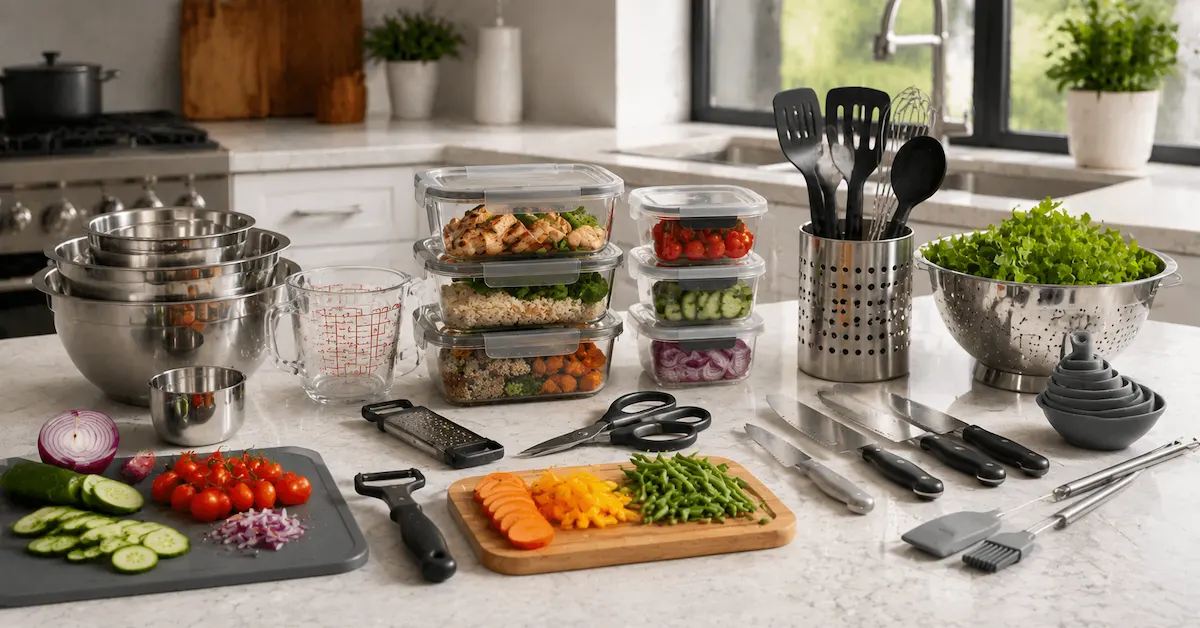
The visible product group covers most stages of a basic batch-cooking process. Nested stainless-steel mixing bowls can hold washed ingredients, marinades, sauces, or prepared mixtures. A perforated colander supports washing and draining. A transparent measuring jug with red graduated markings is intended for liquid measurement, although its exact material, capacity, and units cannot be confirmed from the image.
The utensil group includes items such as slotted spatulas, a solid spoon, whisk, tongs, knives, kitchen scissors, a handheld grater, and a vegetable peeler. Together, these tools address common preparation tasks without requiring a separate purchase for every operation. Cutting surfaces include a dark rectangular board and a wooden board with rounded corners. The assortment also shows a perforated utensil holder and nested measuring cups or small bowls, which may help organize a compact workstation.
Clear rectangular food-storage containers appear in several sizes, with transparent clip-style or snap-on lids. They are shown stacked and holding prepared foods or vegetables. That arrangement points to a practical use case: batch preparation followed by portioning and refrigerator storage. It does not, however, prove that the containers are airtight, leakproof, microwave-safe, freezer-safe, dishwasher-safe, or oven-safe. Those functions must be confirmed through technical documentation or product samples.
Quick reference: what buyers should verify
| Product group | Likely function | Important supplier questions |
|---|---|---|
| Mixing bowls and colander | Washing, draining, mixing, and staging ingredients | What stainless-steel grade, wall construction, finish, sizes, and nesting arrangement are available? |
| Clear storage containers | Portioning and refrigerated meal storage | What plastic resin is used? Are lid fit, temperature range, and food-contact documents available? |
| Measuring jug and cups | Repeatable liquid and dry-ingredient measurement | What are the capacities, graduation units, readability, and material specifications? |
| Utensils and preparation tools | Stirring, whisking, turning, gripping, slicing, grating, and peeling | How are handles assembled, and what cleaning or heat-use limitations apply? |
| Cutting boards | Ingredient cutting and preparation | What material, thickness, finish, and care instructions apply? |
Material and manufacturing considerations
Stainless-steel components
The bowls, colander, and cylindrical utensil holder appear to use polished metal construction. Products of this type are commonly made through sheet-metal forming, deep drawing, stamping, perforation, polishing, and spot or welded assembly. These are likely manufacturing routes, not confirmed processes for the pictured products.
For sourcing purposes, the finish matters as much as appearance. A polished surface may be easier to inspect and clean, but buyers should still ask about edge treatment, seams, weld quality, and the consistency of the finish between production batches. Confirm the stainless-steel grade rather than accepting “stainless steel” as a complete specification. The grade can affect corrosion resistance, strength, and suitability for repeated kitchen use.
Clear food-storage containers
The transparent rectangular containers are likely injection-molded plastic bodies paired with separately molded lids. The exact resin cannot be identified visually. A clear container may be made from several different plastics, and clarity alone does not establish temperature performance or food-contact suitability.
Commercial buyers should request the resin identification, dimensional drawings, lid construction details, and intended temperature range. If containers are used for prepared meals, the fit between body and lid deserves particular attention. A lid that works for refrigerator storage may not be suitable for liquid foods, transport, reheating, or repeated opening and closing. Ask whether the supplier offers replacement lids and whether container sizes share a common lid format where practical.
For operations considering portion control containers, consistency is essential. The outside dimensions should support the available refrigerator shelving, packing tables, and delivery bags. Internal capacity should also match the business's portioning method. A container that is slightly too large can increase material use and storage volume across thousands of meals.
Utensils, boards, and measuring tools
Plastic-handled utensils and tools may be injection molded, with metal blades or working parts inserted or assembled afterward. Buyers should inspect the handle-to-metal connection, grip shape, exposed edges, and cleaning access points. The image shows a handheld grater or slicer with a flat rectangular working surface, but the blade configuration is not clear, so the exact use should be confirmed before ordering.
The cutting boards appear to include a dark rectangular board and a wooden board with rounded corners. The wood species, treatment, thickness, and care requirements are unknown. A wooden board may suit presentation or general preparation, while a commercial operation may prioritize a board material with clearly defined cleaning procedures and replacement availability. Do not assume that a board shown in a product image has the same maintenance requirements as a board already approved for your facility.
How to evaluate a supplier before placing an order
Start with the workflow rather than the catalog. Map the sequence from ingredient washing to cutting, mixing, cooking preparation, portioning, labeling, and storage. Then identify which products must be available in multiples. A single whisk may be enough for a household; a meal-prep kitchen may need several sets staged across workstations.
Next, separate the assortment into core products and optional bundle items. Bowls, containers, measuring tools, cutting boards, and basic utensils may be the operational core. A utensil holder, chopsticks, or extra small bowls may be useful for a retail kit but less important to a high-volume production line. This distinction helps prevent a visually complete set from becoming an inefficient purchase.
Ask the supplier for a clear product schedule covering dimensions, capacities, materials, colors, packaging, and minimum order quantities where applicable. Since the pictured products may represent separate items rather than one complete set, confirm whether the assortment is sold as a bundled household or commercial kitchen setup or as individual products that can be combined into a private-label package.
Samples are particularly valuable for containers and tools. Test lid engagement, stacking stability, measuring-mark readability, handle comfort, board flatness, and cleaning access. A short sample inspection can reveal problems that are invisible in a staged photograph. For a repeat order, retain an approved reference sample and define which visible features must remain consistent.
Common sourcing mistakes
- Assuming a photograph is a specification: Product images do not establish dimensions, material grade, capacity, or performance.
- Ignoring storage geometry: Containers may stack well in a photograph but fail to fit existing refrigerator shelves or transport totes.
- Buying mixed materials without care instructions: Stainless steel, plastic, and wood can require different cleaning and maintenance procedures.
- Overlooking replacement parts: Lids, measuring items, and frequently used utensils may need separate replenishment.
- Using “food safe” as a complete approval: Request the specific food-contact documentation and intended-use conditions required for your market.
One practical warning: do not approve a container for reheating or hot filling merely because it is used to store cooked food. Those are separate use conditions and should be supported by the supplier's technical information.
Buyer advice for private-label and commercial programs
For a retail meal-prep kit, visual coordination may be important: consistent container shapes, matching utensil colors, and compact packaging can improve shelf presentation. For a commercial kitchen, durability, cleaning access, replacement supply, and workstation efficiency usually matter more than perfect visual matching.
If the program will include meal prep glass containers, confirm that the supplier actually offers glass products rather than assuming that transparent plastic containers are glass. The pictured measuring jug may also be glass or clear plastic; this cannot be confirmed visually. Material claims should appear in the product specification, not only in marketing copy.
Buyers should also clarify packaging configuration, quantity per set, country of origin, brand or private-label options, and available compliance documentation. Exact lead times, prices, tolerances, warranties, and test results should be requested directly because none can be established from the assortment shown.
Frequently asked questions
Is this shown as one complete kitchen set?
That is not confirmed. The image presents multiple preparation and storage products, but it may show a staged collection of separate items rather than one standardized SKU.
Are the clear containers microwave-safe or leakproof?
Those functions cannot be verified from the image. Ask for the plastic resin, temperature rating, lid design, and test or use documentation relevant to your application.
Are the metal bowls definitely stainless steel?
They appear to be stainless steel based on their reflective finish and form, but the exact grade and construction should be confirmed by the supplier.
Which buyers could use this product category?
Potential users include households, meal-prep businesses, caterers, cooking schools, commissary kitchens, and retailers developing kitchen starter or food-storage assortments.
Next step: turn the assortment into a sourcing specification
The best next step is to send the supplier a structured requirement rather than a product image alone. Include target container capacities, preferred materials, storage dimensions, tool quantities, packaging expectations, and intended use conditions. Request drawings, samples, material information, and confirmation of whether the products can be supplied individually or as a coordinated bundle.
A supplier that can answer those questions clearly is in a stronger position to support repeat purchasing. For meal-preparation operations, that practical clarity is more valuable than a broad but undefined assortment.
