




How to Evaluate a Yangjiang Knife Manufacturer for OEM Kitchen Knives
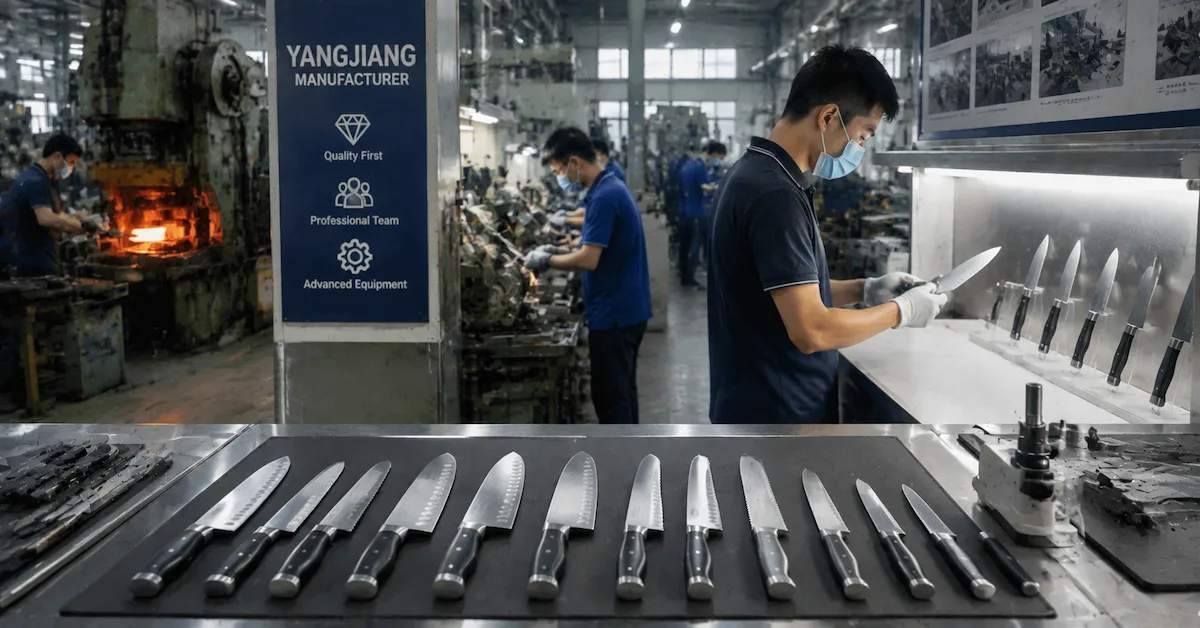
Choosing a Yangjiang knife manufacturer is not simply a matter of comparing photographs or asking which factory can offer the lowest unit price. For a kitchenware brand, distributor, or food-service supplier, the more important questions concern blade construction, repeatability across production batches, handle assembly, inspection discipline, and the manufacturer’s ability to manage several knife profiles at once. This article provides a practical framework for evaluating a factory producing chef’s knives, santoku-style knives, utility knives, paring knives, and serrated bread-style knives.
The available factory evidence shows a mixed range of kitchen knives with bright silver blades, black molded-looking handles, visible rivets on several models, and both smooth and hammered or granton-style blade surfaces. The production environment includes forming, assembly, and inspection activity. That is useful evidence of product scope, but it is not enough to confirm steel grade, hardness, edge retention, tang construction, dimensions, certifications, or output capacity. Those details must be verified during sourcing.
What a buyer should establish first
Before requesting a quotation, define the product decision. Are you buying one high-volume chef’s knife, a coordinated set, or a broad private-label assortment? A factory that can produce several silhouettes may be a good fit for a multi-SKU program, but breadth alone does not prove that every model uses the same materials or process controls.
- Product range: Confirm which chef’s, santoku, utility, paring, and serrated designs are standard products and which require new tooling or development.
- Blade construction: Ask whether each model is forged, stamped, or produced through a combination of forming methods. Do not assume the presence of heated forming equipment means every blade is hot forged.
- Material: Request the exact blade steel designation and the applicable material documentation. A bright silver finish may indicate stainless steel, but appearance does not identify the alloy.
- Geometry: Specify blade length, thickness, edge angle, grind style, handle dimensions, and total weight in the technical drawing or purchase specification.
- Assembly: Establish whether the handle is riveted, molded, mechanically fixed, or assembled through another method. The visible rivets on some models do not confirm the construction of the entire range.
- Inspection: Agree on how blade straightness, edge condition, surface finish, handle security, and cosmetic defects will be checked.
Reading the visible product and process details
The product assortment suggests a factory set up to support more than one kitchen knife format. Broad, curved chef’s knife profiles are suited to chopping and general food preparation. Shorter santoku-style blades may appeal to brands targeting compact, versatile kitchen tools. Narrow utility and paring knives address trimming and smaller preparation tasks, while a serrated bread-style knife serves products that require a toothed cutting edge rather than a conventional sharpened edge.
This variety can reduce the number of manufacturing partners required for a knife set. It can also introduce purchasing risk. Different profiles may use different blank dimensions, grinding sequences, heat-treatment conditions, handle parts, and inspection fixtures. A buyer should therefore request model-specific specifications rather than accepting a general statement that the factory produces kitchen knives.
Several blades show a dimpled or hammered-looking surface, commonly associated with a granton-style appearance. Such dimples may influence how food contacts the blade during cutting, but their visual presence is not proof of a particular cutting performance. The pattern, depth, location, and grinding quality should be evaluated on production samples. Smooth blades and serrated blades should be treated as separate technical products, with different edge inspection and sharpening requirements.
Materials, forming, and finishing
Blade steel and heat treatment
Blade steel is one of the first areas where a sourcing team should avoid assumptions. The supplied product view supports the description of a bright silver metallic blade, likely stainless steel, but the exact alloy is not shown. Stainless steel grades can differ substantially in hardness, corrosion resistance, toughness, sharpening behavior, and cost.
Ask for the proposed steel grade for each SKU and identify whether the same grade is used throughout the range. If heat treatment is part of the process, request a description of the controlled steps and the inspection method used to verify results. Exact hardness values should be specified only when the factory can support them with appropriate test documentation. A supplier’s general claim that a blade is “high hardness” is not a substitute for a defined requirement.
Forging, stamping, and grinding
The illuminated furnace and press-like equipment visible in the factory context suggest that heated metal forming may be used for some components. However, the image does not establish whether the knives are forged, stamped, or made through a combination of processes. This distinction matters because blank preparation, material flow, grinding allowance, and cost structure can differ between models.
Request a process flow for each proposed knife. It should identify blanking or forming, heat treatment where applicable, grinding, polishing, edge finishing, handle assembly, and final inspection. A process flow is particularly valuable when the buyer is developing several SKUs. It exposes where one model may require a different control plan from another.
Surface finishing also deserves a clear specification. Bright polished areas, hammered patterns, satin sections, and serrations can each show different cosmetic defects. Define acceptable limits for scratches, discoloration, uneven polishing, burrs, incomplete dimples, and inconsistent serration profiles. These are inexpensive details to overlook during sampling and expensive details to correct after retail packaging.
Handle and tang verification
Black handles with a smooth molded appearance and visible metal rivets are present across several displayed models. End caps or bolsters are also visible on some designs. That gives a useful starting point for a product brief, but the tang construction cannot be confirmed from the available information.
For commercial kitchen use, handle security and comfort should be assessed alongside appearance. Ask whether the proposed design uses a full tang, partial tang, or another internal structure. Confirm the handle material, rivet material, bolster design, joint condition, and resistance to movement after repeated use. These points should be reviewed with physical samples, not only product drawings.
Pay attention to the transition between blade, bolster, and handle. A visible gap, sharp corner, exposed burr, or poorly finished bolster can affect both user comfort and cleaning. If the knives are intended for food-service or hospitality channels, the handle should also be assessed for grip when wet and for areas where food residue could collect. Do not claim food-contact compliance unless the supplier provides the relevant evidence for the complete product.
A practical qualification process for buyers
A sensible qualification program starts with a written specification and a small sample review. The sample set should include the models that represent the greatest technical variation: for example, one broad chef’s knife, one dimpled blade, one narrow paring knife, and one serrated knife. This is more informative than sampling four nearly identical profiles.
- Issue drawings or controlled product sheets with dimensions, materials, edge requirements, handle details, finish, and packaging assumptions.
- Request pre-production samples and record all measured characteristics, including blade length, thickness, weight, handle dimensions, and edge geometry where relevant.
- Inspect the blade surface under consistent lighting. Check grinding symmetry, polish, dimples, serration uniformity, and visible damage.
- Evaluate handle assembly by checking alignment, rivet seating, bolster fit, and movement under reasonable manual pressure.
- Agree on an inspection standard before mass production. The standard should separate critical defects, functional defects, and cosmetic defects.
- Approve a reference sample or golden sample and require production to remain consistent with it.
Testing should match the sales channel. A retail gift set may place greater emphasis on appearance and packaging, while a restaurant supplier may focus more heavily on edge condition, handle durability, cleaning practicality, and repeatability. Either way, the test plan should be agreed in advance. A factory visit or third-party inspection can verify process activity, but neither replaces a clear product specification.
Common sourcing mistakes
The most common error is treating a product image as a technical datasheet. Images can show the number of visible designs, surface styles, handles, and factory areas. They cannot verify the blade alloy, edge angle, hardness, production capacity, minimum order quantity, lead time, certification status, or warranty.
Another mistake is requesting a very broad assortment without defining model ownership and revision control. If a supplier proposes several similar knives, record the exact handle, blade, finish, and packaging configuration for each SKU. Otherwise, substitutions can occur without being obvious until goods reach the market.
Buyers should also be cautious about using “forged,” “professional,” or “premium” as complete specifications. These terms may be useful marketing language, but they do not state how a particular knife was made or how it will perform. Convert them into measurable requirements wherever possible.
Questions to ask a prospective supplier
FAQ
Can the factory produce a complete kitchen knife set?
The visible assortment suggests capability across several common profiles and edge styles, so a coordinated set may be feasible. Confirm the exact models, shared components, tooling needs, and model-specific process controls with the supplier.
Are the blades stainless steel?
They appear likely to be stainless steel based on their bright metallic finish, but the exact alloy is not provided. Request the steel designation and supporting material documentation before approving production.
Are these knives forged or stamped?
The factory scene includes equipment that may support heated forming, but the process for each knife cannot be confirmed. Ask for a model-by-model process description rather than relying on the facility image.
Can the handles be customized?
Customization may be possible in an OEM or ODM program, but no specific options are verified here. Ask about handle materials, colors, logos, rivets, bolsters, tooling, and packaging as separate development items.
What should be included in a quotation request?
Include the knife profile, dimensions, blade material, surface finish, edge type, handle construction, logo requirements, packaging, inspection expectations, order quantity, and delivery requirements. This gives the supplier a basis for a comparable offer.
Next step for a sourcing team
Use the visible product range as a starting point, not as final proof of technical capability. Shortlist the models that fit your market, then request model-specific drawings, material information, samples, process details, and inspection criteria. A capable cutlery manufacturer should be able to discuss these points clearly and consistently. If your program requires multiple styles, also test whether the factory can maintain the same level of control across smooth, dimpled, and serrated blades.
For brands comparing a Yangjiang knife manufacturer with other supply regions, the right decision is rarely based on location alone. It depends on whether the supplier can convert a visual concept into a controlled specification and repeat that specification through production. A disciplined sample review and documented approval process will reveal far more than a catalog photograph.
