




How to Evaluate a Yangjiang Knife Manufacturer for Professional Kitchen Knives
Choosing a Yangjiang knife manufacturer is not simply a matter of comparing photographs and unit prices. For restaurant groups, distributors, catering suppliers, and private-label product teams, the real decision is whether a factory can repeatedly produce the required blade geometry, edge finish, handle construction, packaging, and quality level. This guide explains how to assess a supplier for santoku-style and general-purpose professional kitchen knives, including the practical questions to ask before approving a sample or placing an OEM order.
Why the Factory Decision Matters
A chef knife may look straightforward, but it passes through several manufacturing stages. Steel must be formed or blanked, shaped, heat-treated, ground, sharpened, finished, assembled, inspected, and packed. A weakness at any stage can affect the finished product. An attractive sample may not represent stable production if the supplier has poor process control or relies heavily on manual finishing without a defined inspection method.
For buyers, the risk is not limited to a blunt edge. Inconsistent blade thickness can change cutting feel from one production batch to the next. Poor handle assembly can create movement at the blade junction. Uneven scalloped recesses can affect appearance and may be difficult to reproduce in volume. Packaging and knife-block fit also become important when the product is sold as a set rather than as a loose individual knife.
The decision this article helps with is practical: should a buyer proceed with a particular factory, request a revised sample, or continue comparing suppliers? The answer should be based on documented capability and repeatability, not on a catalogue image alone.
Quick Reference: What to Check Before Ordering
- Product definition: Confirm blade style, intended use, dimensions, handle design, finish, and whether the knife is sold individually or in a set.
- Material disclosure: Ask for the proposed blade steel and handle material. Do not infer steel grade from a metallic or brushed appearance.
- Process control: Clarify how blanking, heat treatment, grinding, sharpening, and assembly are managed and inspected.
- Sample-to-production consistency: Require an approved reference sample and define which features must remain unchanged.
- Private-label readiness: Discuss logos, packaging, knife blocks, inserts, barcodes, and carton configuration early.
- Quality documentation: Request the inspection plan or agreed acceptance criteria rather than relying on general statements about quality.
Understanding the Knife Design
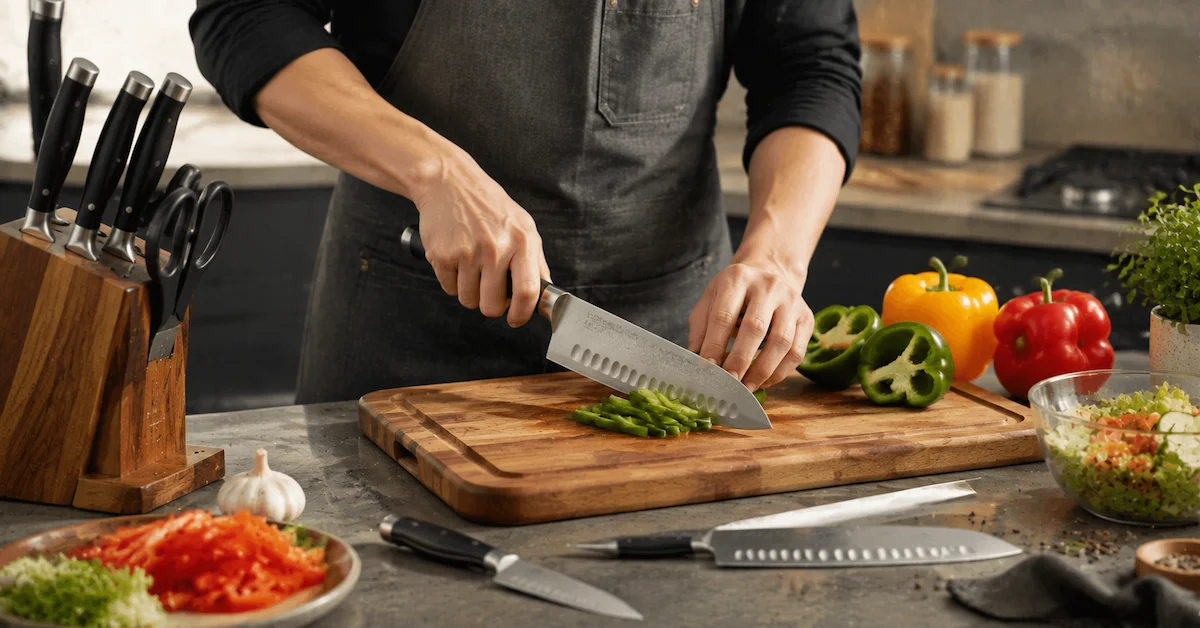
The visible product is a santoku-style chef’s knife with a broad, relatively short blade, a gently curved cutting edge, and a pointed front section. This geometry is suited to slicing, chopping, and dicing vegetables, herbs, meat, and other food ingredients. The broad blade can also help a user transfer chopped ingredients from the cutting board to a pan or bowl.
Several oval recesses appear above the cutting edge. These are commonly described as granton-style recesses and are intended to reduce food sticking during some cutting tasks. The visible design should not automatically be treated as proof of improved performance. The depth, spacing, edge shape, and production method all influence the result. A buyer should evaluate the actual sample with representative foods rather than approving the feature solely because it is visible in a product photograph.
The blade has a metallic satin or brushed appearance, but the exact steel type cannot be identified from an image. That point deserves emphasis. Steel grade, hardness, corrosion resistance, edge retention, and sharpening behavior should be confirmed through supplier documentation and agreed specifications. They should not be guessed from color, surface texture, or a marketing name.
The dark handle appears to include a metal bolster or collar at the blade junction. It may have visible fastening points, but the tang construction cannot be confirmed from the available product view. Full-tang construction, partial tang construction, handle material, and assembly method should therefore be treated as open specification items until the manufacturer provides clear information.
Manufacturing Stages to Discuss With a Supplier
Blade forming and geometry
Ask whether the blade starts as a stamped, laser-cut, forged, or otherwise formed blank. The correct choice depends on the target design, volume, tooling investment, and required appearance. The supplier should be able to explain how the broad blade profile, pointed front, cutting-edge curve, and recesses are produced.
For the scalloped recesses, possible methods include stamping, grinding, or machining. The exact process is not identifiable from the product image. What matters to a buyer is whether the method produces consistent location, depth, and edge transitions without visible distortion or sharp unintended marks.
Heat treatment and grinding
Heat treatment has a direct relationship with blade behavior, but buyers should avoid accepting vague claims. Ask what material is proposed, what characteristics are controlled, and how the supplier verifies the result. Unless agreed test data is provided, do not publish or assume a precise hardness value.
Grinding establishes the blade thickness profile and prepares the cutting edge. Inspect the sample under consistent lighting for hollow spots, uneven bevels, grinding lines, and abrupt transitions near the bolster. A knife can be visually attractive while still having an inconsistent edge profile, so hands-on inspection is important.
Sharpening, finishing, and assembly
Sharpening should be assessed for edge continuity from heel to tip. The specified edge angle, sharpness-retention target, and inspection method should be agreed rather than left to informal factory judgment. Surface finishing also needs a defined reference. “Satin” can mean different things to different suppliers unless the buyer approves a physical sample or controlled visual standard.
At assembly, check the fit between blade, bolster, and handle. Look for gaps, looseness, exposed adhesive, uneven rivets, or a handle that does not align with the blade centerline. If the knife includes a block set, confirm that each knife seats securely and can be removed without scraping the blade or damaging the block.
Evaluating a Chef Knife Factory Beyond the Sample
A credible chef knife factory should be able to discuss its process in operational terms. Ask who controls incoming steel, how blade blanks are checked, how heat treatment is recorded, and which dimensions are inspected after grinding. The supplier does not need to promise laboratory-level testing for every order, but it should provide a clear answer about what is measured and when.
Request a production sample made using the intended process, not a specially finished showroom piece. If the product will carry a private label, the logo application, handle color, surface finish, packaging, and knife-block configuration should be represented in the approval sample where possible.
It is also useful to separate cosmetic and functional acceptance criteria. Cosmetic criteria may include scratches, discoloration, logo placement, recess symmetry, handle alignment, and packaging damage. Functional criteria may include cutting performance, blade straightness, handle security, opening and closing condition of any packaging components, and safe storage in the block. Keep the criteria specific enough that two inspectors can reach a similar decision.
When an OEM Knife Manufacturer Is the Right Choice
An OEM knife manufacturer can be suitable when the buyer needs a custom handle, branded blade, special packaging, a knife-block set, or a product adapted for a particular distribution channel. OEM work usually introduces more variables than selecting an existing catalogue item. Tooling, artwork, packaging inserts, minimum order conditions, and sample revisions should be discussed before commercial approval.
Do not assume that a factory capable of making a standard santoku-style knife can immediately reproduce every custom feature. A deeper recess pattern, unusual bolster, colored handle, or non-standard block may require new tooling or a different production route. Ask the supplier to identify which parts are standard, which parts are modified, and which parts are newly developed.
Common Buyer Mistakes
- Inferring material from appearance: A satin metallic blade does not identify the steel grade.
- Approving from one photograph: Images rarely show edge symmetry, handle security, or block fit.
- Leaving dimensions informal: Blade length, overall length, weight, and handle dimensions should be written into the product specification.
- Ignoring the production method: A sample made by one route may not match a volume order made by another.
- Using broad quality language: Terms such as “premium,” “sharp,” or “durable” need measurable or visually defined acceptance criteria.
- Forgetting the use environment: Commercial kitchens, culinary schools, home users, and catering operations may have different expectations for storage, cleaning, and handling.
Practical Questions for a Supplier Meeting
Before moving forward, ask the manufacturer to identify the proposed blade material, handle material, tang construction, blade dimensions, overall dimensions, surface finish, and sharpening specification. Confirm whether the knife is supplied individually or with a wooden countertop block and other accessories such as kitchen shears.
Ask for details on the approval process: how many samples are included, how revisions are recorded, what constitutes a production deviation, and how packed goods are inspected. If the supplier cannot yet provide a final answer, record the item as open rather than filling the gap with an assumption.
FAQ
Is the pictured knife definitely made from a particular steel?
No. The steel type cannot be identified from the visible appearance. The buyer should request the proposed grade and relevant documentation from the supplier.
Are the oval blade recesses guaranteed to prevent food from sticking?
No. They are commonly intended to reduce sticking, but actual performance depends on the recess design, blade geometry, food, cutting technique, and surface condition.
Can the knife be sold as part of a set?
The visible wooden block suggests a set configuration may be possible, but it is not confirmed whether the product is sold individually, as a set, or in multiple configurations. Confirm the commercial offering and packaging details.
What should be checked before a purchase order?
Approve a representative sample, finalize the written specification, agree inspection criteria, confirm packaging and branding, and verify that the supplier will use the approved production route.
Next Step for Buyers
Prepare a short technical brief before contacting a Yangjiang knife manufacturer. Include the knife style, intended users, blade and handle requirements, visible finish, recess design, packaging format, branding needs, and inspection expectations. Then ask each candidate supplier to respond against the same brief. That comparison will reveal more than a catalogue review and will help distinguish a capable manufacturing partner from a seller offering only a polished sample.
