




Wholesale Kitchen Scissors for Retailers: Bulk Supply & Factory Insights
For retailers, importers, distributors, and private label kitchenware brands, sourcing wholesale kitchen scissors is not only a price negotiation. The more important question is whether a supplier can deliver consistent cutting performance, retail-ready packaging, clear communication, and repeatable quality across multiple purchase orders.
Common sourcing problems include inconsistent blade sharpness, weak hinge durability, packaging that does not display well in stores, and delayed shipments during seasonal demand. These issues can create returns, poor reviews, and gaps on retail shelves. A better sourcing process starts with defining the product use case, comparing suppliers carefully, and asking practical factory questions before confirming a bulk order.
Key Takeaways
- Do not evaluate wholesale kitchen scissors by unit price alone; check consistency, packaging, and after-order support.
- Ask suppliers how blade sharpness, hinge movement, handle fit, and final packaging are inspected before shipment.
- For OEM or private label orders, confirm logo method, packaging artwork requirements, sample approval steps, and carton marking details.
- Request commercial details such as MOQ, lead time, sample cost, payment terms, and available product models directly from the supplier.
Why Retailers Source Kitchen Scissors in Bulk
Kitchen scissors are widely used in household kitchens and commercial food preparation because they can handle tasks such as trimming ingredients, cutting packaging, and general kitchen utility work. Retail buyers often include them in kitchen tool ranges, supermarket displays, online bundles, and private label collections.
Bulk sourcing can help buyers create a stable assortment, but it also increases risk if specifications are unclear. A small difference in blade edge, screw tightness, handle comfort, or packaging quality may not be obvious in a single sample, yet it can become a problem across thousands of units. This is why retailers should treat kitchen scissors as a product that requires structured inspection rather than a simple commodity purchase.
Product Types to Clarify Before Ordering
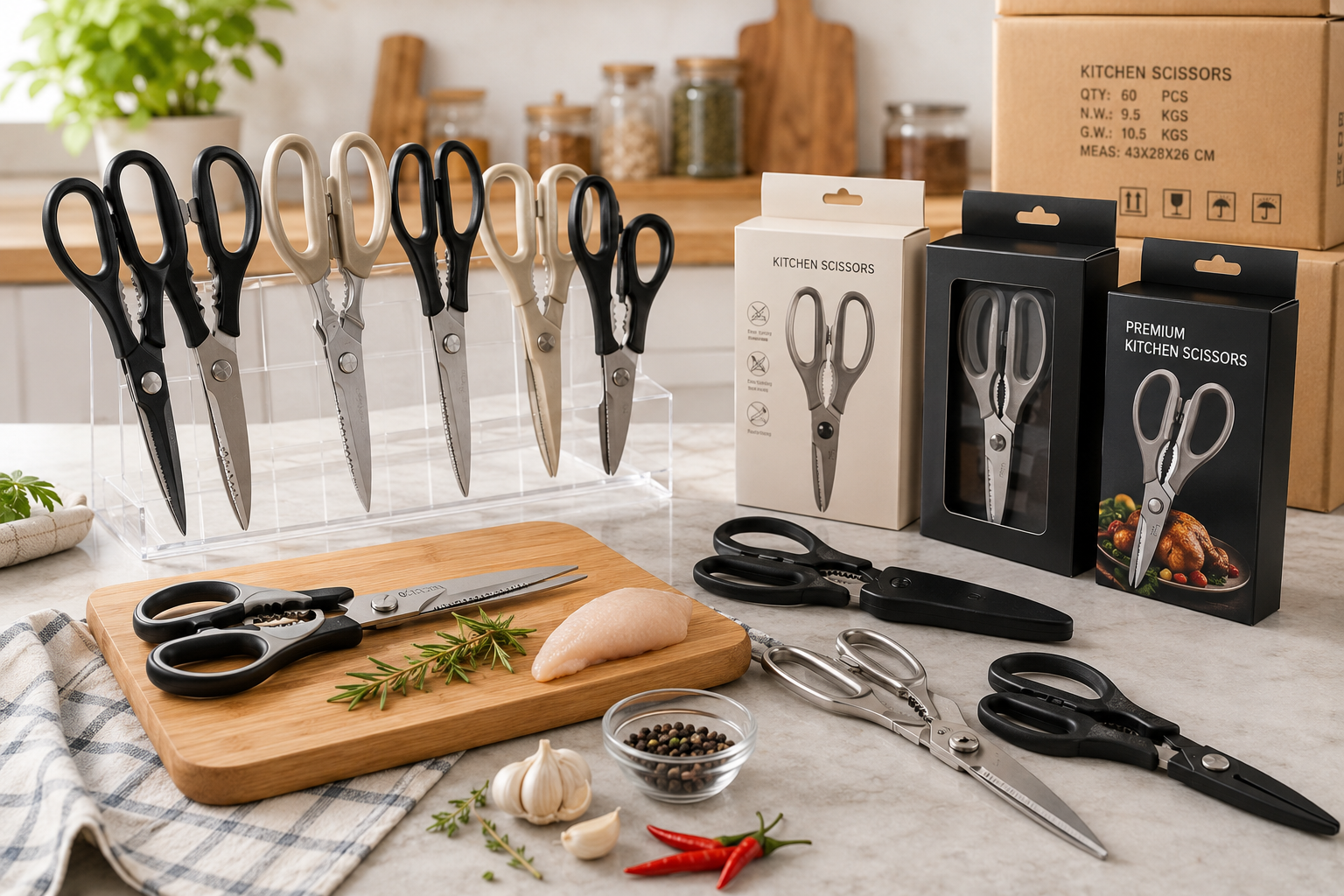
The original product category may include several styles, and each style serves a different buyer need. Common types mentioned for wholesale kitchen scissors include multi-purpose kitchen scissors, poultry scissors for meat cutting, household utility scissors, and heavy-duty stainless steel scissors. Before requesting a quotation, define which type fits the sales channel and target user.
Useful product-selection questions include:
- Will the scissors be sold for general kitchen use, poultry cutting, or household utility tasks?
- Does the retail channel require hanging card, blister packaging, or color box packaging?
- Should the item support OEM/private label branding?
- What sample tests will be used to compare sharpness, grip comfort, and opening/closing smoothness?
- Are replacement orders expected throughout the year, or is the order a one-time promotion?
Factory, Trading Company, or Wholesaler: What to Compare
Some importers prefer to work directly with a kitchen scissors manufacturer, while others buy through trading companies or kitchenware wholesalers. There is no single best option for every buyer. The right choice depends on order size, customization needs, communication expectations, and the buyer’s ability to manage quality control.
| Sourcing option | Best for | Questions to ask |
|---|---|---|
| Factory or manufacturer | Repeat bulk orders, OEM packaging, private label programs | What production steps are handled in-house? How are samples approved? What QC records can be shared? |
| Trading company | Mixed kitchenware orders and buyers needing sourcing support | Which factory makes the scissors? Who handles inspection? Can specifications remain consistent in repeat orders? |
| Wholesaler or distributor | Smaller replenishment orders and faster stock availability | Are products already in stock? Can packaging be customized? Are the same models available for future orders? |
Manufacturing and Quality Control Points to Discuss
A professional sourcing conversation should cover more than product photos. Kitchen scissors typically involve material selection, blade forming, sharpening, assembly, surface finishing, and packaging. Buyers should ask the supplier to explain how these steps are controlled for the specific model being quoted.
Quality control should focus on measurable and visible details. Ask how incoming materials are checked, how blade sharpness is evaluated, how hinge or screw tension is controlled, and how final goods are inspected before packing. If the scissors have safety locks, ergonomic handles, corrosion-resistant surface treatment, or other promoted features, request confirmation of how those features are verified for the order.
For larger retail programs, consider arranging pre-production samples, packaging samples, and pre-shipment inspection. Buyers should also keep an approved sample as a reference for future repeat orders.
OEM and Retail Packaging Considerations
OEM customization is a major requirement for many retailers and private label brands. The original article notes common options such as private label printing, blister packaging, color box packaging, hanging card packaging, and OEM packaging design. These options can improve shelf presentation, but they also add approval steps and possible delays if artwork is incomplete.
Before production, confirm the logo placement, printing method, packaging dimensions, barcode position, warning text requirements, carton marks, and language versions. Do not assume that all packaging formats are available for every model. Ask the supplier which packaging options match the selected scissors and whether a physical packaging sample can be reviewed before mass production.
Commercial Questions Buyers Should Ask
Because commercial terms vary by model, customization level, destination, and order volume, buyers should request written answers instead of relying on assumptions. Ask about MOQ, sample availability, production lead time, packaging charges, export carton details, payment terms, and whether repeat orders can use the same approved specification.
It is also useful to ask how peak-season scheduling is handled. Delayed shipments are a common issue in retail supply chains, so buyers should confirm order cut-off dates, sample approval deadlines, and expected production timelines before launching seasonal promotions.
Practical Supplier Checklist
- Request clear product photos, dimensions, and available model options.
- Ask whether OEM/private label packaging is supported for the selected model.
- Confirm the inspection process for blade sharpness, hinge movement, handle assembly, and packaging.
- Review a physical sample before confirming a large purchase order.
- Keep written records of approved artwork, product details, carton marks, and delivery terms.
- Ask what happens if a shipment does not match the approved sample or order specification.
FAQ
What is the MOQ for wholesale kitchen scissors?
MOQ depends on the model, packaging choice, customization level, and supplier policy. Buyers should ask for MOQ by specific item rather than by general category.
Can kitchen scissors be customized for private label retail?
Many suppliers support OEM options such as logo printing and retail packaging, but availability depends on the product and order details. Confirm artwork requirements and sample approval steps.
Which packaging is common for retail sales?
Common packaging options include blister packaging, color boxes, and hanging card packaging. The best option depends on the sales channel, display method, and branding plan.
How should buyers check quality before bulk ordering?
Review samples for cutting feel, blade alignment, hinge smoothness, handle comfort, finish, and packaging strength. For larger orders, consider pre-shipment inspection.
What information is needed for a quotation?
Provide the target model, estimated quantity, packaging type, logo or artwork needs, destination market, and expected delivery schedule. Clear details help suppliers quote more accurately.
Conclusion
Wholesale kitchen scissors can be a reliable retail category when buyers manage sourcing with clear specifications and practical quality checks. Instead of choosing only by the lowest price, compare supplier capability, packaging support, inspection process, and repeat-order consistency. For Bonet Houseware or any kitchen scissors supplier, the strongest approach is to ask specific questions, approve samples carefully, and keep all commercial and product requirements documented before production begins.
