




Quick answer: A retailer searching for a kitchen gadget supplier China partner should begin with an approved product task—not a large catalog or a promised unit price. Build a small assortment around specific jobs, test each function under repeatable conditions, record material and packaging specifications, and establish a production-to-reorder approval system. For a first discussion with BONET HOUSEWARE, four publicly listed tools provide useful starting points: M054 for peeling, M028 for garlic preparation, M031 for knife maintenance, and U103 for gripping and serving food. Their published features make them useful examples; their final fitness for a buyer's market still requires samples, current specifications, documentation, and a project-specific quotation.
A multi-SKU program is harder to manage than buying one peeler. Each tool has a different moving mechanism, user-contact risk, cleaning method, packaging need, and reason to earn space on a retail shelf. A peeling blade needs to cut consistently; a garlic tool must process food without trapping excessive residue; a sharpener needs clearly defined compatible knives and safe handling; and cooking tongs must retain their grip under intended use. Treating all four as interchangeable “kitchen gadgets” hides the decisions that affect returns, margins, and repeat orders.
This guide explains how importers, supermarket buyers, distributors, e-commerce sellers, and private-label teams can use one practical function-test matrix to qualify a focused kitchen-tool range. It draws on BONET's published product information and stated OEM/ODM services; proposed tests and buying controls are recommendations for purchasers, not claims that BONET has already completed them for every SKU.
1. What Should a Kitchen Gadget Supplier in China Actually Help You Decide?
For most B2B buyers, the first question is not “Can you manufacture kitchen gadgets?” It is “Can the right products be supplied with consistent functions, verified materials, realistic packaging, and repeatable commercial terms?” A relevant supplier should be able to connect the customer's sales channel to an appropriate product or development route and explain where the remaining decisions sit.
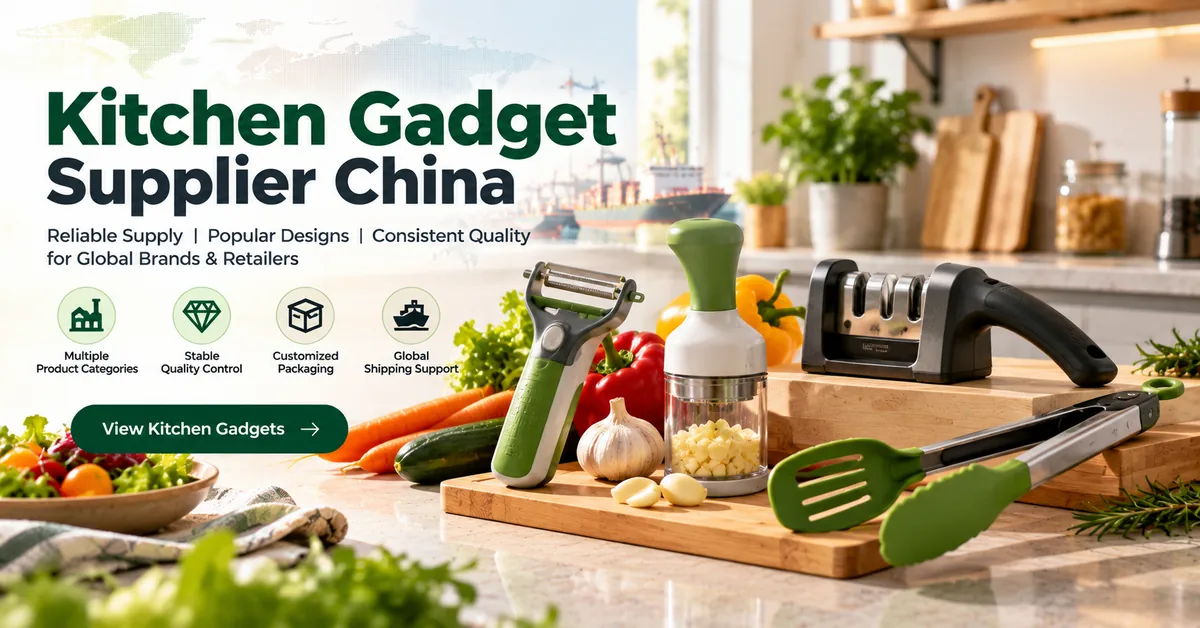
Four kinds of support matter. Product selection establishes whether a catalog item solves a real task and suits the user. Technical communication identifies the important components, dimensions, finishes, test methods, and possible constraints. Commercial coordination keeps MOQ, customization, packaging, price, delivery basis, and lead-time assumptions clear. Reorder control preserves the approved product, carton, artwork, and inspection version rather than relying on a photograph from the first purchase.
BONET HOUSEWARE CO., LTD. describes kitchen gadgets, multifunctional tools, scissors, kitchen knives, utensils, and chopping boards among its online product areas. Its OEM/ODM page states that buyers can discuss production against drawings or samples, material and color options, logo methods, packaging, sampling, inspection, and production coordination. That is a reasonable basis for an RFQ, not evidence of a single universal MOQ or guarantee that every requested product can be built with every material.
Best-fit customers include kitchenware importers, private-label brands, supermarket category managers, houseware wholesalers, and online retailers developing a coherent prep-tool group. A purchaser requiring a certified medical instrument, a factory-validated industrial machine, or an unlisted regulated electrical appliance should not assume these categories fall within BONET's current kitchen-gadget scope. Ask for a named product and a precise capability confirmation before committing.
2. Start With Four Consumer Tasks, Not Four Advertising Claims
A buyer searching for kitchen gadget supplier China will often encounter long catalogs, but product selection should start with a simpler question: What job becomes easier, more controlled, or more convenient because this item exists? A product may have three features and still fail the one task customers care about. Conversely, a simple tool can outperform a multifunctional alternative if it is easier to clean and comfortable to use.
Consider four distinct tasks: peel and prepare vegetables; process garlic; maintain an appropriate knife edge; and lift, turn, or serve food. They cover different moments in the kitchen, so they can form a merchandising story without pretending to be a single interchangeable tool set. The products also provide a useful range of quality risks: sharp edges, internal food-contact cavities, abrasive mechanisms, and articulated or joined grips.
For an online retailer, product photography should demonstrate a task with the real production version. For a supermarket, the task must be legible from packaging and display within seconds. For a distributor, the benefit must be explainable to retailers without an elaborate training video. Those different environments should shape product selection before samples are requested.
The four-tool approach does not mean every buyer should order all four SKUs or that they are sold by BONET as a fixed package. It is a proposed evaluation set. Start with the tasks that match your category strategy and remove a tool if the channel, margin, evidence, or function does not justify it.
3. Verified BONET Product References: M054, M028, M031 and U103
The following comparison uses publicly displayed product identifiers and specification fields. Buyers should confirm the latest drawings, component details, prices, availability, and final sample revisions directly. Published specifications do not substitute for a signed production specification.
| BONET model | Product and primary task | Published materials | Published dimensions | First buyer question |
|---|---|---|---|---|
| M054 | 3-in-1 vegetable peeler; peeling and preparation | 420 stainless steel; PP plastic | L: 18 × 10.8 × 2.5 cm; M: 15.1 × 9.2 × 2 cm; S: 13 × 6 × 2 cm | Which blade functions and size are included in the quoted SKU? |
| M028 | Lazy Garlic Pounder; garlic preparation | 420 stainless steel; ABS plastic | 10 × 9.5 cm | How is the tool disassembled, cleaned, and checked for blade retention? |
| M031 | Dual-stage knife sharpener; knife maintenance | 420 stainless steel; PP plastic (catalog fields) | 12.3 × 5 × 6 cm; 108 g | Which knives and sharpening stages are compatible with the approved unit? |
| U103 | 2-in-1 spatula tongs; lifting, turning and serving | 420 stainless steel; NYLON in plastic-material field | 27.5 × 8 × 4 cm | Which actual components are nylon or silicone, and what use conditions have evidence? |
The M054 page describes straight, serrated, and julienne blade functions. The M028 page describes a hand-operated garlic-preparation design; its public text also mentions a transparent section, but a buyer should verify its exact material and final configuration. The M031 page describes coarse and fine sharpening stages. The U103 listing identifies a combined spatula-and-tongs concept, but its descriptive text mentions silicone while the structured material field says nylon. Do not publish a single-material claim for U103 until BONET resolves that discrepancy for the exact product revision.
Open the actual product references: M054 3-in-1 Vegetable Peeler, M028 Lazy Garlic Pounder, M031 Dual-Stage Knife Sharpener, and U103 Multifunctional Spatula Tongs.
Product names and website categories can overlap: some kitchen gadgets appear in BONET’s Multi Functional collection or as individual product pages. Use the four verified model pages for initial sourcing and request BONET’s latest availability and quotation list rather than assuming every website category is a complete live inventory.
4. Turn Product Promises Into Repeatable Function Tests
To turn a kitchen gadget supplier China search into a buying decision, start with a four-task test matrix. Its purpose is not to impose invented pass/fail numbers on BONET. It is to help a buyer agree on the same evaluation conditions before approving samples and mass production. Record the sample ID, task material, operator instructions, test repetitions, observed result, failure definition, and responsible approver.
| Task and candidate | Practical test setup | Observation and evidence | Example rejection concern |
|---|---|---|---|
| Peel — M054 | Agreed produce type, maturity and test instructions; each approved blade mode | Output consistency, user force, blade security, comfort and cleaning access | Loose blade, unpredictable cutting or inaccessible residue trap |
| Prepare garlic — M028 | Agreed garlic size and amount; repeated operation and wash-down | Processing completeness, mechanism action, assembly fit, trapped residue | Misaligned moving part, cracked body or difficult-to-clean food cavity |
| Maintain knife — M031 | Compatible reference knife, controlled initial condition and approved instructions | Stability, guard position, sequence clarity and observable result | Slipping base, unclear compatibility or unsafe hand position |
| Lift/serve — U103 | Specified food weight, grip positions and approved hot/cold-use conditions | Jaw alignment, retention, hinge feel, head attachment and cleaning | Loose joint, poor hold or unsupported temperature claim |
The buyer should set acceptance limits based on the intended market and supported use—not invent performance numbers from a catalog description. A useful test report answers three questions: Did the tool perform the task? Can the end user perform it safely under the stated instructions? Can the supplier reproduce the approved construction across a production lot?
Every sample needs a reference code. A photograph of an attractive peeler cannot demonstrate how its blades behave; a glossy image of a garlic tool cannot show how its hidden cavity cleans. Retain a physical golden sample and a short video of the agreed operating method whenever practical. If the product changes, create a new revision and repeat any affected tests.
5. M054: Evaluate the Three Functions Separately
A three-in-one peeler is attractive to a retailer because it promises more function within one compact purchase. Yet that promise creates a quality-control obligation: straight peeling, serrated handling, and julienne cutting are three different user expectations. Inspecting only appearance or only the main blade is insufficient.
Begin with the exact size version that will be sold. The BONET M054 page lists L, M, and S dimensions; it does not mean a quoted price automatically includes all three sizes. Confirm whether the intended assortment uses one size, several sizes under separate barcodes, or an agreed bundle. Record blade configuration, handle color, labeling, protective packing, and cleaning instructions by SKU.
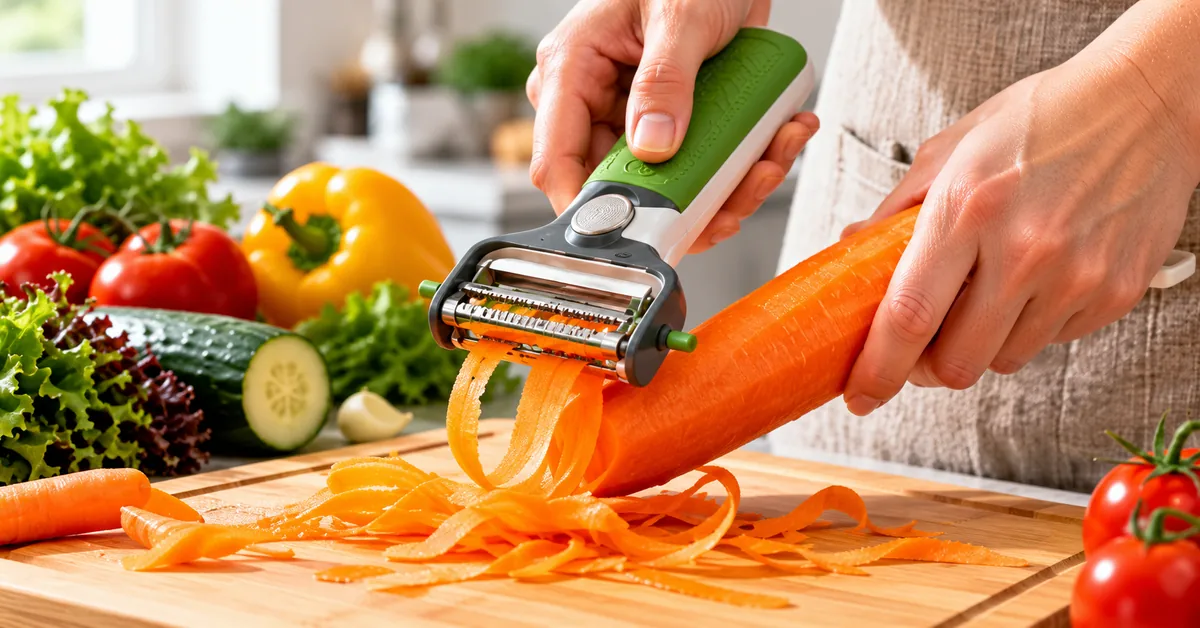
For a practical evaluation, assign produce appropriate to each function and use the same reference material and instructions across candidate samples. Observe whether the blade bites too aggressively, skips, clogs, or requires uncomfortable wrist movement. Check for exposed points when the tool is stored, and confirm whether covers or accessories shown in marketing images actually belong to the ordered product.
Recommended quality gates are secure blade attachment, smooth molding without sharp flash, stable handle fit, correct included components, understandable function labels, and accessible cleaning surfaces. A good demonstration video should show the real unit and its limits; the phrase “three functions” is not evidence of universal performance on every vegetable.
For commercial decisions, M054 can serve as an anchor item for a vegetable-preparation range or as a companion to a knife and board offer. However, marketing the peeler as suitable for young children, all foods, or professional high-volume service requires additional verification. A clear target-use claim usually converts better than an unsupported promise to do everything.
6. M028: Make Cleaning and Assembly Part of the Buying Decision
Garlic-preparation tools solve a repetitive cooking task, but their design introduces a special concern: food particles may lodge in joints, inserts, cavities, or moving components. Buyers should assess cleanability and component retention with at least as much care as visual processing speed.
BONET lists M028 as a Lazy Garlic Pounder and publishes a 420 stainless steel and ABS material combination with dimensions of 10 × 9.5 cm. That information helps identify the reference, but it does not provide a verified food-contact report, a dishwasher-safe declaration, or a universal processing capacity. These details require confirmation for the finished product.
A sample trial should record the preparation size, number of operations, observable output, opening or disassembly method, accessible surfaces and post-wash condition. Look for retained garlic in concealed spaces, difficult edges, and movable parts that can separate unintentionally. Ask whether any component is intended to be removed by the customer and, if so, what assembly instruction accompanies it.
The product may be appropriate for e-commerce demonstration because its task can be shown quickly. That creates a corresponding listing obligation: the demonstration must not exaggerate the result, conceal necessary steps, or imply cleaning instructions that have not been approved. Buyers who plan a giftable prep set should also confirm that every component is individually protected and accurately shown on the box.
A supplier conversation should identify the food-contact components, applicable materials, blade-retention checks, packaging protection and possible alternate colors. The result should be a measurable purchase specification rather than an exchange of adjectives such as “easy,” “premium,” or “perfect.”
7. M031: Handle Knife-Sharpening Claims More Carefully
A compact sharpener has a different risk profile from a peeler. The buyer must establish which knives it is intended to maintain, how the stages operate, and where a user's hand should be placed. Without an approved compatibility statement and use instructions, claims such as “works on all knives” or “professional-grade results” can create avoidable complaints.
The M031 page identifies a dual-stage knife sharpener with a coarse/fine concept, a 12.3 × 5 × 6 cm body, an indicated 108 g weight, and catalog material fields of 420 stainless steel and PP. It does not establish the precise composition of every abrasive component or validated suitability for ceramic, serrated, single-bevel, or specialty knives. Ask BONET for the current internal component list and compatible-use guidance.
For evaluation, use reference knives representing the intended sales claim. Fix the initial condition and user instructions; assess stability on the worktop, hand clearance, correct staging, visible wear or shedding, and the resulting condition using an agreed assessment method. Do not improvise a potentially hazardous demonstration to make a sales claim. Use trained evaluators and the manufacturer's applicable safety instructions.
A distributor may regard M031 as an attachment product alongside knives, but the package should state compatibility limitations and warn against inappropriate use where relevant. The knife itself may be the higher-value sale; the sharpener becomes valuable when it gives customers a practical maintenance option they can understand.
If a supplier proposes different abrasive inserts or body colors, obtain a revised sample and documentation. An identical outer shell does not prove an identical internal function. The buyer's approval file should distinguish cosmetic changes from component changes that affect performance or instructions.
8. U103: Verify Material Fields Before Promising Heat Use
The U103 is relevant to a kitchen-gadget discussion because it combines spatula and tong actions. It also demonstrates why product pages must be checked beyond the marketing headline. BONET's structured listing shows 420 stainless steel and NYLON with dimensions of 27.5 × 8 × 4 cm, while descriptive content refers to silicone. Those statements are not sufficiently consistent to support a definitive claim about all contact components.
Resolve the issue in writing. Ask which exact part is stainless steel, nylon, silicone, or another material; what the intended contact conditions are; and which cleaning and temperature instructions are supported for the approved version. Do not transfer a heat-resistance statement from a generic silicone article to a particular U103 order.
A function trial should test grip, release, alignment, joint stability and ease of cleaning using agreed foods and conditions. A tong that grabs food securely but cannot release it cleanly may create frustration. A spatula surface that bends excessively for the intended task may not meet the buyer's claim even if it looks attractive in photographs.
U103 may be more naturally merchandised with kitchen utensils than with peeling tools. This is an example of cross-category assortment planning, not evidence that it is stocked in the same gadget collection. Buyers should decide whether its role is a companion SKU, a separate utensil line, or a bundled item—and price the packaging accordingly.
9. Which Materials and Components Need Their Own Evidence?
Many kitchen gadgets combine metal blades, molded plastics, pivots, abrasive elements, soft grips, inserts, coatings, or removable parts. Material words alone do not prove finished-product safety or performance. “420 stainless steel” identifies a general steel designation; it does not provide hardness, corrosion performance, edge retention, or a test result for that particular component.
Similarly, PP, ABS, nylon, and silicone describe broad material families. Actual behavior depends on grade, additives, geometry, processing, contact conditions and finished-product construction. A food-contact declaration for a resin does not automatically establish compliance of every finished product, color or accessory. Ask the supplier for component-level material details and evidence relevant to the destination market.
Create a bill-of-materials summary listing the food-contact parts, hand-contact parts, moving joints, sharp elements, coatings and printed marks. Mark any uncertainty as an open question. If the buyer changes a color, coating, lubricant, adhesive, or contact component, review whether earlier documentation still applies.
This information also improves return analysis. A cracked ABS body, a loose steel blade, a worn abrasive slot, and a weak nylon joint are different failures requiring different corrective actions. One generic “defective kitchen gadget” category provides little useful feedback for the next order.
10. How Do Manufacturing Methods Affect Consistency?
Small kitchen tools may involve metal forming or stamping, grinding, molding, assembly, surface finishing, cleaning and packaging, but not every BONET model necessarily uses every process or receives every step inside the same facility. The correct buyer question is: Which process and quality checkpoint controls the function that matters for this SKU?
For M054, focus on blade geometry, attachment and molding around contact areas. For M028, focus on the alignment and security of moving components. For M031, identify the origin, installation and checks of the sharpening elements. For U103, investigate the joint, head material and assembly integrity. Ask for a simple process map with incoming, in-process and final checks rather than assuming a factory video proves each item is made identically.
BONET describes quality inspection, packaging and delivery in its official OEM/ODM collaboration process. The buyer should turn that description into order-specific evidence: approval sample, drawing revision, critical dimensions, sample test results, agreed defect guide, packing confirmation and final inspection records. Factory scale and historical certifications do not replace product-level evaluation.
An importer can request photos or video from the relevant production stage when useful, but remote media should supplement—not substitute for—physical samples, supporting documents and suitable inspections. Also confirm whether a specialized subcomponent is purchased externally and which party remains accountable for the final unit.
12. Market Documentation: Food Contact, Safety and Claims
Because some kitchen gadgets contact food, regulatory evidence is part of purchasing—not a final marketing embellishment. For the EU, the European Commission identifies Regulation (EC) No 1935/2004 as the general food-contact framework and Commission Regulation (EU) No 10/2011 as a central plastics measure, with amendments and additional rules depending on the material and article. The precise obligations depend on composition, intended conditions, and market. For the United States, assess the applicable FDA food-contact framework for the actual substances and uses.
These are general buyer due-diligence references, not statements that BONET's M054, M028, M031 or U103 has been certified under those rules. Before making a claim, request current evidence that identifies the tested article or formulation, the issuer, the test scope, relevant conditions and date. Different components and colors may require additional review. The sharpener also requires user safety and compatibility evaluation beyond simple material questions.
Claims such as “BPA-free,” “dishwasher safe,” “heat resistant,” “antibacterial,” “eco-friendly,” and “safe for every knife” should appear only where the precise claim is supported for the product sold. Cleanable does not necessarily mean dishwasher safe; stainless steel is not a guarantee of corrosion resistance under every condition; and a plastic label does not establish every chemical requirement.
Ask the supplier to separate available evidence from new tests required for your market. Identify the party responsible for testing costs and artwork approval. A verified, narrow claim is commercially more durable than a broad promise that a retailer later needs to retract.
13. Match Packaging to the Channel and the Actual Task
Different tasks require different presentation. A peeler needs secure edge protection; a garlic tool may need a simple function demonstration; a knife sharpener needs compatible-use instructions and controlled access to potentially abrasive or sharp elements; and spatula tongs need a pack that prevents deformation and clearly identifies the materials used.
| Sales channel | Typical packaging priority | Common preventable issue |
|---|---|---|
| Supermarket | Clear function, barcode, brand, safe hanging or shelf format | Feature claims too small or hidden by the pack |
| E-commerce | Compact protected parcel, accurate dimensions and instructions | Loose tools damage the box or arrive with displaced components |
| Distributor | Case-pack consistency, carton labels, efficient storage | Different SKU/carton mixes not identified consistently |
| Promotional or gift | Coherent presentation, approved brand marks and contents | A photographed accessory is missing from the shipped set |
| Kitchenware specialist | Detailed material and use instructions | Sales claims exceed the verified application |
BONET's OEM/ODM information lists color boxes, gift boxes, retail packaging, barcode labels and export cartons as available service categories. Availability for a chosen model, print run, format, carton quantity and unit price must still be confirmed in the quote. A shared packaging system across a four-product range may simplify shelf presentation, but blades and shapes often require distinct protective inserts.
Inspect the packed sample, not only an artwork PDF. Check barcode scan, logo alignment, pack contents, sharp-edge protection, labeling language and how the cartons survive the agreed transport route. If the buyer uses multiple marketplaces or regions, track each packaging revision separately.
14. Compare the Whole Program Cost, Not a Single Unit Price
Once a kitchen gadget supplier China candidate is shortlisted, the buyer must compare full program economics: a low-priced gadget is not necessarily a low-risk retail SKU. A stronger purchasing decision considers the total cost of delivering a saleable, correctly labeled product to the intended sales channel. A tool with an extra moving part may cost more to inspect and protect. A colorful retail box can increase cube or require a separate printing minimum. A slow-moving variant can consume working capital long after the initial sale window.
For comparison, use landed cost per saleable unit = all attributable product, packaging, freight, duty, inspection and related costs divided by the expected saleable quantity, taking care not to count defects or losses twice. Use current freight, tariff and tax information from competent parties rather than a generic price published for another country.
| Cost bucket | Per-SKU question | Why it changes the decision |
|---|---|---|
| Product | Same revision, blade/mechanism, materials and quantity? | Prevents an apparent price difference caused by a different product |
| Setup and tooling | One-time, shared, refundable or amortized? | Changes economics for small or repeat orders |
| Branding | Logo method, color setup, approved artwork? | May introduce separate minimums |
| Packaging | Unit pack, insert, barcode and master carton? | Affects shelf readiness, freight cube and damage |
| Verification | Samples, testing, inspection and corrective action? | Makes true launch risk visible |
| Logistics | Trade term, named place, carton dimensions and route? | Determines who pays for each movement |
| Inventory | SKU/color splits, forecast and safety stock? | Avoids stranded packaging or slow variants |
Request prices for the same specification and named trade term. Ask the supplier to separate standard catalog items from modified OEM versions and entirely new ODM concepts. A useful quote clearly marks what is confirmed, what needs technical review, and what remains an assumption.
15. MOQ, Capacity and Lead Time: Ask Per SKU, Not Per Website
Manufacturing and purchasing minimums can come from different sources: component batches, plastic color preparation, tooling cycles, printed sleeves, special cartons or assembly. The fact that a supplier offers OEM does not establish a single order minimum for every gadget. Confirm MOQ for M054, M028, M031 and U103 individually, including any minimum by color, size or packaging version.
Also separate sample timing, tooling or development timing, production, inspection, and transport. A production estimate starts only when essential materials, samples and artwork are approved. If the buyer has an urgent product launch, the most useful question is which milestones can be confirmed today, which need a buyer decision, and which depend on third-party suppliers.
A multi-SKU shipment adds a coordination problem: one late item can hold an entire consolidated order. State whether partial shipments are acceptable, which items have priority, and who pays for split freight if the schedule changes. Define whether the promised delivery milestone is factory completion, handover to a forwarder, port departure or arrival at destination; the Incoterms rule and named place matter.
No fixed BONET MOQ, capacity number, delivery period or unit price is implied by this guide. Obtain those from a current quotation tied to the exact order.
16. Where OEM, Private Label and ODM Add Real Value
Private-label kitchen gadgets are not only generic items with a logo. A buyer may need one coherent visual language across different mechanisms: matching handle tones, packaging system, product names, brand mark placement and clear instructions. The challenge is to coordinate appearance without weakening the function or overpromising what the materials can do.
Standard or light private label is usually the simplest route when the existing product meets user needs and only approved branding or packaging changes are requested. OEM fits a buyer supplying a reference sample, drawing, or defined modification. ODM becomes relevant when the mechanism, handle, internal structure or product concept needs development assistance. BONET describes all three service directions, but feasibility and ownership of new designs must be agreed case by case.
For the four-tool range, a sensible first customization may be a shared retail sleeve or controlled color theme. A new blade mechanism for M054 or a structural revision to U103 is a substantially different project and may require engineering review and tooling. Ask the supplier to label every change as cosmetic, component, structural or packaging-related, then identify which tests must be repeated.
Discuss logo file formats, possible marking locations, color references, artwork proof, traceability, who owns tooling and design files, intellectual-property responsibilities, and the route for replacement components or changes on a second order. A reliable partnership depends on written revisions, not a promise that “everything is customizable.”
17. A Four-Week Sample Evaluation Sprint Buyers Can Adapt
A fixed four-week calendar is an illustrative buyer-side evaluation workflow, not BONET's claimed factory lead time. Its goal is to replace an endless sample discussion with a decision record. If samples or test documents take longer, extend the schedule rather than making an unsupported launch promise.
Week 1 — Define. Choose the customer, channel and one task per candidate SKU. Build a comparison sheet with model, sample revision, published material data, critical questions, pack concept and required market evidence. Send the same brief to all shortlisted providers. Assign a technical and a commercial approver.
Week 2 — Test. When samples are available, perform the approved real-task evaluations: M054 blade functions, M028 assembly and cleaning, M031 stability and compatibility, U103 grip and material identification. Record observations and photos, not just a score. Mark every unknown claim as pending.
Week 3 — Cost and pack. Review boxed samples, carton dimensions, artwork, barcode, landed cost assumptions, MOQ by variation, sample and tooling costs, and the inspection plan. Remove SKUs with unresolved fundamental risk rather than keeping them solely because they photograph well.
Week 4 — Decide. Approve, revise, hold or reject each candidate independently. Issue a small but complete item master: approved product and package revision, mandatory documents, key function checks, commercial assumptions, and release owner. Only then request the final purchase order and production schedule.
The most valuable output is not a four-point average score. It is a decision that can be audited six months later. A supplier should know exactly which approved configuration to produce, and a retailer should know what consumer benefit to communicate accurately.
18. The RFQ: What to Send BONET to Receive a Useful Answer
For buyers using the term kitchen gadget supplier China to identify potential partners, a vague “send kitchen gadget catalog and best price” inquiry still forces the supplier to guess. A high-quality RFQ makes the necessary assumptions visible and shortens the distance between interest and a workable quotation. Use the exact product pages as a starting point, but identify which details still require evidence.
Include: (1) buyer company and destination country; (2) retail, e-commerce, distributor or private-label channel; (3) M054/M028/M031/U103 references or another clearly identified item; (4) intended customer task; (5) forecast order quantity per SKU, color and pack; (6) required material, mechanism or design change; (7) logo, label, languages and packaging; (8) market documents and testing requests; (9) target delivery milestone and trade term; and (10) sample, quote validity and inspection requirements.
A practical first inquiry could read: “We are developing a four-item retail prep-tool line for [market]. Please review M054, M028, M031 and U103 as reference products. We would like prices for [quantities] per model, available colors and packaging options, material declarations for food-contact components where applicable, sample arrangements, MOQ by SKU/color/pack and a proposed inspection process. Please flag the difference between standard products and custom work rather than assuming every feature is available.”
Send the request through BONET's contact page and review BONET's OEM/ODM capabilities before finalizing development assumptions. If you only need peelers and food-preparation tools, the Multi Functional product area is a better initial product reference than an empty category listing.
19. Five Mistakes That Undermine a Kitchen-Gadget Launch
1. Choosing by demonstration video alone. A video can show a task once under ideal conditions but cannot establish material compliance, cleaning access or production consistency. Require samples and an agreed evaluation method.
2. Combining unrelated tools into one generic inspection checklist. Shared packing rules are useful; shared functional tests are not. A peeler's blade performance cannot be assessed with a tong-grip test, and a sharpening tool requires explicit compatibility and safety review.
3. Assuming catalog material words cover every component. The U103 material-field discrepancy shows why buyers need component-specific answers. Resolve ambiguous silicone/nylon descriptions before making heat-use or food-contact claims.
4. Multiplying colors, packs and functions too early. Every variation introduces a new minimum, artwork, sample, and inventory decision. Prove one product-channel fit before expanding the line.
5. Failing to control the repeat order. Protect the approved product revision, logo, artwork, packaging and functional acceptance criteria. Require written approval before materials, joints or mechanisms change—even when the product photo looks identical.
20. FAQ: Kitchen Gadget Supplier China Buying Questions
1. How do I choose a kitchen gadget supplier in China for a new retail line?
Choose the customer task and target channel first, then compare suppliers on relevant real products, component specifications, sample results, market documentation, packaging, MOQ and repeat-order controls. For a multi-SKU range, ask who owns quality decisions across the different mechanisms and any subcontracted parts.
2. Which BONET gadgets can buyers use as real reference models?
BONET publicly lists M054 (3-in-1 vegetable peeler), M028 (Lazy Garlic Pounder), M031 (dual-stage knife sharpener), and U103 (2-in-1 spatula tongs). Their online descriptions provide useful starting specifications, but availability, sample revisions, documentation and commercial conditions require direct confirmation.
3. Is BONET's Kitchen Gadgets catalog complete online?
BONET groups multifunctional products and specific gadget models across several product pages. A category menu is not a substitute for current inventory or a confirmed manufacturing offer. Ask BONET for an up-to-date catalog and specify the product models you want quoted.
4. Can I combine several kitchen gadgets into one wholesale order?
You can ask about a coordinated order, but mixed-SKU feasibility, product-level MOQ, production source, packaging, consolidation and shipping milestones must be quoted. The four highlighted items are a suggested buying comparison—not a verified prepacked BONET kit.
5. Does BONET provide private-label kitchen gadgets and OEM packaging?
BONET's OEM/ODM page describes customization of materials, colors, logos and retail or export packaging, plus sample and production support. Confirm the actual options for each chosen product, including artwork, marking method, print minimum, tooling and approval responsibility.
6. What is the minimum order quantity for BONET kitchen gadgets?
The reviewed public pages do not establish one fixed MOQ across M054, M028, M031 and U103. Request MOQ by model, size, color and package. A standard version and a custom printed box may have different minimums.
7. Are all BONET kitchen gadgets dishwasher-safe or food-contact certified?
That cannot be concluded from generic website descriptions. Request current product-specific documentation, suitable cleaning instructions, and any applicable food-contact evidence for the intended market and use. Do not treat material names or marketing phrases as certification.
8. What technical issue should I clarify for U103 spatula tongs?
Its structured product field lists NYLON, while descriptive copy mentions silicone. Ask BONET to identify the material of every relevant contact component for the current sample and to provide any supported use-condition claims before publishing heat- or food-contact statements.
9. How should I inspect a mixed order of peelers, garlic tools, sharpeners and tongs?
Use shared checks for identity, appearance, quantity, barcode and packaging; add function-specific tests for each model. Agree on sampling, defect classifications, critical safety handling, inspector responsibilities and the process for rejected lots before production.
10. What information helps BONET quote a kitchen-gadget program accurately?
Provide model references, destination, channel, intended tasks, quantities by SKU and variation, customization, packing, documentation requests, target milestones and trade term. Ask for standard-versus-custom options, sample timing, MOQ, inspection scope, and any assumptions that remain unconfirmed.
Conclusion
A successful search for a kitchen gadget supplier China partner should end with a focused, testable buying program—not merely a price list. Start by defining the task each product performs, then approve real samples, component materials, packaging, function checks and production revisions. This allows importers, retailers and private-label brands to reduce avoidable returns, compare commercial offers fairly and create repeat orders that do not depend on guesswork.
BONET HOUSEWARE's public product information provides concrete references for peeling, garlic preparation, knife maintenance and serving tools, while its OEM/ODM page describes development, customization, quality inspection and export packaging support. The next practical step is to choose the models that fit your customers, state the market and order scope, and ask which standard or custom options can be documented and quoted for that project.
Explore BONET's published kitchenware products, review OEM/ODM services, and contact BONET HOUSEWARE with your model list, forecast quantities, packaging brief and testing requirements to begin a supplier conversation grounded in real specifications.
