




Quick Answer:
A reliable kitchen gadgets manufacturer China partner should connect each consumer task to a defined mechanism, control user-contact risks, document SKU-specific materials, support branding and packaging, and reproduce an approved sample. Buyers should compare function tests, assembly checkpoints, instructions, quotation assumptions and repeat-order records. MOQ, tooling, testing, sample timing, production timing and delivery terms must be confirmed for the exact project.
Introduction: A Clever Idea Is Not Yet a Reliable Product
Kitchen gadgets attract buyers because they promise a visible shortcut. A peeler removes a repetitive step. A can opener turns force into a controlled cutting path. A compact grinder replaces a board-and-knife sequence. A manual sharpener guides a blade through a maintenance action. The promise is simple enough for a shopper to understand in seconds, but the mechanism behind that promise may contain several interacting parts. A small error in blade position, wheel alignment, lid fit, handle leverage or assembly can change the experience completely.
That is why importers, private-label brands, supermarket teams and online sellers should not evaluate gadgets as decorative accessories. A gadget is a task, a mechanism and a user interaction packaged together. The buyer must define what goes in, what the user does, what should come out and what must never happen along the way. Without that definition, factories can produce samples that look similar while behaving differently.
Commercial pressure makes the gap wider. Product listings reward compact feature claims. Retail packs have limited space. Buyers want a range that feels fresh, while factories need clear drawings, components, inspection points and approved references. If the teams use words such as “multifunctional,” “safe,” “ergonomic” or “heavy duty” without an agreed observation method, each side may be approving a different idea.
This guide offers a nine-step sourcing method. It starts with the job rather than the novelty, maps the mechanism and possible failure modes, then connects materials, user contact, private-label design, packaging, sample approval and quotations. BONET HOUSEWARE category, product, manufacturing and OEM/ODM pages are linked as public examples. Their descriptions are useful for an initial review. Project-specific construction, claims, tests, MOQ, costs, timing and delivery arrangements still require written confirmation.
What Is a Kitchen Gadgets Manufacturer China Partner?
A kitchen gadget manufacturer in China turns a defined food-preparation or kitchen-maintenance task into a repeatable handheld product. The work can combine formed or sharpened metal parts, molded bodies, rotating components, springs, pins, lids, containers, grips, locks and retail packaging. Some tools are structurally simple. Others depend on the alignment and movement of several pieces. The manufacturer's job is to control the relevant processes and assemble the same approved version across the order.
“Kitchen gadget” is a commercial category rather than one material or mechanism. It may include peelers, graters, slicers, can openers, garlic tools, fruit tools, sharpeners, whisks, presses, mills and other compact products. The common thread is a focused action. Each product therefore needs its own functional definition and sample test. A successful peeler test tells a buyer little about a grinder, even when the two products use the same plastic color or appear in the same catalog.
Manufacturing routes also differ. A brand may apply artwork to an existing product, change colors and packaging, modify a component or develop a new mechanism from a drawing or physical reference. The more the mechanism changes, the more the buyer must discuss feasibility, tooling, tolerances, sample rounds, instructions and validation. Calling every route “OEM” does not remove these differences.
Gadgets are sold through supermarkets, homeware stores, online marketplaces, direct-to-consumer brands, gift programs, promotional campaigns and wholesale distribution. Channel affects size expectations, pack format, demonstration content and handling. Selecting a manufacturer is therefore a match between the product's mechanism, the factory's relevant processes, the brand's evidence requirements and the way the item will be presented and delivered.
Step 1: Write the Consumer Job Before Choosing the Gadget
Start with a plain-language job statement. “The user needs to peel firm vegetables into a predictable strip” is more useful than “three-in-one premium peeler.” “The user needs to open a specified can format with controlled hand force” is more useful than “effortless opener.” State the input, the action, the expected result and the representative user. Add the use frequency and environment. These details give the product team a practical boundary.
A job statement also exposes weak concepts. If the team cannot name the food, container, blade or task that a feature serves, the feature may exist mainly for a product photo. That does not automatically make it worthless; visual interest can matter in retail. It does mean the range manager should classify it honestly as aesthetic, promotional or functional instead of testing it as something else.
Next, describe the channel. A supermarket shopper may decide from the front panel and visible mechanism. An online customer may inspect close photographs, dimensions, video and reviews before ordering. A wholesale buyer may need a clear master-carton identity and a stable replenishment model. The same gadget could require different packaging and explanation for each route. Place the channel beside the job statement so neither gets lost during development.
Before approaching a kitchen gadgets factory China, make a one-page opportunity brief. Include the target user, representative input, action, desired output, unacceptable result, channel, destination market, volume estimate, branding level, packaging direction and target timing. Mark each item fixed, preferred or open. The factory can then recommend an existing model or a development route without silently inventing the buyer's priorities.
| Job field | Question to answer | What it controls |
|---|---|---|
| Input | Which food, container, blade or ingredient? | Geometry, material and sample media |
| Action | Peel, open, grind, press, slice or maintain? | Mechanism and user motion |
| Output | What result counts as successful? | Acceptance observation |
| Boundary | What use is outside the intended claim? | Instructions and risk control |
| Channel | How will buyers discover, inspect and receive it? | Packaging and product content |
Step 2: Build a Gadget Range Around Tasks, Not Feature Counts
A coherent range does not need every clever object in the catalog. It needs recognizable jobs, sensible price roles and a reason for the products to sit together. Begin with the preparation sequence. Washing, peeling, cutting, opening, grinding, mixing, serving, storage and blade maintenance each create possible product territories. Choose the territories that fit the brand and shopper before choosing individual items.
Give each proposed SKU one primary job. A multifunction product may support additional actions, but one use should lead the explanation and the test. This prevents the front panel from becoming a crowded list and stops the quality team from approving a tool against a vague feature count. If a product claims three functions, create three test rows. One successful function cannot stand in for the other two.
Assign a commercial role as well. An entry item may solve one frequent task with a straightforward pack. A core item may carry the brand's signature color or mechanism. A premium item may justify more complex construction or presentation. A promotional gadget might attract attention but need a tightly controlled cost and pack. An accessory should complete another product's use rather than compete with the range's main story.
A buyer reviewing a China kitchen gadgets manufacturer should ask for options by task instead of requesting “best sellers.” Historical popularity does not prove a product fits the buyer's channel, price architecture or customer. A task map lets the team compare models using a common purpose and quickly identify unnecessary duplicates.
Have a target customer, gadget idea or reference sample?
Have a target customer, gadget idea or reference sample?
Send Your Kitchen Gadget BriefStep 3: Map the Mechanism and Its Likely Failure Modes
A gadget succeeds through interaction between parts. Draw the action as a short sequence: load, position, engage, move, release, remove and clean. Not every product uses every step, but the sequence reveals where performance can change. A peeler depends on blade exposure and alignment with the food path. A rotary or twisting grinder depends on lid engagement, blade clearance and container fit. A can opener adds wheel contact, feed and handle leverage. A sharpener needs clearly identified slots, angle guidance and a stable position.
For each step, ask what could go wrong without guessing that it will. The input may not fit. A part may flex, bind or disengage. Food may accumulate where the user cannot see it. A lid may appear closed before it is fully engaged. A grip may require more force than the target user expects. A loose tolerance may cause variation from one sample to another. These possibilities become the agenda for sample review and factory questions.
Separate design risk from manufacturing variation. If every sample is difficult to load, the geometry or use concept may need revision. If one of several nominally identical samples behaves differently, component or assembly control may need attention. The response is not the same. A design problem requires a controlled change and new approval; a production variation requires the factory to identify the relevant checkpoint and reaction plan.
Use the mechanism map when speaking with an OEM kitchen gadgets manufacturer. Ask which dimensions and fits are critical, which process creates them, where they are checked and how a nonconforming part is handled. The discussion becomes much more useful when it names the wheel, pin, blade, joint or lock instead of asking whether “quality is good.”
| Mechanism area | Buyer observation | Factory question | Record |
|---|---|---|---|
| Blade or cutting edge | Exposure, alignment, burrs and path | Which dimension and process control the result? | Drawing, sample and defect standard |
| Moving connection | Play, binding, feed and repeated motion | How are fit and assembly verified? | Assembly check and reference feel |
| Load or lid | Fit, engagement, release and false closure | What prevents incorrect assembly? | Use sequence and fit criteria |
| Handle or grip | Force, slip, pinch area and control | Which surfaces and joints carry the load? | User-contact review |
| Disassembly | Access, sequence, loose parts and reassembly | How is the cleaning route communicated? | Care method and instruction revision |
Step 4: Tie Every Material Claim to the Exact SKU
Materials matter because they interact with food, force, cleaning, appearance and the mechanism. They should never float free from a product identity. Ask the supplier to list each component and its proposed material for the exact model. If a grade, resin or surface claim appears on the pack, connect it to the corresponding sample and available project evidence. A report for another product is not automatically proof for the new one.
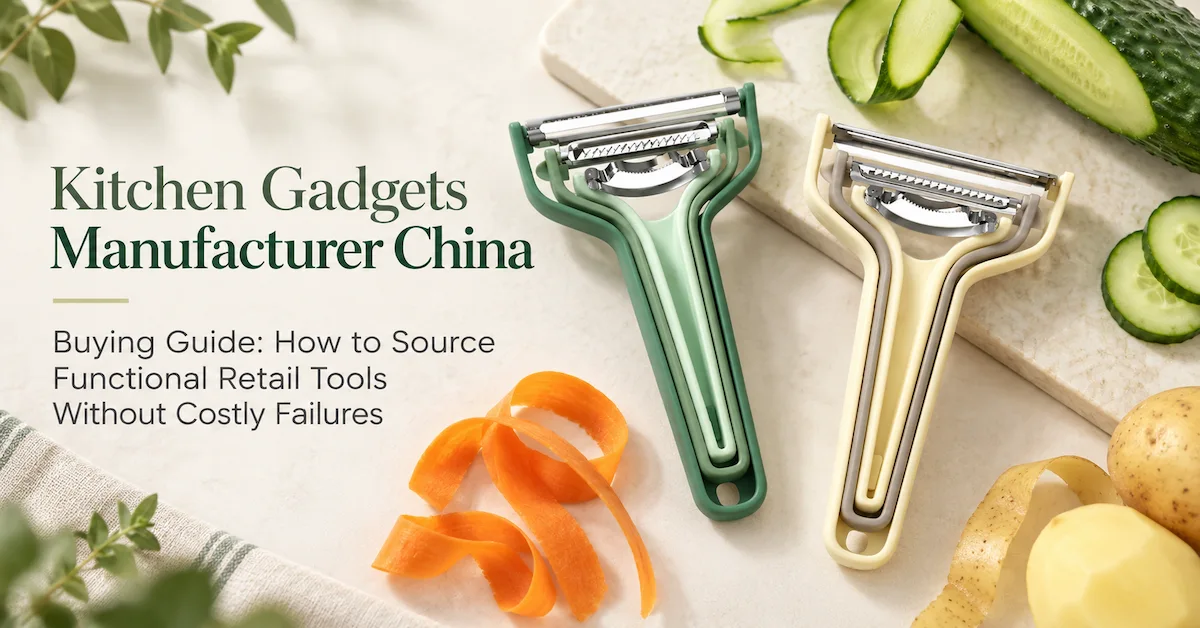
BONET's public product pages give useful examples of SKU-level fields. The M054 three-size vegetable peeler page lists 420 stainless steel and PP. Its dimension field separates L at 18 × 10.8 × 2.5 cm and 32.6 g, M at 15.1 × 9.2 × 2 cm and 23 g, and S at 13 × 6 × 2 cm and 16.5 g. The sizes are distinct variants on that page, not a general range standard.
The M031 dual-stage knife sharpener page gives 12.3 × 5 × 6 cm and 108 g, with 420 stainless steel and PP in its material fields. The M025 garlic grinder page lists 10 × 9.5 cm, 420 stainless steel and ABS. The M024 can opener page lists 20.2 × 9.5 × 1.6 cm, 430 stainless steel and ABS.
These values help a buyer identify starting references. They do not establish performance, compliance or the composition of a customized revision. A stainless steel kitchen gadgets manufacturer may use different grades and polymers across products because the components do different work. Confirm the exact material, component location, finish, joining method and evidence after the structure is selected.
Avoid unsupported phrases such as “food grade,” “BPA free,” “dishwasher safe,” “rust proof” or a universal service-life promise. These statements may require product- and market-specific support. The responsible buyer or qualified adviser should determine the applicable destination-market requirements. The supplier should provide accurate product information and arrange or support agreed evidence without extending one result beyond its model and scope.
| BONET reference | Page-listed dimensions | Metal field | Plastic field | Buyer follow-up |
|---|---|---|---|---|
| M054 peeler | Three listed sizes | 420 stainless steel | PP | Confirm variant, blade function and sample |
| M031 sharpener | 12.3 × 5 × 6 cm, 108 g | 420 stainless steel | PP | Confirm slot materials and intended blades |
| M025 grinder | 10 × 9.5 cm | 420 stainless steel | ABS | Confirm internal structure and lid engagement |
| M024 opener | 20.2 × 9.5 × 1.6 cm | 430 stainless steel | ABS | Confirm mechanism, can formats and force |
Step 5: Review User Contact, Instructions and Cleaning Together
Many gadget problems occur at the boundary between mechanism and hand. Identify every place the user holds, presses, twists, pulls, unlocks or cleans. Note sharp or abrasive areas, moving joints, pinch zones, stored force and parts that may be touched during disassembly. The purpose is not to make legal conclusions from a checklist. It is to ensure that obvious contact conditions are not ignored while the team focuses on appearance.
Observe the target user completing the intended sequence with a production-intent sample. Does the correct orientation make sense? Can the product be loaded without touching the working edge? Does a lid give visible or tactile confirmation when engaged? Does the tool remain controlled at the expected force? Can it be released and emptied without an awkward hand position? Record what happens instead of using a general “ergonomic” score.
Instructions are part of the product. A diagram or short sequence may need to explain loading, orientation, locking, slot order, disassembly or care. Every instruction must match the physical sample. If the tool changes, reopen the instruction review. A beautiful leaflet that shows an obsolete latch or wrong slot sequence can create more confusion than having no illustration.
Cleaning review begins with actual access. Inspect blades, teeth, slots, joints, lids, containers and recesses after the proposed care method. If components detach, check how they separate, whether loose parts are easy to identify and whether incorrect reassembly is possible. Do not print dishwasher or other care claims until they are supported for the exact construction and intended market. A modest, accurate instruction is more valuable than a broad convenience promise.
Step 6: Turn Private-Label Customization into Controlled Changes
Private label can range from applying a logo to an existing item through developing an entirely new mechanism. Define the level before requesting a quote. Level one changes artwork. Level two changes color or finish. Level three modifies a component while retaining the underlying architecture. Level four creates a new structure. Each level brings different feasibility, tooling, sample and validation work.
BONET's public OEM/ODM page describes production by drawing or sample, material and color customization, logo printing, laser engraving, packaging customization, concept development, structural optimization, material recommendations, feasibility assessment, samples and mass-production support. These are company-page descriptions of available service categories. The suitable process, MOQ, tooling, price and schedule remain project-specific.
For private label kitchen gadgets, prepare one brand-control sheet. Include the artwork filename and revision, color reference, logo method, position, size, orientation and acceptable appearance. Add the product name, function wording, instruction revision, barcode and package dieline. Now the physical item and consumer-facing content can be approved together.
A custom kitchen gadgets manufacturer should explain whether a requested change affects the mechanism. Changing a logo may be largely visual. Moving a grip, adding a second function or altering a lid can affect force, fit, cleaning and user contact. Ask for a written change-impact list that covers tooling, materials, dimensions, tests, pack fit, quotation and timing. It prevents a cosmetic request from quietly becoming an unreviewed structural change.
Need a custom mechanism, logo, color or retail pack reviewed together?
Need a custom mechanism, logo, color or retail pack reviewed together?
Request an OEM Gadget ReviewStep 7: Design Packaging That Demonstrates Without Overpromising
A gadget often needs more explanation than a familiar spoon or pan. The pack may have to show the input, hand action, output and care sequence in a small area. Decide what the shopper must understand in five seconds and what belongs in detailed instructions or online content. Lead with the primary task. Secondary functions should appear only when the production sample performs them and the wording can be supported.
Physical protection is equally important. A blade or wheel should not become exposed because the product shifted. Moving parts should not operate freely in the pack. A heavy component should not tear a hanging card. Loose accessories need positive retention and a pack-content check. For e-commerce, the individual package also faces parcel movement, compression and presentation after delivery. Include that route in the packaging brief rather than adding an outer mailer at the last minute.
BONET's OEM/ODM page lists color boxes, gift boxes, retail packs, barcode labels and export cartons among its packaging support. Ask who creates the dieline, which file format is required, how physical color is approved and which packed sample becomes the reference. Confirm individual pack dimensions, carton quantity, orientation, labels and handling marks after the product revision is final.
Claims and imagery must agree with reality. Do not show food, container sizes or functions that were never part of the sample review. Do not use “works with every...” when the method covered only specific representative inputs. Avoid placing an unsupported material or cleaning claim in a prominent badge. The responsible buyer should review destination-market labeling and legal requirements with qualified support where necessary.
| Packaging layer | Decision | Approval evidence |
|---|---|---|
| Front panel | Primary job, product identity and visual hierarchy | Artwork revision and shelf review |
| Demonstration | Input, action and output shown accurately | Claim-to-test matrix |
| Retention | Edges, moving parts and accessories secured | Packed sample and handling observation |
| Instructions | Use, cleaning, reassembly and appropriate warnings | Instruction revision matched to sample |
| Carton | Count, orientation, labels and dimensions | Carton specification and pack-out record |
Step 8: Approve Production-Intent Samples and Comparable Quotations
Give each sample an ID before testing. Record its model, revision, dimensions, components, stated materials, color, logo, instructions and packaging status. Photograph the full product and critical areas of the mechanism. When a part changes, issue a new revision and a short change list. An undated sample on a desk is not enough to control production.
Use a repeatable method built around the job statement. Specify the input, preparation, loading direction, action, number of repetitions where appropriate and observed output. Add checks for movement, fit, user contact, cleaning, reassembly and packaging. Test every function that will appear in the product name or package. Note normal variation in the media so the team does not confuse a changing carrot, can or clove with product variation.
BONET's manufacturing page publicly describes stamping, straight adjustment, heat treatment, rough grinding, water grinding, polishing, injection molding, ultrasonic cleaning, setting and assembly, quality checks, final cleaning and packing. A gadget may use some of those steps and not others. Ask which stages apply to the chosen model and where its critical characteristics are checked. Final inspection cannot correct every poor fit or edge condition created earlier.
After sample approval, normalize quotations. Match the model, revision, materials, finish, branding, packaging, carton, quantity, quality basis and delivery term. Separate unit price from samples, artwork setup, tooling, testing and other project charges. Identify exclusions and provisional values. For a kitchen gadgets supplier China, a useful quotation points back to the same version the buyer tested.
MOQ and timing should be treated the same way. They can vary with the model, mechanism, material, mold or tooling, color, logo, packaging, quantity, tests and production schedule. Do not publish a universal number when the evidence is project-dependent. Request written sample timing, approval assumptions, production timing and delivery terms after the brief is complete, then reopen them if the revision changes.
| Gate | What to check | Evidence retained | Reason to stop |
|---|---|---|---|
| Identity | Model, revision, dimensions and parts | Sample ID and photographs | Cannot trace sample to brief |
| Task | Input, action, output and repetition | Test method and observations | Primary function is inconsistent |
| User contact | Grip, force, edge, pinch and release | Contact review and instruction | Use sequence is unclear or uncontrolled |
| Pack | Retention, claims, contents and carton fit | Packed sample and artwork | Product moves or content disagrees |
| Quote | Same product, pack, quantity and terms | Normalized commercial sheet | Assumptions do not match approval |
Step 9: Protect Wholesale Launches and Repeat Orders
A gadget with several parts creates more ways for information to drift. Build an item master for each SKU. Include the model, drawing revision, dimensions, component materials, finish, color references, logo artwork, instruction file, packaging dieline, barcode, pack contents, carton arrangement, sample ID and agreed inspection basis. A set should also state which exact revisions are included.
Use a change record that says what changes and what remains fixed. A new color should not silently reopen the blade or mechanism. A revised claim may require a new task test. A packaging insert can change retention and carton quantity. Name the owner, date, version replaced and effect on tooling, sampling, tests, cost and timing. This gives both teams one source of truth.
Before a repeat order, compare the purchase order and current artwork against the item master. Review retained samples or controlled visual and measurable standards as appropriate. During inspection, use the same identity, mechanism and task language that supported approval. The second order should not depend on a salesperson or engineer remembering a conversation from months earlier.
When a field issue appears, record the observed condition before proposing a cause. Include the SKU, batch or order reference, affected quantity, input used, use sequence and photographs. Ask for containment, cause review, corrective action and verification appropriate to the issue. A report that says “opener does not work” is difficult to investigate; a report that names the can format, point of disengagement and sample comparison gives the supplier something concrete to examine.
For wholesale kitchen gadgets China programs, consistency is a commercial feature. Distributors and retailers need the replacement product to match listings, shelf plans, barcodes and customer expectations. The item master and change log may feel administrative, but they protect the visible brand experience.
Ready to compare one gadget project on a controlled specification?
Ready to compare one gadget project on a controlled specification?
Send Your Gadget Range RFQKitchen Gadgets Manufacturer China FAQ
What should I send with my first kitchen gadget inquiry?
Send the target user, food or container, intended action, expected output, reference product or drawing, destination market, sales channel, estimated quantity, required materials, color and logo direction, packaging idea, required evidence and timing. Mark each point fixed, preferred or open. A short video or annotated photograph can clarify movement better than a long adjective list.
How do I choose between an existing gadget and custom development?
Use an existing model when its mechanism, dimensions, user action and output already match the job, and branding or packaging provides enough differentiation. Modify a product when one defined component needs to change. Choose new development when the job cannot be solved by the available architecture. Ask how each route affects tooling, sample rounds, tests, MOQ, cost, timing and repeat-order control.
How should multifunction kitchen gadgets be tested?
Create one row for every advertised function. Define the input, preparation, user action, output and stop condition. Test the functions on the same production-intent sample that supports the packaging claim. A three-in-one label requires three separate observations. Do not let a total feature count replace evidence for each named use.
What material should a buyer choose?
Start with the component's job, contact conditions, force, movement, cleaning route, appearance and destination-market requirements. Then identify the exact grade or resin and where it is used in the SKU. A metal cutting part and a molded grip solve different problems. Material evidence should point to the selected model and revision rather than to a broad category.
Can BONET customize gadget colors, logos and packaging?
BONET's public OEM/ODM page describes material and color customization, logo printing, laser engraving and packaging customization. Feasibility depends on the selected model, surface, mechanism, artwork, quantity and packaging. Ask for project-specific confirmation of method, tooling, sample needs, MOQ, cost and timing. Approve the physical product and pack together.
How should buyers compare several gadget quotations?
Normalize the product model, revision, mechanism, materials, finish, branding, instructions, packaging, carton, quantity, inspection basis, currency and delivery term. Separate recurring unit price from samples, tooling, artwork setup, testing and other charges. Mark exclusions and provisional assumptions. Prices become comparable only when they describe the same approved work.
Does the available ISO certificate cover kitchen gadgets?
No. The reviewed ISO 9001 certificate for Yangjiang Master Scissor & Knife Manufacture Co., Ltd. states the scope “production and sale of scissors.” It should not be presented as certification of kitchen gadgets. Gadget sourcing needs its own SKU specification, sample approval, appropriate project evidence and destination-market assessment.
What is the MOQ and production lead time?
The public information reviewed for this guide does not establish one universal MOQ or lead time. Both can change with the existing or custom model, mechanism, tooling, materials, color, logo, packaging, quantity, testing and factory schedule. Send a controlled brief and request written project values for sampling, approval, production and delivery.
RFQ Checklist for a Kitchen Gadgets Supplier in China
- Target user, input, action, output and unacceptable result are defined.
- Sales channel, destination market and retail role are stated.
- Each SKU has one primary job and every extra function has a test row.
- The mechanism sequence and critical components are identified.
- Blade, wheel, joint, lid, grip, lock and container requirements are separated where relevant.
- Dimensions, tolerances, component materials and finishes point to the exact revision.
- User-contact areas, loading, release, disassembly and cleaning are reviewed.
- Logo artwork, color, application method and product wording are controlled.
- Instructions and claims match the physical sample and intended use.
- Individual packaging secures edges, moving parts and accessories.
- Carton quantity, dimensions, labels and delivery assumptions are included.
- Sample approval names the product, artwork, instruction and packaging revisions.
- Quotation lines use the same model, customization, pack, quantity and commercial term.
- MOQ, tooling, sample cost and timing, tests, production timing and delivery are confirmed for the project.
- An item master and change log protect the first launch and every repeat order.
Conclusion: Source the Mechanism, Evidence and Pack as One Product
The right kitchen gadget partner does more than reproduce a shape. The project has to begin with a consumer job, translate that job into a mechanism, identify failure modes, control materials and user contact, and keep the instructions and packaging aligned with the approved sample. A normalized quotation and item master then protect the commercial decision.
BONET HOUSEWARE publicly presents kitchen gadgets, OEM/ODM services and manufacturing information, with individual pages for the M054 peeler, M031 sharpener, M025 garlic grinder and M024 can opener discussed above. Buyers can use those pages to identify reference models and prepare better questions. Final acceptance still belongs to the project-specific specification, sample, evidence, packaging and written terms.
To begin an inquiry, send the target user, input, intended action, desired output, product drawing or reference, destination market, estimated quantity, material direction, logo files, packaging idea and desired timing. BONET can then review whether an existing private-label route, a modified product or broader development work fits the brief and confirm the commercial details for that exact project.
Turn a gadget idea into one testable, quote-ready brief.
Turn a gadget idea into one testable, quote-ready brief.
Contact BONET HOUSEWARE