




Kitchen Gadgets Manufacturer: What Buyers Need from Prep Tool Sets
A kitchen gadgets manufacturer is not only producing small utensils. For modular prep tool sets, the manufacturer is building a repeatable kitchen workflow: slice, dice, peel, collect, clean, and store. That workflow matters to importers, retailers, private label teams, and product managers because the category looks simple but depends on many small details working together.
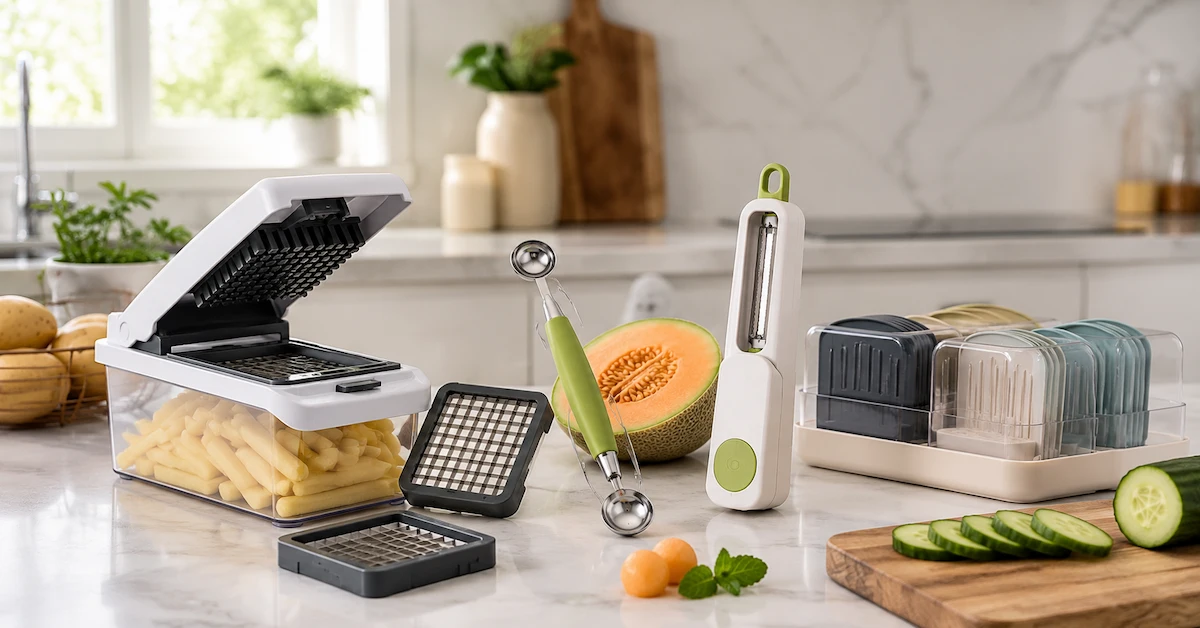
The product shown here is a kitchen preparation set built around a manual chopper or dicer, a clear collection bin, interchangeable blade inserts, handheld slicing or peeling tools, a melon baller, and an accessory storage rack. It is positioned as a compact household prep system rather than a single-purpose tool. That means buyers should evaluate it as a complete user experience, not just as a list of included parts.
Key Takeaways
- Modular prep sets succeed when the parts are easy to identify, assemble, clean, and store.
- Buyers should test fit, blade retention, hinge movement, and container stability before committing to a design.
- More accessories are not always better; excessive small parts can create confusion and after-sale complaints.
- Commercial details such as materials, MOQ, packaging, testing, and compliance should be confirmed directly with the supplier.
Why Prep Tool Sets Remain Attractive to Buyers
Consumer interest in kitchen prep tools is easy to understand. Home cooks want faster vegetable preparation, more consistent cuts, and less mess on the counter. A dicing box with a transparent container lets the user see progress without opening the tool. Interchangeable cutting grids can support different prep tasks. A stand for spare inserts helps prevent sharp parts from getting lost in a drawer.
For B2B sourcing teams, the appeal is broader than convenience. A coherent set can support gift retail, online bundles, private label ranges, and seasonal merchandising. However, the product must feel reliable in hand. If the lid flexes too much, the cutter insert shifts, or the accessories are difficult to store, the set may look strong in photos but perform poorly in real use.
Design Features Buyers Should Inspect
The central component is usually the manual chopper or dicer. It combines a hinged press lid, a cutting insert, and a collection bin. The buyer should check whether the lid closes evenly, whether the insert sits securely, and whether chopped food drops cleanly into the container. Small alignment problems can lead to jamming, uneven cuts, or user frustration.
The transparent bin is also important. It gives the product visual clarity and makes portioning easier. Buyers should ask how the supplier manages surface finish, scratch resistance expectations, and cleaning access around corners and seams. No assumption should be made about the exact plastic type unless the supplier confirms it in writing.
Interchangeable blade inserts are useful, but they add risk. Each insert needs clear orientation, safe handling points, and consistent compatibility with the base. Handheld tools such as peelers and slicers should be checked for grip comfort, blade mounting security, and storage safety. The melon baller and rack add perceived completeness, but only if they are practical rather than decorative clutter.
Comparison Checklist for Supplier Evaluation
| Evaluation Area | What to Check | Questions to Ask the Supplier |
|---|---|---|
| Fit and assembly | Lid alignment, insert seating, bin stability | How is part compatibility controlled during production? |
| Blade handling | Safe removal, storage, and replacement of inserts | What packaging or storage method protects users from sharp edges? |
| Cleaning | Crevices, hinge areas, removable parts, residue traps | Which parts are intended to be removable for cleaning? |
| Accessory logic | Number of parts, identification, rack stability | Can the set be simplified or customized for a target market? |
| OEM readiness | Color options, logo areas, packaging structure | What customization options are available, and what limits apply? |
Materials and Manufacturing Questions to Clarify
Visually, this product type often combines molded plastic housings with metal cutting elements, but buyers should not assume specific grades, finishes, or performance claims without supplier documentation. Instead, create a sourcing checklist that separates visible features from confirmed specifications.
Ask the manufacturer to clarify the material used for the container, lid, handles, blade inserts, and any soft-grip components. Request information on how the cutting parts are fixed into their frames, how the hinge is assembled, and how the accessory rack is inspected. If the product is intended for a regulated market, ask what documents, tests, and labeling requirements the supplier can support. Avoid relying on general statements; request details relevant to the exact SKU and destination market.
How to Review Samples Before Ordering
Sample review should be hands-on. A product rendering cannot show whether the press action feels smooth or whether a blade insert is annoying to remove. Use real produce during evaluation because different foods expose different weaknesses. Firm vegetables can reveal flexing and alignment problems, while softer fruits can show whether the grid crushes instead of cuts.
- Assemble the tool without instructions and note any confusing steps.
- Change every insert several times to test ease of handling and retention.
- Press the lid repeatedly and watch for wobble, bending, or sticking.
- Fill and empty the container to check stability and grip.
- Wash the parts and inspect corners, joints, and blade frames for trapped residue.
- Place all accessories in the rack and test whether storage feels stable.
If the set is being considered for OEM or private label, also review packaging layout, warning language, instruction clarity, barcode placement, and how spare inserts are protected during shipping. These details affect customer satisfaction as much as the tool itself.
Common Buyer Mistakes
One common mistake is choosing the set with the highest number of accessories. More parts can create stronger online images, but they can also increase confusion, inspection work, packaging complexity, and lost-component complaints. A smaller, clearer set may be easier to explain and easier to use.
Another mistake is ignoring storage. Modular blades are helpful only when users can store them safely and find them again. If the rack is unstable or takes too much counter space, customers may separate the accessories from the main tool, reducing repeat use.
Buyers also sometimes focus on sharpness while overlooking the housing. Cutting performance depends on blade geometry, but also on the rigidity of the lid, the support under the insert, and the way force transfers through the tool. A weak frame can make even a promising insert feel unreliable.
Best-Fit Applications and Product Positioning
This kind of kitchen gadget set is best suited for everyday household preparation: salads, fruit bowls, basic vegetable dicing, garnish work, and meal prep routines where consistency and convenience matter. It should not be positioned as a substitute for heavy-duty food processing unless the supplier provides evidence supporting that claim.
For retailers and importers, the strongest brief is usually practical and specific: a compact prep set with safe accessory storage, intuitive assembly, easy cleaning, and clear user instructions. If customization is required, ask the supplier which elements can be adjusted, such as color, packaging, accessory count, or branding area, and what constraints apply.
Practical FAQ for Sourcing Teams
Is a modular kitchen gadget set always better than a single tool?
No. Modularity is valuable only when each part has a clear purpose and is easy to store. Too many inserts can reduce usability.
What should buyers ask a kitchen gadgets manufacturer first?
Start with material confirmation, blade attachment method, part compatibility control, cleaning instructions, packaging protection, and available OEM or private label options.
How should samples be tested?
Test with real fruits and vegetables, repeat the assembly process, change every insert, wash the parts, and evaluate storage after use.
Can this type of product be developed into a wider range?
Potentially, yes. A supplier may be able to adapt accessories, colors, or packaging, but buyers should confirm tooling limits, compatibility, and commercial terms directly.
Next Step for Buyers
When evaluating a kitchen gadgets manufacturer for prep tool sets, treat the product as a system. Review the cutting action, fit, storage, cleaning, packaging, and user instructions together. The best sourcing decision is not the set that looks busiest, but the one that makes repeated household preparation simple, safe, and consistent.
