




Kitchen Knife Set Manufacturer: What Buyers Should Check First
Choosing a kitchen knife set manufacturer is not only a matter of finding a supplier that can produce sharp blades. For retail, hospitality, wholesale and private label buyers, the better question is whether the supplier can deliver a coordinated product system: knives that cut consistently, handles that feel secure, a block that stores the set safely and maintenance tools that make sense for daily use.
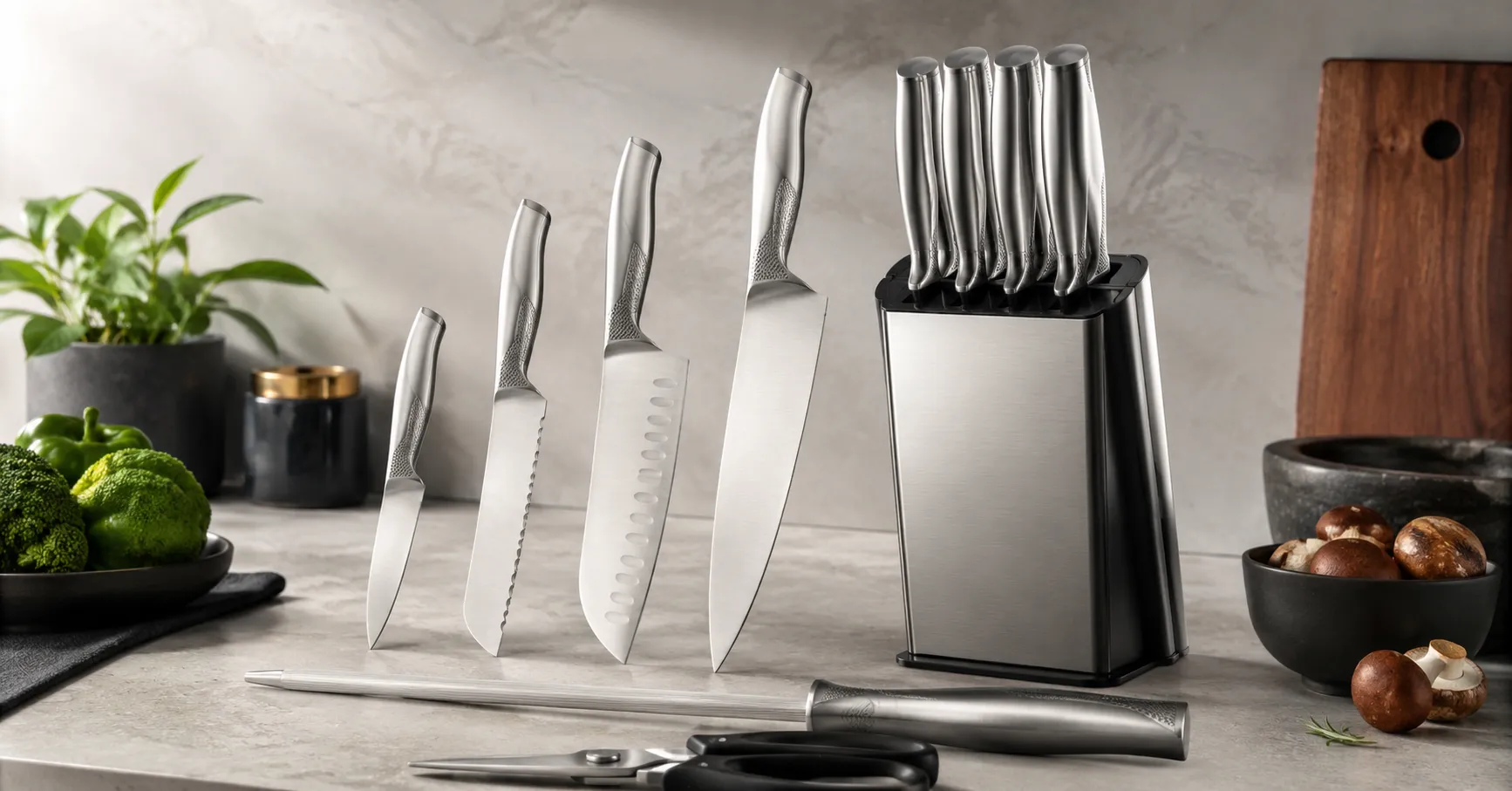
The product shown here represents a common knife block set format. It includes multiple stainless-steel knives, a matching countertop storage block and a honing rod. The block has a rectangular shape, a brushed silver front panel, black top and base sections and vertical slots. Visible knife types appear to include a chef’s knife, a serrated knife, a santoku-like knife with scallops and smaller prep knives. Exact steel grade, hardness, handle construction and block material are not confirmed from the image, so buyers should request those details before placing an order.
Key Takeaways
- Judge a knife set as a complete system, not as separate pieces placed in a block.
- Ask for confirmed blade material, construction method, handle build and block material instead of relying on appearance.
- Check blade consistency, grip comfort, slot fit and finish durability before discussing branding details.
- For OEM or private label projects, clarify what can be customized without weakening usability or repeatability.
Start With the User and Sales Channel
A kitchen knife set for a household retailer does not have the same duty cycle as a set intended for restaurant back stations, rental kitchens or promotional wholesale programs. The visible assortment is practical for everyday preparation because it covers chopping, slicing, trimming, smaller detail work and edge maintenance. However, buyers should define the expected use before comparing factories.
Useful sourcing questions include: Will the set be used daily or occasionally? Is it intended for first-time home cooks, experienced users or light commercial prep? Will the block sit on a retail shelf where appearance matters, or in a working kitchen where cleaning and stability are more important? These answers should guide the knife mix, handle finish, block design and packaging brief.
Blade Consistency Matters More Than Piece Count
Many sourcing mistakes begin with piece count. A ten-piece set is not automatically better than a smaller set if several knives overlap in use or if the edge geometry varies from blade to blade. Buyers should ask the manufacturer how blade profiles are controlled across production and how edges are finished before shipment.
For this type of stainless-steel knife set, do not assume the steel grade, hardness or production route from the photo. Stamped and forged constructions can both be acceptable when well executed, but each has different cost, weight and feel implications. Ask the supplier to explain the blade material, forming method, heat treatment approach if applicable, edge angle target, polishing process and inspection procedure. If they cannot describe these points clearly, sample quality may not represent bulk production.
Handle Comfort and Balance Need Physical Review
The visible knives have a coordinated metallic appearance, which gives the set a unified look. That does not confirm whether the handles are solid metal, clad, hollow or made with another construction. Buyers should request a component breakdown and review physical samples with wet and dry hands.
Important handling checks include grip security, balance point, transition between blade and handle, surface smoothness, weight distribution and fatigue during repeated cutting. A handle that photographs well may feel slippery or awkward during real prep. For private label programs, avoid approving handle changes based only on renderings. Small changes in shape, texture or weight can noticeably affect user experience.
The Knife Block Is Part of the Product
The storage block is often treated as packaging, but users interact with it every day. The block shown has a contemporary rectangular design with vertical slots, a brushed silver front and black top and base areas. Those visual details help the set look organized on a counter, but practical performance still depends on construction quality.
Ask how the slots are sized for each blade, whether the knives insert and remove smoothly, how stable the block is when the largest knife is pulled out and how easily the slot openings can be wiped. Slots that are too tight can damage edges; slots that are too loose make the set feel unstable. If the block uses mixed materials, ask how the parts are joined and how the finish is expected to resist normal kitchen moisture and handling. Do not assume dishwasher-safe claims or special surface treatments unless the supplier provides written confirmation.
Comparison Checklist for Supplier Evaluation
| Area to Check | What to Ask the Manufacturer | Why It Matters |
|---|---|---|
| Blade material | What is the exact stainless-steel grade and finishing process? | Helps assess corrosion resistance, sharpening behavior and long-term complaints. |
| Construction route | Are the blades stamped, forged or made by another method? | Affects cost, weight, balance and production repeatability. |
| Handle build | What is the handle material, internal structure and attachment method? | Impacts grip comfort, durability and perceived quality. |
| Block design | What are the block materials, slot dimensions and cleaning recommendations? | Protects edges and affects daily safety and storage convenience. |
| Maintenance tool | Is the honing rod standard, and what user guidance is supplied? | Supports routine edge care and reduces confusion between honing and sharpening. |
| OEM controls | Which parts can be customized, and how are samples matched to production? | Prevents branding changes from creating quality or consistency problems. |
OEM and Private Label Questions to Ask Early
For OEM knife set sourcing, start with the assortment and performance target before discussing logos. Decide which knives are genuinely useful for the intended customer. The visible mix of a chef’s knife, serrated blade, santoku-like knife, smaller prep knives and honing rod is a practical general-purpose configuration, but your channel may need fewer pieces, different blade shapes or a different block layout.
- Request a written specification sheet for every knife and the block.
- Confirm whether branding affects handle finish, blade marking, packaging or block appearance.
- Ask how the supplier controls color, polish and slot fit across production lots.
- Clarify sample approval steps and what happens if bulk goods differ from approved samples.
- Ask about packaging protection for blade tips, edges, handles and the block surface during transit.
Do not invent missing requirements during negotiation. If your market requires specific labeling, safety, testing or compliance documentation, ask the supplier directly and verify the documents through your own compliance process.
Common Sourcing Mistakes
The first mistake is buying by appearance alone. A brushed block and coordinated handles can support retail presentation, but they do not prove blade performance. The second mistake is assuming every stainless-steel knife behaves the same. Steel grade, processing and edge finishing matter.
A third mistake is overlooking the honing rod. Honing is not the same as sharpening; it helps realign an edge between sharpenings. If the set includes a honing rod, buyers should ask whether user instructions are provided. Clear care guidance can reduce unnecessary returns from customers who think normal maintenance means product failure.
Finally, avoid vague wording such as “premium steel” or “professional quality” unless it is backed by measurable specifications. Good suppliers should be willing to discuss tradeoffs between cost, edge retention, corrosion resistance, handle feel and block construction.
Practical FAQ
Is a larger knife block set always better for wholesale buyers?
No. A focused set with useful blade types often performs better than a larger set with redundant pieces. Match the assortment to the end user’s real cooking tasks.
Can I confirm steel grade from a product image?
No. The image shows stainless-steel knives, but not the exact grade, hardness or production method. Ask the manufacturer for written specifications.
Should the block be evaluated separately from the knives?
It should be evaluated as part of the full product. Slot fit, stability, cleaning access and finish durability all influence user satisfaction.
What should private label buyers confirm before ordering?
Confirm blade specifications, handle construction, block materials, customization limits, packaging details, sample approval rules and any market-specific documentation you require.
Does a honing rod mean the knives are low quality?
No. A honing rod is a normal maintenance tool. It suggests the set is intended to be cared for during use, but buyers should still verify blade and edge specifications.
Final Sourcing Advice
When comparing a kitchen knife set manufacturer, prioritize the details that affect daily use: consistent blades, secure handles, a stable block and clear maintenance guidance. Treat missing specifications as questions to resolve, not assumptions to fill in. A reliable supplier should help you understand the tradeoffs behind the set so your retail, wholesale or OEM program can avoid avoidable complaints after launch.
