

For wholesale buyers, the best starting point is to compare three things together: the complete set specification, the packed-unit economics, and the supplier's repeat-order controls. Confirm the exact pieces and component materials, approve a working and fully packed sample, and obtain quotations on comparable trade terms before allocating volume.
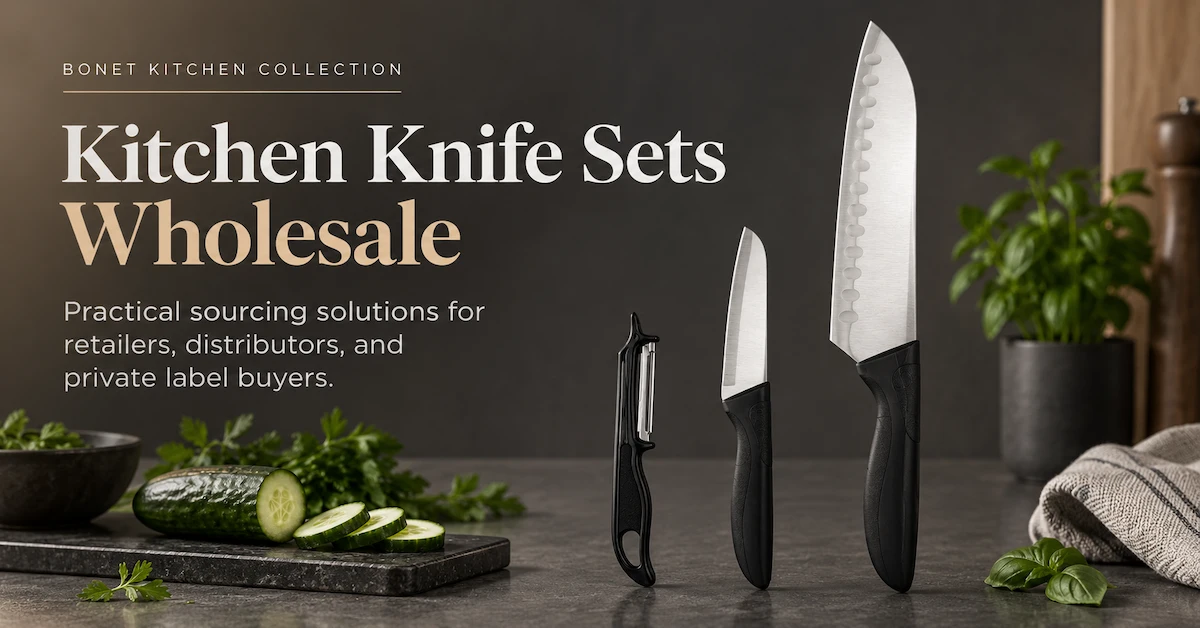
This guide is for kitchenware importers, wholesalers, chain-store buyers, distributors, private-label brands, e-commerce sellers, and hospitality procurement teams. It focuses on assortment and commercial decisions rather than repeating a general knife-manufacturing or custom-design guide. The tables and testing procedures are recommended buyer frameworks, not claims of test results or fixed commercial terms already achieved by BONET.
What Does Kitchen Knife Sets Wholesale Mean for B2B Buyers?
Wholesale kitchen knife sets are finished assortments purchased for resale, distribution, institutional supply, or branded retail programs, generally under an agreed bulk-order arrangement. They may be standard catalog sets or buyer-specific configurations. Unlike a one-off consumer purchase, a wholesale order must work across an entire batch and support future purchasing decisions.
A set may contain several knives, knives plus scissors or a peeler, a storage block, blade guards, and retail packaging. The name “six-piece set” can be ambiguous: one supplier may count six knives while another counts five knives and a block. A buyer who compares those quotations without an itemized list is not comparing equivalent products.
The purchasing file should therefore connect a parent retail SKU to every included component. At minimum, record the blade and handle specification of each knife, the accessories, the pack dimensions, the carton quantity, and the approval revision. This is the operational difference between ordering a pretty photograph and buying a reproducible product.
Wholesale does not automatically mean private label. A distributor may source existing models with standard packaging. A retailer may request custom sleeves and barcodes. A mature kitchenware brand may require its own handle colors, logo treatment, and coordinated assortment. All are valid routes, but they have different minimum-quantity, development, and cost implications.
Who Buys Wholesale Knife Sets—and Which Set Fits Each Channel?
Buying priorities should follow the channel. An e-commerce operator may care intensely about packed dimensions and parcel damage; a supermarket buyer may prioritize visible shelf benefits and barcode accuracy; a hospitality buyer may prefer a practical tool mix and predictable replenishment.
| Buyer or channel | Typical commercial goal | Set and packaging priority | Risk to control |
|---|---|---|---|
| Supermarket and chain store | Consistent volume and clear price tiers | Easy-to-understand knives, retail display, barcode | Shelf-space inefficiency and replenishment inconsistency |
| Home-goods retailer | Coordinated home-kitchen range | Useful blade mix, attractive finish, gift or display box | Too many overlapping functions |
| Importer and distributor | Repeat supply to several accounts | Stable SKU, carton efficiency, documented specs | Mixed versions or unexpected substitutions |
| E-commerce and marketplace brand | Differentiated listing and good delivery experience | Clear images, protective inserts, compact packed size | Parcel damage, returns, misleading claims |
| Hospitality supply | Practical preparation tools | Cutting behavior, grip, cleaning, replacement continuity | Mismatch between advertised and real duties |
| Promotional and gifting program | Complete presentation within budget | Gift-ready pack, finish and logo consistency | Packaging costs exceeding perceived value |
Some buyers should not choose a large general household set. A professional kitchen requiring individual replacement knives may benefit more from separate SKUs. Small-apartment retailers may prefer compact boxes to countertop blocks. Price-sensitive buyers may gain more from a curated four-tool assortment than from a large set with rarely used accessories. Recognizing these limits is part of sound wholesale planning.
Choose the Right Assortment: Four, Five, Six or More Pieces?
The number of pieces is a merchandising decision, not a reliable measure of quality. Every knife in a set should have a clear task. A chef knife or Santoku-style knife may serve broad chopping and slicing; a bread knife serves serrated cutting; a utility knife fills intermediate tasks; a paring knife handles smaller work. Accessories can add value, but only when their intended functions make sense for the channel.
Define the included pieces before designing the box. Write each knife's role in one sentence and remove duplication that consumers will not value. Then decide whether the collection needs scissors, a peeler, a block, or guards. Keep the actual product count consistent across the product listing, outer box, invoice, BOM, and marketing images.
| Assortment format | Potential positioning | What to validate before wholesale approval |
|---|---|---|
| Compact 3–4-tool set | Starter kitchen, apartment, entry retail | Covers essential jobs without weak filler items |
| Curated 5-piece knife set | Mainstream home kitchen, gifting | Each blade has distinct use and consistent handle identity |
| Knife-and-tool combination | Family cooking, practical prep | Accessories are properly counted, sourced, and inspected |
| Knife block set | Countertop presentation | Stability, slot fit, footprint, packed weight |
| Boxed set without block | E-commerce and compact storage | Blade protection, opening safety, post-unboxing storage guidance |
A supplier should state whether it quotes the complete pack or only the loose knives. A small difference in the component list can change unit cost, master-carton weight, and consumer value. For wholesale negotiation, the BOM is as important as the headline set description.
Compare BONET K102, K103, K105 and K107 Without Assuming Identical Specifications
BONET's published kitchen knife range offers several reference directions. These product pages provide a useful basis for requesting samples and quotations, but their structured fields should not be treated as complete component-level material certificates or cutting-performance reports.
| Reference model | Product direction | Published metal field | Published plastic field | Wholesale decision to verify |
|---|---|---|---|---|
| K102 Chef Knife Set | Mixed knife and preparation-tool assortment | 420 stainless steel | PP | Exact knife/accessory count and packaging configuration |
| K103 Kitchen Knife Set | Stainless-steel and plastic-handle direction | 430 stainless steel | PP | Which components use the listed metal grade |
| K105 Plastic Handle Knife Set | Coordinated plastic-handle range | 430 stainless steel | PP | Blade material, handle construction and uniform finish |
| K107 Hollow Handle Knife Set | Hollow-handle visual positioning | 430 stainless steel | / | Component construction, joins and packed-set consistency |
The 430 listings deserve a precise follow-up question. In general materials terminology, 430 commonly identifies a ferritic stainless-steel family, unlike the hardenable martensitic families often associated with cutting blades. Ask the supplier which part uses the published grade and confirm the actual cutting-blade specification. A single material field for an entire set does not prove that every blade or handle shares that composition, nor does it establish a defect.
For each proposed wholesale SKU, obtain the current bill of materials, the intended retail composition, product photos matching the shipment, and a representative sample. This protects purchasing teams from assuming performance based on a name or comparing sets that are not truly equivalent.
Evaluate Wholesale Sets by Customer Use, Not Steel Grade Alone
Blade material is important, but a steel name is not a full product specification. Knife performance also depends on edge geometry, relevant heat treatment, grinding, finish, handle attachment, and intended use. A chef knife should be evaluated on representative vegetables and general preparation. A bread knife should be evaluated on suitable bread. Smaller knives should be checked for the specific trimming work they are intended to perform.
A buyer can compare the functional usefulness of each knife before negotiating advanced material claims. If a retailer markets a particular finish or durability benefit, it should have evidence related to the actual product. Do not assume “stainless steel” means rust-proof, or that a blade described as “professional” meets an unstated hardness or lifespan value.
For household sets, consider handle comfort, clear care instructions, suitable storage, and coherent finish across the knives. For trade channels, consider replacement continuity and ease of maintaining the tools. For gift-oriented sets, presentation matters, but attractive packaging should not conceal weak or duplicated contents.
Request both component specifications and a realistic cutting demonstration. For a private-label program, link the approved results to the master SKU file so an impressive first sample does not become an unrepeatable exception.
Wholesale Price vs Landed Cost: What Should Buyers Compare?
A factory price may exclude artwork development, individual packs, product inserts, testing, export cartons, freight, duties, and destination handling. Buying decisions based only on a low unit price can therefore damage margin after the products arrive.
A reliable purchasing comparison uses the same set composition, quantity, packaging, acceptance conditions, and quoted delivery term. Then calculate the expected landed cost per saleable unit. Include estimated freight, import charges, required inspection, warehouse receiving, and an appropriate allowance for foreseeable damage or returns where your own data supports it.
| Price component | What to ask the supplier | Impact on wholesale buying |
|---|---|---|
| Knives and accessories | Are all BOM components included? | Prevents incomplete comparison |
| Material and finish | Are the exact approved materials and finishes quoted? | Prevents specification drift |
| Branding | Is logo application included? | Changes the delivered unit cost |
| Retail box and inserts | Is the packed unit included in the unit quotation? | Affects shelf readiness and parcel protection |
| Export cartons | What is packed quantity, size and gross weight? | Affects storage, handling and freight |
| Development or tooling | Are costs separate from recurring units? | Changes launch investment, not necessarily reorder cost |
| Inspection and testing | Which checks are included or separately charged? | Helps control claims and batch acceptance |
| Incoterm and transport | Which party pays for which shipment stages? | Determines comparable landed cost |
Do not call the difference between retail price and factory price your gross margin. A more useful commercial approach starts with net expected selling revenue after discounts and channel fees, subtracts landed product cost and other direct costs relevant to your business, and then evaluates the result against your required contribution and overhead structure.
A supplier cannot calculate your true margin without knowing your sales channel, taxes, returns experience, fulfillment costs, and retail terms. It can, however, make its quotation more transparent and provide accurate carton and product data.
How to Build a Wholesale Price Ladder Without Guessing Volumes
Wholesale buyers often need more than one price level. A distributor may purchase several knives sets in one shipment while a chain retailer needs a price structure aligned with regular replenishment. The right quantity break depends on production setup, component purchasing, packaging orders, and demand—not an arbitrary online price tier.
Ask manufacturers to quote several buyer-provided quantity scenarios against the same approved product. Keep an identical BOM, artwork, and packing specification in every quote. Where lower cost depends on simpler packaging or a material change, label that as a separate configuration rather than a volume discount.
A useful tier conversation covers a pilot order, a normal replenishment order, and a possible higher-volume program. It should also address whether multiple color variations or models can share packaging or component quantities. Never assume that a mixed-model order automatically satisfies the MOQ for every customized part.
The best arrangement is one the supplier can actually repeat when demand changes. A seemingly attractive high-volume price is not useful if the buyer must carry inventory far beyond the realistic sales plan.
What Affects Minimum Order Quantity for Kitchen Knife Sets Wholesale?
MOQ is often the first commercial question, but it cannot be answered responsibly before the product is defined. An existing set with standard colors and plain packaging may require a different minimum than a custom handle collection with multiple printed boxes, additional accessories, or a new block.
Factors include the selected base product, material availability, handle colors, blade finishing, logo methods, printed packaging runs, inserts, block construction, supplier setup, and whether tooling changes are necessary. The same outer box can contain different configurations with different production requirements.
Before requesting MOQ, send the desired model, complete BOM, packaging format, artwork scope, initial quantity, and reorder estimate. Ask the supplier to distinguish the minimum for the finished set from any component-specific minimum. If packaging dictates the initial quantity, determine whether alternative standard packaging could improve feasibility without undermining the brand.
BONET's OEM/ODM services identify customization and quote confirmation as part of the project process, but its public page does not give one universal MOQ for every kitchen knife set. Treat any exact quantity or delivery commitment as project-specific information to be confirmed, not something to invent for a blog.
Packaging Format Can Determine Wholesale Profitability
A knife block may photograph well but occupy considerable retail and carton volume. A compact boxed set may use less space, but requires careful internal separation and edge protection. A gift-ready package may justify a stronger retail proposition while increasing pack cost and shipping weight. Choose packaging in the context of the channel.
For supermarkets, confirm hanger or shelf compatibility, barcode placement, visible contents, accurate claims, and consistent package dimensions across stores. For e-commerce, confirm parcel protection, package strength, component retention, unboxing safety, and reasonable dimensional weight. For distributors, check carton quantities, labels, scanning accuracy, stacking, and warehouse handling.
Test the complete packed unit, not just the empty box. A box that looks attractive without the knives may fail if blades move, the handle rubs against another component, or the storage block damages an insert. The packaging drawing, the packed reference sample, and the carton specification should be linked to the same SKU revision.
BONET lists color boxes, gift boxes, retail packaging, barcode labels, export cartons, and customization support through its OEM/ODM program. Confirm which option is suitable for the actual model and required distribution environment.
Carton Efficiency and Shipping: Small Decisions That Affect the Order
Freight and handling considerations should influence the assortment before the final order. A large block set may contain fewer retail units per outer carton than a compact boxed collection. This does not make it a bad product; it means the buyer must evaluate its economics correctly.
Ask for individual pack dimensions, master-carton dimensions, packed quantity, and verified net and gross weights. Confirm labeling, pallet or stacking considerations where relevant, and the terms used in the freight quote. Make sure the sample carton reflects production packaging rather than a showroom arrangement.
Import terms matter. EXW and FOB are not interchangeable descriptions of “factory shipment”; responsibilities depend on the chosen rule, named place, and agreed Incoterms version. Customs classification, tariffs, and destination requirements must be checked for the actual shipped products rather than copied from another seller's example. The importer should use qualified customs and logistics support for its market.
A reliable supplier should help you collect accurate shipment data. It cannot promise a universal duty rate, fixed delivered cost, or market-wide import approval for every knife assortment.
The Wholesale Sample Approval Plan: Check Every Knife and the Packed Set
Sample review should occur at two levels. First, examine each knife and accessory. Second, inspect the full retail set. This catches problems that do not appear when a product is photographed or demonstrated by itself.
For the individual knives, inspect cutting behavior on representative food, handle comfort, visible finish, attachment quality, cleaning instructions, and any feature claimed on the package. For the complete set, verify piece count, matching finish, positioning, block or tray fit, packaging retention, barcode, labels, and opening safety.
| Approval level | Suggested checks | Approval record |
|---|---|---|
| Individual blade | Application-based cutting, geometry, finish | Model specification and tested sample |
| Individual handle | Comfort, fit, color, unacceptable gaps | Physical sample and color reference |
| Accessories | Scissors, peeler, guards, block if present | Itemized approved BOM |
| Entire set | Correct count, consistent appearance and arrangement | Golden packed sample |
| Retail package | Artwork, claim accuracy, barcode, inserts | Signed artwork and dieline version |
| Outer carton | Quantity, marks, internal protection | Packing specification and agreed handling test |
These checks are recommended buyer procedures, not evidence that a particular BONET model already achieved a stated pass rate. Define the exact test materials, sample count, acceptance criteria, and responsibility for each project. Do not invent hardness, edge-cycle, or drop-test numbers where the product has no published results.
Quality Control for Wholesale Knife Sets: More Than Blade Sharpness
A knife-set order can fail even when the blades are individually acceptable. Mixed contents, an incorrect printed sleeve, a missing peeler, loose guards, wrong barcodes, or a mismatch between carton count and invoice can disrupt wholesale distribution.
A quality plan should therefore include incoming material controls as relevant, manufacturing-stage checks, finished blade inspection, component counts, brand appearance, and packed-unit inspection. The manufacturer and buyer should agree on how to classify defects and what happens when a sample fails. A universal AQL number without a product-specific defect definition is not enough.
For retail programs, add checks on packaging versions and assortment identity. The team releasing the shipment should be able to distinguish a complete, approved set from a lookalike configuration. A change in handle color or accessory supplier may affect brand consistency even when the knives still cut.
BONET's manufacturing workflow publicly describes stages including stamping, straight adjustment, heat treatment, rough and water grinding, polishing, injection molding, ultrasonic cleaning, assembly, quality checking, final cleaning, and packing. The exact process route and inspection plan for a quoted knife set should be confirmed at model level.
Certifications, Materials, and Destination-Market Requirements
Wholesale buyers should separate factory management information from product conformity. BONET's company profile references quality and social-compliance management information including ISO9001, BSCI, and Sedex. This can support supplier due diligence, but does not automatically prove that a particular knife or set satisfies every destination-market requirement.
Products aimed at household consumers may require different labeling, packaging, and product-safety considerations from knives sold through specialist hospitality channels. Where a set includes food-preparation accessories, component materials should be checked for the intended market and application. Claims about food contact, washing, corrosion, coatings, or specific material grades should have appropriate support.
Request current relevant documents and clarify the exact scope. If a retailer requires third-party testing, specify the applicable product, method, report and acceptable laboratory. Do not describe a product as universally certified or legally approved based only on a factory credential or marketing phrase.
Stock Planning: Trial Orders, Seasonal Peaks and Replenishment
One reason kitchen knife sets wholesale programs underperform is that the purchasing decision focuses entirely on the first order. A low-cost set may sell quickly but become difficult to replenish in the same configuration. Another may require so much initial inventory that the buyer ties up cash before demand is proven.
A sensible launch separates three stages: sample validation, a commercially manageable pilot, and a reorder plan. The pilot should test both product-market fit and operational quality.Track actual sell-through, return reasons, carton issues, and buyer feedback rather than assuming that an attractive photo predicts demand.
When reorder demand becomes clearer, share a forecast with the supplier and confirm whether component or packaging constraints create special lead-time requirements. Maintain approved materials, artwork, accessories, and carton details. A forecast is planning information, not a promise of guaranteed purchase volume unless the agreement says so.
For seasonal gifting programs, reverse-plan from the retailer's required warehouse date. Include sampling, artwork approval, production, inspection, transportation, and customs clearance. The factory production date is not the same as the date products are ready on shelves.
Avoid SKU Proliferation and Cannibalization in the Knife-Set Range
Offering several similar knife sets can look like range depth while creating operational waste. If two products have almost identical contents and price positioning, they may compete with each other rather than attract different customers. The result can be slower sell-through and additional packaging or inventory complexity.
For each SKU, document its primary buyer, selling price tier, key distinguishing benefit, channel, and why it should exist. A compact set may serve apartments, a coordinated set may target mainstream home preparation, and a block set may suit gift or countertop-display customers. These distinctions should be clear in the listing and reflected in the actual knife assortment.
Where possible, standardize elements that do not harm differentiation: approved logo files, color systems, carton formats or common components. But do not force a single handle or blade geometry across every knife if it undermines the intended cooking task. SKU rationalization is a commercial discipline, not an excuse to ignore product performance.
When Does OEM or Private Label Add Value to Wholesale Purchasing?
Not every wholesale program needs custom tooling. An importer testing a new distribution account may prefer a proven existing model with standard components and branded packaging. A supermarket running a long-term house brand may benefit from exclusive handle colors, logo treatment, consistent shelf presentation and a controlled reorder specification.
OEM generally refers to manufacturing against a defined drawing, sample or specification. ODM may include concept development, structural optimization and sample development. Existing-model private labeling may require less engineering but still needs proper approval of branding and packaging. The buyer should choose the route that creates commercially useful differentiation at manageable risk.
For wholesale customers, the investment should have a reason: improved product fit, distinctive shelf recognition, better packed efficiency, or a useful exclusive configuration. Avoid requesting complex changes simply to make a generic product appear unique. Such changes may raise MOQ, tooling costs or lead time without improving sell-through.
BONET publicly offers drawing/sample production, material and color customization, logo marking, surface-treatment advice, brand packaging and development support through its OEM/ODM service. Ask which changes are feasible for the selected wholesale models.
Supplier Comparison: A Wholesale-Specific Scorecard
Manufacturing skill matters, but wholesale suitability also requires commercial and distribution readiness. The following weights are a hypothetical purchasing tool, not a published ranking of BONET or any other supplier.
| Evaluation area | Example weight | Evidence to request |
|---|---|---|
| Set assortment and target-market fit | 20% | Itemized sets, representative samples, channel rationale |
| Product material and cutting quality | 20% | Component specs and agreed application tests |
| Retail packing and logistics | 20% | Packed sample, carton data, labeling, protection |
| Cost transparency and MOQ | 15% | Comparable quote with inclusions and quantity assumptions |
| Batch QC and replenishment | 15% | Inspection method, revision controls, change notification |
| Communication and OEM support | 10% | Timely answers, customization feasibility, clear project ownership |
| Total | 100% |
Use mandatory pass/fail gates for safety, legal requirements, or critical specifications. A good weighted score does not compensate for a prohibited material, unsafe product, or missing required documentation. Adjust the scoring to the actual program: supermarkets may weight barcode and replenishment risks more heavily, while gifting programs may place higher priority on presentation.
A stronger supplier can explain trade-offs and document decisions. Be cautious of a factory that promises every feature and every quantity without clarifying material, tooling, packaging or inspection.
Wholesale RFQ Template: What to Send for a Useful Knife-Set Quote
A clear RFQ reduces back-and-forth and avoids non-comparable offers. Buyers should distinguish firm requirements from areas where they want recommendations. Attach existing model links when available; avoid telling the factory to quote an undefined “premium knife set.”
| RFQ field | Information to include |
|---|---|
| Buyer / destination | Brand or distributor type, country, sales channel |
| SKU configuration | Exact knives, accessories and counts |
| Product reference | BONET K102/K103/K105/K107 or approved images/drawings |
| Intended application | Household prep, gift, hospitality, entry retail etc. |
| Materials | Component-level blade and handle requirements or questions |
| Appearance | Colors, surface finish, logo method/location |
| Packaging | Block, box, inserts, barcodes, labels and outer carton |
| Quantities | Pilot quantity, expected reorder cadence, variants |
| Quality | Tests, inspection plan, critical defects and compliance needs |
| Commercial terms | Quote currency, Incoterm, destination, timeline |
Sample enquiry: “We are planning a wholesale knife-set program for household retailers. Please quote a core four-knife assortment and an alternative set with a bread knife and storage option. We need itemized specifications, handle materials, retail-ready packaging, barcode placement, a pilot quantity, and suggested replenishment tiers. Please confirm customization availability, MOQ, sampling, carton data, lead time and the quality-approval process.”
A request like this gives the supplier a concrete problem to solve. Buyers can submit their project details through BONET's contact page for model-specific evaluation rather than a generic price list.
Common Wholesale Sourcing Mistakes to Avoid
Comparing unlike sets: A four-knife box is not equivalent to five knives plus a block. Approve a detailed BOM first.
Treating “best selling” as verified demand: Your channel may behave differently. Pilot with a clearly defined audience and use sell-through data.
Ignoring packed-unit economics: Freight, packaging, duties and damaged goods can materially change margins.
Assuming all published metals are blade grades: Confirm material by component, particularly when a set has one general stainless-steel field.
Approving only loose knife samples: A complete packed set needs separate inspection for contents, retention and safe handling.
Making unsupported performance claims: Do not invent hardness, lifetime, food-contact approvals or corrosion guarantees.
Using vague MOQ requests: Ask for the minimum based on the actual model, variants, logo, packing and volume plan.
Overloading the product range: Similar SKUs can dilute demand and create stock complexity.
Neglecting carton marks and barcodes: Administrative mistakes can delay retailer receiving even when knife quality is acceptable.
Reordering from an old product photograph: Use the approved SKU revision, BOM, artwork, packing and change history for each repeat purchase.
How BONET Can Fit a Wholesale Kitchen Knife Set Program
BONET HOUSEWARE CO., LTD. is based in Yangjiang, China, and publicly presents kitchen knife sets, broader kitchenware categories, manufacturing processes, and OEM/ODM services for B2B buyers. Its Kitchen Knife category includes K102, K103, K105 and K107 product directions; its OEM/ODM page describes drawing/sample production, customization, sample approval, quotation, quality inspection and packaging. The company also publishes its manufacturing workflow.
These sources make BONET a company worth evaluating for kitchen knife sets wholesale, but they do not prove an exact current MOQ, monthly capacity, per-model lead time, or tested blade hardness. Buyers should confirm the specific materials, selected pack configuration, model availability, applicable documentation and commercial terms before placing a purchase order.
For deeper engineering and brand-development questions, BONET has an existing custom kitchen knife set buying guide. Wholesale buyers can use the present guide to focus on assortment economics, packed-unit logistics and repeat supply, then review the more product-oriented resource where needed.
If you have a target market, preferred product reference and volume forecast, the next useful step is to request a comparable quotation for the exact packed retail SKU. Include both the first-order quantity and the likely reorder plan, and ask what could change between them.
FAQ: Kitchen Knife Sets Wholesale Buying Questions
What does kitchen knife sets wholesale include?
It refers to sourcing knife sets in commercial quantities for retail, resale, distribution or institutional channels. The quote may include individual knives, accessories, block or tray, retail packaging and export cartons, but only if those are explicitly specified. Always confirm the exact BOM, packed-unit configuration and quotation scope.
Is a five-piece kitchen knife set better than a seven-piece set for retail?
Not automatically. A five-piece assortment with distinct cutting tasks may be more useful than a larger set with duplicated knives or low-value accessories. Evaluate consumer needs, shelf space, packaging cost and landed cost. Confirm whether a block or other accessory is included in the marketed piece count.
Can I order BONET kitchen knife sets in bulk without custom branding?
BONET publishes existing kitchen knife set models and offers OEM/ODM services. Whether a particular model is currently available in a standard wholesale configuration, its MOQ, price and lead time must be confirmed directly. Provide the item number and intended quantity to receive a useful response.
What changes the wholesale price of a kitchen knife set?
The blade and handle materials, number and type of components, surface finishing, storage block or accessories, logo treatment, printed retail packaging, carton configuration, quality requirements, tooling and order volume can all affect price. Compare equivalent quoted specifications and shipping terms rather than headline prices alone.
What is the MOQ for kitchen knife sets wholesale?
There is no reliable universal MOQ across all models. An existing set with standard components can have different requirements from custom colors, packaging, accessories or newly developed structures. Ask for MOQ tied to the exact retail SKU, number of variants and proposed pilot order.
What should an importer test before approving a wholesale knife set?
Review each knife's intended cutting tasks, handle fit, visible finish, accessories and safety-related characteristics. Then check the fully packed retail unit for exact piece count, branding, barcode, inserts, component protection and carton arrangement. Use project-specific acceptance criteria; do not assume an online photo proves performance.
Are K102, K103, K105 and K107 made from the same steel?
BONET's published material fields differ. K102 lists 420 stainless steel, while K103/K105/K107 list 430 stainless steel in their general metal fields. Buyers should verify which components those fields describe and request current blade specifications before making comparative performance claims.
How can wholesale buyers reduce shipping damage?
Approve the completed retail pack with every knife and accessory in position. Check blade separation, insertion or tray fit, product movement, carton arrangement and representative handling requirements. Confirm actual pack and carton dimensions and agree on damage-inspection procedures before shipment.
Can wholesale kitchen knife sets be private labeled?
Yes, depending on the selected model and project scope. BONET describes logo marking, material and color customization, packaging options and OEM/ODM development support. Buyers should confirm tooling, approved samples, printing quantities, MOQ and exclusivity terms where relevant. Adding a logo does not by itself make an existing knife design exclusive.
How do I request a wholesale kitchen knife sets quotation from BONET?
Send the intended market, channel, reference models, exact set contents, packaging format, logo or color preferences, initial order volume, expected replenishment and destination requirements. Use BONET Contact Us for a project-specific quotation that explains product, packed-unit, MOQ and delivery assumptions.
Conclusion
Successful kitchen knife sets wholesale purchasing depends on an assortment customers actually use, a verified component list, transparent landed costs, protective retail packaging and dependable reorders. Approve both the individual knives and the complete packed set, then retain the same specifications for future orders.
BONET offers kitchen knife set references, published manufacturing information and OEM/ODM customization support. To evaluate a wholesale program, request a specification-based quote with your target channel, set configuration, packaging and planned quantities.