




How Do You Verify a Kitchen Scissors Factory in China Before a Bulk Order?
For a buyer evaluating a kitchen scissors factory China supplier, the first task is to connect a real scissors model with a real production process. Confirm the product construction, materials, manufacturing stages, approved sample, inspection criteria, packaging and customization requirements before treating a quotation as ready for mass production. Factory size or an attractive unit price may help with initial screening, but neither tells you whether the same approved scissors can be reproduced consistently across a commercial order.
BONET HOUSEWARE offers multiple kitchen-scissors formats that can be used as practical sourcing references. Buyers can begin with the BONET product range and then narrow the evaluation to the exact scissors configuration they intend to sell. That makes the factory discussion specific: instead of asking whether a supplier is “professional,” the buyer can ask how one model is manufactured, inspected, packed and controlled for repeat orders.
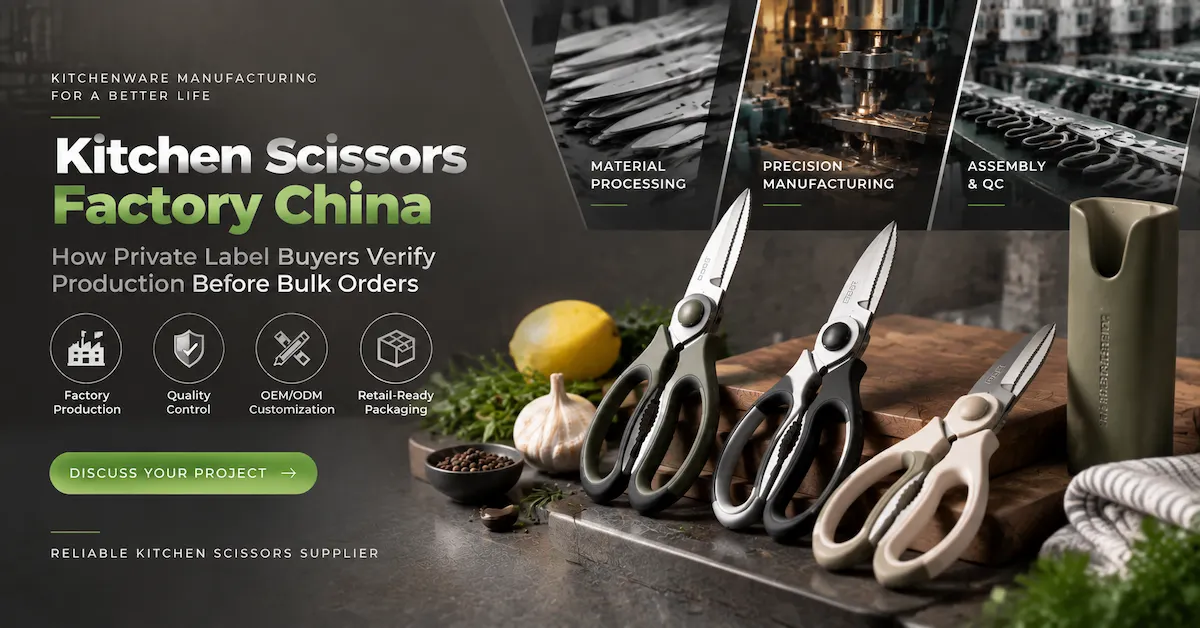
1. Start With the Exact Kitchen Scissors You Plan to Sell
A kitchen scissors factory should be evaluated against the product in your sourcing brief rather than against its entire catalog. A simple household scissors model, detachable cooking shears and a multifunction model with a storage accessory may share similar blade materials, yet they can require different assembly, inspection and packaging controls.
That distinction matters for supermarket private labels, kitchenware distributors and ecommerce brands. A supermarket buyer may care heavily about retail-pack consistency and replenishment. An ecommerce seller may need the photographed accessories, product description and delivered package to match precisely. An importer handling several scissors styles may be more concerned with SKU identification and repeat-order consistency. The factory review should reflect the commercial situation.
Use BONET Models as Product-Level References
The following BONET listings provide useful examples. The dimensions and material descriptions below are published product information, not independent laboratory results, and should be reconfirmed against the version being quoted.
| BONET model | Published dimensions | Listed materials | Product direction | Buyer should confirm |
|---|---|---|---|---|
| G2003 Cooking Shears | 24 × 7.5 × 1.5 cm | 420 stainless steel, PP + TPR | Detachable cooking shears with magnetic-storage concept | Blade assembly, detachable operation, handle construction, sheath and pack contents |
| G2004 Multipurpose Kitchen Scissors | 19 × 9.5 × 1 cm | 420 stainless steel, PP | Detachable multifunction kitchen scissors | Included functions, assembly, cutting tasks and packaging |
| G2011 Magnetic Kitchen Scissors | 21.8 × 8.6 × 2 cm | 420 stainless steel, PP | Kitchen scissors with magnetic-storage feature | Storage configuration, sheath fit, intended surface and final accessories |
These three models illustrate why a buyer should not select a factory on steel grade alone. Product dimensions, handles, detachable structures, storage concepts and accessory requirements can change both production and QC requirements.
2. Map the Manufacturing Route for the Selected Model
When assessing a kitchen scissors factory China partner, ask for the manufacturing route of the specific model being quoted. BONET's manufacturing information presents operations including stamping, straight adjustment, heat treatment, grinding, polishing, injection molding, cleaning, assembly, quality checks and packaging. Not every scissors model necessarily passes through every process in exactly the same way, so the buyer's job is to identify which stages apply to the selected product.
A useful production discussion follows the scissors rather than the machines.Ask where metal parts enter production, which processes determine the blade geometry, where handle components are produced or introduced, how the pivot is assembled, when functional checks take place and how finished products are identified before packing.
Turn the Factory Tour Into a Process Audit
| Production stage | What the buyer should ask | What should become traceable |
|---|---|---|
| Material preparation | What material specification applies to the blades and other metal parts? | Material requirement connected to the SKU |
| Forming | How are blade blanks or metal components formed? | Product revision and relevant dimensions |
| Heat treatment | Which product characteristics is the process intended to control? | Process requirement tied to the selected model |
| Grinding and finishing | How are blade geometry, surface and edges controlled? | Visual and dimensional acceptance criteria |
| Handle/component production | Which components are molded or externally supplied? | Component specification and supplier responsibility |
| Assembly | How are blades, pivot,handles and accessories fitted together? | Assembly reference and approved sample |
| Functional inspection | Which actions are tested before release? | Test method and acceptance requirement |
| Packaging | How is the approved product protected and identified? | Pack version, contents and carton reference |
The purpose is not to insist that every operation must be performed inside one building. A buyer needs to know who performs each relevant activity and who is responsible for accepting the result before the product moves forward.
3. Make the Approved Sample the Factory's Production Reference
A sample becomes valuable when the sales team, buyer, production team and QC team are all referring to the same version. Give it a model number or sample identification, record the date or revision, and link it to the written product specification.
Avoid a vague approval such as “sample OK.” A sample can be approved for appearance but still have an unresolved packaging issue. A prototype can demonstrate a handle shape without confirming the final material. A pre-production sample may have the correct logo but still need a functional adjustment. Writing down what has actually been accepted prevents the factory from interpreting an incomplete sample as permission to start unchanged mass production.
Separate Function, Appearance and Pack Approval
Functional review should examine what the scissors are expected to do. Appearance review should cover finish, handle color, logo location and visible assembly. Packaging review should examine the actual scissors, accessories, protection and printed materials together.
For a detachable model such as G2003 or G2004, the sample review should include separation and reassembly. For a magnetic-storage design, the holder or sheath needs to be evaluated as part of the saleable product rather than treated as a photography accessory.
4. Inspect the Finished Scissors, Not Just the Raw Material
Many buyers searching for a stainless steel kitchen scissors manufacturer ask about the steel grade first. It is a relevant question, but a finished scissors is a system.Blade geometry, processing, grinding, pivot adjustment, handle assembly and the relationship between both blades affect how the tool operates.
BONET's G2003, G2004 and G2011 listings identify 420 stainless steel. That published information gives buyers a starting point for a specification discussion. It does not by itself establish a particular hardness, cutting life, corrosion result or suitability for every food-preparation task.
Define the Cutting Task Before You Define “Good”
A useful test begins with the intended application. Scissors sold for herbs, food packaging and light preparation should be evaluated against those tasks. If poultry preparation or other demanding cutting is part of the commercial claim, the corresponding sample review and acceptance method need to reflect it.
Do not rely on a factory demonstration using an undefined material simply because the scissors appear sharp. Record what was cut, how the tool was operated and what result the buyer considers acceptable.
5. Check the Pivot and Blade Contact as One System
Two individually attractive blades can still produce a poor pair of scissors if their contact or pivot adjustment is wrong.During sample review, observe opening and closing, blade interaction, visible gaps, unexpected rubbing and excessive looseness.
The pivot should also remain part of the repeat-order specification. If one production batch changes the pivot component or assembly condition, the scissors may feel different even though the blade material and handle color remain unchanged. This is why a factory should control the complete product configuration rather than simply purchase components to approximately match a sample.
Detachable Scissors Need an Extra Check
For detachable kitchen scissors, repeatedly separate and reassemble the sample using the intended consumer method. Observe whether reassembly is obvious, whether the parts locate correctly and whether cleaning access matches the product instructions. If the buyer plans to advertise detachable cleaning as a benefit, that feature needs to be recognizable on the actual production version.
6. Evaluate Handles for Construction, Not Just Color
Private-label buyers often begin customization with handle colors because color immediately affects shelf appearance. The construction underneath matters just as much.
G2003 lists PP + TPR, whereas G2004 and G2011 list PP on their respective product pages.A buyer comparing these models should therefore examine grip feel, molding quality, component fit, visible seams, surface consistency and the actual color result on physical samples.
A custom kitchen scissors manufacturer should distinguish between a simple color change and a structural handle redesign. Changing a color reference is not the same project as changing the handle dimensions, shape or material combination. The latter may affect tooling, sampling, fit and production timing and should therefore be documented separately.
7. Treat Magnetic Storage as a Product System
A buyer considering a magnetic kitchen scissors manufacturer is not purchasing only a pair of blades and handles. The storage component becomes part of the user experience and retail package.
Confirm whether the quoted version includes a sheath or holder, how the scissors are inserted and removed, what orientation is intended, and what type of surface the product is meant to work with. Evaluate the actual storage arrangement that will appear in your instructions and photographs.
Avoid generic claims such as “sticks to any metal surface” unless the relevant product configuration has been evaluated for that statement.Product-specific language is more useful to buyers and produces stronger, more defensible website content than universal claims.
8. Convert “Strict QC” Into Specific Inspection Points
A kitchen scissors factory China supplier should be able to describe what it checks instead of relying only on terms such as “high quality” or “strict inspection.” The BONET manufacturing page identifies quality checking as part of its published process, but a purchasing project still needs a model-level inspection plan.
For kitchen scissors, practical checkpoints can address product identity, key dimensions, visual finish, blade condition, opening and closing, pivot condition, handle assembly, required cutting tasks, detachable operation where applicable, accessory completeness, logo appearance and packaging.
Four Questions Make QC More Useful
For every important requirement, the buyer should know what is checked, how it is checked, what result is acceptable, and what happens when it fails.This converts quality control from a marketing phrase into a repeatable process.
For example, “check cutting function” is incomplete if the test material and expected result are undefined. “Check package contents” is incomplete if the final list of included components is not controlled by a pack specification.
9. Review Factory Evidence Within Its Real Scope
Factory evidence can include manufacturing records, quality-system documents, social-audit information, inspection records, product test reports and production photographs. These documents do not all answer the same purchasing question.
A management-system certificate concerns a defined management scope. A social audit reviews workplace-related topics. A product test report addresses defined products, materials or test conditions. Buyers should record the company name, location, scope, relevant dates and connection to the proposed order before using any document as evidence.
The most useful question is not “How many certificates does the supplier have?” It is “Which document supports this particular requirement?”
This approach also improves content credibility. It avoids claiming that one factory-level document proves every product, material or destination-market requirement.
10. Define OEM Kitchen Scissors at Model Level
BONET's OEM/ODM service page describes support for drawing- or sample-based projects as well as material, color, logo and packaging customization. Buyers working with an OEM kitchen scissors manufacturer should convert those company-level capabilities into a model-specific project brief.
A catalog scissors with a custom logo and new color is different from a new blade profile or redesigned handle. The first project may focus heavily on branding and packaging approval. The second involves additional product-development decisions and potentially new tooling or validation.
Private Label Kitchen Scissors Need a Controlled Brand File
For private label kitchen scissors, record the supplier model, buyer SKU, product revision, handle color, logo artwork, logo position, packaging artwork, included accessories and approved sample.
The objective is simple: when the buyer places the next order, both sides should know exactly what “same as last order” means.
11. Put Packaging Into the Factory Audit
Kitchen scissors packaging protects sharp or pointed areas, communicates the product features and presents the brand. It should therefore be audited alongside the scissors rather than left until after product approval.
Place the actual approved scissors into the proposed package. Check movement, exposed areas, accessories, product orientation, printed functions, barcode and carton identification. If a magnetic sheath or another accessory is included, verify that the pack contains the exact item shown in the sales material.
For ecommerce products, compare the packed sample with the proposed listing photography. For supermarket private labels, review how the pack will display and how SKUs can be identified during replenishment.
12. Clarify MOQ by Model, Color and Packaging Version
“What is your MOQ?” is rarely detailed enough for a customized project. A factory may have one minimum for a scissors model and different requirements for molded colors, customized packaging or another component.
BONET's OEM/ODM information treats MOQ as a project-specific commercial item rather than publishing one number for every product. Buyers should therefore request MOQ for the exact configuration being discussed.
If a project contains three scissors models, do not assume that the quantities can automatically be combined. Ask which minimum applies to the model, color, logo or retail package, and make sure each quotation states the assumption clearly.
13. Check Capacity Against the Actual Bulk Order
Factory capacity is useful only when connected to a defined order and schedule. A headline annual output figure does not reveal whether the relevant line, components and packaging are available during your required production window.
Ask the supplier what production step is likely to control the schedule, when key components are expected, when mass production can begin after sample approval and when final inspection and packaging are planned.
A responsible kitchen scissors factory China sourcing decision distinguishes sample lead time, production time, inspection time, factory completion, shipment departure and destination arrival.These dates should not be compressed into one undefined “lead time.”
14. Compare Factory Quotations on the Same Configuration
Price comparison becomes useful after product scope is controlled. Give shortlisted suppliers the same drawing, sample reference, materials, functions, quantity, branding, packaging and delivery basis.
| Quotation item | What should remain comparable |
|---|---|
| Base scissors | Same model or agreed construction |
| Blade requirements | Same specified material and product requirements |
| Handle | Same construction, material direction and color |
| Accessories | Same sheath, holder or multifunction components |
| Logo | Same artwork,location and method |
| Packaging | Same retail format and included components |
| Quantity | Same SKU and version breakdown |
| Sample/development | Clearly separated where applicable |
| Inspection | Same buyer-required scope |
| Delivery | Same commercial and destination basis |
If one offer is much cheaper, identify what changed before concluding that the factory is more competitive. An excluded accessory, simpler pack or different specification can easily create a lower unit price without creating better value.
15.Build Reorder Control Before the First Shipment
Repeat orders are where factory discipline becomes visible. Keep a controlled product file containing the approved specifications, sample reference, artwork versions, packaging revision and relevant inspection requirements.
When a repeat quotation is issued, ask whether anything has changed in materials, components, process, production location or packaging. If a change is necessary, record and approve it rather than allowing the new version to silently become the reference.
For distributors and supermarket programs, this consistency can be more valuable than adding another minor feature. Customers recognize a product through its appearance and use, while the buyer also needs the next shipment to behave like the previous one.
16. What Should You Send BONET Before Requesting a Factory Quote?
Before contacting BONET, identify the target market, customer type, intended scissors application, candidate model or reference sample, estimated quantity, handle requirement, desired functions, logo and packaging direction. Mark undecided items as open for discussion.
You can first review BONET's product catalog, manufacturing information and OEM/ODM capabilities. Then use the contact page to request model-specific information on samples, customization, MOQ, production planning and packaging.
Frequently Asked Questions
1. How do I find a reliable kitchen scissors factory China supplier?
Start with a real scissors model and ask the supplier to connect it to a manufacturing process, approved sample, QC plan and packaging specification. Verify responsibilities at product level rather than relying only on a factory introduction or catalog size.
2. What is the difference between a kitchen scissors factory and a kitchen scissors supplier?
The terms alone do not prove who performs each operation.Ask which manufacturing, component sourcing, assembly, inspection and packing activities apply to your selected product and who is responsible for the finished order.
3. Which BONET kitchen scissors can buyers compare?
G2003, G2004 and G2011 provide useful published examples with different dimensions, handle-material listings and product features. Buyers should confirm the final configuration, accessories and production specification for the version being quoted.
4. What stainless steel does BONET list for these kitchen scissors?
The published pages for G2003, G2004 and G2011 list 420 stainless steel. A buyer should still evaluate the finished scissors because material designation alone does not determine blade geometry, assembly, cutting result or suitability for every use.
5. Can BONET support OEM kitchen scissors?
BONET's OEM/ODM page describes drawing- and sample-based manufacturing support plus material, color, logo and packaging customization.The exact options, commercial terms and development work should be confirmed for the selected model.
6. Can kitchen scissors be customized for a private-label brand?
Private-label projects can include branding, color and packaging changes, while more substantial structural changes require a separate development discussion. Keep the product version, artwork and approved sample identifiable throughout the project.
7. What should buyers check on multifunction kitchen scissors?
Confirm every advertised function on the actual sample, the components included in the retail pack, opening and closing, detachable operation where applicable, handle construction and the product's intended food-preparation tasks.
8. What should buyers check on magnetic kitchen scissors?
Review the scissors together with the relevant holder or sheath. Define the intended storage surface and orientation, test insertion and removal, and confirm that the quoted and packaged configuration contains the same storage component.
9.What is BONET's MOQ for customized kitchen scissors?
BONET does not publish one universal MOQ for every custom scissors project on its OEM/ODM page. Buyers should request the minimum for the specific model, color, branding and packaging version and clarify whether multiple SKUs can be combined.
10. What information should I provide for a kitchen scissors quotation?
Provide the target market, sales channel, intended application, model or reference sample, quantity, desired materials, handle requirements, functions, logo artwork and packaging concept. Use the BONET contact page to begin the model-specific discussion.
Conclusion
Choosing a kitchen scissors factory China supplier is not simply about finding a factory that can make two blades and a handle. A strong purchasing decision connects the selected model to its manufacturing route, material requirements, approved sample, measurable QC checks, customization scope, packaging and repeat-order controls.BONET's real kitchen-scissors listings give buyers concrete products to start that evaluation, while its manufacturing and OEM/ODM pages provide additional context for a sourcing discussion. Buyers preparing an OEM, private-label or wholesale kitchen-scissors program can contact BONET with the model, expected quantity, target market and customization brief to clarify the next production steps.
