




Selecting a kitchen scissors manufacturer begins with a pair of shears in hand, not a catalog price. Look at the complete cutting system: blade geometry, edge condition, pivot behavior, handle construction, intended tasks, cleaning access and packaging protection. Put those decisions on paper before seeking prices; otherwise each supplier may quote a different interpretation of the same photograph.
Direct answer: prepare an item-level brief, then ask the factory to build and identify a sample from it. Turn the agreed result into checks that an inspector can see or repeat. Put blade, pivot and handle questions on the table. Name the required functions. Review the tool inside its finished pack, and tie price, MOQ, testing and timing to that exact version.
Importers, private-label teams, distributors and category managers all face the same awkward moment: several offers look similar, yet the samples are not truly comparable. This guide follows the decisions that move one of those samples toward production. BONET HOUSEWARE's published products and factory information provide concrete examples, while every model detail remains attached to its own SKU.
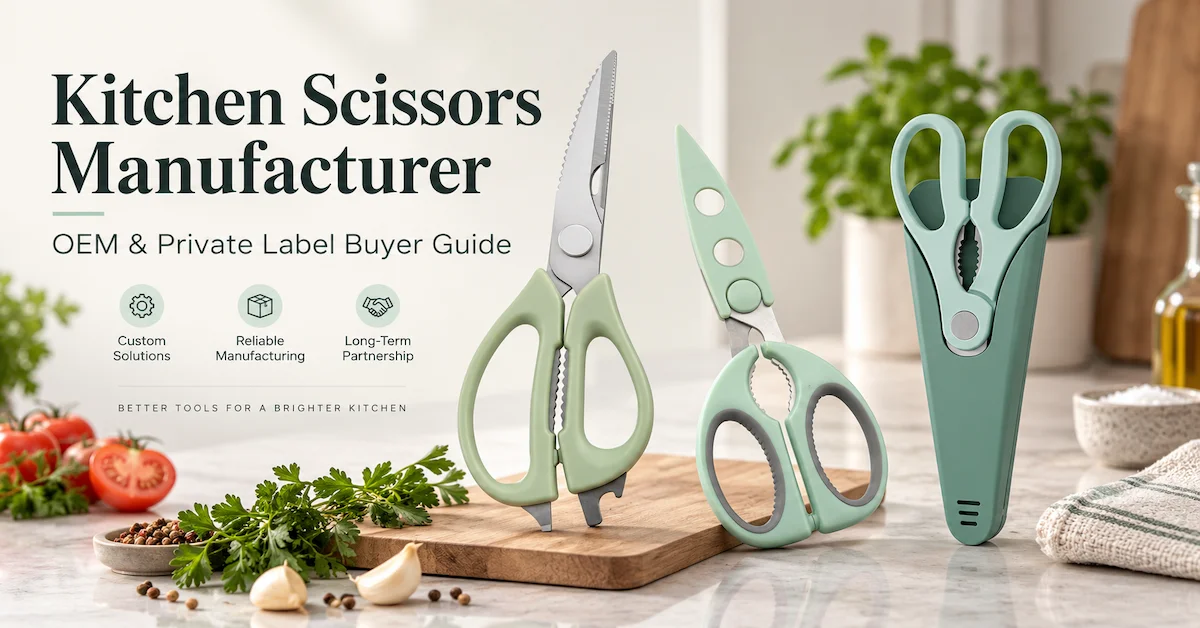
1. Define the Kitchen Scissors Before You Compare Manufacturers
A familiar office-scissors outline tells a kitchenware buyer very little. Put the sample on a prep surface and the gaps become obvious. Which food or package will it cut? How often? Do the blades separate? Can a cloth reach the pivot area? Is the grip manageable with a wet hand, and where does the tool live after use? Begin with those answers and the retail channel, not with a copied product photograph.
Write the intended tasks in order. Herbs, food packaging, thin poultry skin and general kitchen opening tasks do not create the same load or edge requirement. If a product must perform another task, identify the action and material precisely. On the brief, replace "multifunction" with named jobs. A serration, notch or opener earns a packaging claim only after the relevant sample check. The manufacturer should review each requested function against the chosen construction.
The retail channel matters just as much. A supermarket peg pack, e-commerce parcel, gift box and food-service distributor pack create different requirements for visibility, protection, instructions, pack size and handling. Destination-market information can affect labeling and compliance work. Give the market and channel at the first inquiry, not after the sample has been approved.
| Brief field | What the buyer should state | Why it changes the project |
|---|---|---|
| Primary use | Specific foods or packaging, frequency, user and any prohibited use | Guides blade, edge, pivot and handle discussions |
| Product route | Existing model, modified model, drawing, physical sample or new concept | Separates selection work from development work |
| Market and channel | Destination country, retail format and intended positioning | Shapes labeling, packaging, documentation and testing questions |
| Commercial frame | Estimated quantity, target date and delivery destination | Allows project-specific feasibility and quotation review |
| Brand system | Logo artwork, color references, pack format and barcode status | Prevents the product and packaging from becoming separate projects |
A sourcing team looking for a kitchen scissors manufacturer China can use this brief to compare process clarity rather than geography alone. The supplier's first response is revealing. Does it identify missing details, distinguish firm requirements from preferences and explain which questions need a sample? Or does it immediately return a number with unspecified assumptions?
2. Read Blades, Pivots and Handles as One Cutting System
Three visible parts control much of the user experience, but they should not be evaluated in isolation. The blades meet through a pivot, and the user's hand supplies force through the handles. A change in blade thickness or geometry can alter the feel at the pivot. A handle shape can make a technically sharp tool tiring to use. A loose pivot may allow the blades to separate under load even when each edge looks acceptable.
Blade questions
Record the blade profile, dimensions, finish, edge form and any serration or functional detail on the approved sample or drawing. Then define what is inspected: symmetry, alignment, surface appearance, burrs, edge continuity and the result on agreed cutting media. For a sheathed model, fit the sheath to the actual sample, shake and remove it several times, and note any exposed point, looseness or contact with the edge.
Pivot questions
The pivot should be evaluated through repeated opening and closing as well as a visual check. Buyers can document opening resistance, smoothness, side play, fastener appearance and whether the two blades remain aligned through the stroke. If the construction is detachable, define how the halves separate and reconnect, which surfaces become accessible, and how the product will be presented safely. Cleaning statements should match the actual construction and market evidence rather than assumptions.
Handle questions
Handle review includes more than color. Inspect molding, flash, seams, insert fit, comfort, ring dimensions and the connection between the handle and metal component. Test with the likely user's hand orientation and the expected task. A soft-feel insert, an integrated opener or a decorative color can influence tooling, assembly, cleaning, artwork and packaging. Every visible option should be tied to a controlled revision.
| Component | Specification evidence | Sample observation | Repeat-order record |
|---|---|---|---|
| Blade | Drawing or approved profile, material direction, finish and edge description | Alignment, surface, edge condition and agreed cutting result | Reference sample, revision and inspection method |
| Pivot | Fastener type and assembly direction | Movement, resistance, play and appearance | Approved feel or measurable range where appropriate |
| Handle | Construction, material direction, color reference and logo location | Fit, molding, comfort, defects and assembly | Color standard, artwork and controlled sample |
| Accessories | Sheath, magnet, insert, label or other included parts | Fit, retention, completeness and safe presentation | Bill of materials and pack-content checklist |
Have a drawing, reference sample or target retail pack?
Discuss Your Kitchen Scissors Project3. Standard, Multifunction and Magnetic Kitchen Scissors Serve Different Retail Jobs
The right assortment is not necessarily the model with the longest feature list. A focused general-purpose item may be easier to explain and package. A multifunction model can support a stronger demonstration story, but each added detail must be defined and tested. A magnetic-storage product changes the conversation again because storage, retention, cover construction and pack presentation become part of the user experience.
BONET's public pages provide useful examples. Model S52034 is listed as an 8-inch kitchen-scissors model with 420 stainless steel and PP. The SKI022 multifunction model is listed at 9 inches with 420 stainless steel and PP plus TPR. Magnetic model G2011 is listed at 21.8 x 8.6 x 2 cm with 420 stainless steel and PP. Another multifunction model, SKI090, is listed at 9 inches with 420 stainless steel and PP. These are listed specifications for those named models, not a universal material or dimensional promise.
| Product direction | Example BONET page | Buyer review focus | Claim boundary |
|---|---|---|---|
| Standard kitchen scissors | S52034 kitchen scissors | Core cutting task, pivot feel, handle fit, sheath and basic pack | Use the SKU page and final specification; avoid category-wide assumptions |
| Multifunction model | SKI090 multifunction kitchen scissors | Name every function, test every claimed function and check cleaning access | An integrated feature does not prove suitability for every material |
| Alternative multifunction model | SKI022 multi-purpose kitchen shears | Handle material direction, functional details, size and display story | Listed values apply to the model shown |
| Magnetic-storage model | G2011 magnetic kitchen scissors | Retention, cover fit, chosen mounting surface, removal and packaging | Storage performance needs an agreed test and target surface |
A buyer comparing a multifunction kitchen scissors manufacturer should request a feature matrix with one row per function. The matrix should state the intended material or action, the sample test, the pass observation and the wording proposed for packaging. This simple step prevents marketing copy from outrunning the physical product.
For a magnetic kitchen scissors manufacturer, add the storage system to the specification. Identify the magnetic component, its location, the intended surface, the orientation during storage, the removal action and any protective cover. Test the exact production-intent sample on the defined surface. Use a narrow claim such as "magnetic storage on the specified test surface" instead of the careless promise "sticks anywhere."
4. Stainless Steel: What Has the Material Line Left Out?
Quite a lot remains unknown after a catalog says "stainless steel." The buyer still has to pin down the blade geometry, heat-treatment direction, hardness where specified, finish, corrosion review, edge preparation and final cutting result. Treat the material line as the first clue, then follow it through the process and into the actual sample.
When approaching a stainless steel kitchen scissors manufacturer, ask which grade is proposed for the specific blade and how that grade is documented. Then connect it to the intended task, surface finish, heat-treatment direction, agreed cutting test and destination-market requirements. If a test report or declaration is needed, identify the document, issuing party, sample identity and applicable market before the order. Do not treat a report for one product or material batch as automatic coverage for another.
BONET publicly lists 420 stainless steel for the named models above. That makes 420 a useful starting point for those SKU conversations, not proof that every BONET scissor uses the same grade. A professional specification should retain the model number, drawing or sample revision and material confirmation together. If the product changes, the evidence review may also need to change.
5. Build the OEM or Private-Label Specification Before Sampling
An OEM kitchen scissors manufacturer normally works from an agreed reference: an existing model with selected options, a buyer's drawing, or a physical sample. The supplier's task is not to guess the commercial intent hidden behind the reference. The buyer should state which dimensions, materials, colors, functions and appearance details are fixed, and which are open to a manufacturing recommendation.
A custom kitchen scissors manufacturer may also need to discuss tooling or structural development. "Custom" can mean a printed logo on an existing model, a color change, a modified handle, a new pack or a substantially new product. Those routes do not share one cost or calendar. Label the requested customization level before asking for MOQ, sample timing or production timing.
For private label kitchen scissors, the product and brand system should be approved together. BONET's public OEM/ODM page describes support for drawing or sample production, logo printing, laser engraving, colors, materials, packaging, sampling and production. The method still needs to be matched to the chosen SKU, surface, artwork and order. A logo that looks acceptable on a digital mockup can change when applied to textured plastic, a curved handle or a small metal area.
What a production-ready RFQ should contain
- Product model, drawing or clearly identified physical reference.
- Intended tasks, target user, destination market and sales channel.
- Dimensions, blade material direction, finish, edge and pivot requirements.
- Handle construction, color reference and any soft inserts or functional details.
- Logo file, position, size, color and proposed application method.
- Individual packaging, protective parts, inserts, labels, barcode and outer-carton needs.
- Estimated order quantity, requested sample timing, launch window and destination.
- Required documents, testing discussion and inspection expectations.
- A list of open questions, with the party responsible for each answer.
Intellectual-property control belongs in this phase. Send artwork through the agreed business channel, identify the owner and approved use, and keep a revision log. Limit access to people named for the project, then ask the supplier to confirm what happens to old artwork files and whether any outside component partner receives them. A logo approval should include scale, position, orientation and color, not just the source file.
Ready to turn an idea into a reviewable sample?
Request an OEM Sample Review6. Test the Sample as a Product, Not as a Photograph
A sample is valuable because it makes questions visible. It is not production approval until the buyer records what was received, how it was evaluated, what changed and which version became the reference. Give every sample a simple identifier. Photograph the full product, pivot, blade surfaces, handles, logo, protective parts and pack. Record the date and specification revision beside it.
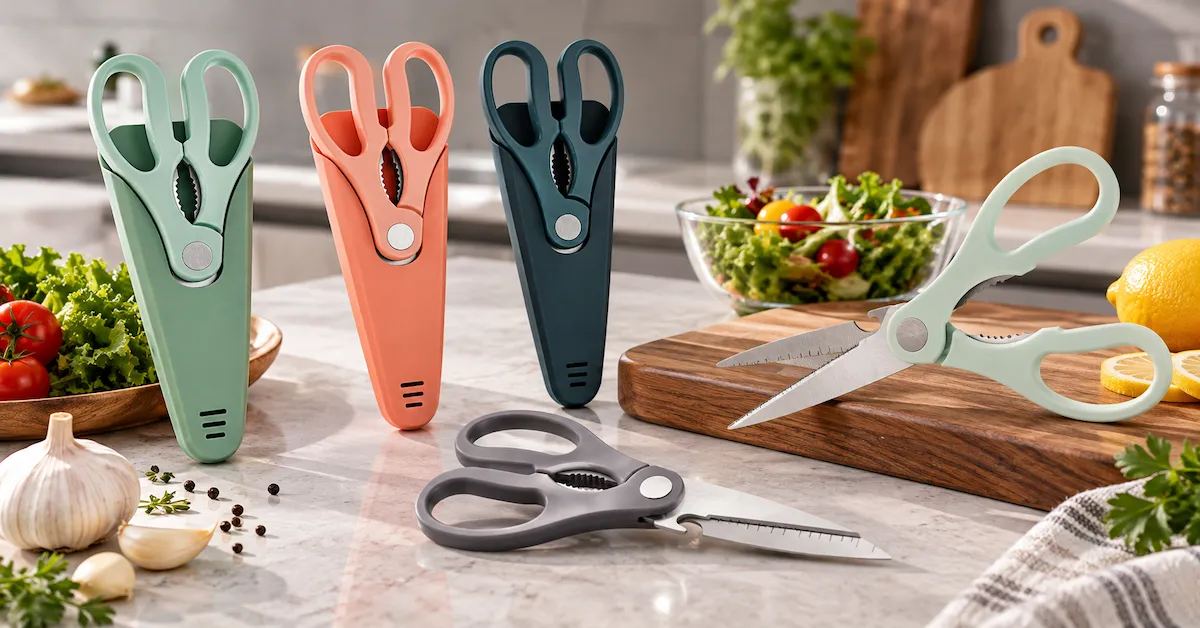
Use agreed test media that represent the intended tasks. Record the media, preparation, number of repetitions where relevant and pass observation. The aim is not to create a theatrical demonstration. It is to produce a repeatable comparison between revisions and, later, between the approved reference and production units. If the tool is not designed for a task, keep that task out of the test and out of the marketing claim.
| Sample gate | Practical review | Record to keep | Reason to stop |
|---|---|---|---|
| Identity | Model, revision, dimensions, components and pack contents | Sample ID, photos and received date | Sample cannot be tied to the current brief |
| Cutting | Agreed media, full stroke, edge behavior and material movement | Method, result and any visible damage | Result is inconsistent or outside the intended use |
| Pivot | Opening, closing, resistance, play, fastener and alignment | Observation and approved reference feel | Movement changes, binds or allows blade separation |
| Handle and assembly | Grip, molding, fit, color, logo and attached components | Defect notes and approved appearance | Comfort, fit or assembly does not match the brief |
| Cleaning review | Accessible surfaces and the proposed care statement | Cleaning method reviewed for the actual construction | Care claim is unsupported or important areas remain inaccessible |
| Packaging | Retention, point protection, removal, labels, barcode and carton fit | Approved artwork and packed sample photos | Product moves, is exposed or pack information is incomplete |
Approve corrections explicitly. "Looks good" is too vague for a repeat order. A useful approval says which sample ID and which specification, artwork and packaging revisions are accepted. It also lists any conditional item that must be shown again before production. Keep a retained sample where the project and local practice allow.
7. Connect Manufacturing Stages to Quality-Control Checkpoints
BONET's public manufacturing description includes stamping, straight adjustment, heat treatment, rough grinding, water grinding, polishing, injection molding, ultrasonic cleaning, setting and assembly, quality checks, final cleaning and packing. Not every kitchen-scissors SKU necessarily follows every listed stage. The useful buyer question is: which stages apply to this model, and what is checked before the product moves forward?
Early controls matter because a finished-product inspection cannot economically correct every upstream issue. A blade blank that is out of shape, a surface affected during grinding or a handle component with inconsistent molding may become more expensive to address after assembly. For each applicable stage, note who checks the work, when the check occurs and where a failed piece goes. A three-line answer is enough when it names the real product and process.
| Published process area | Relevant buyer question | Possible evidence for the project |
|---|---|---|
| Stamping and straight adjustment | How are profile and flatness controlled for this blade? | Drawing reference, in-process check or recorded sample |
| Heat treatment | What project requirement is connected to the selected material and process? | Agreed specification and available process record |
| Rough grinding, water grinding and polishing | Where are geometry, edge condition and surface appearance checked? | Work reference, visual standard and inspection result |
| Injection molding | How are color, molding appearance and metal-to-handle fit reviewed? | Color reference, approved sample and defect criteria |
| Assembly and quality checks | How are pivot movement, alignment, function and completeness verified? | Item-level checklist and approved reference |
| Final cleaning and packing | How are appearance, protection, labels and pack contents confirmed? | Packed sample, artwork revision and carton record |
Yangjiang Master Scissor & Knife Manufacture Co., Ltd. holds an ISO 9001:2015 certificate whose stated scope is production and sale of scissors. Keep that wording inside its certificate scope. The official ISO 9001 overview places the standard at quality-management-system level. The certificate therefore informs a factory review, but it cannot answer whether this blade, pivot, handle and pack match the buyer's approved sample.
8. Packaging Is Not an Afterthought
A pack that only looks good on screen has not done its job. It must carry the sales story, survive the chosen distribution route and keep the cutting end and moving parts under control. Put the real scissors into the proposed pack. Turn it over, lift it by the display area, remove the product and look for movement, rubbing, opening blades or pressure marks.
The artwork review should include the product name, intended-use wording, care information, warnings where required, barcode, origin and other market-specific information. The exact content depends on the destination and channel. Keep legal and compliance approval with the responsible buyer or qualified adviser; the manufacturer can provide product and production information but should not be asked to guess every market obligation.
Private-label packaging also affects the quotation. A printed sleeve, blister-style presentation, color box, gift box, tray, insert and e-commerce mailer have different material, assembly and transport implications. Specify the product orientation, number of components, display face, opening experience and outer-carton arrangement. Ask whether artwork setup, inserts, labels, cartons and pack-out labor are included in the quoted assumptions.
When the package carries a multifunction or magnetic-storage claim, connect the words to the sample test. A small diagram can help the shopper, but it must reflect the actual feature. Avoid crowding the front panel with claims that the product specification and evidence file do not support.
9. Kitchen Scissors Wholesale China: Are the Quotes Actually Comparable?
A search for kitchen scissors wholesale China can place unlike numbers side by side: one may cover a bare product, another a printed retail pack, and a third a different quantity or delivery point. Rebuild the offers on a common specification before ranking them. Price alone neither exposes the cheapest landed route nor proves that an expensive supplier has better control.
Build one comparison sheet with the same specification revision in every column. Separate confirmed values from allowances and exclusions. Note the currency, validity period and trade or delivery term used in the quotation. Ask how a change to handle color, logo process, package structure or order quantity changes the offer. Keep the answer in writing.
| Quotation line | What to normalize | Question to ask |
|---|---|---|
| Product | Model, revision, material direction, finish, handle, functions and accessories | Does this price point to the same approved construction? |
| Branding | Logo method, location, colors, setup and artwork revision | Which branding costs are included or separate? |
| Packaging | Individual pack, insert, labels, barcode, master carton and pack quantity | Is the quotation based on the approved packed sample? |
| Development | Sample, prototype, tooling, artwork changes and additional rounds | Which charges are one-time, refundable, provisional or recurring? |
| Quality and documents | Inspection basis, testing requests and required project documents | What evidence is included, and what requires separate arrangement? |
| Delivery | Quantity, timing, destination and agreed commercial term | What assumptions sit outside the unit price? |
MOQ, unit price, tooling, sample timing and production lead time cannot be stated responsibly as universal BONET numbers. They move with the model, material, customization, pack, quantity and factory schedule. First let the team mark up the brief. Then collect the commercial figures beside its revision number, and reopen the quotation when that number changes.
10. Make the Second Order Recognizable
Six months after delivery, a buyer may remember "the black pair in the orange box" while the factory sees several similar components and artwork files. Give both teams one item master containing the model, revision, dimensions, materials, finish, color references, logo artwork, packaging dieline, barcode, pack contents, carton arrangement and approved sample ID.
Mark a redline with two short lists: what changes, and what stays exactly as approved. Give the changed file a new revision number instead of writing over the old one. Beside that number, record any effect on tooling, material, appearance, pack fit, quotation, sample approval, testing or schedule, then name the version it replaces.
Keep issue feedback equally precise. A photograph should show the whole item and a close view, include scale where useful and reference the affected quantity or batch information available to the buyer. Describe the observed condition without guessing the cause. Then request containment, cause review, corrective action and verification appropriate to the issue. That record makes the next production discussion more useful than a general complaint.
11. A Practical Manufacturer Scorecard
A scorecard prevents one attractive sample or one low quotation from dominating the decision. Weight the categories according to the project. A new multifunction design may place more weight on development and sample discipline. A repeat catalog model with custom packaging may place more weight on artwork control, pack-out and delivery reliability.
| Evaluation area | Evidence to request | Suggested review question |
|---|---|---|
| Category fit | Relevant models, process explanation and item-level answers | Does the supplier understand this construction and intended task? |
| Specification discipline | Marked brief, drawing, sample ID and revision log | Can every quoted feature be traced to a controlled reference? |
| Sample quality | Functional result, pivot behavior, assembly, appearance and pack | Does the physical sample meet the agreed method, not just look attractive? |
| Manufacturing control | Applicable process stages, checkpoints and reaction plan | Are important risks checked before final inspection? |
| Commercial clarity | Included, excluded, provisional and separate cost lines | Can offers be compared on the same assumptions? |
| Communication | Decision recap, ownership and response to open questions | Will changes remain visible across buyer and factory teams? |
| Repeat-order readiness | Item master, retained evidence and obsolete-file control | Can the approved product be reproduced without relying on memory? |
BONET HOUSEWARE publicly positions its offering around scissors, kitchen knives, kitchen tools, cutting boards, gadgets and OEM/ODM support. For a scissors-focused program, evaluate that public category fit beside the item-level evidence described above. A website starts the conversation; the controlled specification, sample and commercial confirmation decide whether the program is ready.
Buyer FAQ About Kitchen Scissors Manufacturing
What should I send a kitchen scissors manufacturer with my first inquiry?
Send the intended tasks, target market, sales channel, existing model or reference, dimensions, material and finish direction, handle and function requirements, logo artwork, packaging idea, estimated quantity, requested timing and required documents. Mark each item as fixed, preferred or open. Include photographs or drawings where they clarify the request.
What is a typical MOQ for OEM or private-label kitchen scissors?
There is no responsible universal MOQ. An existing model with a simple logo, a custom-color molding run, a new structural design and a special gift pack create different constraints. Ask for a project-specific MOQ after the product, branding, pack and quantity assumptions are clear, and request the basis in writing.
How long do sampling and production take?
Timing depends on whether the buyer selects a catalog model, changes a component, needs tooling, approves custom colors, requires several artwork rounds or requests specific testing. The live production plan also matters. Ask the manufacturer for separate dates for information review, sample preparation, buyer feedback, final approval and production against the actual revision.
How should buyers compare 420 stainless-steel kitchen scissors?
Treat the listed grade as one input. Compare the exact model's blade geometry, heat-treatment direction, finish, pivot, handle construction and performance on agreed media. Check how the material is documented and whether any report applies to the same SKU and revision. BONET's cited model pages list 420 stainless steel for those specific products; the value should not be generalized without confirmation.
Can BONET add a custom logo and retail packaging?
BONET's public OEM/ODM page describes logo printing, laser engraving, color, material and packaging customization, including retail-oriented packaging options. Feasibility, appearance, artwork limits, setup, MOQ, cost and timing should be confirmed for the chosen model and order. Approve branding on a physical sample when surface, curvature or texture affects the result.
What should be tested on magnetic kitchen scissors?
In addition to blade, pivot and handle checks, define the storage configuration, intended surface, orientation, retention observation, removal action, cover fit and packaged presentation. Test the production-intent sample on the agreed surface. Keep the consumer claim no broader than the documented result.
How can a buyer protect confidential artwork or a new design?
Identify ownership and permitted use in the commercial agreement, share controlled files through the agreed channel and use revision numbers. Name the people allowed to handle the files; also record the disposal of obsolete artwork and the role of any outside tooling or component partner. Ask counsel in the relevant jurisdiction to review the contract language.
How should ISO 9001 be read during this purchase?
Read it at system level. It does not measure how one pair cuts. The company-provided certificate's scope is limited to the production and sale of scissors, so the buyer still needs the approved sample, item specification, testing decisions and inspection evidence for the intended market.
Final RFQ Checklist for a Kitchen Scissors Manufacturer
- The intended tasks, target user, destination market and sales channel are stated.
- The model, drawing or physical reference is clearly identified.
- Blade, pivot, handle, accessories and storage features are described separately.
- Material claims remain tied to the exact SKU and evidence.
- Every multifunction claim has a corresponding sample check.
- The logo artwork, color reference, location and application method are controlled.
- The individual pack, labels, barcode, protective parts and outer carton are included.
- The sample has an ID and is approved with specification, artwork and packaging revisions.
- Applicable manufacturing stages and quality checkpoints are understood.
- MOQ, price, tooling, sample timing, production timing and delivery assumptions are confirmed for the project.
- Required tests or documents are matched to the product and destination market.
- A repeat-order item master will preserve the final approved version.
The strongest kitchen-scissors sourcing decisions are built from ordinary, inspectable details. Define the job. Read the blade, pivot and handle as one system. Choose a product direction the retail channel can explain. Test the real sample, approve the real pack and keep the evidence tied to one revision. That is how a buyer moves from a search result to a product that teams can quote, inspect and reorder with fewer surprises.
To start a focused discussion with BONET HOUSEWARE, send the selected model or reference, intended tasks, target market, quantity, material direction, logo files, packaging idea and requested timing. The team can then review whether an existing, OEM, private-label or development route fits the brief and confirm the commercial details for that project.
Send one brief. Get a project-specific kitchen scissors review.
Send Your RFQ to BONET HOUSEWARE