




A kitchen scissors private label supplier should help a brand control the entire saleable item—not simply place a logo on a pair of shears. For importers, supermarket buyers, distributors, and e-commerce brands, the crucial deliverable is one reproducible specification connecting the selected scissors, verified functions, packaging artwork, inspection criteria, and reorder identification.
The practical challenge begins after a buyer likes the sample. Can the supplier prove the functions shown on the carton, keep the handle color consistent, protect the blade tips in transit, and deliver a second order that matches the first? This guide presents a concrete launch-control method using BONET HOUSEWARE's published kitchen-scissors models as starting references. It is designed to support better purchasing decisions, not to replace project-specific testing or regulatory advice.
1. What Does a Kitchen Scissors Private Label Supplier Actually Deliver?
Private label means that a product is supplied for sale under a buyer's own brand. In a simple project, the supplier may provide an existing pair of kitchen scissors and discuss available decoration, packaging, or handle-color options. In a more involved OEM project, the buyer might request a change to a handle, blade geometry, surface finish, or supplementary function. Every change can affect tooling, samples, inspection, price, and schedule.
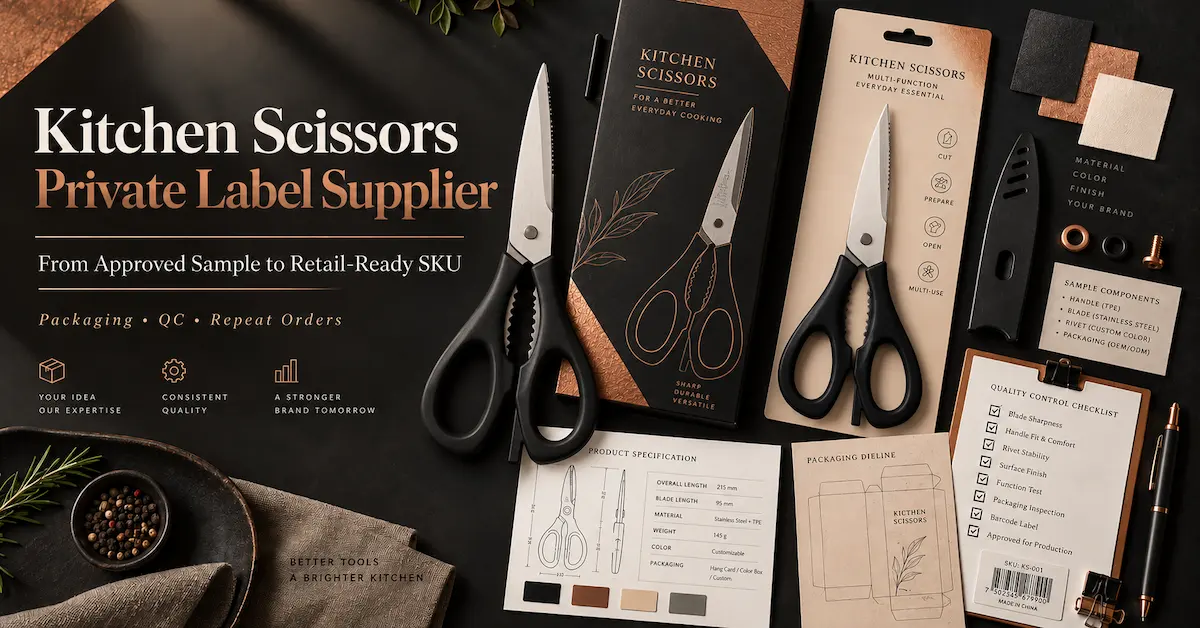
A useful supplier proposal therefore identifies not just a product family but the exact configuration being sold: manufacturer model, buyer SKU, dimensions, materials, accessories, approved artwork version, packaging type, agreed functional claims, and quality checks. If any of those fields remains undefined, comparing two offers can be misleading. The cheaper offer may simply cover fewer components or a less demanding inspection scope.
BONET HOUSEWARE CO., LTD., based in Yangjiang, China, presents kitchen scissors among its cutting-tool and kitchenware products. Its OEM/ODM services describe production from drawings or samples, material and color customization, logo printing or laser engraving, retail packaging, and design-development support. These are company-level services; the availability and conditions for any particular scissors model still belong in a project-specific quotation.
2. Why This Sourcing Decision Is Different From a General Scissors Purchase
Scissors are mechanically simple to look at but sensitive to small variations. Two metal blades need suitable geometry and contact, the pivot needs the right movement, the handles must guide the user's fingers comfortably, and any detachable feature must return to its intended position. The packaging then has to make correct promises about what the finished tool does. This combination makes the brand owner's risk broader than ordinary cosmetic inspection.
A stationery-scissors sample that cuts paper cleanly does not automatically prove suitability for herbs, food packages, or poultry preparation. Similarly, a household model with a textured pivot area does not automatically qualify for a nutcracker claim. The task, conditions, and intended user must be documented before an acceptance test is designed.
Private-label brands also own the customer-facing description. If a carton says a product is dishwasher safe, magnetic, detachable, or able to cut bones, buyers need evidence relating to the exact finished configuration. If a future batch changes the pivot, handle polymer, or accessory, that evidence may need to be reviewed again. Launch controls are what turn a supplier relationship into a dependable retail SKU.
3. Match the Product to the Retail Channel Before Choosing a Model
Supermarkets and retail chains generally need a clear product hierarchy, easy shelf presentation, consistent printed information, and reliable replenishment. Decide whether the scissors will be an entry-price everyday tool, a midrange multifunction option, or a gift-worthy accessory. The same kitchen shears may require different packaging and instructions depending on the chain's merchandising plan.
E-commerce brands must consider the product after individual parcel handling, as well as in a master carton. Images, dimensions, detachable features, holder accessories, and pack contents should match the listing precisely. A return may be triggered by a missing storage sheath even when the scissors themselves work correctly. Protecting the tips and preventing movement in the parcel matters as much as a polished product photo.
Importers and wholesale distributors need repeatable versions and sensible order quantities across different models. They may supply multiple independent retailers with different price positions. Make sure the catalog options are sufficiently distinct and that each model can be replenished without switching silently to a similar-looking replacement.
Hospitality or specialist food-preparation buyers may require different cleaning, durability, and use conditions from household retail. Do not describe a standard domestic pair as suitable for professional processing or intensive bone-cutting unless the exact application has been evaluated. A supplier can discuss alternative models, but the buyer should define those requirements separately.
4. Compare BONET's Published Kitchen Scissors as Real Sourcing References
BONET's public product pages provide several distinguishable models. The table uses the website's listed dimensions and material fields; it is not a statement that any model has passed a buyer's target tests. Request the current approved drawings, actual configuration, and sample for the specific item before relying on these details in a commercial purchase.
| Model and product page | Website dimensions | Listed materials | Private-label decision |
|---|---|---|---|
| G2003 Cooking Shears | 24 × 7.5 × 1.5 cm | 420 stainless steel; PP + TPR | Check detachable construction, magnetic storage configuration, handle feel, and full retail pack. |
| G2004 Multi-Purpose Kitchen Scissors | 19 × 9.5 × 1 cm | 420 stainless steel; PP | Confirm the exact multifunction features, blade separation procedure, and claim-specific tests. |
| G2011 Magnetic Kitchen Scissors | 21.8 × 8.6 × 2 cm | 420 stainless steel; PP | Define holder or sheath contents, mounting limitations, package protection, and storage instructions. |
| SKI090 Multi-Functional Scissors | 9 inches | 420 stainless steel; PP | Verify the proposed blade and integrated-tool configuration before labeling or advertising functions. |
For buyers working with the search term kitchen scissors private label supplier, this comparison makes sourcing specific. It prevents four different products from being treated as interchangeable simply because each is described as kitchen scissors. The use case, packaging architecture, and validation program may differ substantially between a detachable model, a magnetic-storage model, and a straightforward multifunction pair.
Steel grade is only one specification field. The catalog's 420 stainless steel label does not reveal an order's measured hardness, edge condition, corrosion-test result, or long-term cutting consistency. PP and PP + TPR are likewise material descriptions, not guarantees of any particular grip performance. Use the physical sample and technical records to decide.
5. Build a Claim-to-Evidence Map Before Writing Packaging
A highly practical way to control private-label risk is to write every consumer-facing claim in one column and the evidence needed to support it in another. This exercise works best before packaging artwork is finalized. It helps the commercial team distinguish appealing language from statements that describe measurable product behavior.
For example, “comfortable grip” can be explored through defined user evaluation, but “ergonomic design prevents hand fatigue” is a stronger claim that needs stronger support. “Magnetic sheath included” is a packaging fact if the holder is present; “mounts securely on every metal surface” is a broad performance claim that may not be true. “Detachable blades” requires the specific configuration to separate and reconnect safely according to the instructions.
| Proposed claim | What must be defined | Practical approval evidence |
|---|---|---|
| For everyday food preparation | Specified food tasks and materials in contact with food | Relevant material documentation, application tests, care instructions |
| Detachable for cleaning | Actual separation sequence and cleaning access | Approved sample, repeatable assembly review, accurate instructions |
| Magnetic storage included | Holder or sheath, intended surface, orientation and accessory count | Complete pack inspection and defined mounting evaluation |
| Multifunction tool | Each named tool feature and the method of use | Feature-specific tests and matching packaging illustrations |
| Dishwasher safe | Exact product materials, wash cycle, duration, exclusions | Product-specific validation supporting the final care claim |
| Cutting poultry | Which poultry task and substrate are intended | Defined performance and safety evaluation, not a generic demonstration |
Not every claim needs to appear on the pack. Remove claims that are difficult to verify or offer little real value to the intended customer. Where compliance documentation is necessary, obtain advice relevant to the actual destination market. Treat supplier statements, independent reports, and buyer tests as distinct forms of evidence rather than interchangeable guarantees.
6. Create a Single SKU Passport to Prevent Specification Drift
Private-label products frequently encounter difficulty at the handoff between merchandising, purchasing, the supplier, and the inspection team. Each group may hold a different file: a packaging PDF, an old sample, a new quotation, or a chat message about the handle color. A SKU passport provides a controlled reference document linking those decisions together.
The passport should identify the manufacturer model and buyer article number, approved product drawing and revision, blade material and profile, handle materials, color reference, logo size and placement, permitted functions, exact accessories, packaging version, carton data, inspection requirements, and approval sample reference. Add a named owner for changes and a revision history. This is especially useful when a brand has several similar scissors with different holders or grip finishes.
Separate an approved attribute from an open question. “420 stainless steel” might be the listed catalog material, while “final material documentation to be supplied” remains pending. A retail pack can be in artwork review while a particular cut test is still incomplete. Making that status visible is safer than letting a draft document appear fully approved.
Practical release rule: no production authorization should rely on an email saying “same as the sample” unless both parties know which sample and which specification revision the instruction refers to. Link the purchase order, artwork, sample ID, and inspection plan in one controlled file.
7. Verify the Cutting System: Blade, Pivot, Handle and User Task
A scissor cuts through the interaction of two edges rather than the reputation of its steel alone. Blade profile, matching between the halves, edge preparation, pivot design, and assembly condition all influence the result. A model with a suitable steel grade can still disappoint if the pivot binds, the handles flex excessively, or the cutting contact changes along the length of the blades.
Define the test material instead of saying “sharp scissors”
For a household model positioned around herbs and food-pack opening, define a representative herb stem or wrapping material and the expected cutting result. For a heavier-duty claim, create a different test suited to that application, including appropriate safety precautions. Evaluate the cutting path from the area near the pivot to the tip where relevant. Avoid choosing a single dramatic demo material that does not represent real use.
Review pivot action as a repeatable characteristic
Open and close several samples, compare resistance through their travel, and observe whether the blades remain properly aligned. Ask the supplier which assembly settings or functional checkpoints help control pivot feel in production. Record whether a loose or tight sample is a cosmetic variation, a performance defect, or a safety concern. The classification should be agreed before shipment inspection.
Examine the handle in realistic conditions
Finger-loop size, contact edges, material texture, and the interaction between handle and blade determine comfort. Review the sample with intended users, including damp-hand handling where relevant. PP and TPR descriptions alone do not prove comfort or secure grip. A color change may be a decorative modification, while a shape change may require a new tooling discussion and renewed validation.
8. Give Special Attention to Detachable, Magnetic and Multi-Tool Features
Extra functions can justify stronger retail positioning, but every added feature creates additional failure points and inspection questions. A detachable assembly can help access areas for cleaning only if it separates and reconnects in the intended way. A storage holder can improve organization only if it is included, compatible with the stated surface, and safe to use as demonstrated.
For a detachable model, ask for instructions that show the sequence of separation and reassembly without ambiguity. Examine pinch points, the transition from connected to disconnected blades, and any risk created by handling exposed edges during cleaning. Repeat the operation with samples from the proposed production configuration. “Easy to clean” should be tied to the actual design and care method, not assumed from the detachable label.
For magnetic storage, inspect both the cutting tool and its sheath or holder. Confirm what the consumer receives, the expected orientation, the limitations of the mounting surface, and the insertion or removal motion. Do not assume every metal surface is magnetic or that the holder is suitable for mounting above a work area without additional evaluation. The packed holder is part of the SKU even when marketing photography focuses on the scissors.
For nutcracker jaws, bottle-opening features, herb strippers, or serrated grip areas, verify the actual function with the design owner. The presence of a notch or textured surface does not authorize a function claim on the retail box. Ask whether a feature is included on the exact supplier model and whether its performance has been evaluated under defined conditions.
9. Separate Brand Customization From Engineering Changes
Brand differentiation is valuable, but not every customization route has the same cost or development risk. Artwork changes, handle-color changes, modification of an existing mold, and an entirely new blade design belong to different approval paths. Make those paths visible at the quotation stage. BONET lists logo printing, laser engraving, customized colors, retail packaging, and product development among its OEM/ODM services; the exact options should be confirmed for the selected model.
| Requested change | Main buyer decision | Possible approval impact |
|---|---|---|
| Logo location or artwork | Check dimensions, substrate, method and legibility | Decorated sample and packaging-image update |
| Handle color | Agree physical color reference and material identity | Color sample, appearance tolerance, order minimum |
| Handle geometry or texture | Assess grip, tooling, fit and assembly | Prototype, production-tooling review, new tests |
| Blade shape or edge | Assess use case and cutting requirements | Engineering drawings, sampling, revised functional checks |
| Accessory or holder | Identify what is included and how it is used | Accessory validation and revised packing specification |
| Printed retail box | Confirm claims, barcode, translations and protection | Artwork, packed-sample and transit review |
Adding a logo does not confer exclusivity over an existing scissors design. If a brand funds a new mold, proprietary feature, or design asset, document development ownership and usage rights through an appropriate agreement. Clarify access to tooling, replacement components, change approvals, and treatment of unused printed packaging before commitments are made.
10. Design Retail Packaging Around Claims, Protection and Scanning
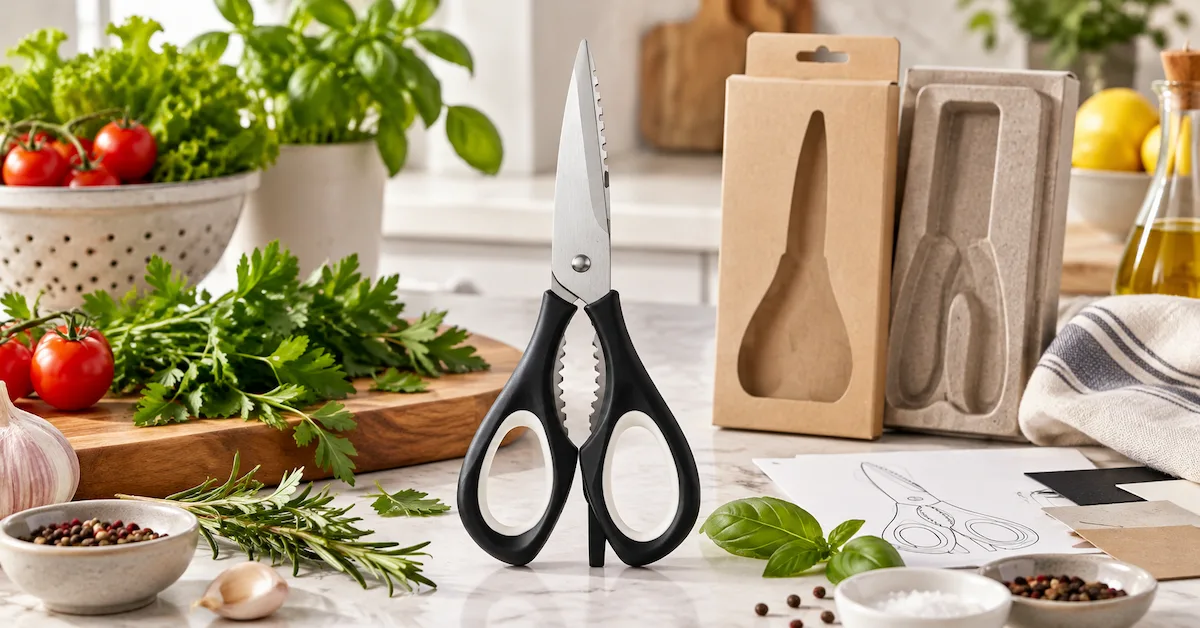
A private-label carton is not only a visual sales tool. It is a physical enclosure for two sharp edges and, potentially, a removable holder or other accessories. Review the package with the exact product inside it. Packaging that looks good when empty may allow a loose pair to rub against printed surfaces or expose a tip under transit vibration.
For a supermarket program, define the selling-unit dimensions, hanging or shelf presentation, barcode format and scan placement, required language, pack contents, handling instructions, and master-carton arrangement. For online sales, also examine the shipping parcel and the possibility that the product is handled without the protection of a palletized retail case. One pack may not serve both channels equally well.
Keep the product image, instruction drawing, and included accessories synchronized. If the listing shows a magnetic sheath, the current approved pack must include the intended sheath. If the handle color changes between launch seasons, update imagery and artwork versions together. Avoid using a previous version's promotional photograph when its functions or accessories differ.
Ask the supplier to identify the cost and production minimum for each packaging form: paper card, blister, sleeve, color box, display box, or gift set, where offered. The minimum for printed packaging may differ from the minimum for the metal scissors. Packaging revisions can also alter shipping volume and the finished cost per saleable unit.
11. Treat Compliance as a Product-and-Market Question, Not a Logo
Kitchen scissors may touch food during preparation, yet their exact regulatory position depends on the intended use, component materials, destination market, and consumer-facing claims. Start with a material breakdown for blades, handles, coatings, colorants, and accessories. Identify which components can contact food under foreseeable use and ask a qualified specialist to determine relevant requirements and testing conditions.
For the European Union, the general framework for materials intended to contact food includes Regulation (EC) No 1935/2004 and good manufacturing practice rules under Regulation (EC) No 2023/2006 where applicable. General consumer-product obligations must also be assessed for the product and market. In the United States, food-contact regulation should be evaluated by material, authorization or applicable exemption, and intended use. Naming an authority is not proof that a particular finished scissors model has passed a specific test.
If the product is advertised as dishwasher safe, corrosion resistant, suitable for poultry, or intended for another demanding task, request supporting product-specific evidence. Claims about antimicrobial performance, sterilization, or unusually broad safety benefits deserve particular scrutiny. A factory quality-management certificate and a product test report serve different purposes; one cannot be substituted for the other.
Review document scope, legal entity, model identification, tested materials, sample date, method, result, and any limitations. Confirm whether a report applies to the exact color or revised part that will be purchased. Work with a competent laboratory and import compliance adviser before writing regulated claims onto the packaging. These checks are buyer obligations, not verified certificates claimed here for BONET.
12. Audit Manufacturing Steps That Affect the Approved SKU
A factory presentation can include stamping, grinding, heat treatment, surface finishing, plastic injection, assembly, cleaning, and packaging. The valuable question is which of those processes applies to the shortlisted model and how its output is controlled. BONET's manufacturing information describes cutting-tool and kitchenware production activities, which buyers can use to prepare more concrete questions.
Ask where blade material is identified, which process establishes the cutting geometry, how molded handles are matched to the approved color, and where the pivot is assembled and checked. If parts are supplied by outside vendors, ask how incoming material and components are identified and accepted. The purpose is not to demand that every step occur in one building; it is to understand how the final specification remains under control.
For prototypes and new versions, confirm whether the sample comes from an intended production method or a temporary development process. Production tooling and manual prototypes may differ in surface finish, fit, or flexibility. Make that difference explicit and build a final production-sample review into the approval plan where needed.
Ask the supplier to describe the handoff between product engineering, production, quality inspection, and packing. If the packing team receives a new artwork file but the inspection team still uses an old standard, a defect can reach the consumer despite multiple checks. Revision control is therefore as important as the inspection count.
13. Use Three Approval Gates Before Authorizing a Bulk Order
Gate A: Product intent. Approve the use case, selected reference model, intended functions, major materials, and physical design direction. Document unresolved questions separately. An attractive product photo is insufficient if a multifunction claim has not been tested or the storage accessory has not been defined.
Gate B: Production-representative sample. Approve an identifiable physical sample and corresponding specification, ideally representing the intended manufacturing process. Review cutting tasks, pivot action, handle fit, removable components, markings, and appearance using repeatable methods. If the product is modified after this gate, assess which evaluations need to be repeated.
Gate C: Saleable pack. Inspect the complete product in the final packaging configuration, with accurate artwork, instructions, barcode, accessories and master-carton details. Retain the approved packed sample. A buyer should not approve a carton solely as a flattened print proof when there are sharp edges, inserts, and detachable pieces inside.
Assign each gate an owner and approval date. Hold production if critical evidence remains missing. This system need not become bureaucratic; a concise approval sheet prevents more confusion than dozens of unrelated messages. It also gives the inspector an unambiguous target for pre-shipment verification.
14. Translate Quality Into Observable Inspection Criteria
Statements such as “high quality” and “100% inspection” are not enough to control a private-label purchase. A buyer and supplier should agree what to inspect, the accepted range or qualitative reference, and the response to a failure. Inspection may use a combination of controlled visual checks, measurements, functional tests, and documents matched to the SKU passport.
| Inspection item | Practical method | How to record acceptance |
|---|---|---|
| Model and materials | Verify identification against the approved bill of materials | Correct model/revision and supporting records |
| Blade geometry and finish | Visual review and agreed dimensional checks | Sample or drawing reference; defined defect limits |
| Cutting performance | Use agreed representative substrates and method | Pass/fail result for each named task |
| Pivot and handle | Open/close, check alignment and grip, examine assembly | Approved functional reference and any measurable limits |
| Detachable or magnetic function | Perform approved assembly or holder check | Correct operation and complete accessories |
| Logo, color and marking | Compare to approved artwork and physical color reference | Position, legibility, finish and variation criteria |
| Retail packaging | Inspect complete packed unit, labels and protection | Artwork revision, contents, barcode and pack condition |
| Master carton | Verify quantities, marks, dimensions and condition | Pack-out record tied to order and SKU |
Do not invent a single universal cutting-force target, corrosion duration, drop height, or lifetime cycle count for every scissors model. Tests should reflect intended use and be agreed before supplier comparison. If the contract uses a sampling method such as an ISO 2859-1-based plan, define the applicable version, lot definition, inspection level, defect classes, and acceptance rules with a competent quality professional. Sampling does not replace legally required safety verification.
Classify defects by consequence. An exposed hazardous burr, an unsafe assembly, or a misleading material statement may require a different disposition from a small permissible print variation. The purchase contract should establish how nonconforming goods are separated, reworked, reinspected, replaced, or rejected, and who authorizes any concession.
15. Protect the First Order From Packaging and Fulfillment Mistakes
The first production order carries several simultaneous risks: a new logo method, untested carton inserts, unconfirmed accessory counts, and staff working from new artwork. Separate the production of the scissors from completion of the saleable pack in the project plan so that neither is assumed ready merely because the other is finished.
Request a packing list that distinguishes product quantity, retail units, inner packs if used, and master cartons. Verify that the buyer SKU and the supplier's production code are connected. For an e-commerce program, check the selling unit as it is actually dispatched, including any retailer-required label or parcel protection.
Inspect a sample from the final packed lot, not only a showroom prototype. Make sure the product and printed claims agree. If an option is omitted to meet a target price—for example, the magnetic sheath is removed—update the package content statement and photography as well as the quotation. A change invisible on a proforma invoice can become very visible in customer reviews.
16. Handle MOQ and Commercial Terms at the SKU Level
Minimum order quantity can attach to different cost drivers. There may be a production minimum for a scissors model, another for handle color, another for printing, and another for custom packaging. Ask the private label kitchen scissors supplier to identify the governing minimum for each variation. A mixed order of three colors is not necessarily treated as one production lot for every component.
Request a quote with clear line items for the base product, branding, packaging, tooling or setup if applicable, samples, agreed testing, inspection, and shipping terms. Ask whether spare or unused printed cartons carry separate charges. An apparently inexpensive unit can become expensive if its packaging consumes more freight space or the order must be split into separate runs.
Compare quotes on the same incoterm and approved configuration. The buyer should know what price includes and where risk and freight responsibility transfer. When estimating landed cost, use current carrier and customs advice instead of treating a generic percentage as a dependable duty rate. Also consider working capital tied up in stock that differs only by minor decoration.
For a new brand, a more focused launch assortment may be commercially stronger than many nearly identical SKUs. Discuss which existing BONET models suit the target channel, where branding can be added without structural change, and which proposed differences genuinely justify a separate inventory position.
17. Plan Lead Time Around Evidence, Artwork and Production
Production time should be divided into development, approvals, material readiness, manufacturing, inspection, packing, and logistics. Ask what starts the supplier's quoted clock: a deposit, signed specification, approved sample, approved artwork, or receipt of all components. The answer determines whether an advertised lead time is meaningful for a retail launch.
Customized molds, new handle colors, magnetic holders, and printed packaging can follow different schedules. Identify which path controls the final shipment date. An approved blade without an approved color box cannot become a completed saleable item. If a retailer needs goods for a fixed seasonal window, plan backward from the required warehouse arrival date and allow for verification and corrective action.
Repeat orders may be faster only if the required materials, tooling, artwork, and supplier capacity are available. Confirm those assumptions instead of treating the initial schedule as a guaranteed replenishment lead time. For every reorder, state the product revision and ask the supplier to identify any proposed substitution before production starts.
18. Establish Traceability and a Repeat-Order Change Process
The second order is where a private-label program demonstrates whether it is truly controlled. Keep a golden sample or equivalent approved reference, the current SKU passport, and the approved packaging files. Request production-lot identification suitable for the product and distribution program. This helps investigate complaints without assuming every unit or every order is identical.
Define a change notice process for blade material or finish, pivot construction, handle resin, color, accessory supplier, packaging dimension, or printing method. Some substitutions are harmless; others can affect compliance, function, product photographs, or customer expectations. The buyer should assess changes and determine which approvals or tests need repeating.
Collect complaint data by reason rather than treating all returns as one number. Dull cutting, stiff pivot, cracked handle, missing magnetic holder, mismatched color, and damaged carton represent different control failures. A corrective action should identify the affected lots, likely cause, containment steps, and effectiveness check before the next production release.
A useful reorder agreement also explains record retention, handling of old packaging, disposition of unused branded parts, and what happens if a model is discontinued. Private-label dependence on a single product platform is manageable when the transition plan is explicit; it becomes costly when a replacement is supplied without buyer approval.
19. Evaluate BONET as a Project Partner Using the Actual SKU
BONET's website positions the company in scissors and kitchenware manufacturing, with an all-purpose scissors catalog, specific kitchen-scissors product pages, and a published OEM/ODM workflow. The service page describes requirement communication, design and sampling, quotation confirmation, and further production stages. This gives a buyer concrete places to begin, but not a substitute for asking model-specific questions.
When contacting BONET, identify the shortlist first. For instance, G2003 and G2011 both have magnetic-storage directions, while G2004 emphasizes integrated multifunction features. Ask for current packed samples and confirm every quoted accessory. Request the actual material and quality documents needed for the intended destination. Do not rely solely on a website description when finalizing legal claims.
Use the company's About Us page for corporate context and its contact page to submit a project brief. If facility claims or management-system certifications are important to supplier approval, request current documents and check the legal entity, site, certificate scope, and validity independently. A category page showing a product is not proof of a particular production slot, MOQ, or current inventory status.
20. Copy This Technical RFQ Structure for Your First Inquiry
A strong inquiry makes supplier comparison possible before the buyer spends time debating price. Describe the buyer, market, intended functions, shortlisted reference, quantity per variation, and required launch date. Then make clear which changes are essential and which are optional. Ask the supplier to return any assumptions as separate entries rather than making unannounced substitutions.
Example RFQ: Private Label Kitchen Scissors for Retail
Buyer and channel: [Brand], selling through [supermarket / e-commerce / wholesale], destination [country].
Reference product: BONET [G2003 / G2004 / G2011 / SKI090] or attached drawings and photographs; intended food-preparation functions listed separately.
Product requirements: blade material and construction, dimensions, handle material and color, pivot feel, detachable or magnetic features where applicable, logo position, and approved accessory list.
Retail requirements: pack type, artwork and barcode files, content statement, instructions, language, protective insert, master-carton marking, and distribution channel.
Quantity and timing: forecast opening units per SKU and color, likely replenishment schedule, requested delivery milestone and destination.
Quality and evidence: sample approval, task-specific cutting evaluation, material and claim documentation, inspection plan, final packed reference, and treatment of rejected goods.
Commercial quotation: MOQ by model/color/pack, product cost, branding and packaging costs, tooling if any, sample charges, lead-time assumptions, delivery term, and quotation validity.
Send Your RFQ to BONET →The reply should be detailed enough to create an accurate purchasing specification. If a supplier cannot confirm a performance claim, request an alternative description or evidence plan. If a new feature adds tooling or testing, consider whether its likely retail value justifies the additional development risk.
21. A Practical Launch Checklist for Buyers
- Position the SKU: identify who buys it, the channel, and the tasks it will perform.
- Select real model references: compare functional designs and obtain current specifications.
- Map every claim: connect carton language, photos, and online descriptions to evidence.
- Build the SKU passport: document materials, dimensions, accessories, artwork, and revision.
- Approve representative samples: confirm function, safety, appearance, and pack-out.
- Agree on inspection: define defects, tests, lot sampling if applicable, and disposition.
- Normalize quotations: compare the same product, packaging, MOQ, and delivery terms.
- Authorize production: only after critical requirements and launch artwork are approved.
- Check shipment: inspect actual packed units and verify carton and SKU identification.
- Protect repeat orders: retain approved references, document changes, and review complaints.
This sequence is more useful than selecting the lowest-price listing and trying to define quality afterward. It also produces documents that can be reused for inspection, retailer onboarding, replenishment, and future product development, even if a brand expands into additional kitchen tools.
Frequently Asked Questions About Private Label Kitchen Scissors
1. What is a kitchen scissors private label supplier?
It is a business that supplies kitchen scissors for sale under the buyer's brand. A project can include an existing model with approved branding, customized packaging, or more complex OEM development. The exact scope should be specified in the quotation and confirmed with samples rather than assumed from the term “private label.”
2. How are private-label kitchen scissors different from wholesale scissors?
Wholesale purchasing may involve standard products without buyer-specific design or decoration. Private label adds responsibility for branding, retail claims, artwork, product identity, and repeat-order consistency. Even when the underlying model is unchanged, the approved selling unit and its packaging become a controlled brand specification.
3. Which BONET scissors models can I use as sourcing references?
Published examples include G2003 cooking shears, G2004 multi-purpose kitchen scissors, G2011 magnetic kitchen scissors, and SKI090 multi-functional scissors. Their public pages list dimensions and component material fields. Availability, variants, accessories, and current quotation terms should be confirmed directly with BONET.
4. Can BONET add our logo and customize packaging?
BONET describes logo printing, laser engraving, and customized retail packaging among its OEM/ODM services. Confirm the available method, decoration surface, minimum quantities, artwork specifications, and sample approval for the selected scissors. New handle geometry or blade changes may require a separate development route.
5. What blade steel does BONET list for these models?
The G2003, G2004, G2011, and SKI090 product pages reviewed here list 420 stainless steel as the metal material. That catalog field should be confirmed against the actual order specification. Grade alone does not establish measured hardness, edge life, corrosion performance, or finished cutting quality.
6. Are detachable kitchen scissors easier to clean?
A detachable design can provide access to surfaces that are harder to reach when assembled, but actual cleaning suitability depends on the construction and instructions. Test the separation and reassembly process on the approved sample. Do not promise dishwasher compatibility or hygienic performance without appropriate verification.
7. Can magnetic scissors holders work on every metal surface?
No universal assumption should be made. Magnetic compatibility depends on the holder, surface, orientation, and intended loading. If storage is a selling point, specify the included accessory and test its use under defined conditions before writing broad claims on a retail package.
8. What is a reasonable MOQ for custom kitchen scissors?
There is no single MOQ that applies to every model and variation. Request quantities separately for the base scissors, each handle color, branding option, and retail package. BONET's project-specific minimum and the effect of a mixed-SKU order should be confirmed in a current quotation.
9. Which quality checks matter most before shipment?
Check the approved model, materials, blade condition, cutting tasks, pivot action, handle assembly, accessories, logo, packaging claims, quantities, and carton identification. Define acceptance criteria and defect handling in advance. Use a qualified inspection plan appropriate to the order rather than a generic unverified “100% QC” promise.
10. Can a supplier certificate prove that the scissors are food-contact compliant?
Not automatically. A management-system certificate addresses the scope of the management system. Food-contact obligations and any required material or product evidence depend on the intended use, destination market, and applicable requirements. Request relevant documentation for the exact product and obtain appropriate compliance advice.
11. How do buyers keep repeat orders consistent?
Use a controlled SKU passport, a retained approved sample, identified artwork versions, a defined inspection plan, and a change-approval rule. Record production-lot information and evaluate complaints by defect type. Every approved change should be assessed for effects on function, claims, packaging, and testing.
12. How should I request a quote from BONET?
Send the intended market, chosen model or reference, target use, order quantity by variation, logo requirements, packaging concept, delivery timing, and required quality evidence. Ask BONET to specify assumptions, customization limits, MOQ, and lead-time milestones. Use the BONET inquiry page to start a model-specific discussion.
Conclusion
A successful kitchen scissors private label supplier relationship is built around an approved product that can be sold honestly and reproduced reliably. The strongest buying process begins with the customer and use case, compares real scissors models, defines the blade and handle construction, verifies the functions promised to consumers, and connects samples, packaging, inspection, and commercial terms in one SKU record.
For retail chains, importers, distributors, and branded e-commerce sellers, that discipline improves decisions before the first shipment and makes future replenishment easier to manage. BONET HOUSEWARE offers published kitchen-scissors references and OEM/ODM services as a starting point for a practical sourcing discussion. Explore the kitchen scissors product selection, review the customization service, and request a specification-based quotation for your intended market, SKU, and retail packaging.
Ready to Develop Your Own Kitchen Scissors Line?
Share your preferred BONET model, functional requirements, logo, retail pack, opening quantity, and intended market. Request a clear proposal identifying what can be supplied, what needs validation, and which details must be approved before production.
Talk to BONET About Your OEM Project →