




For many sellers, kitchen tools for Amazon sellers look simple on the surface: spoons, tongs, knives, colanders, boards, and a few other everyday items that seem easy to source and easy to list. In practice, they are a little less forgiving. Small differences in material, finish, packaging, and bundle logic can decide whether a product feels like a useful home staple or just another generic kitchen listing fighting for the lowest price.
That is why this category deserves more attention than it usually gets. Kitchen tools sit at the intersection of repeat household use, visual merchandising, and practical buyer expectations. If you are sourcing for Amazon, you are not just buying a utensil. You are buying a product that has to photograph well, survive fulfillment, make sense in a search result, and stay understandable when it arrives on a customer’s counter.
What makes this category attractive, and where sellers get tripped up
Kitchen tools are broad enough to support many subcategories, yet specific enough that shoppers often know exactly what they want. A colander should drain cleanly. A cutting board should feel stable. A whisk should look sturdy. Serving tools should not feel flimsy in hand. Those expectations are ordinary, but they matter because the buyer has no patience for guesswork once the product arrives.
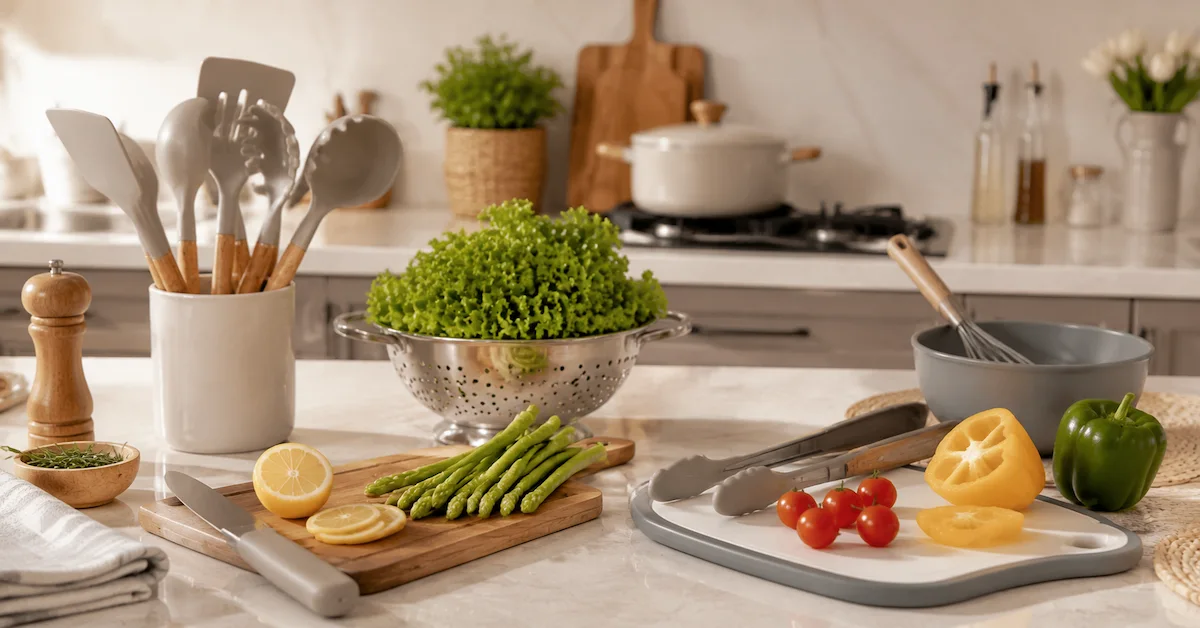
The trouble for Amazon sellers is that many listings blur together. A product photo shows a mixing bowl, a whisk, a set of tongs, maybe a pepper mill, and a few other items arranged on a countertop. That kind of image can suggest a complete kitchen setup, but it does not tell the buyer what is actually included, how the pieces compare, or whether the finish will hold up after regular use. Misalignment between image, title, and package contents is one of the fastest ways to earn returns in this category.
So the real question is not whether kitchenware sells. It does. The question is how to choose items that are clear, practical, and easy to present honestly. That is the decision this article is meant to help with.
Quick takeaways for sourcing and listing
If you want a fast filter before going deeper, use these basic checks.
First, choose products with a clear daily use case. Food prep, stirring, draining, slicing, and serving are easy for shoppers to understand. Second, look for visible durability cues. Wooden handles, stainless-steel-looking components, and a stable cutting board communicate value better than vague claims ever will. Third, think in terms of set logic. A buyer may want a single tool, but a seller often performs better when the bundle feels useful rather than random.
That last point matters more than many new sellers expect. A neat tray with a few well-matched tools can look premium if the contents are coherent. An overstuffed set with no clear theme can look cheap, even when individual pieces are decent. In kitchen tools wholesale sourcing, coherence is often more valuable than sheer count.
Reading the product properly before you source it
The kitchen setup you are considering appears to combine several familiar housewares elements: a cylindrical utensil crock, a rectangular wooden cutting board, a round perforated colander, a mixing bowl with whisk, long-handled serving tools, and a pepper mill. The visible material mix is also useful from a sourcing perspective. Wood, metal, and gray or white molded components are common in this category because they give the eye a sense of function and household familiarity.
That mix has a commercial advantage. Buyers tend to trust kitchen items that look like they belong in a real home rather than a styled concept photo. Wood adds warmth. Metal signals strength. Neutral finishes make the product easier to imagine in different kitchens. None of that guarantees quality, of course, but it shapes first impressions, which is where Amazon listings are won or lost.
Wood, metal, and coated components each send a different message
Wooden handles and boards usually suggest natural handling and a more traditional kitchen feel. Metal parts often signal sturdiness and utility. Molded or coated gray and white components can soften the visual tone and make the product appear cleaner or more modern. For Amazon sellers, the issue is not choosing one material in isolation. It is choosing a combination that looks intentional and supports the product story.
There is a practical caution here: buyers on Amazon do not inspect products in person, so surface quality has to travel through photography. A brushed finish can look elegant in one image and dull in another. Natural wood can look premium, but only if the grain and edge finishing are consistent. The same is true for a colander or whisk; if the metal appears thin or unevenly finished, customers will assume the product is lower grade, even before they read the title.
How to choose kitchen tools that fit Amazon demand
Start with the actual shopping intent. Some buyers want a replacement tool. Others want a starter set for a new apartment, a dorm, a rental property, or a gift. Those are not the same market, and they should not be treated as the same SKU. A single-purpose tool needs a strong utility claim. A bundle needs obvious everyday usefulness.
When evaluating kitchen tools wholesale options, look for products that are easy to explain in one sentence. For example, a cutting board plus knife combination is simple. A colander plus mixing bowl speaks to washing and prep. Serving tools in a countertop crock suggest quick access and neat storage. If the pitch becomes too clever, buyers often hesitate. Simplicity is a selling feature here.
Also pay attention to the visual mix across the set. Amazon shoppers often scroll quickly, and a listing image has to carry the message at a glance. A tray with vegetables, a colander, and a few serving tools reads as a practical prep scene. That is better than a featureless product shot because it helps the buyer picture the item in use. However, the lifestyle image should still match what is actually in the box. If not, the return rate will remind you.
Common mistakes sellers make with kitchen tools
The first mistake is overbundling. Adding too many pieces can make a set harder to price and harder to understand. Shoppers do not always reward quantity. They reward clarity and usefulness.
The second mistake is neglecting packaging. Kitchen products ship through a system that can be rough on corners, blades, thin handles, and polished surfaces. Even a basic cutting board or colander can arrive looking tired if the pack-out is weak. This is especially important for Amazon FBA, where the warehouse does not care whether the product is delicate or not.
The third mistake is vague product labeling. If the listing does not clearly identify materials, dimensions, or what is included, buyers fill in the gaps themselves. That usually leads to disappointment. Since exact specifications are not always available from suppliers, it is better to be cautious and precise than to overstate. If the gray bowl or utensil heads are coated metal, silicone, or plastic, say so only when confirmed.
The fourth mistake is ignoring the visual hierarchy. In a kitchen listing, the main product should be obvious within the first image or two. If everything is crowded together, the shopper has to work too hard to understand the value. On Amazon, that usually means they move on.
What a kitchen utensils supplier should be able to support
When you are speaking with a kitchen utensils supplier, useful questions are often basic ones. Can the supplier keep finishes consistent across batches? Can packaging be adapted for FBA prep? Are component materials consistent from order to order? Can the product be packed as a set, or should it be sold as individual pieces? These are operational questions, not marketing questions, and they matter because they affect listing stability.
If you are building a broader assortment, it helps to separate items into clear use groups: prep, cooking, serving, and storage. A utensil crock belongs more naturally with countertop organization. A colander belongs with washing and draining. A whisk and mixing bowl sit in the prep and mixing lane. A pepper mill is more of a table or finishing item. Keeping those roles straight makes the assortment easier to merchandise.
Practical buyer advice for Amazon sellers
Think like your customer and also like the person who will handle returns. That means reviewing edge finishing, handle feel, and image clarity with unusual discipline. A product can look fine in a staged photo and still feel cheap if the handle geometry is awkward or the metal edge looks rough. If possible, request samples and check how the product sits on a counter, how it nests with other tools, and whether it reads as kitchen-ready without explanation.
It also helps to decide early whether you are selling convenience or completeness. A focused three-piece item can outperform a cluttered ten-piece set if the use case is stronger. Buyers often want less than sellers think, especially when the item is meant for everyday prep rather than a gift box.
For sellers exploring kitchen tools for Amazon sellers, the healthiest strategy is usually to start with a clear niche, test a simple assortment, and expand only when the listing language and packaging prove themselves. That approach is slower than dropping in a big bundle, but it usually produces a cleaner catalog and fewer customer complaints.
FAQ
Are kitchen tools a good Amazon category for new sellers?
They can be, but only if you keep the offer simple and the product story clear. The category is crowded, so entry is easier than differentiation.
Should I source bundles or single items?
It depends on the buyer intent. Bundles work best when the pieces logically belong together. Single items work well when the tool has a strong, obvious purpose.
What matters most in sourcing?
Consistency, clear materials, practical packaging, and a product that photographs honestly. Those four points often matter more than trying to chase the lowest possible unit cost.
How do I reduce returns?
Use accurate photos, clear inclusion lists, and packaging that protects the product in transit. Returns in this category often come from expectation gaps, not dramatic defects.
A sensible next step
If you are evaluating kitchen tools wholesale opportunities for Amazon, start with products that already make sense at a glance: a solid colander, a stable cutting board, a useful serving set, or a well-composed prep bundle. Keep the assortment tight, the language plain, and the packaging honest. That is usually enough to separate a workable kitchen listing from one that looks attractive on paper but creates problems later.
The best next move is to review your current supplier options with the same question in mind: does this product solve a real kitchen task cleanly, and can I explain it in one clear listing without overpromising? If the answer is yes, you probably have something worth testing.
