




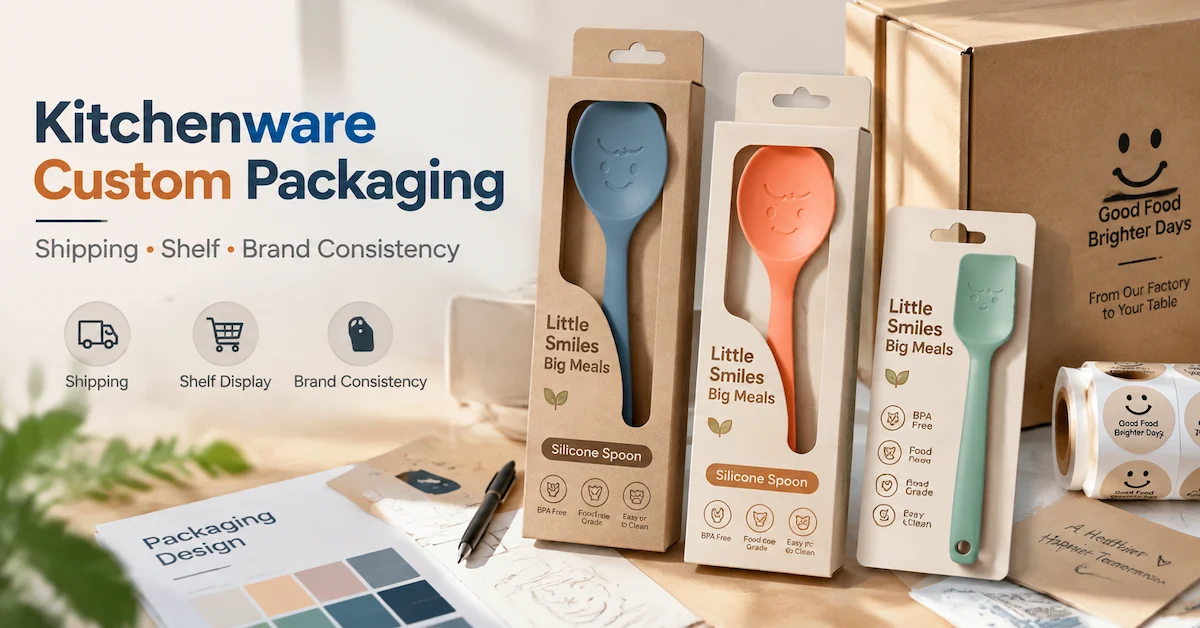
Quick Answer:
Put the product on the table before choosing its box. A useful kitchenware custom packaging brief explains where the item will be sold, how it travels and what may be damaged on the way. From there, the buyer can settle the structure, materials, artwork, barcode, sample approvals and reorder file. BONET HOUSEWARE publicly describes support for custom retail packs, color and gift boxes, barcode labels and export cartons. MOQ, materials, tests, timing and price still need written confirmation for the SKU being purchased.
Introduction: Packaging Is a Procurement Decision, Not a Decoration
Packaging looks simple while it is still a flat drawing. The trade-offs appear once a real item goes inside. A knife must stay away from fingers and printed panels; a long utensil must not slide out of its sleeve; a board needs its corners intact when the carton reaches a store. At the same time, the shopper has to recognize the product and the warehouse has to scan and count it. More window area may improve visibility yet weaken a panel. A molded insert can steady a blade, but it also adds material, assembly time and freight cube. A rigid gift box that suits a seasonal set may be wasteful for a grocery line.
This is why procurement teams often feel that packaging quotes are difficult to compare. One supplier quotes a retail sleeve, another assumes a full color box, and a third has left the barcode label, insert, export carton and drop-test assumption outside the unit price. The numbers look close until the buyer asks what is actually included. A custom packaging for kitchenware project needs a written scope before a price can become meaningful.
The practical question is not “Which box looks best?” It is “Which pack protects this product through this channel at an acceptable total cost, while presenting the SKU clearly and leaving a controlled path for the next reorder?” This guide answers that question for brands, importers, wholesalers, supermarket buyers and e-commerce sellers sourcing from China.
BONET HOUSEWARE is used here as a manufacturer reference, not as a substitute for project approval. The company's public OEM/ODM page says it supports kitchen knives, kitchen tools, cutting boards, kitchen gadgets, multifunctional kitchenware and scissors. It also lists packaging customization, color boxes, gift boxes, retail packaging, barcode labels and export cartons. The same page describes a six-stage collaboration flow from requirement communication through sampling, quotation, mass production, inspection, packaging and delivery. Those public statements help a buyer frame an inquiry; they do not confirm a fixed price, MOQ or delivery date.
What Does Kitchenware Custom Packaging Include?
Kitchenware custom packaging is the complete physical and information system used to sell, protect and ship a kitchenware SKU under a buyer's brand. It can include a primary pack such as a folding carton, sleeve, blister, tray, gift box or polybag; internal retention such as a paper insert, molded pulp, divider or cardboard lock; printed information; barcode and label areas; a retail or e-commerce shipper; and the export carton used for pallet or container movement. A pack specification should state which layers are included and which are not.
The decisions behind the pack matter as much as the printed shell. Lay out the product as the customer should see it, then record which face is visible and how many pieces belong in the set. Add the market, channel, color variants, care copy and carton count. Now look for the awkward details: a sharp tip, a spring, a loose guard, an unusually long handle or a food-contact surface that should stay clean. The retention design has to deal with those details. “Gift box” remains only a description until its structure, stock, printing, finish and pack-out are written down.
| Packaging layer | Buyer decision | Evidence to request |
|---|---|---|
| Primary retail unit | Sleeve, carton, tray, box, blister or other format | Dieline, board or film basis, dimensions and packed sample |
| Internal retention | How the item stays still and protected | Insert drawing, fit check and product access review |
| Information panel | What a shopper, retailer and market need to know | Approved copy, barcode file, care and warning ownership |
| Shipping unit | How units move in cartons and parcels | Carton quantity, dimensions, gross weight and mark plan |
| Reorder record | What controls the next production run | Version code, approved sample, change log and owner |
Who Needs This Packaging Guide?
A private label brand may need a distinctive retail pack but only have a small team to approve the artwork. An importer may need mixed kitchenware categories to share one visual system while each SKU uses a different insert. A wholesaler may care more about carton efficiency and easy receiving than about a large front window. A supermarket buyer may need barcode placement, shelf handling and country-specific copy closed before a purchase order is released. An e-commerce seller may need to protect the product through parcel fulfillment without adding a box inside a box.
These buyers do not need the same pack. They do need the same discipline: define the route, identify the product risk, record the pack architecture, approve the physical result and keep the release data available for replenishment. This guide is therefore a commercial investigation resource. It helps a buyer decide what to ask a custom kitchenware packaging manufacturer and how to tell a useful proposal from a vague one.
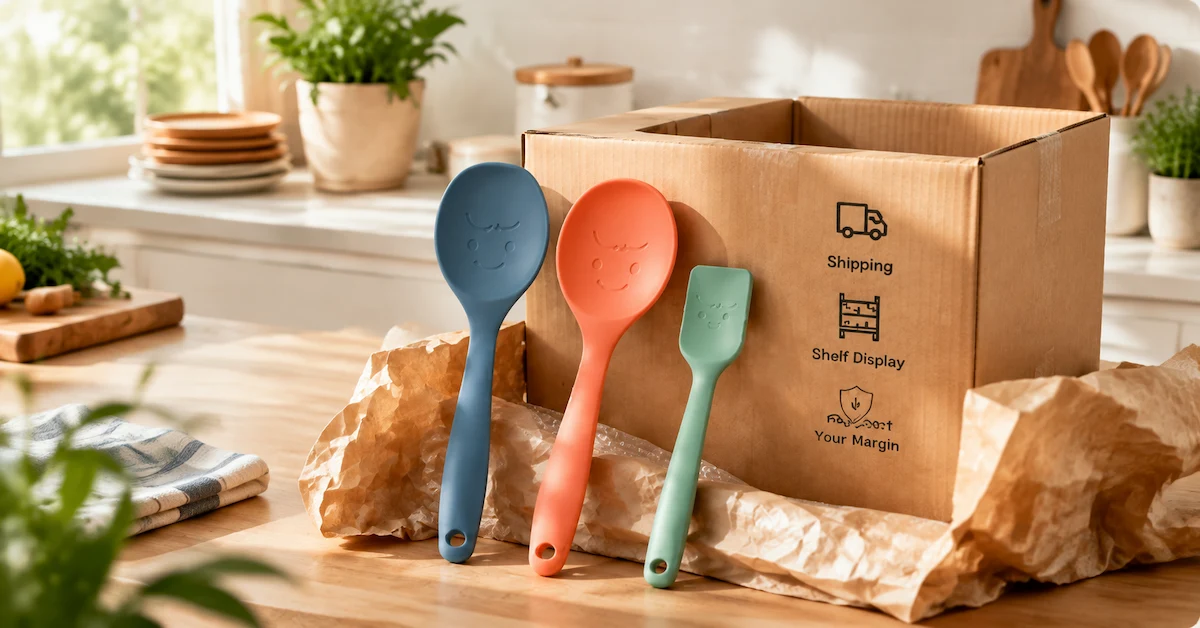
Channel Changes the Packaging Brief
Retail shelf packaging is judged quickly. The front panel must communicate product identity, set count, variant and one credible benefit without becoming a wall of claims. A window can help when the product's form is a selling point, but the window must not weaken the panel or expose the product to dust and handling. A hanging tab, shelf footprint and stacking behavior may matter as much as the visual design.
E-commerce packaging is judged by a longer chain of handling points. A retail unit may enter a fulfillment center, sit in a tote, move through a parcel network and arrive at a customer who did not see the product before opening the box. The design brief should address vibration, compression, shock, humidity and the possibility that the retail unit is shipped inside a larger carton. The International Safe Transit Association describes ISTA 3L as a data-driven simulation for e-commerce retailer fulfillment and consumer delivery hazards; the exact test route and acceptance limits should be agreed with the buyer and test provider.
Wholesale and distributor packs are often judged at the receiving door. Can a worker count the case quickly? Will the stack remain square? Is the label visible without turning every carton? A sleeve may be enough for a stable product, while a color carton may still need an outer case to stop its edges being crushed. Tell the supplier where the first opening happens. A warehouse operator, a store employee and the eventual customer handle the same closure in very different ways.
Gift and seasonal channels introduce presentation and timing pressure. Foil, embossing, windows, ribbons and special inserts can add perceived value, but every extra process introduces another approval and another possible delay. If the launch date is fixed, separate the visual ambition from the non-negotiable protection and information requirements. A supplier should be able to show which changes affect tooling, print slots, assembly or carton availability.
| Channel | Primary packaging job | Questions before quotation |
|---|---|---|
| Retail shelf | Explain and protect the SKU in limited viewing time | Shelf orientation? Hanging or standing? Window? Barcode side? |
| E-commerce | Survive fulfillment and parcel handling | Ship-alone or overpacked? Drop route? Empty-space limit? |
| Wholesale | Move efficiently through receiving and storage | Units per carton? Carton marks? Pallet pattern? |
| Gift / seasonal | Create presentation value within a date window | Special finish? Assembly? Approval deadline? |
| Mixed assortment | Share a system without confusing SKUs | Which elements are common and which vary by item? |
Material Choices: Compare the Whole Pack, Not Just the Board
Material choice begins with the failure the buyer is trying to prevent. Paperboard gives a good printable face. Corrugated board brings stacking strength. Molded pulp holds a shape, and a clear window lets the shopper see color and finish. Film, labels, foam and small clips solve narrower problems. None is automatically right. Weight, sharp edges, visible surfaces, humidity and the journey all change the answer. A light carton may suit a spoon that is locked in place but fail around a knife that can travel inside it. An oversized corrugated shipper protects the retail pack while charging the buyer to move air.
“Eco paper” is not a usable purchase description. Ask the supplier to name the board, its caliper or basis weight, its coating and any relevant recycled-content statement. Ink and adhesive limitations belong in the same conversation. For an FSC label, check the chain behind the label rather than accepting a green icon in the artwork. FSC guidance connects label use and claims to the applicable certification and documentation, so the buyer should identify the certified organization and retain the evidence for the final pack.
European projects also need a dated regulatory check. The European Commission says the Packaging and Packaging Waste Regulation begins to apply from mid-2026 and covers areas including recyclability, recycled content, waste prevention, labels and restricted substances. That is not a shortcut to a universal “EU pack.” It is a reason to name the destination, list the components and assign the evidence review before the artwork is frozen.
| Material route | Strengths | Risks or checks |
|---|---|---|
| Folding carton | Strong graphics, efficient storage, retail friendly | Board grade, edge crush, moisture, inner retention |
| Corrugated shipper | Protection and stacking for distribution | Cube, compression, carton marks and pallet pattern |
| Molded pulp | Shape retention and paper-based presentation | Fit, moisture, fiber dust, tooling and surface variation |
| Plastic window or tray | Product visibility and controlled presentation | Material identification, recycling route, scratch and seal |
| Paper sleeve | Low material use and easy SKU variation | No protection from all impacts; product stability needed |
| Rigid gift box | Premium opening and strong structure | Higher cost, cube, assembly and schedule exposure |
The Nine-Step Kitchenware Custom Packaging Method
The following method is meant for a live sourcing file, not a presentation board. After each step, write down what was decided, what is still open and who owns the next answer. That short record travels with the sample, gives quality staff something concrete to check and saves the reorder team from reconstructing old conversations.
Step 1: Define the Commercial Job of the Pack
Begin with the commercial job in plain language. Where will the item be seen, who buys it and when must stock be ready? Describe the route as it will really happen: perhaps a shelf first and a parcel later, or a wholesale case that is never shown to the consumer. Then explain the SKU's place in the range. A hero set, an entry-price tool and a seasonal gift do not justify the same amount of packaging work. “Make it premium” leaves the supplier guessing; a channel, price position and launch date give that word a boundary.
Record the decision in one page. Include the product name, product code if known, intended user, destination market, sales channel, unit count, expected use, target retail or landed-cost direction, and the function the packaging must perform. This brief is also the first evidence that a custom kitchenware packaging manufacturer has understood the project.
Step 2: Map the Product Risk
List what can break, scratch, bend, stain, detach, rust, dull, leak or become unsafe. A blade needs edge protection and controlled movement. A silicone utensil may need a clean surface and a retention method that does not mark the material. A cutting board can be heavy, broad and vulnerable to corner damage. A gadget with a hinge or spring may require a locked position. A set has a second risk: pieces can strike one another when the pack is shaken.
Ask the supplier to confirm the packed orientation and the contact points. Use photographs and a simple sketch if the product is not yet final. The goal is not to design the entire pack in the first email; it is to stop the quotation from hiding the product risk inside a generic “insert.”
Step 3: Choose the Pack Architecture
Select a primary format, retention method and shipping unit. A sleeve can make a product visible and flexible for multiple colors. A folding carton can carry more information and protect a larger surface. A tray can hold a set in a clear arrangement. A molded pulp or paper insert can reduce movement. A corrugated shipper can create a second protective layer. Make the architecture explicit, including whether the retail pack ships inside a master carton or is itself the shipping unit.
For a range, identify what is shared. The logo zone, side panel hierarchy, barcode position, paper color and insert language may be common. Dimensions, product name, piece count, warnings and care instructions will vary. Shared rules lower artwork and sampling effort without forcing every product into one physical box.
Step 4: Set the Information Hierarchy
Look at the front panel from a shopper's distance. The product name and set count should be obvious before the smaller claims compete for attention. Side and rear panels can carry dimensions, material wording, care, warnings, origin, importer details and destination-specific disposal information. Give every line an owner. The designer arranges approved copy; the designer should not be asked to invent a warning or decide the legal origin statement during prepress.
GS1 guidance says barcode placement should be considered alongside the packaging process so a symbol is not hidden by a fold, edge, flap or another layer. This is a small detail with a direct operational consequence. Place the barcode on the dieline, reserve its quiet zone, check contrast and scan the final packed sample.
Step 5: Select Materials and Finishes With Evidence
Only choose the finish after the product and route are clear. For each component, ask what the supplier is actually buying: which board, coating, ink, adhesive, window film or insert grade? Special effects deserve a sample in the hand. Matte laminate, soft touch, foil and embossing can shift with the base paper and the light, and photographs flatter some finishes. Use the screen proof to check position and copy. Use a physical swatch or made-up sample to approve the surface.
For “sustainable” packaging, write the claim narrowly. State the material and evidence rather than promising an outcome the supplier cannot document. The pack may use paperboard, but a plastic window, adhesive, coating and mixed-material insert can change the recycling route. A buyer can ask for material composition, supplier declarations and destination-market review without assuming that one icon solves the whole question.
Step 6: Build and Approve the Prototype
Treat the first mockup as a fitting. Put the actual product inside, close it, shake it gently and take it out the way a customer would. Check the facing direction and see whether the planned carton count still works. Print and finish come after those structural questions. Name each approval stage because “sample approved” is dangerously vague. The record should say whether the team accepted fit, dimensions, graphics, color, protection and barcode, or only one of those items.
Use a decision log with the SKU, sample revision, open issue, requested change, evidence and owner. Photograph the sample with a ruler and the product inside. Retain one signed or otherwise controlled reference. A digital image can be part of the record, but scale, color and hidden retention points are easier to judge with a physical sample.
Step 7: Test the Pack Against the Route
Sketch the journey before naming a test. One order may leave the factory in a container and finish on a retail shelf. Another continues through a fulfillment center and a parcel carrier. Compression, vibration, drops, humidity and heat appear in different combinations along those routes. ISTA describes package testing as a challenge to the product-and-package combination, not to an empty box. Agree what damage means, how much cosmetic change is tolerable, how many samples will be used and where the report will be kept.
Use production-intent packaging for the final test whenever it can be obtained. A hand-cut mockup is excellent for finding a fit problem, but it says little about print rub, adhesive or carton compression. Record the method, date, sample identity, damage and disposition. Later, if someone proposes a new board, insert, closure or carton count, reopen the test record and decide whether its old conclusion still applies.
Step 8: Normalize the Quote and Release Data
A useful quote lets the buyer see what will be paid once and what returns on every order. Put dies, plates, screens and development samples in the first group. In the recurring group, show the pack components, assembly, inspection, cartons and agreed logistics basis. Testing may sit in either group, so it needs its own line. Ask which quantity controls each price and what happens when the order is split by artwork or color. MOQ is not one number here; the product, printer and special material may each impose a different floor.
The release file should connect the product code, pack code, artwork revision, material, finish, insert, barcode, carton configuration, sample approval, inspection point and change owner. BONET's public OEM/ODM page states that its collaboration process reviews cost, MOQ, lead time, specifications and project schedule before production. A buyer should still request those fields in writing for the specific project.
Step 9: Protect the Reorder and the Claim Process
A successful first order is not the finish line. Store the approved packed sample, artwork files, dieline, carton marks, supplier quote, test record and inspection checklist under one release code. When the buyer says “same as last time,” the supplier should be able to identify exactly which last time. If the material, printer, adhesive, insert, factory line or carton quantity changes, the change should be proposed and approved before production.
Define what happens when a shipment arrives with damage or a barcode that does not scan. The claim record should identify the SKU, carton, lot or production date, photographs, quantity affected, packaging condition and requested containment. This turns a complaint into a packaging learning loop rather than a debate based on memory.
How BONET Can Fit a Packaging Conversation
BONET HOUSEWARE's public OEM/ODM page presents a product scope that includes kitchen knives, kitchen utensils, chopping boards, kitchen gadgets, multifunctional products and all-purpose scissors. It lists export packaging solutions, color boxes, gift boxes, retail packaging, barcode labels and export cartons. It also states that buyers can share product ideas, target market, materials, packaging, quantity and quality requirements at the first communication stage.
Use the public manufacturing page and About Us page as evidence leads, then verify them against the project. The available ISO 9001:2015 / GB/T19001-2016 certificate has a precise scope: production and sale of scissors. The Yangjiang legal entity also has a BSCI monitoring record. Neither record should be stretched into a blanket packaging or market-compliance claim. They belong in supplier due diligence alongside the sample, specification and quality agreement for the goods being ordered.
Supplier Comparison Scorecard for Custom Packaging
Do not score suppliers until they have answered the same brief. A tempting unit price may rest on lighter board, no insert labor, fewer units per carton or an assumption that has never been tested. Give one mark to the proposal and another to the proof behind it. The difference between those marks is often where purchasing risk is hiding.
| Decision area | Strong proposal | Question to ask |
|---|---|---|
| Product protection | Risk map and retention proposal tied to the actual SKU | Which feature stops movement, edge damage or blade contact? |
| Retail communication | Dieline hierarchy with product, pack count and variant clear | What will a shopper understand in the first three seconds? |
| Material evidence | Grade, finish, supplier basis and claims boundary | Which documents support the material or sustainability statement? |
| Testing | Route, sample, method, acceptance limit and report owner | What happens if the pack passes but the product is scratched? |
| Quotation clarity | Setup, unit, labor, carton, testing and freight assumptions separated | What changes when quantity or SKU split changes? |
| Release control | File code, approved sample, inspection checklist and change process | How will the next order call up the same pack? |
What Does Custom Kitchenware Packaging Cost?
A packaging price without a drawing or description is a placeholder. Imagine two quotes for the same silicone spoon. One factory has pictured a narrow paper sleeve; the other has allowed for a printed carton that can enter parcel fulfillment. Their unit prices describe different work, even though both documents say “custom pack.” Before comparing the last decimal place, uncover the surrounding spend: tooling, proofs, inspections, outer cases, transport and any printed stock left over from the minimum run.
Build the comparison sheet before quotations arrive. Give every SKU its own row and note the quantity behind it. Columns should expose the retail pack, insert, labels, assembly, outer carton, sampling, tests, inspection and shipping basis. Keep setup charges apart from repeat costs. Send that same sheet to each bidder. When one factory proposes a different carton or leaves a test open, write the difference beside its price instead of forcing unlike figures into a false comparison.
What Belongs in the First Packaging Inquiry?
The first email should let the supplier picture the job. Attach a link, drawing or a few honest product photographs, with size and weight beside them. Say where the goods will sell, where they are going and how the quantity divides across SKUs. Add the preferred pack if there is one, along with the material direction and the current state of artwork and barcode work. Carton needs, expected checks and the stock date round out the brief. Unknowns are acceptable; silent blanks are not.
For a set, photograph every component and show the arrangement you have in mind. Call out anything sharp, hinged, heavy, flexible or likely to be washed before first use. For a family, separate the house rules from the SKU-specific details. In its reply, the supplier should distinguish between an existing production route, a new tool or insert, and an idea that needs a physical mockup before anyone can sensibly price it.
| Send this | A useful supplier reply explains |
|---|---|
| Product reference with size and weight | How the item will be held and how much material the pack uses |
| Selling channel and destination | What must be visible and which handling route is assumed |
| Quantity by SKU and color | The print minimum, setup basis and economical breakpoints |
| Current artwork and barcode files | What prepress work remains and which proof comes next |
| Expected transport checks | The sample, test route and proposed pass rule |
| Delivery and carton assumptions | Packed cube, case labels and the price basis being quoted |
Questions to Close Before the Packed Sample Is Approved
Can knives, utensils and gadgets share one packaging system?
A product family can share a visual grammar without sharing one box. Keep the logo position, colors, panel order, barcode area and material wording consistent. Let size and retention follow the object. The knife still needs its guard, the utensil may need to hang, and the gadget may be easier to understand when its moving part is visible in a tray. Consistency should help shoppers navigate the range, not force unlike products into an unsafe structure.
Should I use a paper sleeve or a full box?
A sleeve earns its place when the product already holds its shape and a small printed area is enough. Choose the carton when handling exposure is higher, the copy needs more room or the opening has to be controlled. Price the shipped system, not only the printed piece. A cheap sleeve plus an oversized protective shipper can cost more than a compact carton once labor and freight are counted.
How do I protect a sharp kitchen knife in retail packaging?
Mark the edge, tip, handle and the path a customer's hand will take when opening the pack. Hold the blade so it neither rubs through the carton nor travels toward an opening during handling. Ask for the intended guard or insert in the physical sample. Only then review removal, warning copy, barcode position and the way the finished carton behaves under a stack.
What should be checked on a custom printed kitchenware box?
Check the dieline, panel order, text, product count, material statement, barcode, color reference, print registration, fold direction, glue or lock points, scuff resistance and packed fit. Inspect the final sample rather than only a flat proof. A box can look correct as artwork and still fail when folded around the actual product.
Can the packaging supplier also provide the product?
Some kitchenware manufacturers coordinate product and packaging as one OEM/ODM project. The buyer should still identify who owns the packaging specification, who purchases the printed materials, who approves the sample and who controls changes. BONET's public page describes packaging customization alongside kitchenware OEM and ODM support; the exact responsibility split should appear in the quotation and purchase documents.
What does “private label kitchenware packaging” need to protect?
It needs to protect the product, the brand file, the SKU identity and the reorder path. Record the approved logo, packaging copy, barcode, material, finish, product revision, carton configuration and sample. Limit access to superseded artwork and require approval before a relevant material, printer, insert or factory change.
How should I ask about sustainable packaging?
Ask for the exact material composition, certification status where a claim is requested, recycling guidance for the destination market, coating and adhesive information, and the party responsible for substantiation. Avoid broad claims such as “100% eco” unless the evidence and market wording support them. The EU PPWR and FSC guidance are useful starting references, not a substitute for market-specific advice.
What information should be included in an inquiry?
Send the product or sample, target market, channel, quantity by SKU, material direction, preferred pack, artwork status, barcode status, shipping route, required date and quality expectations. Ask for MOQ, setup cost, sample timing, lead time, unit price basis, carton data, testing proposal and change-control method.
Conclusion: Approve the Pack You Intend to Reorder
The strongest packaging decision is rarely the most decorative one. It is the one that connects product risk, channel behavior, material evidence, retail communication, shipping protection, quotation clarity and reorder control. Define the job, map the product, choose the architecture, set the information hierarchy, select materials, approve a physical prototype, test the route, normalize the quote and protect the release record.
A buyer who sends that brief gives a supplier something real to solve. A supplier who responds with a product-specific structure, sample plan, cost basis, testing route and change record gives the buyer something real to compare. For a kitchenware custom packaging project, that shared clarity is what turns a packaging conversation into an RFQ that can move toward sampling and production.
Send your product link or sample, target market, quantity, packaging preference, artwork status and required date through the BONET HOUSEWARE contact page.
Packaging Economics: Look Beyond the Printed Unit Price
Packaging cost is a system cost. The printed box is only one line. The buyer may also pay for a die, plate, proof, insert, label, assembly, inner bag, master carton, pallet, inspection and the freight space consumed by the pack. A rigid box that adds 25 millimeters to a product can change the carton quantity and the number of cartons in a container. A window can reduce the amount of printed information needed on the front, but it can also add another material stream and another sealing operation. The correct comparison is the cost of the packed, shipped and received unit, not the cost of the empty box.
Build a simple landed-pack worksheet. Start with the recurring unit pack. Add expected setup amortization for the first order, packaging labor, carton and pallet costs, testing and any special inspection. Add the logistics effect of dimensions and weight. Then show a second line for the reorder, because tooling and artwork setup may not repeat. This view helps a buyer decide whether a slightly more expensive pack lowers damage, improves receiving speed or removes manual work at the warehouse. It also gives the supplier a clear question when a quote appears unusually low.
For a range, separate costs that can be shared from costs that follow each SKU. Three utensils might use one carton family and three different inserts. A common paper color can simplify buying, yet small artwork runs may still make each SKU expensive. Ask the factory to price a few realistic scenarios, such as one color versus three or a pilot run versus the printer's efficient run. Those figures reveal the step changes. A large total order does not necessarily solve the minimum attached to one board size, foil or insert.
Material Engineering Questions for a Custom Packaging Manufacturer
A custom kitchenware packaging manufacturer should be able to explain how its proposed structure responds to the product. Ask where the load travels when the carton is stacked. Ask which part stops the item from moving. Ask whether a handle touches a printed surface, whether a blade touches an insert, and whether a removable accessory can fall into a seam. A short answer such as “the insert keeps it safe” is not enough; the buyer needs a drawing or sample that makes the contact points visible.
Turn material questions into things that can be seen on a sample. With board, inspect grain or flute direction, folds, glue joints and the edges that bear a stack. With molded pulp, rub the contact surface, check for fiber dust and see how much the cavity varies. Flex a window at the fold and ask how its resin will be identified at destination. Put an adhesive label through storage, oil contact and removal rather than discussing tack in the abstract.
Do not turn a material conversation into an unsupported food-contact claim. The package may touch the outside of a utensil but still need to keep printed ink, adhesive or dust away from a food-contact surface. If a package includes a coating, insert, film or tray that could touch the item, state the intended contact and ask the supplier what evidence is available. BONET's public material list includes stainless steel, silicone, plastic, wood, bamboo, aluminum alloy and composite directions for products; the packaging material and its evidence still need a separate project decision.
Packaging Information Architecture for International Buyers
A global pack often needs to serve more than one language, channel or importer. Decide whether the same carton can carry all required information or whether a label, sticker or market-specific sleeve is more practical. Keep the product name, piece count and variant in the same visual location across the range. A buyer should not have to hunt for the barcode on one SKU and the care instructions on another. Consistency helps store receiving, customer service and reorder checks even when the products use different physical formats.
Use a copy matrix with one row per panel and one column per market. The matrix should identify the approved English, translated copy, owner, revision and date. Keep mandatory information separate from optional marketing copy. If a destination market adds a symbol, importer address or language, mark the affected panels and verify that a late label will not cover a barcode, fold, warning or product view. A packaging supplier can place the content, but the brand or importer remains responsible for the accuracy of the information it approves.
Barcode control deserves its own gate. Scan the actual packed unit, not only the flat artwork. Check quiet zone, contrast, orientation, curvature, glare and the possibility of a sleeve or sticker covering the symbol. If a retail buyer supplies a specific barcode or 2D data carrier, record the version in the release file. If the buyer has not assigned the code, leave a reserved zone in the dieline rather than improvising a final position after printing.
Inspection Plan for Product and Pack Together
A packaging inspection plan should mirror the real failure modes. For a knife, inspect guard position, tip exposure, blade movement, print rub and carton edge crush. For a silicone utensil, inspect color consistency, product orientation, hanging hole access, insert pressure and label adhesion. For a cutting board, inspect corner protection, moisture barrier, pack flatness and the stated dimensions. For a gadget set, inspect every accessory, lock position, retention point and the piece-count label.
Create a first-piece checklist and an in-process checklist. The first piece confirms that the current artwork, product revision, pack method and barcode are aligned. The in-process check looks for drift: a shifted label, a changed insert, a weak glue point, an incorrect carton mark or a product packed upside down. The final check confirms count, carton configuration, visible damage and the evidence needed for shipment release. The inspection plan should name the method and acceptance rule, not only the word “quality.”
Photographs are useful when they include a scale, product code and sample revision. Keep a physical reference when color, fit or tactile finish matters. If the supplier cannot retain the master sample, agree who stores it and how a signed photo is linked to the release record. A buyer should be able to reconstruct the approved pack six months later without searching through personal messages.
When to Ask for a Different Packaging Route
A supplier proposal should be challenged when the pack solves one problem by creating another. A large front window may create a weak fold. A tight insert may scratch a polished handle. A foam block may protect the product but conflict with a destination market's material policy. A full-color box may look premium but use too much empty space for a low-price wholesale item. A printed sleeve may be elegant but fail to retain a long utensil in a shipping carton.
Ask for two alternatives when the trade-off is material. One may optimize cost and cube; the other may optimize gift presentation or product visibility. Require the supplier to state what changes: board grade, insert, tooling, print coverage, assembly, carton quantity, delivery time or testing. A comparison is useful only when the differences are named. The buyer can then choose a route based on channel and margin instead of judging a rendered mockup in isolation.
Packaging Supplier Links for the RFQ
For the next sourcing step, review kitchenware custom packaging with a custom kitchenware packaging manufacturer, compare a custom packaging for kitchenware proposal, and ask about private label kitchenware packaging. Buyers can also request OEM kitchenware packaging, custom printed kitchenware boxes, or a coordinated program with a kitchenware packaging supplier China. For product-led ranges, connect branded packaging for kitchen utensils with a wholesale custom kitchenware packaging quote.
