




Kitchenware Manufacturer China: How to Source Coordinated Housewares Sets
For sourcing teams, searching for a kitchenware manufacturer China is rarely about one spoon, one bowl, or one utensil holder. The goal is usually a coordinated housewares set that can be presented as a complete retail line, gift bundle, or private label program. That makes supplier selection more complex than a simple unit-price comparison.
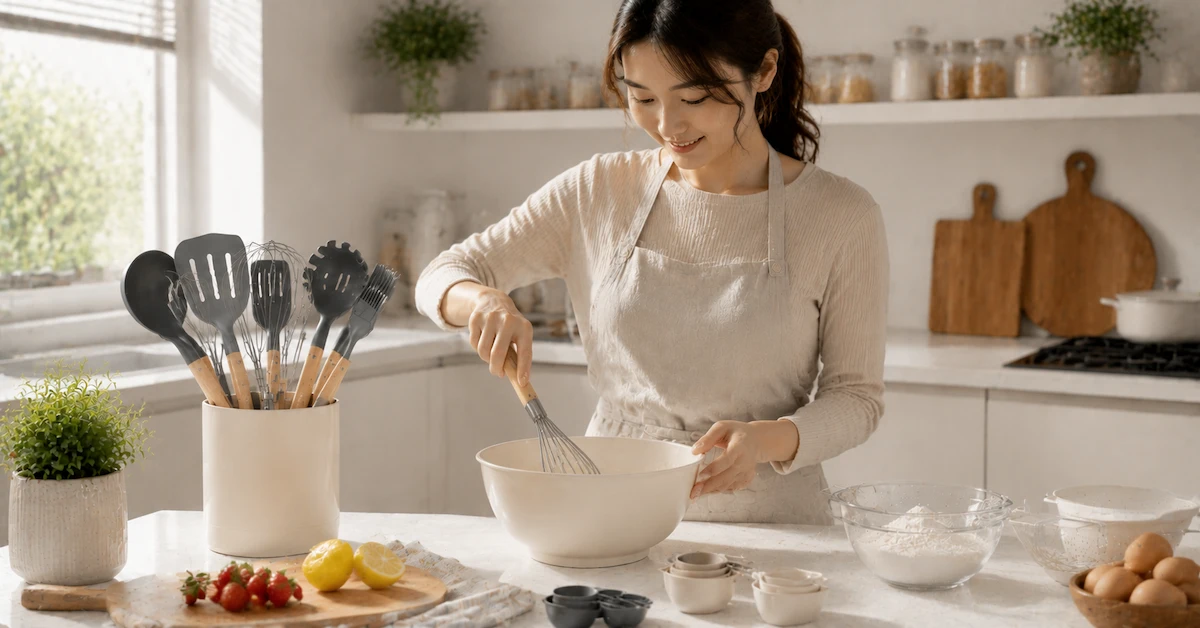
The product style shown in the original article suggests a neutral kitchen set with long-handled utensils, a countertop caddy, and nested prep or mixing bowls. The exact materials are not stated, so buyers should avoid assumptions. What can be evaluated is the sourcing challenge: multiple components must look related, function well together, survive handling, and be packaged without damage.
Key Takeaways
- A coordinated kitchenware set should be evaluated as one product system, not as isolated items.
- Supplier type matters: kitchenware, cookware, and tableware factories may have different strengths.
- Buyers should verify materials, finishes, packaging methods, and which parts are made in-house.
- Samples should include the full set, not only the most attractive item.
Why Buyers Source Coordinated Kitchenware Sets from China
China remains an important sourcing base for kitchen and housewares programs because buyers can often find suppliers with access to varied product categories, finishes, packaging resources, and export experience. For a coordinated set, this matters because the program may include utensils, a holder, bowls, labels, inserts, cartons, and retail packaging.
The main challenge is not simply finding a factory that can make one component. It is finding a supplier that can manage consistency across the assortment. A utensil handle, bowl surface, and countertop caddy may come from different production streams. If their color tone, surface texture, or proportions do not align, the finished set can look assembled rather than designed.
What the Product Mix Tells a Sourcing Manager
A set with utensils, a storage holder, and bowls is a hybrid housewares product. It is partly food-prep related, partly countertop organization, and partly retail presentation. That means a sourcing manager should ask more detailed questions than they would for a single SKU.
Useful questions include: Which components are core to the set? Which items are optional add-ons? Are the bowls intended for prep, serving, or display? Is the holder part of the functional product or mainly a packaging-style presentation feature? These answers affect the supplier profile, tooling needs, inspection plan, and packaging design.
Buyers should also request clear material confirmation. The visible image may suggest several possible materials, but sourcing decisions should be based on supplier documentation and physical samples, not appearance alone.
Comparison Table: Supplier Types to Consider
| Supplier type | Best fit | Questions to ask |
|---|---|---|
| General kitchenware manufacturer | Mixed utensil, holder, and accessory sets | Which parts are produced in-house? Which are outsourced or partner-made? |
| Cookware manufacturer China | Pots, pans, stovetop tools, and heat-focused product lines | Do you also manage non-cookware accessories and retail set packaging? |
| Tableware manufacturer China | Bowls, serving pieces, dining sets, and presentation items | Can you coordinate utensil components and countertop accessories? |
| Trading or sourcing company | Multi-factory coordination across categories | How do you control inspections, samples, timelines, and responsibility for defects? |
Material Coordination Is the Real Quality Test
Minimalist housewares sets can look simple, but they expose inconsistency quickly. A slight mismatch in finish, an unstable holder, a rough handle, or bowls that do not nest smoothly can reduce perceived value. For private label and retail buyers, the customer often judges the whole set by its weakest component.
When evaluating samples, compare the items together under normal lighting, not only in individual product photos. Check whether the utensils sit comfortably in the holder. Look at whether the bowl sizes feel useful. Review whether finishes appear intentionally coordinated. If the supplier proposes different material options, ask how each option affects weight, durability, cleaning guidance, packaging, and cost.
What to Confirm Before Requesting Quotes
A strong RFQ should give suppliers enough information to respond accurately. Vague requests such as “kitchen set” often lead to incomplete pricing or mismatched samples. Before asking for quotations, prepare a clear product brief.
- List each component in the set, including optional items.
- State the intended use: prep, cooking, serving, countertop display, or gift set.
- Define the target look, color direction, and finish requirements.
- Ask suppliers to identify exact materials for every component.
- Request packaging concepts for fragile or scratch-sensitive parts.
- Ask which production steps are in-house and which are subcontracted.
- Clarify sample lead time, production lead time, MOQ, and customization options as questions, not assumptions.
This approach helps buyers compare suppliers on the same basis. It also reduces the risk of selecting the cheapest quote only to discover later that packaging, color matching, or component sourcing was not included.
Sample Review Checklist for Housewares Sets
Samples should be reviewed as a complete system. A beautiful bowl or well-balanced utensil is not enough if the set fails as a retail bundle. Use a simple checklist during sample approval:
- Finish consistency: Do all visible parts look coordinated in color, texture, and gloss level?
- Handling: Are the utensils comfortable to grip and easy to remove from the holder?
- Stability: Does the holder remain upright when filled with tools?
- Nesting and fit: Do the bowls stack cleanly without awkward gaps or wobble?
- Packaging protection: Are hard, fragile, or coated surfaces separated to reduce scratches or chips?
- Retail presentation: Does the set look coherent when displayed together?
Common Sourcing Mistakes to Avoid
One common mistake is treating all kitchen suppliers as interchangeable. A cookware specialist may be strong in heat-performance products but less experienced with decorative countertop sets. A tableware supplier may produce attractive bowls but may not coordinate utensils and holders well. Supplier fit should match the product mix.
Another mistake is approving a single “hero” sample instead of the entire set. In coordinated housewares, the interaction between components is the product. Buyers should review production-style samples with packaging whenever possible.
A third mistake is leaving packaging until the end. Mixed sets can include long tools, nested items, and parts with different surface sensitivities. Ask early how the supplier plans to protect each item during shipment and retail handling.
Practical FAQ
Can one kitchenware manufacturer in China make the whole set?
Sometimes. Some suppliers may manage a full set directly or through partner factories. Buyers should ask which components are made in-house, which are outsourced, and who is responsible for quality control across the complete set.
Should I choose a cookware or tableware manufacturer instead?
Choose based on the center of the program. If the range is mainly pots, pans, and heat-related tools, a cookware manufacturer may fit better. If bowls and serving pieces dominate, a tableware supplier may be stronger. For mixed utensil-and-countertop sets, a general kitchenware supplier is often a practical starting point.
What should I inspect first in samples?
Start with finish consistency, holder stability, utensil comfort, bowl nesting, and packaging protection. These are the details most likely to affect customer perception and retail returns.
What commercial details should buyers ask about?
Ask about MOQ, customization limits, sample costs, lead times, packaging options, inspection process, and applicable test requirements for your target market. Do not assume these details until the supplier confirms them in writing.
Final Sourcing Advice
Choosing a kitchenware manufacturer in China for coordinated housewares sets is a design, quality, and supply-chain decision. The right supplier should help the utensils, holder, and bowls feel like one planned collection rather than separate products placed in the same carton.
Before committing, define the set clearly, request complete samples, compare supplier capabilities honestly, and ask direct questions about materials, production responsibility, packaging, and quality checks. That disciplined process gives buyers a better chance of building a kitchenware set that is practical for end users and reliable for retail programs.
