




Why supermarkets care about the right kitchenware supplier
A kitchenware supplier for supermarkets is not just filling shelf space. They are helping a retailer decide which products will move quickly, survive handling in stores, and avoid becoming the sort of item customers pick up once and never replace. For chains and independent grocers alike, the challenge is the same: stock kitchen tools that feel useful at a glance, are easy to merchandise, and give shoppers a clear reason to buy without a long explanation from staff.
That matters more than it may sound. A peeler, spatula, measuring cup, or storage item sits in a very crowded category. If the product looks flimsy, too complicated, or too premium for a supermarket aisle, it can stall. If it is too basic, it disappears into the background. Buyers need suppliers who understand this middle ground. They need product lines that can work as everyday essentials, not novelty items.
A good supermarket cookware supplier should also think beyond the carton. Supermarket assortments live or die by shelf appeal, barcode accuracy, packaging clarity, and the ability to replenish in volume. The product has to make sense to a household shopper in ten seconds or less.
The practical problem: shoppers want simple tools, not demonstrations
Most supermarket customers are not comparing technical specifications in the aisle. They are making a fast choice based on need: replace a worn tool, grab something for a recipe, or pick up a small giftable item. That means the product itself has to communicate use immediately.
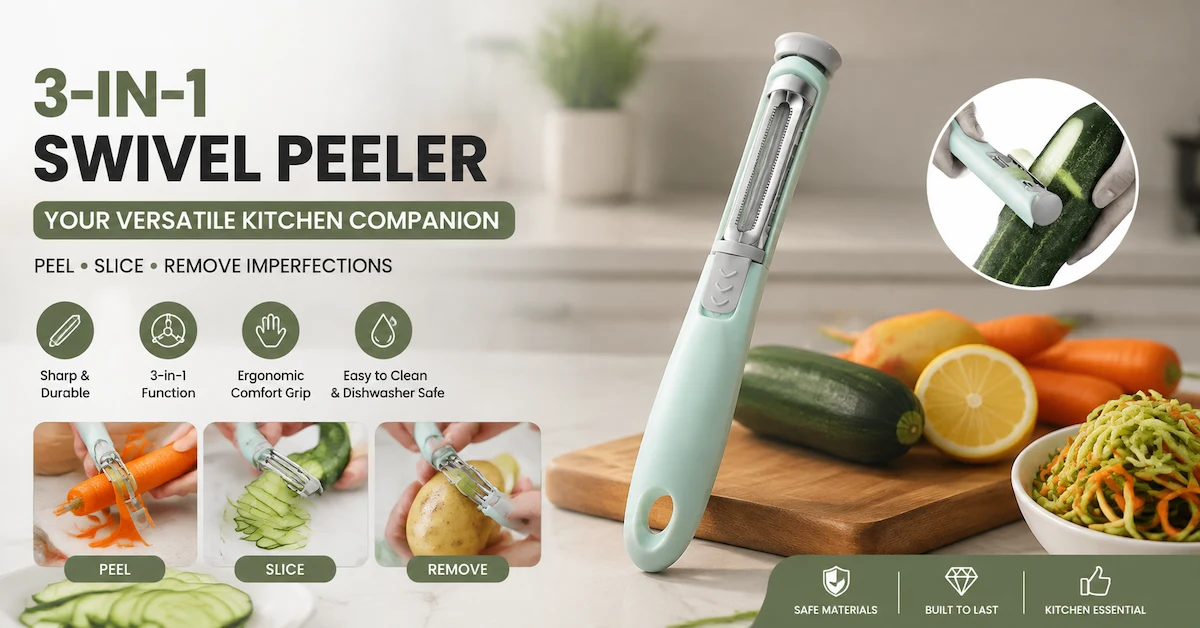
Take a 3-in-1 swivel peeler as an example. It is the kind of compact kitchen hand tool that can earn space because it solves several small jobs at once: peeling carrots, cucumbers, zucchini, and potatoes; shaving thin ribbons; and removing blemishes from produce. The rotating blade head follows curved surfaces more naturally than a fixed blade, which can make the tool feel easier for everyday prep. For a supermarket buyer, that versatility is useful because it gives one SKU broader appeal.
Still, the promise has to stay realistic. A peeler is a simple item, and shoppers will judge it on the first use. If the handle feels awkward, the blade drags, or the head wobbles too freely, the product becomes a return risk and a reputation risk. That is why the source matters as much as the item itself.
What to look for in a supermarket-ready kitchenware supplier
Good sourcing decisions usually come down to a few practical checks, not marketing language.
First, look at form factor. Supermarket kitchenware should be easy to understand from the shelf and easy to use at home. The swivel peeler described here has a long narrow ergonomic handle with a hanging hole at the base and a compact one-hand layout. That is the sort of shape that works in a busy kitchen drawer, which helps its perceived value.
Second, look at materials and finish with a sober eye. In the product data, the handle appears mint-green with a matte or satin finish, while the blade assembly looks gray with a stainless-steel-like cutting edge. Exact materials are not fully verified from the image, so a buyer should not assume more than that. In retail, finish matters because it affects both appearance and cleaning perception. A dull, scuffed plastic look can weaken shelf appeal even if the tool performs well.
Third, check the supplier’s ability to support the retail format. Packaging should be readable, durable in transit, and honest about use. Claims such as “easy to clean,” “dishwasher safe,” or “sharp & durable” may appear in product graphics, but they should be treated as marketing copy unless independently verified. That caution is worth stating plainly. Supermarket buyers do not want to spend time correcting untested claims after a consumer complaint.
Fourth, ask how the product is made and assembled. The likely category here is consumer kitchenware with an injection-molded handle and assembled metal peeling blades plus a pivoting or swiveling head mechanism. That is a plausible manufacturing direction, but it is not fully confirmed. For sourcing teams, the key point is less about the exact process and more about consistency: the handle, blade assembly, and moving head should arrive with stable fit and finish from batch to batch.
Why compact tools often outperform larger kitchen items in supermarkets
There is a quiet advantage to small hand tools in grocery retail. They are lower-ticket, easier to display, and often bought on impulse. A customer shopping for produce may notice a peeler and think of the carrots or potatoes already in the basket. That is a fast conversion path.
A 3-in-1 swivel peeler also fits the supermarket buying pattern because it is not highly specialized. It does not require the shopper to know the difference between three niche kitchen devices. It simply claims to do three related tasks well enough for home cooking.
That said, the supplier still needs to protect against overpromising. If a product is sold as a one-size-fits-many tool, the design has to support that idea. The blade must stay sharp enough for ordinary produce work, the grip should be comfortable in wet hands, and the swivel action should feel controlled rather than loose. Buyers should ask for samples and use them on real produce before they commit to volume.
Selection criteria that matter to sourcing teams
When reviewing a kitchenware supplier for supermarkets, use a shortlist that reflects how the item will actually be sold.
1. Shelf clarity
Can a shopper understand the item in a few seconds? The product name, use case, and key benefit should be visible without a long read.
2. Everyday usefulness
Will the tool fit common cooking habits? A peeler that works on carrots, cucumbers, zucchini, and potatoes has a broader case than one that seems designed for a single task.
3. Handling comfort
An ergonomic comfort grip is not a luxury detail in a hand tool. It affects whether customers keep using it. But comfort should be checked in hand, not just assumed from a label.
4. Build credibility
A swivel blade head can be useful, but moving parts also introduce wear points. Buyers should examine how securely the head is assembled and whether the tool feels robust after repeated use.
5. Cleaning and care
If a supplier says dishwasher safe, ask what that means in practice. Retailers should be careful here, because customer expectations can be much higher than the product’s true durability under heat and detergent.
Common buyer mistakes when sourcing supermarket kitchenware
One common mistake is choosing products that look good in a photo but are awkward in hand. The supermarket aisle is full of items that win the thumbnail and lose the kitchen drawer.
Another is assuming all kitchenware suppliers understand retail. Some can make a useful product but struggle with packaging, labeling, barcoding, or replenishment discipline. Supermarket programs need predictability.
A third mistake is overloading the assortment. Too many similar peelers, graters, or utensils make the display feel repetitive. One well-chosen 3-in-1 swivel peeler may do more work than three near-identical alternatives.
Finally, do not ignore the merchant’s side of the job. If the item is too complex to explain to store teams, it may not get the attention it needs. Simpler usually wins in grocery retail, though not always. Sometimes a slightly better-feeling tool justifies its place.
How to evaluate a supplier before placing a bulk order
A practical review should include sample inspection, packaging review, and use testing on real produce. If possible, peel a carrot, a cucumber, a zucchini, and a potato. That gives a fast sense of blade behavior and grip comfort. It is not laboratory testing, but it is closer to how the product will actually be used than a spec sheet alone.
Also pay attention to repeatability. One sample can be excellent while the next batch is merely acceptable. In supermarket sourcing, consistency is often more valuable than a dramatic feature.
For bulk kitchenware programs, ask the supplier how they handle visual standards, carton protection, and accessory packing if the product includes inserts or hanging display features. A hanging hole on the handle can be a useful merchandising detail, but only if the rest of the package supports it.
FAQ for supermarket buyers
What makes a kitchenware item suitable for supermarket shelves?
It should be easy to understand, easy to price, and useful for everyday home cooking. Compact tools usually perform well if they have clear packaging and believable claims.
Why is a swivel peeler useful for retail?
It solves several routine prep tasks and gives shoppers a visible reason to choose it over a basic fixed peeler.
Should buyers rely on claims like “dishwasher safe” without verification?
No. Treat those claims cautiously unless the supplier provides solid supporting information.
Is the cheapest option always best for supermarkets?
Not usually. Low cost helps, but weak ergonomics or poor blade performance can hurt sell-through and increase dissatisfaction.
What a good next step looks like
For sourcing managers and product teams, the best move is to narrow the field to suppliers who can provide samples, stable packaging, and realistic product claims. If you are reviewing a kitchenware supplier for supermarkets, start with the tools that shoppers buy on impulse and use often. Small hand tools like a 3-in-1 swivel peeler can be a sensible test case because they are simple enough to evaluate quickly but important enough to expose quality differences.
If a supplier can show a well-finished product, practical ergonomics, and packaging that belongs in a grocery aisle, that is usually a better signal than a polished brochure. In supermarket retail, the product has to do the talking after the shopper leaves the store.
