




Why supermarket buyers keep asking for kitchenware suppliers who can do more than ship boxes
A kitchenware supplier for supermarkets is not judged the same way a boutique retailer is judged. Grocery chains, mass merchants, and regional supermarket groups need products that move quickly off the shelf, survive handling in stores and back rooms, and fit into a price architecture that leaves room for margin. That sounds simple until you try to balance presentation, durability, compliance, and replenishment on a product like a kitchen knife and cutting board set.
This is the point where many buyers run into trouble. The item looks basic, but the purchase decision touches packaging, material choice, safety perception, end-user convenience, and whether the set can earn its place in a crowded housewares aisle. A reliable retail kitchenware supplier has to understand those pressures, not just quote a unit price.
For supermarket teams, the real question is rarely “Can you make this?” It is “Can you make it consistently, package it cleanly, and keep the offer sharp enough for retail?”
What this type of kitchenware set is actually selling
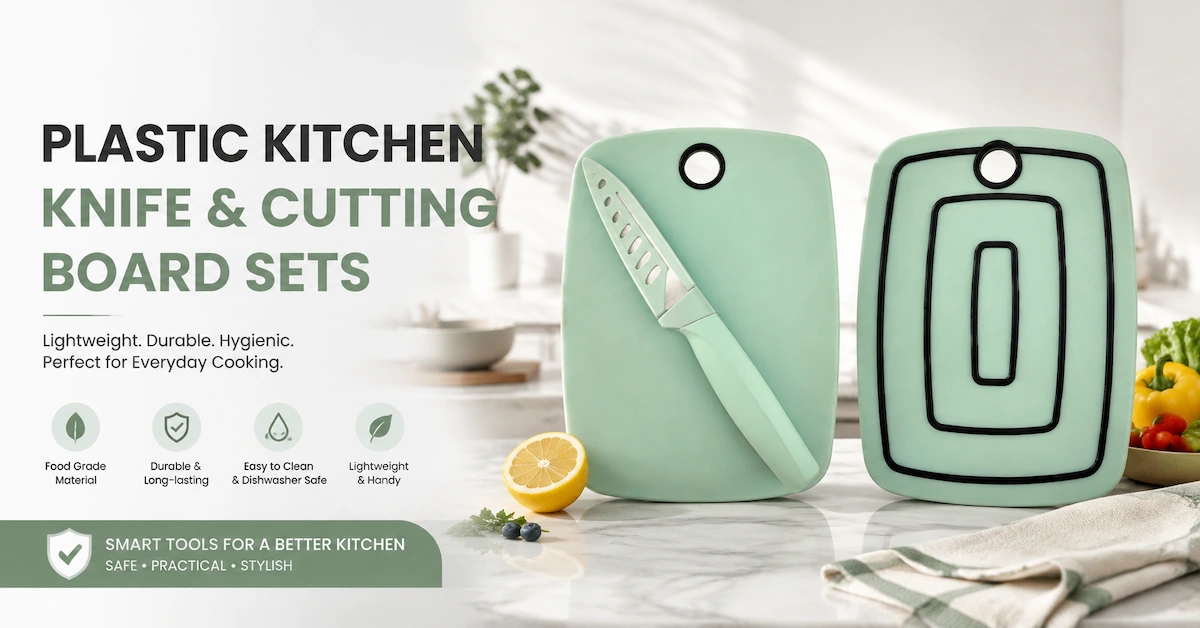
The product category here is a food-prep tool set built around a kitchen knife and cutting boards. In the supplied product information, the boards are shown in a mint-green finish with rounded corners, integrated hanging holes, and smooth molded surfaces. One board has black outlined groove-like decoration. The knife is a matching mint-green utility-style piece with a perforated blade section and molded handle.
The image text indicates “plastic kitchen knife & cutting board sets,” which suggests an injection-molded plastic or food-grade polymer construction for the boards, while the knife may use a stamped blade with a molded handle. That is a common structure in this part of the market, though the exact materials are not confirmed.
For supermarket shelves, this kind of set sells on practical value: compact size, light weight, easy cleaning, and visual freshness. The mint-green color also helps it stand out against the many gray, black, and clear products that dominate housewares packaging. Small visual choices matter more than buyers sometimes admit.
Quick buyer read: what to check first
If you are sourcing a set like this, start with four questions:
- Does the product presentation match the aisle and price tier?
- Is the material suitable for everyday food prep and repeated handling?
- Can the supplier support stable production from batch to batch?
- Does the packaging communicate the benefits without making exaggerated claims?
Those four points usually tell you more than a glossy sample ever will.
Why supermarkets need a different sourcing mindset
A supermarket program is built on volume, assortment discipline, and repeatability. Products need to fit planograms, promotional calendars, and private-label strategies. A knife-and-board set is not a one-off gift item; it may be treated as an entry-level kitchen essential, an add-on near seasonal displays, or a basic housewares staple.
That means buyers should look beyond the sample and ask how the kitchenware manufacturer handles production control. Plastic tooling consistency, color matching, mold finish, and assembly alignment all influence the shelf appearance. If the hole for hanging is off-center or the surface finish varies too much, the item can look cheap even if it performs adequately.
There is also a practical retail issue that sometimes gets overlooked: the customer is often buying with one hand, quickly, under fluorescent store lighting. The product has to communicate use in seconds. If the package says the set is food grade, durable & long-lasting, easy to clean, dishwasher safe, lightweight & handy, safe/practical/stylish, those claims need to be believable and supportable. Buyers should be cautious about packaging language that overreaches, because end users notice the gap faster than suppliers expect.
Material and construction choices that matter
In products like this, material choice drives both cost and customer satisfaction. For the boards, the molded appearance points to a plastic or polymer base. That usually means lower weight, easier wiping, and simpler color styling than wood or glass. For supermarket merchandising, that is useful because it reduces breakage concerns and makes shelf presentation easier.
Still, “plastic” is not a complete specification. A buyer should ask what resin family is used, whether the surface finish is glossy or matte, and how the product behaves after repeated washing. If a set is meant to be dishwasher safe, the statement should be supported by the supplier’s own verified testing or documentation. Don’t assume every molded board handles heat the same way.
The knife deserves equal attention. A perforated blade section may help with reduced sticking in light food-prep work, but the buyer should confirm whether the blade is stainless steel, another metal, or a decorative element in the sample. For retail, a knife that looks sharp and clean in packaging helps sell the set, but safety perception matters just as much as cutting performance.
How to evaluate a supplier before you place volume orders
The best supermarket sourcing teams tend to ask operational questions early. That is where a serious kitchenware supplier for supermarkets separates itself from a trader who only forwards photos.
Look for the following:
- Stable molding quality on the boards, especially around corners and hanging holes.
- Consistent color across units and between production runs.
- Clean finishing with no obvious flash, sink marks, or rough edges.
- Packaging that protects the knife and boards without looking overbuilt.
- Clear product labeling that matches the actual product configuration.
If the supplier is also a kitchenware manufacturer, you may have a better path to customization on color, packaging, and set composition. That can matter if your supermarket chain uses private label or wants a house color that aligns with seasonal campaigns. But manufacturing capability should be verified, not assumed from the title alone.
A practical aside: some buyers get too focused on the knife because it adds perceived value, then forget the board is the part customers touch every day. In a low-cost set, the board finish and durability often shape satisfaction more than the blade does.
Common mistakes supermarket buyers make with kitchen prep sets
One frequent mistake is treating every kitchenware offer as interchangeable. It isn’t. A set designed for impulse purchase has different requirements than one meant for a coordinated home-goods aisle.
Another mistake is over-specifying without knowing the use case. If the product is positioned for everyday slicing and chopping of fruit, vegetables, herbs, and light food-prep tasks, you may not need premium knife steel or heavy-duty board thickness. But if the marketing claims drift toward professional kitchen performance, the product will be judged more harshly.
Buyers also sometimes ignore display behavior. Rounded corners, hanging holes, matte surfaces, and compact geometry all affect how the product presents in retail and how easily it fits on hooks or in shelf trays. Those details are not decorative trivia; they influence sell-through.
How to compare offers from different suppliers
When three samples look similar, compare them in a way that reflects supermarket reality rather than showroom logic.
Ask for:
- product drawings or dimensional specs
- material declaration for boards and knife components
- packaging mockups with barcode placement
- sample photos under normal store lighting
- confirmation of the exact set contents
If the supplier’s communication is vague, that is a warning sign. A good retail kitchenware supplier should be able to explain what is confirmed, what is standard, and what is customizable. The less guesswork there is in the sourcing stage, the fewer unpleasant surprises appear during replenishment.
Practical buying advice for chains and distributors
For supermarkets, the safest approach is often to treat this as a value-driven utility item rather than a feature-heavy gadget. Customers buying a knife and cutting board set want straightforward function, tidy presentation, and an easy cleaning story. Keep the offer simple enough to understand in seconds.
If you are building a range, consider how this set sits beside other kitchen basics. Does it fill an entry-level price point? Does the color give it seasonal flexibility? Can it be bundled with other prep items without creating a confusing shelf story? These are the questions that affect sell-through more than a dramatic product claim.
Also, do not let the low cost of a molded product create false confidence. Basic products still fail when tolerances drift, finishes become inconsistent, or packaging tears in distribution. Retail is unforgiving in that way.
FAQ for supermarket sourcing teams
Is this type of set suitable for everyday household use?
Yes, the product description points to ordinary food-prep tasks such as slicing and chopping fruit, vegetables, herbs, and similar ingredients.
Can I assume the boards are dishwasher safe?
Not without supplier confirmation. The marketing image says so, but buyers should verify the claim before listing it on packaging or in product copy.
Should I ask for private-label packaging?
If the item is going into a supermarket program, usually yes. Packaging is often part of the retail value proposition.
Is color important?
More than many sourcing teams expect. A mint-green finish can help the set stand out, but only if the color is consistent and matches your shelf strategy.
What a good next step looks like
If you are sourcing this kind of set, start by requesting a complete specification sheet, sample photos, and packaging options from the supplier. Clarify the board material, knife structure, set contents, and any claims you want to place on shelf or online. That small amount of discipline saves time later, especially when a supermarket rollout depends on consistent presentation across many stores.
A solid kitchenware supplier for supermarkets should be able to talk in practical terms: what is molded, what is assembled, what can be customized, and what remains fixed. That is the kind of answer that helps buyers move from interest to a workable program without wasting a season on guesswork.
