




Quick Answer:
For kitchenware wholesale China , start with the sales channel and the job assigned to each SKU. A useful partner can identify component materials, reproduce the signed sample, pack for the destination and show where quality is checked. Put quotations on the same product and packing basis; then confirm MOQ, tooling, dates and delivery terms. Keep the final choices in an item master so the second order does not depend on memory.
Introduction: Wholesale Buying Is an Assortment Decision
Many kitchenware inquiries begin with seven words: "Send your catalog and best price, please." The reply is usually a fat PDF. It may contain 400 photographs and still leave the purchasing team unable to build an order. Which spatula belongs beside which tongs? Will next year's board match this year's board? Is the quoted box a retail pack or a plain brown carton? The catalog seldom settles those questions.
An importer sees freight and customs. A supermarket buyer sees shelf width and price points. An online seller sees parcel damage and returns. The private-label manager sees artwork versions. Put one ladle in front of those four people and each will circle a different risk. A loose neck can spoil the feel of a six-piece set. A carton full of air can consume the margin somewhere between the factory gate and the buyer's warehouse.
Mixed categories make the exercise harder. Kitchen scissors have a pivot and two cutting edges. A board needs a stable working face. A silicone spatula has a flexible head and a joint that must stay clean. A peeler places a small blade directly in the food path. One color swatch can tie their appearance together, but it cannot give these products a common test plan.
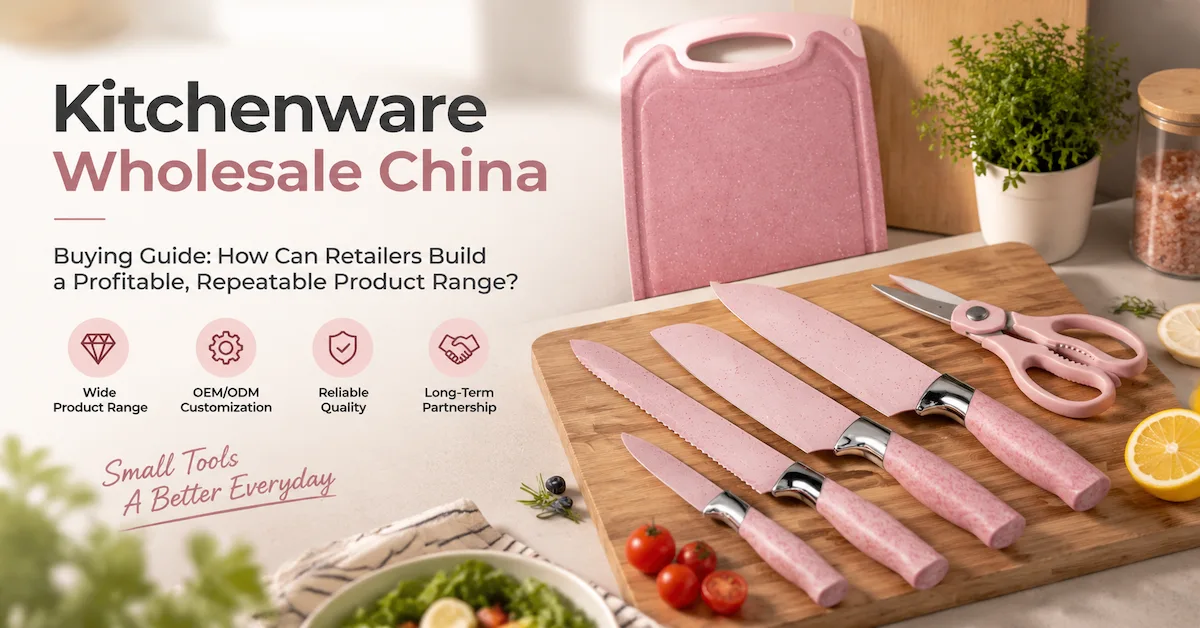
This guide treats Chinese kitchenware wholesale as a sequence of buyer decisions. It explains how to define the channel, build a compact SKU architecture, choose a supplier model, compare materials, approve samples, normalize quotations, develop packaging and protect repeat orders. BONET HOUSEWARE pages are used as public references for product categories and stated services. A web page is a starting point for questions; current certificates, test reports, prices, MOQ and production dates still need project-specific confirmation.
What Is Kitchenware Wholesale China?
Kitchenware wholesale China refers to the commercial sourcing of kitchen tools, food-preparation products and related household goods from China in quantities intended for resale, distribution, hospitality supply, promotional use or private-label programs. The purchase may involve standard stock, lightly branded products, modified catalog items or newly developed goods. It may cover one SKU or a coordinated family.
The wholesale process usually includes product selection, specification review, samples, quotation, packaging development, quality planning, mass production, inspection and export delivery. In practice, the process is not linear. A packaging change can alter carton quantity. A new color can change MOQ. A revised handle can require another sample and a different inspection point. Commercial and technical decisions must stay connected.
BONET currently presents six principal product categories on its site: all-purpose scissors, multifunctional products, kitchen knives, kitchen utensils, chopping boards and kitchen gadgets. Its OEM/ODM page describes support for production by drawing or sample, material and color customization, logo methods, packaging development, quality inspection and mass-production management. Those categories can form a useful food-preparation range, but buyers should confirm the exact product, process and service scope for each project.
Before searching for a China kitchenware wholesaler, decide where coordination should sit. A knife-focused factory may know far more about grinding than a broad catalog seller. An exporter may save weeks by grouping boards, utensils and gadgets from several sites. A trader may fill a small stock gap quickly. None of those routes wins by default; the useful route is the one that matches the number of categories, the amount of product change and the buyer's ability to supervise detail.
Step 1: Define the Customer, Channel and Buying Job
Picture the purchase rather than an abstract "target market." In a supermarket, someone may compare three utensil sets in less than a minute. In a homeware shop, the same person may pick up a boxed set as a gift. Restaurant staff care whether a broken tool can be replaced next Tuesday. An online listing has to explain size and function without touch, and the parcel has to arrive without a blade rubbing through its insert.
Write a short channel statement before selecting SKUs. It should name the target user, sales environment, intended retail or resale position, typical food tasks and expected reorder pattern. "A compact food-preparation range for urban online shoppers" is more useful than "modern kitchenware." It directs the team toward storage, parcel size, visible functions and concise product claims.
Then define the buying job. Some programs need dependable replenishment of familiar basics. Others need a visually coordinated seasonal range. A private-label launch may need differentiation through color, handle language and packaging. Hospitality supply may favor functional consistency over gift presentation. Trying to satisfy all four jobs in the first order usually creates too many SKUs and conflicting specifications.
When reviewing the kitchenware wholesale market China offers, make a channel pile before making a price pile. A foodservice turner in a bulk carton and a gift-ready turner with a printed sleeve are not competing offers, even if the product names look alike.
| Channel | Typical buying job | Early decisions |
|---|---|---|
| Supermarket | Clear good-better-best shelf range | Price ladder, hanging/display pack, barcode and shelf footprint |
| E-commerce | Differentiated function with low parcel risk | Dimensions, photography, pack protection and return triggers |
| Distributor | Manageable range with dependable replenishment | SKU roles, case pack, stock depth and repeat-order control |
| Hospitality | Practical tools for repeated staff use | Task, cleaning, replacement, identification and bulk pack |
| Gift/private label | Coherent story and brand presentation | Set logic, finish, color system, unboxing and artwork |
Step 2: Build a Small Assortment With Clear SKU Roles
More products do not automatically create a stronger range. A first wholesale program is easier to understand and control when each SKU has a job. Begin with anchor items that express the category, support them with practical companions, then add one or two products that create a reason to notice the range.
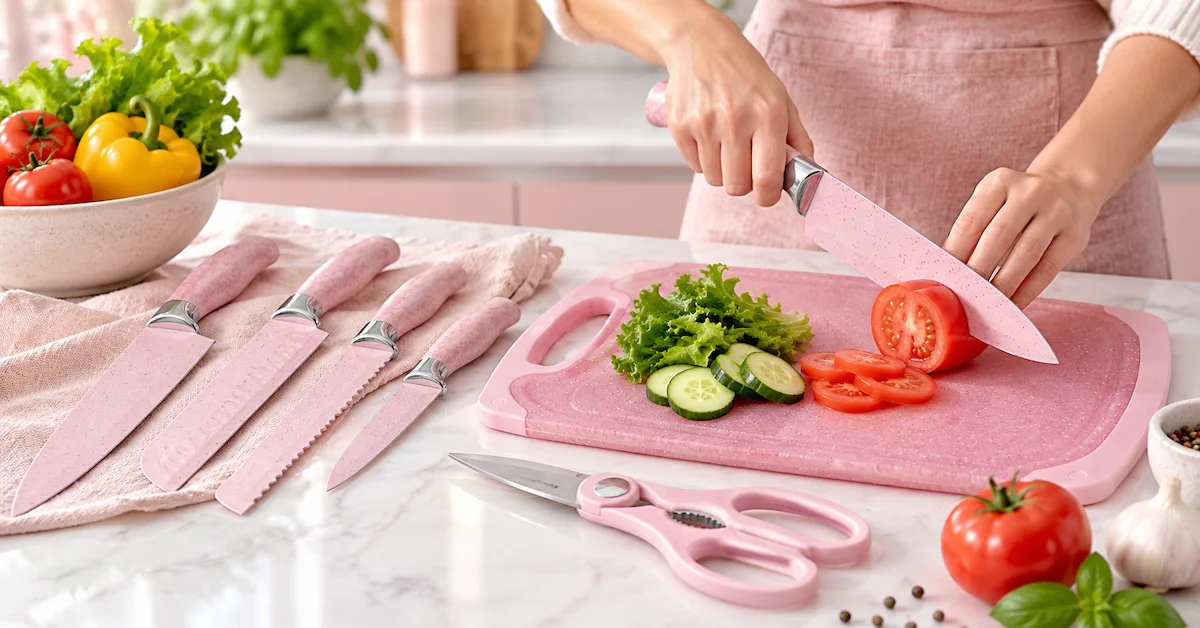
For food preparation, a possible architecture might include kitchen scissors, a knife or knife set, a chopping board, a small utensil group and one compact gadget. The point is not that every buyer needs those five categories. The point is that the products should cover related actions and share a credible merchandising story. A random bowl, bread knife and bottle brush may share a color but still feel like leftover catalog choices.
Assign every SKU one of four roles: traffic item, margin item, attachment item or image item. The traffic item gives shoppers an accessible entry point. The margin item carries a stronger feature or set value. The attachment item is easy to add to a basket. The image item helps the range stand out in a campaign or display. One product can serve more than one role, but writing the role prevents duplicate SKUs that compete with each other.
Limit the first color and size combinations. Every variation creates its own forecast, barcode, artwork, sample and inventory risk. Buyers often approve three colors because the sample board looks attractive, then discover that the factory MOQ applies per color. Ask that question before the assortment meeting, not after artwork is complete.
A bulk kitchenware supplier China project becomes easier to price when the SKU map states which parts are shared. Common handle colors, logo positions, packaging structures or master-carton dimensions can reduce complexity. Do not make the family resemblance literal everywhere: the secure grip needed beside a knife blade is not the long, relaxed grip needed on a ladle.
Step 3: Put the Right Partner Behind Each SKU
"Direct from factory" sounds economical, but the phrase leaves an awkward question unanswered: which factory, for which item? A specialist may control blade grinding closely and have no line for bowls. An export company may save the buyer from coordinating four sites, provided that it can still trace a bad joint or wrong color to the source. A catalog trader is often quickest when the requirement is a standard item with little alteration.
On the sourcing sheet, add four plain columns: production site, specification owner, outsourced process and corrective-action owner. Fill them for every SKU. The labels on a business card matter less than those four answers. There is nothing inherently wrong with making knives inside and buying bowls from a partner; trouble starts when nobody can say who approved the bowl or who must fix it.
For an OEM kitchenware manufacturer China project, determine whether the item is an existing product with branding, a controlled modification or a new construction. Each route needs a different quotation and approval path. Adding a logo to a known item is not equivalent to changing its material, wall thickness, blade geometry or moving mechanism.
BONET's public OEM information describes production by drawing or sample, material and color customization, logo printing or laser engraving, export packaging and quality-inspection support. Its ODM section lists concept development, structural optimization, material recommendations, sample and packaging development, feasibility review and mass-production support. Buyers should identify the required route per SKU and request written project scope rather than treating OEM and ODM as interchangeable labels.
| Supplier route | Useful when | Evidence to request |
|---|---|---|
| Specialized factory | One core category needs process depth or engineering changes | Applicable equipment, process flow, in-process checks and capacity basis |
| Factory-led exporter | A core category is made internally and related items are coordinated | SKU-by-SKU production source and ownership of quality action |
| Sourcing company | Several unrelated categories need consolidation | Factory approval method, inspection plan and change control |
| Catalog trader | Standard products, small tests or fast assortment gaps | Stock identity, specification continuity and reorder availability |
Have a category list, target price ladder or packaging brief?
Have a category list, target price ladder or packaging brief?
Send Your Kitchenware Wholesale BriefStep 4: Name the Material Where It Actually Appears
A single carton can hold steel, molded plastic, silicone, bamboo, aluminum and rubber-like grip material. Write the material beside the part it describes and beside the SKU revision. The shorthand "stainless steel and PP" is still missing the useful facts: which grade, which component, which colorant and which surface treatment?
Create a component table for every item. For scissors, separate blades, pivot, handle and any sheath. For a knife, identify blade, handle, rivets or molded insert and coating if present. For an utensil, distinguish the food-contact head from the handle, joint and hanging feature. For a chopping board, state the working surface, border, feet and insert. This level of detail makes sample review and later changes visible.
Material choice should follow the task. A heat-exposed utensil, a cutting edge, a flexible scraper and a decorative handle solve different problems. Do not select a material only because it appears across the supplier's catalog. Ask what characteristic is needed, how it will be checked and what care statement the user will receive.
BONET's OEM/ODM page lists stainless steel, silicone, plastic, wood, bamboo, aluminum alloy and composite material solutions within its broader capabilities. That list does not establish the composition of an individual product. The model page, sample, specification and current evidence must agree before the buyer publishes a claim.
Claims deserve their own pause. "Dishwasher safe" on a catalog page may have been written for another handle or another market. The same is true of food-contact, corrosion, heat, BPA-free, antibacterial and sustainability wording. Put the destination and SKU beside the proposed sentence, ask what supports it, and leave the sentence off the artwork while the answer is uncertain.
Step 5: Approve Samples as Production References
A sample meeting should answer more than "Do we like it?" Give each sample a model number, date and revision. Record dimensions, weight where relevant, material by component, color, finish, logo method, function and pack status. Photograph the parts that matter. When the supplier submits a change, issue a new revision rather than replacing the old sample without a record.
Take the sample off the meeting-room table. Peel a carrot, lift food from a pan, cut herbs or carry the loaded board, whichever job the item is sold to do. Notice where the thumb lands, whether the head twists and whether a seam catches residue. Glossy photography will not tell you that a handle turns slippery after rinsing, or that a gadget jams once a fragment reaches the joint.
Review the whole set together. Color, gloss and logo scale can drift when products come from different processes. A coral molded handle will not automatically match a coral printed carton or silicone head. Decide whether the range requires an exact match, a controlled family of tones or only a shared accent. Write the acceptance approach.
For a private label kitchenware supplier, the approved product and approved packaging must remain linked. A product change can make care text inaccurate. A package change can reduce protection or conceal an important feature. Sign off the SKU, instruction, artwork and pack revision as one release.
Step 6: Normalize Quotations Before Comparing Price
Three quote sheets can contain the words "cutting board" and describe three different purchases. One board is 2 mm thicker. Another price assumes a plain sleeve. The third uses twelve pieces per carton rather than six. Circle those differences before circling the lowest price.
A working bid sheet does not need to be elegant. Give each supplier a column and break the offer into product revision, quantity, currency, trade term, unit pack, carton, tooling, logo setup, sample, testing, inspection and delivery point. Use a visible marker for blanks and provisional numbers. An empty cell is a question, not a saving.
Compare landed logic, not just unit price. Carton volume, breakage, rework, slow-moving color variants, excess packaging inventory and late delivery all affect the program. A slightly higher unit cost can be rational if it removes a tooling charge, improves carton efficiency or reduces returns. The decision needs a written reason, not an instinctive reaction to the first quotation.
MOQ also needs a unit. Is it per SKU, size, color, logo or package? Does the printed box have a higher minimum than the product? Can unused packaging carry into the next order, and who owns it? These questions can change an apparently flexible offer into a much larger inventory commitment.
A wholesale kitchenware supplier China comparison should also state the production source and quality basis. Two products with similar photographs can use different materials, tolerances or inspection plans. Normalize the commercial offer only after normalizing the physical product.
| Quotation field | What must be fixed | Hidden difference to expose |
|---|---|---|
| Product | Model, revision, material, dimensions and finish | Thinner part, different grade or unapproved construction |
| Branding | Method, size, position, colors and setup | Logo charge, plate cost or durability difference |
| Packaging | Individual pack, insert, label and carton | Generic bag instead of retail-ready package |
| Quantity | Per SKU, size, color and pack | MOQ multiplied by variants |
| Delivery | Trade term, port/place and schedule | Different freight responsibility or readiness date |
Ready to compare your kitchenware range on one quotation basis?
Ready to compare your kitchenware range on one quotation basis?
Request a Project-Specific Wholesale QuoteStep 7: Design Packaging Around the Sales Route
A package earns its place in three different moments. It keeps the tool intact on the journey, tells the shopper what is inside and lets the warehouse handle the order without wasted space. The balance moves with the channel: barcode visibility matters on a supermarket peg; drop and scuff protection matter in a parcel network; a gift set needs the pieces to remain arranged after the box has travelled.
Start with the product, not the graphic design. Put the physical sample into a proposed pack and shake, stack, lift and open it. Look for blade or point contact, surface abrasion, loose parts, crushed corners and unnecessary empty space. If the product can be returned, decide how it can be repacked without becoming a tangle of inserts.
Set packaging data under revision control. The product name, material wording, dimensions, warnings, care instructions, importer information, barcode and destination language should match the approved item. Photographs must show the actual configuration. A set image that includes an accessory not supplied is not a harmless styling choice; it creates a commercial promise.
BONET's OEM/ODM page lists color boxes, gift boxes, retail packaging, barcode labels and export carton solutions among its packaging support. Ask who creates the dieline, which proof controls color and text, how the packed sample is approved and what happens to unused printed material after a design change.
For commercial kitchenware wholesale China projects, bulk packing can be appropriate, but "commercial" should not be inferred from a carton count. The tool must suit the intended work rate, cleaning routine and user environment. Confirm those points separately from the pack format.
Step 8: Build Quality Control From Observable Requirements
"Good quality" cannot be inspected. Replace broad adjectives with observable requirements. Dimensions can be measured. Color can be compared with an approved reference. A blade or mechanism can perform a named task. A handle can be checked for flash, gaps or looseness. Packaging can be compared with artwork and pack-out instructions.
Use three levels of control. Incoming checks confirm the agreed raw material or component identity. In-process checks catch assembly, alignment, molding, finishing or marking problems while correction is still possible. Final checks compare finished goods and packaging with the approved release. The balance changes by product; a knife and a silicone spoon should not use one generic checklist.
BONET's manufacturing page shows stages used for its knife and scissors work: stamping, straightening, heat treatment, grinding, polishing, injection, cleaning, setting, inspection and packing. A whisk or board will plainly follow a different route. Ask which pictured steps belong to the quoted SKU and at which bench, machine or inspection point the important feature is checked.
The About page also displays ISO 9001, BSCI and Sedex names. Request the current files before relying on them. Read the company name, factory address, scope, issuing body and date rather than filing the logo screenshot. These records say something about a site or system; they do not prove the material of the spatula in your hand.
| QC area | Observable check | Reference |
|---|---|---|
| Identity | SKU, revision, components and quantity | Purchase order and item master |
| Appearance | Color, finish, scratches, stains, flash and gaps | Approved sample and defect guide |
| Dimensions | Critical length, thickness, fit and alignment | Drawing or specification |
| Function | Named food-preparation action and stop condition | Test method and approved result |
| Brand and pack | Logo, artwork, barcode, contents and carton | Released artwork and pack sample |
Step 9: Plan MOQ, Lead Time and Delivery as One Schedule
MOQ is not an isolated supplier rule. It can come from a raw material batch, molding setup, color run, logo process, printed package or carton order. Ask the supplier to identify the limiting component. This reveals whether the team can reduce the minimum by using a standard color, shared box structure or existing product construction.
Build a milestone schedule rather than asking only for lead time. Include brief confirmation, quotation, sample production, sample review, artwork, packaging proof, pre-production approval, material preparation, mass production, inspection, packing and shipment readiness. Add buyer decision dates. A factory cannot recover time lost while an artwork file waits for internal approval.
Keep "production complete" separate from "available at destination." Booking, export handling, transit, import clearance and inland delivery all sit after manufacturing. The relevant promise depends on the trade term and named place. Record both the supplier readiness date and the expected arrival planning date without treating the latter as guaranteed by the factory unless the contract says so.
Mixed-SKU orders need special attention. One late item can hold an entire consolidated shipment. Decide whether every product must sail together, whether partial delivery is acceptable and who bears the cost of a split. A low-value attachment item should not silently delay the anchor products for a seasonal launch.
Step 10: Protect Reorders With an Item Master and Change Log
The real test of a wholesale supplier arrives with the second order. Staff change, material availability moves, packaging files are updated and a factory may assume that a minor adjustment is harmless. Without a controlled record, the buyer discovers the change after the container arrives.
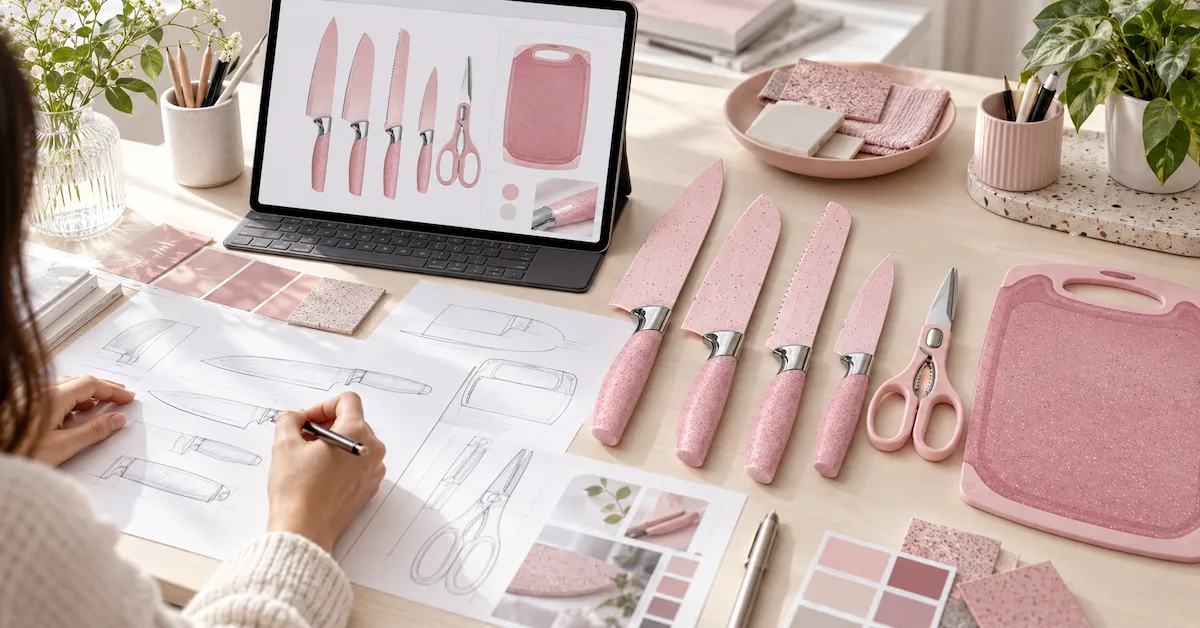
Create one item master per SKU. Include the model, revision, product images, component materials, critical dimensions, weight if important, finish, color reference, logo artwork, care wording, barcode, individual pack, carton arrangement, approved sample ID, inspection basis and applicable documents. Store the related source files, not just screenshots.
Make product changes visible before the line starts. If a mold, resin, factory, finish, logo process or box will change, the note should say why, which orders are affected and whether another sample or document review is needed. An "improved" grip can still leave two visibly different versions hanging beside each other in a store.
Use that same record when complaints arrive. Write down what was seen, how many pieces were affected and which order, batch or carton they came from; attach useful photographs. Replacement stock deals with today's shortage. The factory's cause review and the next inspection record show whether tomorrow's stock has actually changed.
This matters in wholesale kitchen utensils China orders because two tools may share a silhouette while differing at the joint, head profile, grip texture or package. Put those small choices in the item master. Otherwise the product exists only as a picture and a memory.
Need a wholesale range reviewed by category, specification and pack?
Need a wholesale range reviewed by category, specification and pack?
Send Your Kitchenware RFQKitchenware Wholesale China FAQ
How do I choose a kitchenware wholesale supplier in China?
Define the customer and sales channel first. Then compare suppliers on product fit, production source, material detail, sample repeatability, quality control, packaging, documentation, communication and repeat-order systems. Normalize the same SKU, pack, quantity and delivery term before comparing price.
What should be included in a first kitchenware wholesale inquiry?
Include the product categories, target user, channel, destination market, expected quantity, size or material direction, branding, packaging, required documents and target schedule. Mark which decisions are fixed, preferred or open to the supplier's recommendation.
Is it better to buy from one factory or several factories?
One specialized factory can provide strong process control for a core category. Several factories may be necessary for a broad assortment. The important issue is who controls the specification, samples, inspection, consolidation and corrective action for every SKU. Make the production source visible before ordering.
What is the difference between wholesale, OEM and private label?
Wholesale can involve standard goods purchased in commercial quantities. OEM generally follows a buyer's specification, drawing, sample or defined modification. Private label places the buyer's brand on a product and package; it may use a standard item or an OEM design. Confirm the actual work instead of relying on the label.
What is the MOQ for wholesale kitchenware?
MOQ is not one factory-wide number. The product run may start at one quantity, while a custom color or printed box starts at another. Ask for the minimum beside each SKU, size, color and package. That answer shows the real inventory commitment.
How should buyers compare kitchenware samples?
Give every sample a revision, then check identity, component materials, dimensions, appearance, function, cleaning access, color, logo and pack. Use the product in its intended task. Compare all pieces in a set together and record any approved deviation before mass production.
Which documents should a kitchenware supplier provide?
The answer depends on the exact product and destination. Buyers may request material declarations, applicable food-contact or product test reports, specifications, artwork approvals, packing information, factory audit records and inspection reports. Verify the legal entity, product scope, issuer and validity.
How can a buyer reduce risk on the first bulk order?
Start with a focused range, reduce unnecessary variants, approve production-representative samples, release final artwork, define observable inspection points and keep milestone dates visible. Use an item master and require approval for changes. A smaller controlled launch usually teaches more than a large mixed trial.
Can BONET support custom kitchenware and retail packaging?
BONET's public OEM/ODM page states support for material and color customization, logo printing or laser engraving, packaging customization, product development, samples and mass-production support. Feasibility, MOQ, cost, timing and the exact manufacturing route must be confirmed for the selected SKU.
RFQ Checklist for Kitchenware Wholesale Buyers
- Target customer, sales channel, destination market and price position are stated.
- Every SKU has a clear role in the assortment.
- Production source and responsible quality owner are visible per item.
- Product route is identified as standard, private label, modified OEM or new ODM.
- Materials are tied to exact components and product revisions.
- Dimensions, function, finish and observable acceptance points are defined.
- Food-contact, cleaning, heat and other claims are supported or marked pending.
- Logo, artwork, barcode, instructions and packaging revisions are controlled.
- MOQ is stated per SKU, size, color, logo and package where applicable.
- Unit price, tooling, setup, samples, testing, inspection and delivery basis are separated.
- Sample, artwork, production, inspection and shipment milestones are recorded.
- The item master and change-approval process protect repeat orders.
Conclusion: Build the Range Before You Buy the Volume
A successful wholesale program is not the largest collection a supplier can place in a spreadsheet. It is a controlled group of products built for a named customer and channel. The products have clear roles, specifications and evidence. Their packaging fits the route to market. Their quotations share the same basis. Their approved samples can be recognized months later.
Start with the sales job, then select the SKU architecture. Choose a supplier model that fits the category breadth and required process depth. Tie materials to components, test samples in real tasks, normalize costs and build quality checks from observable requirements. Finally, preserve the product, artwork, pack and inspection basis in an item master before the first reorder.
BONET HOUSEWARE's site groups its offer into knives, scissors, utensils, chopping boards, multifunctional tools and kitchen gadgets. Separate pages describe OEM/ODM work, packaging and selected manufacturing stages. Use them to mark possible SKUs and unanswered questions. An inquiry becomes useful when it names the categories, destination, quantities, product changes, brand files, pack and required date; the reply can then address that particular range instead of offering another general catalog.
Turn your kitchenware list into one controlled wholesale program.
Contact BONET HOUSEWARE