




Made-to-order kitchenware: what buyers should review before sampling
Made-to-order kitchenware is not only a matter of changing a color or adding a logo. For B2B buyers, private-label teams and sourcing managers, it is a product development decision that affects tooling, material choice, finishing, retail presentation and quality control. A spoon, ladle or whisk may look simple, but small details such as handle balance, hanging-hole position and surface feel can determine whether the final line is practical in daily use.
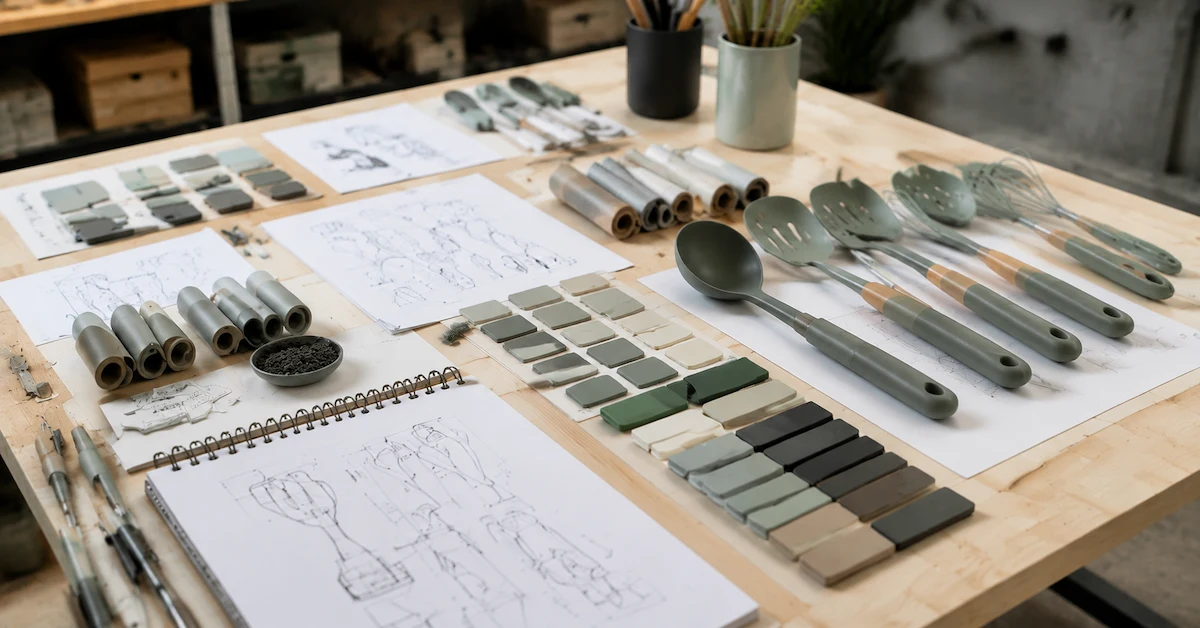
The original development board shows a coordinated utensil family with concept sketches, finish references and several tool types laid out for review. That is a useful starting point because it reflects the stage where buyers should ask detailed questions before committing to samples or tooling.
Key Takeaways
- Made-to-order kitchenware should be reviewed as a manufacturing project, not just a styling exercise.
- Buyers should define use case, utensil lineup, finish direction and inspection expectations before sampling.
- Do not assume material grade, heat resistance, dishwasher suitability or compliance status unless the supplier documents it.
- A coordinated utensil family needs consistency across shape, color, surface texture, hanging features and packaging fit.
- The best time to fix problems is during prototype review, before tooling and production planning become expensive.
Why made-to-order kitchenware needs a clear brief
A custom kitchenware project should start with a commercial and functional brief. The buyer should identify where the product will be sold, who will use it, what price tier it should target and which utensils belong in the set. A home retail set may emphasize comfortable handling and visual consistency, while a professional or food-service line may place more attention on repeated cleaning, strength and simple storage.
The brief should also state what is fixed and what remains open. For example, a buyer may already know the desired utensil types: ladle, slotted spoon, serving spoon and whisk. However, handle material, surface finish, color direction and packaging method may still require supplier input. Separating fixed requirements from flexible options helps a factory or OEM partner respond with practical sampling suggestions instead of guessing.
What to review on the design board
A design board can reveal more than appearance. In the source layout, the utensils appear to share long rounded handles and hanging holes near the ends. That suggests a coordinated family, which is useful for retail display and private-label recognition. Hanging holes should not be treated as decorative details only; they affect how products hang on hooks, how they sit in packaging and how consumers store them at home.
The matte gray-green direction is also important, although the exact material cannot be confirmed from the image. Buyers should ask how the finish will be achieved, whether color matching is controlled by reference samples, and how acceptable color variation will be judged. A finish that looks consistent on a small swatch may look different on a larger handle or under store lighting.
Sampling checklist for B2B buyers
Before requesting samples, prepare a checklist that connects design intent with practical verification. The table below can help sourcing teams organize the first review round.
| Review area | What to check | Questions to ask the supplier |
|---|---|---|
| Use case | Home cooking, retail bundle, gifting or professional prep | Which design choices change based on the intended user? |
| Material | Confirmed material, feel, rigidity and cleaning expectations | What material options are available, and what documentation can be provided? |
| Finish | Color, texture, sheen and consistency across pieces | How will color standards and surface variation be controlled? |
| Ergonomics | Handle length, grip comfort, weight and balance | Can the handle profile be adjusted before tooling? |
| Merchandising | Hanging holes, packaging fit and set presentation | Will samples be reviewed with proposed packaging or display method? |
| Quality control | Inspection points for size, appearance and assembly | What QC criteria should be agreed before production? |
Material and finish questions to settle early
Do not infer technical performance from photos or renderings. The image may suggest a particular finish direction, but it does not prove the material, temperature performance, dishwasher suitability or food-contact status. Those points must be confirmed through supplier documentation, sample testing or buyer-specified third-party checks where relevant.
Useful questions include:
- What materials are proposed for the heads and handles?
- Are alternative materials available if the first sample feels too rigid, too flexible or too heavy?
- How will the selected color be matched across different production batches?
- What surface defects are considered acceptable or unacceptable?
- Which performance or compliance documents can the supplier provide for review?
These questions do not slow the project down; they reduce later rework. A beautiful prototype that cannot be produced consistently is not a production-ready product.
How to evaluate prototype samples
When samples arrive, review them as a complete utensil family rather than as isolated items. A ladle may feel good on its own, but the set can still look uneven if the spoon, slotted spoon and whisk have slightly different handle curves or surface finishes. Line the samples up as they would appear in packaging or on a retail wall.
Check practical handling with dry and wet hands. Hold each tool at different angles. Test whether the head shape suits its intended task: scooping, stirring, serving or whisking. Look at the hanging hole alignment and confirm whether each piece hangs straight. If packaging is part of the project, place the samples in a mock pack to see whether the set appears coherent and whether any tool shifts awkwardly.
Common sourcing mistakes to avoid
One common mistake is approving a concept because it looks polished on a board. Sketches and finish swatches communicate direction, not production readiness. Another mistake is requesting too many variants in the first sample round. A focused review of the core utensils usually produces clearer feedback than a large batch of unfinished options.
Buyers should also avoid vague instructions such as “make it premium” or “improve the handle.” Instead, give measurable or observable feedback: the handle feels too narrow near the end, the ladle bowl is too shallow for soup service, the matte finish appears uneven beside the spoon, or the hanging hole is too close to the edge for the chosen display hook.
Supplier questions before moving beyond samples
Before approving the next stage, clarify the supplier’s role. Some vendors support design development only, while others provide OEM or ODM production. Ask where design, tooling, sampling, packaging and inspection responsibilities begin and end. If commercial details such as MOQ, lead time, tooling cost or packing method are not already documented, treat them as open questions rather than assumptions.
Buyers should ask:
- Which parts of the design can still be modified after the first sample?
- What changes would require new tooling or additional cost?
- How many sample rounds are expected before production approval?
- What reference sample will be used as the production standard?
- How will appearance, dimensions and functional points be inspected?
Practical FAQ
Is made-to-order kitchenware the same as private labeling?
Not always. Private labeling may use existing products with branding changes, while made-to-order kitchenware can involve customized shapes, handles, finishes, utensil combinations or packaging. Buyers should confirm how much customization the supplier can actually support.
When should a buyer request samples?
Request samples after the basic brief is clear: target user, utensil lineup, finish direction, packaging approach and any required documentation. Sampling too early can create confusion and unnecessary revisions.
Can buyers judge performance from a concept image?
No. A concept image can show design intent, but it cannot verify material, comfort, cleaning performance, heat resistance or compliance. Those points require supplier confirmation and, where needed, testing.
What is the most important sample approval step?
Review the utensil set as a system. Check consistency in handle shape, color, surface texture, hanging alignment and packaging fit. A coordinated family should look and feel intentional across every piece.
Final guidance for sourcing teams
Made-to-order kitchenware works best when the buyer treats sampling as structured problem-solving. Start with a precise brief, ask suppliers to explain material and finish options, and review prototypes in realistic use and merchandising conditions. The goal is not to approve the prettiest sample; it is to confirm that the product can be made consistently, used comfortably and presented clearly to the target market.
