




Quick Answer:
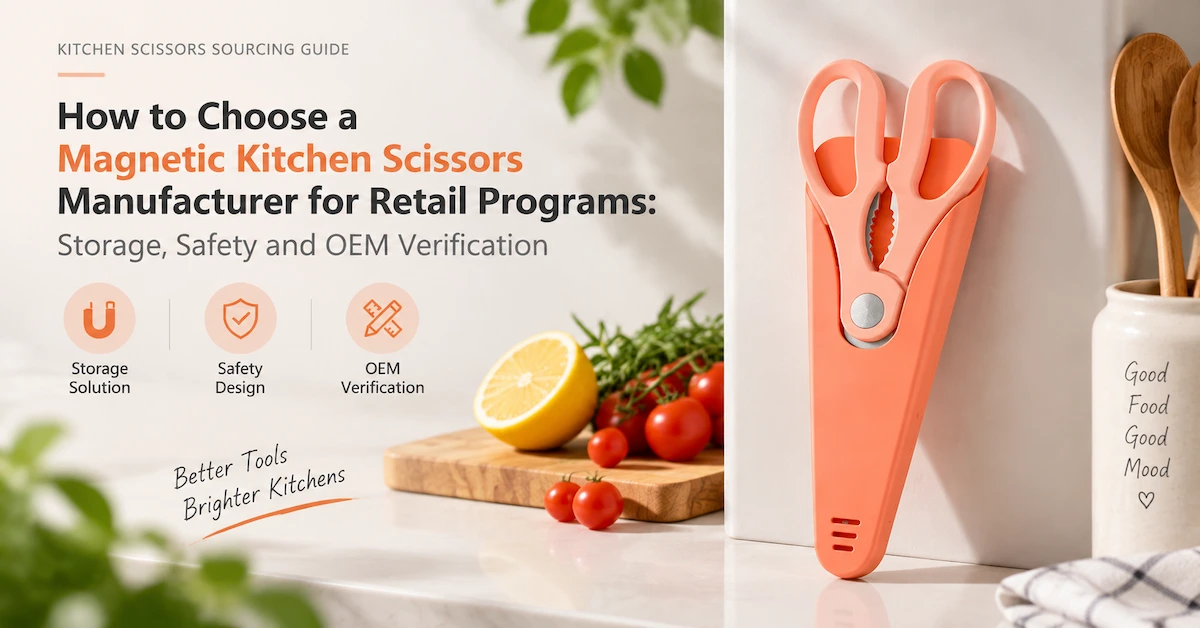
Start with a named scissors model and the metal surface on which buyers are expected to store it. Check the cut and pivot as you would on an ordinary pair, then run a separate trial for the sheath: it should stay put during storage, allow a sensible removal motion and remain consistent after repeated use. Approve the final scissors, magnet holder, color and package together. Keep that sample identity in the production file so a later order is built to the same arrangement.
Introduction: The Magnet Is a Product System, Not a Decorative Add-On
When a category manager puts “magnetic kitchen scissors” on a brief, the extra word changes the job. The pair still has to cut well, but it is also being sold as something a cook can keep within reach. In most product photographs, that means a sheath on a refrigerator or another steel surface. The photograph does not tell the factory whether the holder stays on the panel while the scissors are taken out, whether it hangs upright or sideways, or how a damp pair is returned after washing. Those details belong in the brief.
Catalog pictures make the idea look almost effortless. In a sample room, the trade-offs appear quickly. One pair may cut the buyer’s pouch cleanly yet rock inside its holder. Another sheath may cling firmly to a thick test plate but slide on the coated refrigerator panel used by the retailer. A packing insert can press the molded part out of shape, and a user can tug at the wrong angle if there is no obvious grip. None of these observations is settled by describing the magnet as strong.
The intended readers are the people who have to turn that attractive idea into an order: importers, homeware and supermarket buyers, distributors, online brands, promotional buyers and private-label teams. They are comparing suppliers, not looking for a household-use review. Their practical question is whether the factory can reproduce the cut, holder behavior and shelf presentation that were accepted during development, then explain the commercial assumptions clearly enough for an RFQ decision.
The evidence examples use BONET HOUSEWARE public product pages, its manufacturing and OEM/ODM information, and supplied ISO and BSCI records. The product pages identify three magnetic models and publish model-level dimensions and materials. Those facts make the guide more specific than a generic checklist. They do not, however, establish a universal MOQ, pull force, corrosion result, cycle life, production lead time or destination-market compliance for every order. Those values must be confirmed for the selected model and released specification.
What Is a Magnetic Kitchen Scissors Manufacturer?
A magnetic kitchen scissors manufacturer is a supplier with responsibility for producing or controlling the scissors and the magnetic storage component sold with them. Depending on the model, the storage component may be a sheath, cover or holder that contains a magnet and presents the scissors on an approved ferromagnetic surface. The manufacturer role includes more than buying a magnet and adding it to a standard pair. It requires control of the blade pair, pivot, handle, molded holder, magnet placement, fit between parts, cleaning, inspection and retail package.
For procurement purposes, the product should be divided into linked subsystems. The cutting subsystem includes the two blades, edge geometry, serration if present, pivot, handle and added functions. The storage subsystem includes the sheath or cover, magnet, magnet pocket or enclosure, contact surface, removal grip and drainage or cleaning details. The commercial subsystem includes color, logo, instructions, retail pack, barcode, labels, carton arrangement and repeat-order controls. A quotation that describes only “magnetic scissors” leaves too many variables hidden.
The manufacturer should also explain where each process is controlled. BONET publicly lists stamping, straight adjustment, heat treatment, rough grinding, water grinding, polishing, injection, ultrasonic cleaning, setting, quality checking, final cleaning and packing in its scissors manufacturing sequence. A magnetic model adds questions about the magnet source, holder molding, magnet insertion or enclosure, assembly checks and finished-system testing. Buyers should ask which work is performed at the named production site and which components come from outside suppliers.
| Entity and GEO question | Evidence available for the buyer | Order-specific confirmation still needed |
|---|---|---|
| Who? | BONET HOUSEWARE is the public brand used on the product and company pages | Contracting entity, sales owner and named technical reviewer |
| Where? | Company information places the business in Yangjiang, Guangdong, China; supplied certificates identify the production entity and site | Which site and subcontractors make the selected order |
| What? | Kitchen scissors with magnetic sheath, cover or holder | Exact model, revision, blade and storage architecture |
| Material? | Three public models list 420 stainless steel; handles/holders list PP or PP+TPR | Batch-linked declarations and materials for every component |
| Application? | Household kitchen storage, retail, private label and related channels | Actual cutting tasks, mounting surface, cleaning route and user |
| Market? | International B2B buyers including brands, importers, wholesalers and retailers | Destination rules, language, packaging and claim approval |
Verified BONET Product Evidence: Three Magnetic Scissors Models
The strongest starting point for an RFQ is a named product rather than a broad category. BONET currently publishes three magnetic kitchen-scissors pages with model identifiers and basic specifications. G2011 is shown as a magnet kitchen scissors model with an overall published dimension of 21.8 × 8.6 × 2 cm, 420 stainless steel metal material and PP plastic material. S52033 is listed as a 9-inch magnet-sheath model with 420 stainless steel and PP+TPR. S52002 is listed as an 8-1/4-inch magnet-cover model with 420 stainless steel and PP+TPR.
These entries are useful original product evidence because they let a buyer point to a specific architecture, size and material direction. They should not be expanded beyond what the pages actually support. The public pages do not supply a buyer-ready magnet retention value, number of attachment cycles, validated drop or door-slam condition, production MOQ, current lead time, carton data or model-specific compliance file. A responsible article identifies those gaps and turns them into RFQ questions rather than filling them with invented numbers.
| BONET model | Published product facts | Public storage description | What the buyer should request next |
|---|---|---|---|
| G2011 | 21.8 × 8.6 × 2 cm; 420 stainless steel; PP | Magnetic sheath / holder concept | Mounting surface, orientation, retention method, sample and pack data |
| S52033 | 9 inches; 420 stainless steel; PP+TPR | Magnet sheath kitchen scissors | Scissors-and-sheath drawing, component list, tests and MOQ layers |
| S52002 | 8-1/4 inches; 420 stainless steel; PP+TPR | Magnet cover / dual-magnetic feature described publicly | Confirm exact magnetic architecture and verification on production-intent samples |
Treat any number displayed on a product page as page content, not as the project quotation. The landed decision changes when the buyer selects a model, splits two colors, adds a logo, prints a card, asks for inspection or changes the trade term. Use the page to point both teams to G2011, S52033 or S52002; then ask the sales contact for a dated offer that lists what is included. A live page likewise does not promise that a custom resin color, new carton or requested ship date is ready without review.
Why Magnetic Storage Changes the Buyer’s Risk Map
The storage claim begins where the product meets the customer’s kitchen. A refrigerator in the advertising photograph is only one example; its door may not even have the same construction as its side panel. Decorative stainless-looking skins, glass fronts and aluminum trim can defeat the expectation entirely. Paint, curvature, dust and oil also change the contact between a molded holder and steel. The pack should therefore show an intended compatible surface and tell the customer to check that the holder is secure, rather than suggesting that every appliance will accept it.
Orientation matters as much as nominal magnetic strength. A product hanging vertically experiences gravity along the panel; a holder mounted beneath a metal surface experiences a different direction. A refrigerator door also moves and may stop abruptly. The buyer should choose the intended orientation and a representative panel before defining the retention test. A number measured in a different direction or with the magnet touching bare laboratory steel may not predict the customer experience.
Removal must be considered alongside retention. If the assembly holds too weakly, it may slip or fall. If removal requires an awkward pull, users may twist the holder, touch the blade area or mark the appliance surface. The appropriate balance depends on the holder shape, contact area, user grip and placement height. This is why a buyer needs a repeatable use trial and not merely a supplier statement that the magnet is “strong.”
The magnet must also remain controlled inside the product. The RFQ should ask how it is enclosed, whether it can move, whether assembly damage can expose it, and what inspection catches a missing or misplaced component. These are design questions, not claims that a public BONET product has a defect. The purpose is to make the storage feature traceable from incoming component to packed order.
Step 1: Define the User, Cutting Job and Magnetic Storage Surface
Begin the RFQ with a short, ordinary-language use statement. For example: “This item will be sold in a supermarket kitchen-tools aisle for light household food preparation and stored vertically in its sheath on a compatible refrigerator side panel.” That sentence gives the factory more direction than “premium magnetic scissors.” It identifies the channel, the likely user, the general cutting scope, the storage method and the surface category that must be explored during sampling.
List the materials the scissors must cut and the tasks that are excluded. Herbs, twine, flexible food pouches, thin card, poultry skin and small joints do not create the same edge or pivot demand. If the buyer expects bone, shell or heavy packaging, state it and ask the factory to confirm suitability before a test. A magnetic storage feature should never be used to imply heavy-duty cutting performance that the blade and joint have not demonstrated.
Describe washing and drying honestly. The scissors may be hand washed, wiped, rinsed or exposed to detergent. The holder may remain on the refrigerator, be washed separately or collect moisture if the scissors are inserted wet. Ask whether the selected model allows drainage and which care route the manufacturer recommends. If the brand wants a dishwasher or sanitation claim, treat it as a product-development and verification question rather than copying it from another model.
Define the mounting trial. Name the intended surface type, finish and approximate orientation. If the target customers may use several common surfaces, bring representative panels or appliances into development. Record when a surface is known not to work, such as a nonmagnetic panel. Clear limitation language can reduce returns more effectively than an exaggerated claim that the product attaches everywhere.
| Brief input | Buyer should state | Manufacturer should return |
|---|---|---|
| User and channel | Household, retail, foodservice, gift or e-commerce context | Suitable model and known limitations |
| Cutting tasks | Primary, occasional and excluded materials | Blade, edge and joint proposal plus sample plan |
| Cleaning | Wash, rinse, detergent, drying and storage behavior | Care instruction proposal and applicable checks |
| Mounting surface | Representative ferromagnetic panel, coating and orientation | Retention and removal test proposal |
| Destination | Country or region, language and planned claims | Open compliance and documentation questions |
Step 2: Choose the Magnetic Sheath or Holder Architecture
A buyer should compare storage architectures before discussing color. One route places the magnet in a sheath that covers the blade area and lets the handles remain visible. Another may use a broader cover or a holder with two contact zones. The product can also differ in how the scissors slide, snap or rest inside the storage part. Ask for closed, open, side and rear views, plus a simple component drawing. The rear contact surface is as important as the front styling.
Map every component. The scissors may contain two blades, a pivot and handle parts; the sheath may contain one or more molded pieces, the magnet, an insert, pads or other retained elements. Mark which materials and suppliers apply to each part. Do not assume the magnet itself is stainless steel, that all metal parts share one grade or that the handle resin and sheath resin are identical. A component map prevents a broad material phrase from hiding different risks.
Review insertion and removal paths. The blade tips should enter the holder without catching or cutting the plastic. The product should seat in the intended direction without excessive force. The user needs an obvious grip area that does not require contact near the blade. During sampling, watch several people use the item without coaching. Confusion, upside-down insertion or repeated scraping can indicate that the geometry or instruction needs work.
Inspect the contact face. Raised ribs, sharp molding marks, exposed hard parts or contamination can mark an appliance surface. A protective layer may change holding performance, so the final surface stack must be tested as sold. Ask how molding flash, magnet position and rear-face flatness are checked. If the holder is curved, define the representative panel on which the curve is expected to sit.
| Architecture question | Why it matters | Evidence to approve |
|---|---|---|
| How many magnetic contact zones are used? | Changes retention, balance and component control | Drawing and opened engineering sample or approved component map |
| How is the magnet enclosed? | Affects movement, assembly and service life | Section drawing, assembly explanation and inspection point |
| How do scissors enter and leave? | Controls edge protection and user handling | Observed use trial and approved production-intent sample |
| What touches the appliance? | Affects friction, marking and fit | Rear-face sample on representative panels |
| Can water drain or be removed? | Affects cleaning and storage instructions | Care review and visual inspection after use trial |
Step 3: Verify Blade, Handle, Sheath and Magnet Materials
BONET’s three public magnetic models give a useful starting point: the pages identify 420 stainless steel for the metal material, while G2011 lists PP and S52033/S52002 list PP+TPR for plastic material. These are model-level web specifications, not a blanket declaration for every future order. The quotation and sample record should repeat the material proposal for the selected revision. If the buyer requires a declaration, test report or supplier record, agree when it will be provided and how it links to the order.
Material identity and finished performance are related but not interchangeable. A named steel does not define edge geometry, heat treatment, grind, blade contact, pivot setting or corrosion behavior after processing. Likewise, a PP or TPR description does not define color tolerance, molding flash, odor, attachment or resistance to the intended cleaning route. Approve the component and the finished product. Ask which checks occur at incoming inspection, during processing and after assembly.
Food-contact requirements depend on what is intended to touch food and the destination market. The U.S. FDA Food Code discusses characteristics such as durability, cleanability and corrosion resistance for multiuse food-contact surfaces, while the European Commission explains the EU framework for food-contact materials. Those sources are useful prompts for the buyer’s compliance team; they are not automatic certificates for a product. Identify intended contact parts, destination and claims, then request the appropriate current evidence.
The magnet and any coating, plating or enclosure need their own description. Ask for the component specification used for the approved sample and how a change of source or size is controlled. If the magnet never contacts food, say so in the product map rather than casually calling it food grade. If the brand intends a strong marketing claim about magnet material, holding force or life, the claim should trace to a defined method and current result.
- Record the blade material, surface and any heat-treatment evidence separately.
- Record handle and sheath resin by component, including soft-grip material where used.
- Record magnet size or supplier reference in the controlled component list when commercially appropriate.
- Identify every intended food-contact surface and the destination-market evidence owner.
- Link color, logo and care instructions to the exact production-intent sample.
Step 4: Build a Repeatable Magnetic Retention and Removal Test
Do not begin with an arbitrary pull-force number copied from another product. Begin with the use condition. Select a representative metal panel, clean it in a defined way and mark the mounting orientation. Condition the product as agreed, place the complete scissors in the holder, attach it consistently and observe whether it settles, slides, rotates or detaches. Record the sample identity and panel. A useful test can be repeated by the factory, buyer and inspection team.
Then define removal. The user may pull the scissors from the holder while the holder remains attached, or remove the complete assembly from the panel. Those are different actions. Specify which one the design intends. Measure or describe the acceptable experience using an approved sample, and identify failure modes: holder detachment during scissors removal, accidental blade exposure, excessive twisting, scratching, product drop or magnet movement.
Repeat placement and removal enough times to represent the buyer’s development objective, but do not publish a cycle number until the technical teams agree it. Examine the sheath fit, rear surface, magnet position, pivot and scissors after the sequence. If the refrigerator-door use case matters, define a controlled movement or impact trial with the customer’s appliance conditions. Avoid informal demonstrations that cannot be reproduced or that expose staff to falling scissors.
Environmental conditions may matter. Water, detergent residue, food soil, oil, dust and temperature can change friction or the surface condition even when the magnet itself has not changed. Choose realistic conditions and keep the test proportionate. A household retail item may need a different program from a commercial kitchen tool. The goal is a defensible product claim, not a dramatic laboratory number disconnected from normal use.
| Magnetic-system check | Method fields the RFQ must define | Example failure evidence |
|---|---|---|
| Vertical retention | Panel, coating, orientation, complete product weight, placement method and observation time | Sliding distance, rotation, detachment or photograph |
| Scissors removal | Grip point, pull direction, holder expected to remain or move | Holder lifts, twists, scratches or exposes blade area |
| Repeated use | Number of cycles, pace, cleaning state and post-cycle checks | Wear, looseness, magnet movement or reduced retention |
| Surface interaction | Representative panels, cleanliness and visual inspection lighting | Marks, abrasion, residue or unstable contact |
| Transport and pack | Packed orientation, vibration/drop method if required, unpacking check | Dislodged magnet, deformed holder or loose product |
Keep measured values inside the project file until the method and result are approved for publication. A supplier may provide an internal test, but the buyer should ask whether it used the final holder, final magnet, final product weight and intended surface. A result on a bare steel plate with an uncovered magnet cannot automatically support a claim about a finished PP sheath on a coated refrigerator door.
Step 5: Test the Scissors Independently from the Storage Feature
A magnetic presentation can draw attention away from the cutting tool. Inspect the blade pair along the entire closing path. Look for contact, gap, crossing, burrs, tip alignment and a pivot that supports smooth motion without excessive play. If one blade has serration, define where and why. If the handles include an integrated cracker, opener, stripper or other feature, give each function its own use statement and sample check.
Create reference cutting media. The list should represent the promised use and remain consistent between suppliers. Record where along the blade each material is cut, whether the cut begins cleanly, whether the material folds or pushes, and whether performance changes after an agreed sequence. Keep the reference medium, supplier details or photographs so a later production check does not rely on memory. A clean cut in one thin sheet does not prove every kitchen task.
Handle evaluation should use the expected user group. Check opening size, pressure points, slip, leverage, left- or right-hand assumptions and access to any lock or added tool. If the handles contain TPR, inspect the boundary between materials and the consistency of the soft area. Record flash, short molding, discoloration, contamination, warping and fit limits with photographs. A color swatch alone cannot approve a molded handle.
Cleaning must include the joint and any recessed functions. Ask whether blades detach; do not imply that a fixed pair does. Observe whether water or residue remains near the pivot, handle interface or storage holder. Approve care text that fits the actual design. If the brand wants a dishwasher claim, obtain product-specific evidence and review the logo, magnet holder, soft grip and other components rather than testing only the steel blades.
| Scissors check | Buyer input | Observable result |
|---|---|---|
| Blade closure | Approved sample and viewing method | Contact, gap, crossing, tip position and smooth travel |
| Cutting | Reference media, location, motion and failure rule | Clean start, continued cut, pushing, snagging or deformation |
| Pivot | Opening sequence and acceptable sample feel | Play, tightness, noise, loosening or inconsistency |
| Handle | User group, grip route, visual zones and color reference | Comfort observations, flash, fit, warping and surface quality |
| Cleaning | Water, detergent, drying and storage route | Residue, trapped moisture, staining, looseness or care limitation |
Step 6: Connect BONET Factory Processes to Product Evidence
A factory page is useful only when it helps the buyer ask model-specific questions. BONET’s published sequence gives a process map. Stamping and straight adjustment shape the blade blank and geometry. Heat treatment, where it applies to the selected route, affects properties that later grinding must work with. Rough grinding and water grinding create the edge and blade relationship. Polishing establishes the visible surface. Injection produces plastic parts. Setting, inspection, cleaning and packing join the system.
Ask for the control point after each risk-bearing operation. After forming, which dimensions or flatness indicators are checked? After heat treatment, what evidence is relevant to the selected material? During grinding, how are edge condition, burr and blade contact judged? During molding, how are resin identity, color, flash and magnet enclosure controlled? During setting, how are pivot feel and sheath fit adjusted? The factory need not reveal proprietary settings to provide a credible control plan.
The magnetic feature adds incoming and assembly questions. The factory should identify the magnet or magnetic subassembly, prevent mix-ups, confirm placement and detect a missing component. If adhesive, overmolding, welding, a mechanical pocket or another enclosure method is used, the sample and drawing should agree. The buyer should also ask what happens to rejected holders and how rework is identified. A quick hand check may be part of control, but a defined verification is easier to audit.
Supplied company records add entity context. The ISO 9001:2015 certificate scope includes production and sale of scissors. The BSCI record describes audit-date factory activities including injection, stamping, water grinding, cleaning, assembly, inspection and packaging. Those records support the statement that the named entity operates scissors processes. They do not prove the performance or compliance of G2011, S52033, S52002 or a future custom order without model-level evidence.
| Process stage | Magnetic-scissors risk | Buyer evidence question |
|---|---|---|
| Stamping / straight adjustment | Blade geometry or flatness affects closing | Which dimensions or first-piece checks apply to this model? |
| Heat treatment | Distortion or unsuitable property affects grinding and use | What route applies, and how is the result linked to the lot? |
| Grinding / polishing | Burr, contact, edge and visible finish vary | What sample or inspection standard controls the final blade pair? |
| Injection / holder assembly | Warp, flash, color or magnet placement changes fit and retention | How are resin, molding, magnet enclosure and rear face checked? |
| Setting / quality check | Pivot, insertion and magnetic system may drift | Which complete-system checks occur, and what is recorded? |
| Cleaning / packing | Residue, moisture or pack pressure damages presentation | How is the item dried, protected, counted and identified? |
Step 7: Plan OEM Color, Logo, Instructions and Retail Packaging
OEM development should begin with a controlled base model. Decide whether the buyer is changing only color and branding or also changing blade, handle, holder, magnet, functions or package. A color change may require a molded-material batch; a geometry change may involve tooling and new validation. Keep cosmetic and engineering changes on separate lines. BONET publicly describes drawing- or sample-based production, material and color choices, logo methods and packaging customization through its OEM/ODM service.
Choose the logo location by material and user contact. A blade mark, handle print, molded mark, sheath mark or package logo uses a different process and may face different wear. Ask for the proposed method, setup, size and color limits. Approve a marked sample under normal viewing conditions and after any relevant cleaning trial. Do not assume that a logo method used on a knife or ordinary scissors will behave the same on a magnetic holder.
Instructions should explain compatible storage without overpromising. Show the intended insertion direction, identify surfaces that may not be magnetic, advise users to confirm secure attachment, and keep safety language appropriate to scissors. The buyer’s compliance team should own required warnings and translations. If the package image shows the product on a refrigerator, make sure the image matches the approved model and does not imply attachment to glass, wood, aluminum or every stainless-steel surface.
Package the scissors and holder so the customer receives the same relationship approved in development. Decide whether the pair is nested in the sheath, displayed beside it or secured by an insert. Check blade-tip protection, removal from the retail card, loose magnet components, rubbing, color transfer and deformation. For e-commerce, test the complete retail unit inside the intended parcel. For wholesale cases, confirm the count, orientation and carton protection.
| Customization layer | Decision to document | Approval evidence |
|---|---|---|
| Product platform | G2011, S52033, S52002 or another named revision | Drawing, component map and engineering sample |
| Color | Resin component, standard or custom reference, acceptable variation | Molded production-intent color sample |
| Logo | Location, method, size, color and artwork revision | Marked sample and signed artwork |
| Instructions | Surface compatibility, use, cleaning, safety and languages | Reviewed copy linked to the model |
| Retail package | Dieline, retention, removal, barcode and claims | Printed proof plus packed sample |
| Master carton | Count, dividers, marks, dimensions and weight | Carton specification and shipping sample where needed |
Step 8: Compare MOQ, Price and Lead Time on the Same Scope
A useful MOQ is layered. Ask for the base product minimum, each custom color batch, logo version, printed package, insert, special magnet or holder component, and mixed-order rules. The lowest quantity may use a standard model and standard color with a simple mark. A lower unit count does not automatically mean a better launch if printed packaging, color matching or separate destination labels create excess inventory elsewhere.
Request an itemized quotation. The recurring price should identify the product, magnetic holder, assembly, logo, package, insert, testing or inspection assumptions, carton and trade term. One-time charges such as tooling, fixture, print plate, color setup or development should appear separately. Ask what is excluded. A web page price or an email number without this scope cannot support a like-for-like comparison.
Give suppliers the same quantity matrix by model, color, artwork and destination. One quotation might use G2011 in two standard colors; another might propose S52033 with a soft grip and custom carton. Those are not the same item. Keep alternative architectures on separate lines and compare their total inventory, packaging and testing consequences. A small unit-price saving can disappear when the project creates several separate minimums or a larger parcel.
Build lead time from decisions. Sampling cannot finish before the model, material, color and logo route are known. Production cannot be released before the production-intent sample and artwork are approved. Ask the factory to show assumptions for sample preparation, revisions, material or magnet sourcing, molding, production, inspection, packing and handoff. The evidence available for this article does not contain a verified current lead time for every magnetic scissors order, so no universal number is published.
| Commercial line | What the quote must show | Common hidden variable |
|---|---|---|
| Base product | Model, revision, material and quantity break | Different scissors or holder architecture |
| Color | Standard/custom status and minimum by molded component | Separate handle and sheath batches |
| Magnet system | Included holder, magnet and assembly scope | Special component source or test requirement |
| Logo | Method, location, colors and setup | Multiple artworks or surfaces |
| Packaging | Structure, print, insert, barcode and carton | Print minimum and leftover stock |
| Timing | Approval gates, production and handoff assumptions | Late artwork or model changes |
Step 9: Release Production, Inspect the Complete System and Control Reorders
Production release should name every controlling file. Include the model and revision, component map, blade and plastic materials, magnet or holder reference, approved samples, colors, logo artwork, instruction copy, packaging dieline, barcode, carton plan, test methods, inspection points, quotation and schedule. Ask the supplier to acknowledge the list. A message saying “same as sample” is insufficient when several samples were exchanged or when one had temporary parts.
First-piece review should examine the complete product. Verify identity, dimensions, blade closure, pivot, handle, sheath fit, magnet presence and placement, rear contact surface, color, logo and package. In-process checks should focus on stages where drift can be corrected, such as grinding, molding, magnet enclosure, assembly and marking. Final inspection should confirm function, appearance, count, instructions, retail pack, labels and carton marks using the released revision.
Define change control before the second order. A change of steel source, resin, magnet, magnet supplier, enclosure method, adhesive, mold, grind, pivot hardware, logo process, package printer or carton arrangement may require review. The appropriate response can range from a document check to a partial sample or full reapproval. What matters is that the supplier declares the change before production and the buyer records the decision.
Use complaint evidence to improve the control plan. When a warehouse or customer reports a falling holder, weak cut, loose pivot, surface mark or broken package, capture the model, order, lot or carton reference, quantity, photographs, mounting surface, orientation, cleaning history and observed sequence. Quarantine affected stock when appropriate and ask the supplier to compare retained samples and process records. A detailed report shortens the route from symptom to corrective action.
| Release record | Why it matters | Reorder use |
|---|---|---|
| Approved complete sample | Joins scissors, sheath, magnet, color, logo and package | Physical comparison and change review |
| Specification and drawing | Names materials, dimensions and controlled components | Confirms the exact revision being reordered |
| Test plan and results | Defines cutting, magnetic and package evidence | Shows whether method or acceptance changed |
| Artwork and instructions | Controls claims, surface compatibility and identity | Prevents obsolete print files |
| Inspection and complaint record | Shows production performance and field signals | Targets the next order’s controls |
| Change log | Separates approved evolution from substitution | Requires declaration before production |
How to Compare Magnetic Kitchen Scissors Manufacturers
Create the comparison sheet before asking for quotations. Give each candidate the same use case, model reference, quantities, color split, logo route, mounting surface and package assumptions. Ask the same evidence questions in the same order. This reduces the chance that one supplier prices a standard product while another prices a new custom system. It also reveals which supplier can connect the magnet feature to the actual product rather than treating it as a marketing label.
Pay attention to clarifying questions. A serious manufacturer may ask which refrigerator surface the buyer means, whether the holder must remain in place while scissors are removed, how the item will be washed, which cuts are required, whether colors are standard, and whether artwork is ready. Those questions are useful. A supplier that promises universal adhesion, every cutting task and a fixed schedule without seeing the brief may be giving a fast answer rather than a controlled one.
Score evidence and communication, not only the sample’s appearance. A polished photograph can hide a weak component record. A strong sample with no revision label can be difficult to reproduce. Compare product fit, model-level material evidence, magnetic test method, cutting test, process ownership, sample controls, packaging, commercial transparency, schedule logic and change handling. Weight the areas according to the program’s risk.
| Score area | Suggested weight | Evidence to compare |
|---|---|---|
| Use and product fit | 15% | Named model, cutting scope, mounting surface and limitations |
| Magnetic storage system | 20% | Architecture, component control, retention/removal method and results |
| Scissors performance | 20% | Blade, pivot, handle, cutting and cleaning sample evidence |
| Factory and quality control | 15% | Process map, inspection points, records and containment |
| OEM and packaging | 10% | Color, logo, instructions, packed sample and carton plan |
| Commercial structure | 10% | MOQ layers, itemized quote and trade assumptions |
| Communication and change control | 10% | Clear open points, owners, revisions and reorder discipline |
Illustrative Buyer Scenario: A Supermarket Magnetic Scissors Launch
Consider a fictional supermarket buyer planning two colors of magnetic kitchen scissors on a hanging card. The buyer initially asks three suppliers for “strong magnet, stainless blade, custom color and low MOQ.” The replies cannot be compared. One quote covers scissors without a holder, another includes a standard holder and plain box, and the third assumes new colors and a printed card. The buyer then rewrites the inquiry around a named architecture, a vertical refrigerator-side use case and a quantity split by color.
The revised brief asks suppliers to keep the holder attached while the user removes the scissors, identify the representative panel, propose a repeat-use method and explain how the magnet is enclosed. It lists light household cutting tasks and requests a packed production-intent sample. It separates product, color, logo and printed-card minimums. The buyer also marks the artwork date as a schedule dependency instead of demanding an unsupported delivery promise.
After sampling, one candidate has attractive packaging but the holder twists when scissors are removed. Another has plainer artwork but a clear component map, a repeatable magnetic test and a better cutting sample. The buyer does not automatically select the higher price or stronger-looking magnet. It chooses the route with clearer evidence, requests an artwork improvement and repeats the combined packed sample. This is an example of procurement logic, not a reported BONET customer case.
The production release later contains the selected model, color references, material proposal, storage and cutting methods, artwork, carton plan and approved sample identifiers. When the package printer changes for a reorder, only the package proof is reopened because the scissors and magnetic holder remain controlled. That is the value of a structured manufacturer relationship: product improvements can be reviewed without restarting every decision or losing the original evidence.

High-Intent Buyer Questions Before Requesting a Quote
- Which magnetic model and revision is being quoted?
- Does the holder remain attached while the scissors are removed?
- Which mounting surface, orientation and cleaning state support the storage claim?
- How is the magnet identified, enclosed and checked during production?
- Which blade, handle and sheath materials apply to this exact SKU?
- What cutting media and acceptance observations will be used?
- What changes create separate product, color, logo or packaging minimums?
- Which sample closes engineering, color, logo, packaging and production release?
- What evidence travels with the order and what changes require reapproval?
Frequently Asked Questions
Do magnetic kitchen scissors work on every refrigerator?
No universal attachment claim should be made without evidence. Refrigerator panels differ in material, coating, thickness, shape and internal construction. Some stainless-looking or decorative surfaces may not be suitably magnetic. The buyer should define representative compatible panels, test the final product in the intended orientation and provide clear instructions that ask users to verify secure attachment.
How should magnetic holding strength be specified?
Specify the complete use condition before choosing a number: final scissors and holder, mounting panel, coating, orientation, placement method, observation period, removal action and failure rule. If force is measured, record the direction, fixture and contact condition. A bare-magnet laboratory result should not be presented as finished-product performance unless the relationship is technically justified.
Which BONET magnetic scissors models have public specifications?
BONET’s public pages currently identify G2011 magnet kitchen scissors, S52033 magnet-sheath scissors and S52002 magnet-cover kitchen scissors. The pages list dimensions and material directions. Current MOQ, packaging, production timing, test values and order-specific documents should be requested in a dated quotation.
Is 420 stainless steel enough information for a purchase specification?
It is a useful model-level material statement, but it is not a complete product specification. Buyers should also control the finished blade geometry, heat-treatment evidence where relevant, grinding, surface, pivot, handle, cleaning, test method and lot linkage. A steel designation cannot by itself predict the cut, corrosion appearance or repeat-order consistency of the assembled scissors.
What MOQ should buyers expect for custom magnetic kitchen scissors?
MOQ must be quoted for the selected project. Ask separately about the base model, custom handle or sheath color, logo version, printed package, insert and any special magnetic component. A standard model with existing colors may support a different minimum from a new molded color or unique package. The current evidence does not support publishing one MOQ for every BONET magnetic model.
Can the scissors, magnetic sheath, logo and packaging all be customized?
BONET’s OEM/ODM page publicly describes material and color choices, logo printing or laser engraving, packaging customization, drawing- or sample-based development and production support. Feasibility, tooling, evidence, MOQ, cost and timing depend on the exact change. Request a controlled base model and make each requested change visible in the RFQ.
What should a production-intent sample include?
It should combine the final or clearly identified production-representative scissors, magnetic holder, magnet architecture, color, logo, instructions, retail package, labels and carton route. Every temporary item or deviation should be written down. Approval should reference a sample identifier and file revision rather than a photograph in a chat thread.
How should a buyer investigate a falling holder complaint?
Record the product revision, order or lot, mounting surface, orientation, cleanliness, whether the complete holder or only the scissors fell, photographs, quantity affected and handling sequence. Check retained samples on the same defined method. The supplier can then compare magnet presence and position, holder condition, product weight, assembly and inspection records before proposing containment and correction.
Does ISO 9001 certify the magnetic performance of the product?
No. The supplied ISO 9001:2015 certificate is relevant to the named company’s quality-management system and its stated scope of production and sale of scissors. It is not a model-level certificate for magnetic holding force, food contact, corrosion or cutting life. Product claims still require appropriate specifications, tests and records for the selected SKU.
Can a blog guarantee Google first-page ranking or buyer inquiries?
No responsible publisher can guarantee a specific organic ranking or inquiry volume. A page can improve its opportunity by matching real purchasing intent, giving original model evidence, answering questions clearly, using accurate metadata and internal links, earning trust and being maintained. Search performance must still be measured after publication, and the article should be updated when product or commercial facts change.
BONET Product and Sourcing Links
A buyer screening a magnetic kitchen scissors supplier can begin with the G2011 product page and request a current project quote. A magnetic kitchen scissors factory review should connect the holder and magnet controls to the published scissors process. Brand teams can submit briefs for OEM magnetic kitchen scissors, custom magnetic kitchen scissors and private label magnetic kitchen scissors through BONET’s OEM/ODM route. Distributors comparing wholesale magnetic kitchen scissors should request carton, mixed-order and reorder data. A sourcing team assessing a magnetic kitchen scissors manufacturer China should confirm the legal and production entities. Buyers seeking a stainless steel magnetic kitchen scissors supplier should verify the named model’s full component and test evidence.
Conclusion: Buy the Storage Promise and the Cutting Tool on Evidence
The right magnetic kitchen scissors program does not begin with the strongest claim or the lowest online price. It begins with a named user, cutting scope, cleaning route, compatible surface and holder behavior. The manufacturer then connects those needs to a model, component map, material proposal, cutting sample, magnetic test, OEM plan, package and production controls. The buyer approves evidence in stages and keeps the released product linked to the quotation and reorder.
A concise inquiry can now be specific without pretending every decision is already made. Send the preferred BONET model or reference image, quantities by color, destination, cutting tasks, mounting surface, desired removal behavior, logo, package and required business date. Ask the factory to return its assumptions, open questions, MOQ layers, sample plan, evidence list and approval schedule. That response is a stronger basis for a buying decision than a catalog adjective.
