




A multifunction kitchen scissors manufacturer should help a buyer turn a long feature list into a tool that is comfortable, testable and easy to explain at retail. This guide covers multifunction kitchen scissors supplier selection, OEM multifunction kitchen scissors , private label and custom programs, stainless steel evidence, China sourcing and wholesale decisions.
Multifunction scissors sit between a basic cutting tool and a compact kitchen gadget. That position is commercially attractive, but it also creates more ways for a project to go wrong. A blade may cut well while an opener is awkward. A nut-cracking notch may be difficult to clean. A herb stripper may look impressive in a photograph but fail on the intended stem size. A magnetic sheath may hold on one surface and slide on another. The buyer therefore needs a product definition that describes actions, not just a number of features.
BONET HOUSEWARE provides useful public references for this category. Its product pages include an example of multifunction kitchen scissors and a separate example of multi-purpose kitchen shears. Those pages help a buyer discuss architecture and presentation. They do not replace a project brief, sample approval or written commercial confirmation for a new program.
1. Define the Consumer Job Before Counting Functions
The first question is not “How many functions can this pair include?” It is “Which kitchen problem should this pair solve better than a basic pair?” A family-oriented everyday model may focus on opening food packaging, trimming herbs and cutting light materials. A compact apartment model may emphasize fewer tools in one drawer. A camping or gift-oriented model may need a protective sheath, strong grip and a carefully limited feature set. Each route changes the product story and the tests that matter.
Write the jobs in the order a person is likely to use them. For example: cut a food pouch, snip herbs, open a bottle cap, crack a small nut and store the scissors safely. Then mark each job as essential, useful or optional. This list becomes the backbone of a function matrix. It also prevents the common mistake of adding a feature simply because a competitor photograph shows it.
A buyer working with a custom multifunction kitchen scissors project should describe the user, channel and environment. Wet hands, limited counter space, shared family use and e-commerce shipping create different priorities. A supermarket buyer may need a clear front-of-pack message. A professional kitchen buyer may care more about cleaning access and repeated operation. A private-label brand may want one signature feature that is easy to remember rather than ten features that are hard to demonstrate.
| Consumer job | Feature that may support it | Question before approval | Retail explanation |
|---|---|---|---|
| Open food packaging | Primary blades with an accessible tip | Does the full stroke cut the intended film or pouch without tearing? | Show the actual package type and safe handling. |
| Prepare herbs | Herb-stripping notch or secondary cutting detail | Which stem sizes and herbs are included in the test? | Name the task and avoid an unsupported universal claim. |
| Open a cap | Integrated cap-opening area | Can the user position the cap without pinching or slipping? | Use a simple illustration tied to the tested cap type. |
| Store in a small kitchen | Sheath, hanging point or magnetic storage option | What surface, orientation and retention result are documented? | Explain where the tool can be stored safely. |
The result should be a one-page product promise: primary job, secondary jobs, user, channel and boundaries. Send that page to every candidate multifunction kitchen scissors supplier. Their response will reveal whether they understand the program or are merely repeating a catalog description.
2. Select a Scissors Architecture That Can Carry the Feature Set
Multifunction scissors are systems. The main blades, pivot, handle, secondary features and protective accessories all share space. Adding a notch can change handle clearance. Adding a bottle opener can affect balance. A detachable construction can improve cleaning access but introduce alignment and reassembly questions. A magnetic sheath adds a separate part that needs its own fit and retention review.
Use the BONET examples as architecture references rather than as a universal specification. The public multifunction example SKI090 is presented with a 9-inch format, 420 stainless steel and PP. The multi-purpose example SKI022 is presented with a 9-inch format, 420 stainless steel and PP plus TPR. These details apply to the named models and should be confirmed again for any new version.
For an OEM multifunction kitchen scissors request, identify what is fixed: blade length, handle profile, pivot location, feature geometry, material direction or pack dimensions. Then identify what is open: brand color, logo method, sheath, insert, label language or carton arrangement. This separation makes a development conversation more efficient and keeps a quotation tied to a real revision.
| Architecture choice | Strength | Risk to investigate | Evidence to keep |
|---|---|---|---|
| Fixed one-piece scissors | Simple handoff and fewer loose parts | Some areas may be difficult to clean | Pivot, handle and feature-access observations |
| Detachable blades | Potentially easier cleaning and storage | Reassembly, alignment and accidental separation | Connection review and approved reference feel |
| Integrated opener details | Compact feature story with no accessory | Clearance, leverage and user positioning | Function matrix and tested media |
| Sheath or magnetic storage | Protection and a stronger retail presentation | Fit, retention, removal and surface limitations | Storage test, cover fit and packed sample |
Have a multifunction concept or reference model?
Have a multifunction concept or reference model?
Send It to BONET for Review3. Build a Function Matrix Instead of a Feature Slogan
The phrase “12-in-1” is not a specification. A function matrix is. Each row should identify the action, the intended material, the user movement, the pass observation, the safety boundary and the proposed pack wording. If a feature cannot be described in one testable row, it is not ready to become a retail claim.
Start with the main blades, because they remain the primary reason a shopper buys kitchen scissors. Record the material or package type, the preparation, the full stroke and the expected result. Add secondary functions one at a time. A bottle opener, nut-cracker, bone-breaking notch or herb stripper should not be evaluated in the same vague “works” category. The buyer needs to know what the feature is designed to do and what it is not designed to do.
| Function row | Test setup | Pass observation | Claim boundary |
|---|---|---|---|
| Main cutting | Named food film, herb stem or light package material | Continuous cut through the intended stroke with no visible damage outside the brief | Claim only the tested material or a clearly equivalent category. |
| Herb stripping | Specified stem diameter and herb type | Stem passes through the opening and leaves the intended result | Do not imply every herb or stem size. |
| Cap opening | Named cap size and surface condition | Cap can be positioned, gripped and removed without slipping | State the compatible cap context where needed. |
| Nut cracking | Named nut size and shell condition | Feature holds the item and produces the agreed result without handle damage | Avoid a broad “cracks all nuts” statement. |
| Storage | Actual sheath or magnet on the specified surface | Retention, removal and cover fit remain consistent | Describe the tested surface and orientation. |
Include photographs or short videos in the approval record when a visual result is important. Keep the test media, sample ID and date beside the file name. This makes the evidence useful for packaging review, customer-service questions and repeat orders. It also gives a private label multifunction kitchen scissors buyer a defensible way to decide which features belong on the front panel and which belong in the instructions.
4. Specify Stainless Steel, Pivot and Handle as One User Experience
Material selection is not just a line in a bill of materials. It changes edge behavior, surface appearance, weight, corrosion review, cleaning language and the way the tool feels in the hand. BONET publicly lists 420 stainless steel for the named SKI090 and SKI022 examples. A buyer searching for a stainless steel multifunction kitchen scissors should tie that material statement to the exact SKU and revision rather than copy it across an entire range.
Ask what evidence is available for the selected grade and process. Then review the blade geometry, edge preparation, finish, pivot fastener and handle construction together. A hard-to-open pair can feel poor even when the blades are sharp. A loose pivot can change alignment. A handle with flash or an uneven seam can undermine a premium pack. A soft insert may improve grip while creating a different cleaning question.
Blade evidence
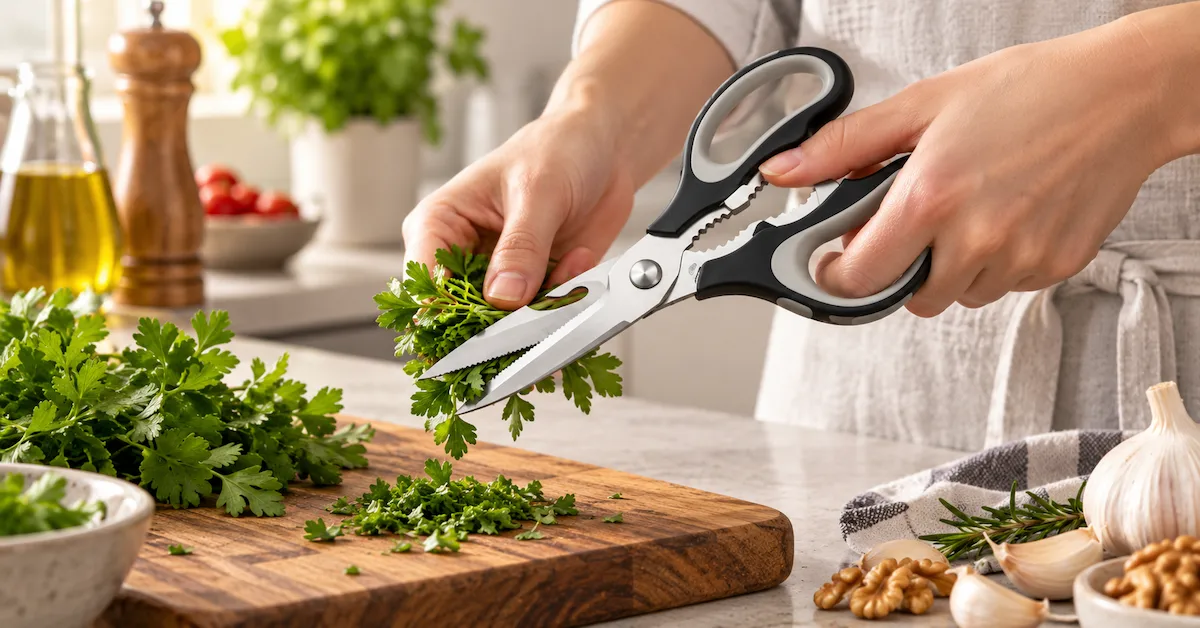
Record profile, dimensions, edge form, finish, alignment and the cutting result on the intended media. Inspect the tip and any serrated section for burrs, exposed points or inconsistent contact. If the feature set includes a notch or opener, check that its edges are intentional and safe to handle.
Pivot evidence
Operate the scissors through a full stroke. Note opening resistance, side play, fastener appearance, smoothness and alignment. If the two halves separate, document the release action, reconnection and cleaning access. Never approve a detachable claim from a photograph alone.
Handle evidence
Review ring dimensions, molding, flash, color, logo area, insert fit and the connection between plastic and metal. Use the intended hand position and test with a realistic grip. If the product is aimed at frequent kitchen use, comfort and control deserve the same attention as feature count.
5. Evaluate a Multifunction Kitchen Scissors Manufacturer's Process
A process description becomes useful when it explains where the selected SKU is controlled. BONET's public manufacturing description lists stages such as stamping, straight adjustment, heat treatment, rough grinding, water grinding, polishing, injection molding, ultrasonic cleaning, setting and assembly, quality checks, final cleaning and packing. Not every model uses every stage. Ask the supplier to mark the applicable stages and the checkpoint for each one.
For a multifunction kitchen shears factory, ask how secondary features are protected during grinding, molding and assembly. A notch can lose definition after polishing. A handle insert can shift during molding. A sheath can fit the sample but interfere with the cutting edge when packed. The right evidence is model-specific: drawing reference, work standard, approved sample, inspection result or packed-unit photo.
| Process area | Buyer question | Risk for multifunction models | Project evidence |
|---|---|---|---|
| Stamping and straight adjustment | How are profile and flatness controlled? | Misalignment affects every function built around the blades. | Drawing reference or recorded in-process check. |
| Grinding and polishing | Where are edge and feature geometry reviewed? | Secondary notches may become blunt, sharp or inconsistent. | Visual standard and inspection result. |
| Injection molding | How are color and metal-to-handle fit checked? | Flash, movement or color drift weakens grip and appearance. | Color reference, approved sample and defect criteria. |
| Assembly | How are pivot, alignment and functions verified? | One loose joint can affect cutting, opening and leverage. | Item-level checklist and reference feel. |
| Cleaning and packing | How are points, labels and contents confirmed? | Product movement or exposed edges can create retail and handling issues. | Packed sample, artwork revision and carton record. |
Evidence should be linked to the product revision. A generic factory video may show capability, but it cannot prove that a particular private-label sample follows the same route. This distinction helps buyers compare a multifunction kitchen scissors manufacturer China candidate on traceability rather than presentation alone.
6. Design Custom Logo and Packaging Around How the Tool Is Used
Branding is strongest when it supports the product's job. A logo on a handle should remain visible without interfering with grip. A printed pack should show the primary cutting action and one or two secondary functions in a way that matches the sample. A protective sheath can become a recognizable visual asset, but it must not hide the feature that justifies the purchase.
For custom multifunction kitchen scissors, specify logo method, position, scale, color, orientation and surface. Keep the vector artwork and packaging dieline under revision control. A color change can affect molding and a new pack can alter the barcode panel, insert, carton quantity or shipping assumptions. Review those changes with the product rather than as separate design tasks.
| Brand or pack element | Decision to make | Evidence before release |
|---|---|---|
| Front-of-pack claim | Which primary and secondary functions deserve the first view? | Function matrix, approved wording and matching sample photograph. |
| Logo surface | Handle, blade guard, sheath, insert or carton? | Physical logo sample on the actual surface. |
| Instruction panel | What action, cleaning note and boundary must be shown? | Artwork proof reviewed against tested construction. |
| Retention and protection | How will points, blades, pivot and accessories stay protected? | Packed sample, movement check and removal observation. |
| Outer carton | What SKU, color, quantity and revision marks are required? | Carton artwork and pack-out record. |
Need a logo and retail pack matched to the sample?
Need a logo and retail pack matched to the sample?
Request a Packaging Review7. Sample Every Function and Approve One Controlled Revision
Sampling is where a multifunction promise becomes honest. Give the sample an ID, received date, model reference and revision. Photograph the entire tool and close views of blades, pivot, handle, secondary features, sheath, logo and pack. If a feature changes, issue a new revision instead of letting a marked-up photograph become the unofficial specification.
Use a gate review. Identity comes first: can the sample be tied to the current brief? Cutting comes next: does the main blade perform on the agreed media? Then inspect pivot, handle, each secondary function, cleaning access and packaging. Stop the approval when a result is inconsistent, a claim is unsupported, a component is missing or the packed sample does not protect the product.
| Gate | Review | Record | Stop condition |
|---|---|---|---|
| Identity | Model, revision, dimensions, components and pack contents | Sample ID, photographs and date | Cannot tie the unit to the current brief. |
| Main cutting | Agreed media, full stroke, edge behavior and movement | Method, result and visible damage | Result falls outside intended use. |
| Secondary functions | One named test per opener, notch, stripper or accessory | Function matrix with pass notes | Claim cannot be supported by the sample. |
| Pivot and handle | Resistance, play, alignment, grip and molding | Observation and reference feel | Movement binds, separates or feels unsafe. |
| Cleaning | Accessible surfaces and proposed care statement | Method reviewed for actual construction | Care wording is unsupported. |
| Packaging | Retention, point protection, labels, barcode and carton fit | Approved artwork and packed photos | Product moves, is exposed or information is incomplete. |
8. Compare Wholesale Offers on the Same Multifunction Specification
A search for wholesale multifunction kitchen scissors can return offers that look comparable but include different assumptions. One price may cover a bare unit. Another may include a sheath, printed card, barcode label and export carton. A third may be based on a different quantity or delivery term. Normalize every offer against the same sample revision.
Ask the supplier to separate product, branding, packaging, development, inspection and delivery lines. Record currency, validity period, commercial term, included documents and exclusions. If the quote changes after a logo, color, accessory or carton revision, keep both versions and identify the reason. This protects the buyer from choosing a low number that does not describe the product the brand approved.

| Quotation line | Normalize | Question to ask |
|---|---|---|
| Scissors construction | Blade, pivot, handle, features, accessories and revision | Does the price refer to the approved sample? |
| Branding | Logo method, color, position, setup and artwork | Which setup or repeat charges are separate? |
| Packaging | Individual pack, insert, labels, barcode and carton quantity | Is the quote based on the packed sample? |
| Development | Prototype, tooling, sample rounds and artwork changes | Which costs are one-time, refundable or recurring? |
| Quality | Inspection basis, tests, records and corrective action | What evidence is included for this SKU? |
| Delivery | Quantity, destination, timing and commercial term | Which assumptions sit outside the unit price? |
MOQ, tooling, sample timing, production timing and shipping dates are project-specific. They can change with the selected model, material, feature set, packaging, quantity and factory schedule. A responsible multifunction kitchen shears factory should confirm the live values against the current brief.
9. Build a Repeat-Order System That Preserves the Feature Story
The first order proves that the product can be made. The second order proves that the brand can control it. Create an item master with model, revision, dimensions, material, finish, color, logo artwork, feature matrix, packaging dieline, barcode, pack contents, carton arrangement and approved sample ID. Keep a retained reference where the commercial process allows it.
When the brand adds a color or changes one feature, describe what changes and what remains fixed. A new handle color may be a molding and artwork change. A new opener may affect geometry, balance, inspection and packaging claims. A new sheath may affect both protection and shipping volume. Give each change a new revision and link the quotation, sample, approval and production release to it.
Use customer-facing language that can survive a reorder. If the package says “opens bottles,” the next revision should contain the same tested feature or a new claim review. If the product page says “stainless steel,” the statement should remain tied to the identified SKU. If the tool is shown stored on a refrigerator, confirm that the actual magnetic or sheath design supports the pictured use. Consistency is a commercial asset.
| Repeat-order record | Why it matters | Owner |
|---|---|---|
| Feature matrix and test media | Preserves the meaning of every consumer claim | Product and quality teams |
| Approved sample ID | Gives production and inspection one physical reference | Buyer and supplier |
| Artwork and dieline revisions | Prevents obsolete logos, barcodes or instructions | Brand and packaging teams |
| Quotation assumptions | Keeps changes in quantity, pack or delivery visible | Purchasing and finance |
| Issue and corrective-action log | Turns a delivery problem into a controlled improvement | Quality and supplier contact |
Buyer FAQ: Multifunction Kitchen Scissors Manufacturer
What should I ask a multifunction kitchen scissors supplier first?
Send the intended jobs, destination market, sales channel, reference model or drawing, dimensions, materials, feature list, logo direction, packaging idea, estimated quantity and timing. Ask the supplier to repeat the brief, identify missing information and separate confirmed values from recommendations.
Is “12-in-1” a useful product specification?
It is a marketing shorthand, not enough for approval. Name each action, test it on the intended media and decide which wording belongs on the pack. A smaller number of clearly demonstrated functions can create a stronger product than a long list that shoppers cannot understand or use.
What is the difference between multifunction kitchen scissors and multi-purpose shears?
The terms overlap in the market. For a buying decision, define the actual architecture and tasks. Use the product page and sample to identify blade length, handle construction, secondary features, accessories and storage. Then write the claims from the tested model rather than from the category label.
How do I evaluate a stainless steel multifunction kitchen scissors model?
Confirm the grade for the exact SKU, then review geometry, edge preparation, finish, pivot, handle and cutting result together. BONET publicly lists 420 stainless steel for the named SKI090 and SKI022 examples. That evidence applies to those models and should not be generalized without written confirmation.
Can a supplier add my logo and custom packaging?
BONET's public OEM/ODM page describes logo printing, laser engraving, material and color customization, export packaging and packaging customization. The practical question is whether the chosen surface, artwork, pack structure, quantity and destination market are feasible for your selected model. Approve a physical sample and a packed sample.
What should a China multifunction kitchen scissors manufacturer quote?
Request a project-specific quote that identifies the model, revision, material, features, accessories, logo, packaging, quantity, commercial term, delivery destination, development work, inspection basis and timing assumptions. Avoid comparing a finished retail pack with a bare-unit price.
How can I protect a private-label feature claim?
Keep the feature matrix, test method, approved sample, artwork revision and market wording together. The claim should be no broader than the evidence. When the construction changes, reopen the claim review rather than carrying the old sentence forward automatically.
Multifunction Scissors RFQ Checklist
- Primary consumer job and secondary functions are listed in priority order.
- Each function has named media, a pass observation and a claim boundary.
- Blade, pivot, handle, opener details, sheath and accessories are specified separately.
- Material statements are tied to the exact model and revision.
- Logo method, position, color and artwork revision are controlled.
- Packaging includes retention, point protection, labels, barcode and carton assumptions.
- Sample ID, photographs, test notes and approval owner are recorded.
- Quotation lines separate product, branding, packaging, development, quality and delivery.
- MOQ, tooling, sample timing, production timing and shipping assumptions are confirmed in writing.
- Repeat-order records preserve the feature matrix and the approved packed sample.
Choosing a multifunction kitchen scissors manufacturer is ultimately a decision about clarity. The best partner can explain why each feature exists, how it is made, how it is tested, how it should be shown to shoppers and how the approved version will be reproduced. Start with the consumer job, choose a balanced architecture, test every function, review the real pack and compare wholesale offers against one controlled revision.
Ready to turn a multifunction scissors idea into a testable retail program?
Ready to turn a multifunction scissors idea into a testable retail program?
Send Your Multifunction Scissors RFQ