




ODM Kitchen Tools Manufacturer Guide for Private-Label Buyers
Choosing an ODM kitchen tools manufacturer is not only about finding a supplier with an attractive utensil set. For private-label buyers, the real question is whether the supplier can support a coordinated kitchenware program: useful pieces, consistent appearance, sensible packaging, and enough customization to fit the target sales channel.
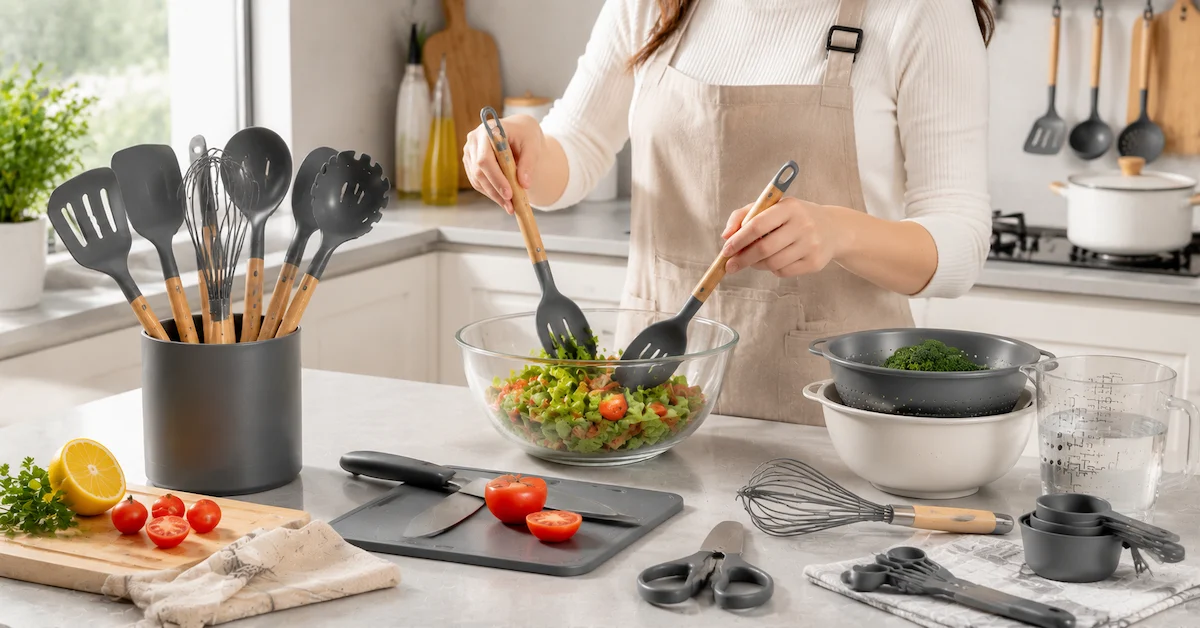
The assortment shown in the original product image includes spatulas, spoons, a whisk, ladle-style tools, measuring pieces, knives, scissors, and a countertop holder. That makes it a broad kitchen tools set designed around common preparation, stirring, serving, cutting, and measuring tasks. For sourcing teams, this type of set can work for retail, e-commerce, gifting, or starter kitchen programs if the supplier can confirm the details behind the catalog photo.
Key Takeaways
- A good private-label kitchen tools set should be practical, coherent, and easy to store.
- Do not assume material grade, heat resistance, dishwasher safety, or coating performance from images alone.
- ODM value comes from adapting the set, packaging, branding, and presentation for your market.
- Supplier evaluation should include samples, packaging protection, customization limits, and batch consistency.
What Buyers Mean by an ODM Kitchen Tools Manufacturer
When buyers search for an ODM partner, they usually want more than a standard utensil order. ODM sourcing often means the supplier already has a product concept or base design that can be adapted through color, piece count, logo placement, packaging format, or accessory selection. This is different from purchasing loose commodity utensils from a catalog with no program planning.
For a multi-piece kitchen tools set, an ODM partner may help buyers decide which items belong together, how the tools should be displayed, and what packaging structure is suitable for private-label resale. However, every capability must be verified. Some suppliers may offer only basic branding, while others may support broader design and packaging adjustments.
Why Multi-Piece Kitchen Tool Sets Need Careful Sourcing
Kitchen tools look simple, but a set contains many small quality points. Handles should feel stable. Hanging holes should be clean and aligned. Working ends should look consistent across the set. The holder should fit the tools without looking crowded. If measuring pieces, scissors, and knives are included, they should be reviewed as functional items rather than decorative add-ons.
Buyers should also consider the intended use case. A home kitchen gift set, an e-commerce starter bundle, and a foodservice utensil program may require different priorities. A product that photographs well for a listing may not be appropriate for heavy-duty use unless the supplier provides suitable specifications and evidence.
Private-Label Evaluation Checklist
Use a simple comparison table before requesting pricing or committing to samples. It keeps the discussion focused on sourcing risk rather than appearance alone.
| Evaluation Area | What to Check | Questions to Ask the Supplier |
|---|---|---|
| Set composition | Number and type of included tools | Which pieces are standard, optional, or customizable? |
| Materials | Handles, working heads, holder, blades, and measuring parts | Can you provide exact material confirmation for each component? |
| Storage | Hanging holes, holder fit, nesting, and countertop footprint | Is the holder included in the standard set or offered separately? |
| Branding | Logo position, color options, and packaging artwork | What branding methods are available for each surface? |
| Packaging | Retail display, gift box, e-commerce protection, carton layout | How are surfaces protected from scratching during shipment? |
| Performance claims | Heat, cleaning, coating, and food-contact statements | What documentation supports any claim used on the label? |
How to Read the Product Like a Sourcing Manager
The product image suggests a coordinated kitchen kit rather than a single-tool purchase. Long handles with hanging holes point to flexible storage. The countertop holder supports organized display. Measuring pieces and cutting tools broaden the value proposition. These are useful clues, but they are not specifications.
A sourcing manager should request close-up images and physical samples. Pay attention to the transition between handles and tool heads, surface consistency, edge finishing, blade fit, and whether the holder remains stable when loaded. If the handles appear wood-like or bamboo-like, confirm the actual material before using those words in retail copy.
Where ODM Support Can Add Real Value
An ODM kitchen tools manufacturer is most useful when the supplier helps align the product with the buyer’s market. For compact apartment retail, the set may need fewer pieces and better nesting. For gifting, the packaging and visual consistency may matter more. For a cookware brand extension, the utensil color and holder design may need to match an existing range.
Possible ODM discussion points include:
- Adjusting the assortment by removing or adding tools.
- Confirming which colors or finishes are available without new tooling.
- Choosing retail, gift, or e-commerce packaging formats.
- Planning logo placement on handles, holder, or packaging.
- Clarifying which components are standard and which require development.
The best approach is to separate “nice to have” design ideas from core commercial requirements. Too many changes at once can increase sampling time and production complexity.
Common Sourcing Mistakes to Avoid
One common mistake is treating all kitchen utensil sets as interchangeable. A broad household set may be suitable for online retail but not for demanding professional kitchens. Another mistake is building product listings around unverified claims. Do not state material grade, heat tolerance, dishwasher safety, or coating performance unless the supplier provides confirmation and appropriate documentation for your market.
Buyers also sometimes focus too much on unit appearance and too little on packaging. A multi-piece set can arrive scratched, loose, or poorly presented if the internal structure is not designed properly. For private-label retail, packaging is part of the product experience and should be reviewed during sampling.
What to Request Before Placing an Order
Before moving from interest to purchase, prepare a structured supplier request. Ask for a specification sheet, sample availability, material breakdown, packaging options, branding methods, and the exact list of included pieces. If you plan to compare suppliers, ask each one the same questions so the results are easier to evaluate.
A practical request list includes:
- Full component list for the set shown or proposed.
- Material confirmation for handles, heads, holder, knives, scissors, and measuring pieces.
- Available customization options and limits.
- Packaging structure, dimensions, and protection method.
- Sample lead time, revision process, and final approval steps.
- Questions about any testing, compliance, or documentation required for your target market.
Practical FAQ
Is this type of set suitable for private-label kitchenware?
Yes, a coordinated set with multiple utensils and storage can suit private-label programs. Buyers should still confirm materials, piece count, packaging, and branding options before positioning it for retail.
Can an ODM supplier change the tool mix?
Sometimes. Ask which pieces are standard and which can be removed, added, or substituted. Customization may depend on existing tooling, available components, and packaging layout.
What should I verify before making product claims?
Verify exact material composition, intended use, cleaning guidance, heat-related claims, coating performance, and any market-specific documentation you need. Do not rely on a catalog image for these details.
How should buyers compare two similar suppliers?
Compare sample quality, answer clarity, packaging protection, customization flexibility, and consistency across the full set. A supplier that communicates limitations clearly is often easier to work with than one that promises everything without details.
Next Step for Private-Label Buyers
If this kitchen tools assortment matches your channel, send the supplier a clear brief: target market, preferred set composition, branding needs, packaging type, and any documentation requirements. A qualified ODM partner should be able to respond with sample options, material clarification, and practical recommendations. That early conversation will show whether the supplier can support a real private-label kitchenware program or only provide a catalog item.
