




OEM Kitchen Scissors Manufacturer: Practical Sourcing Guide
Kitchen scissors are a small product category, but they can create large sourcing decisions for importers, distributors, supermarket buyers, and private-label kitchenware brands. A reliable OEM kitchen scissors manufacturer should be able to support everyday cutting performance, safe storage, clean packaging, and consistent finish quality across repeat orders. This guide rewrites the original product discussion into a more useful sourcing article, focusing on what buyers should verify before placing an OEM or wholesale order.
Key Takeaways
- Confirm the blade material, handle material, and finish details directly with the supplier instead of assuming specifications.
- For kitchen scissors with cover, check sheath fit, retention, blade protection, and packaging stability.
- If sourcing from a detachable kitchen scissors supplier, ask how the joint separates, locks, cleans, and performs after repeated use.
- Request samples and evaluate cutting feel, grip comfort, edge alignment, and cleaning access before approving bulk production.
- Avoid relying only on photos; compare samples, documentation, and supplier responses side by side.
What Buyers Should Expect From OEM Kitchen Scissors
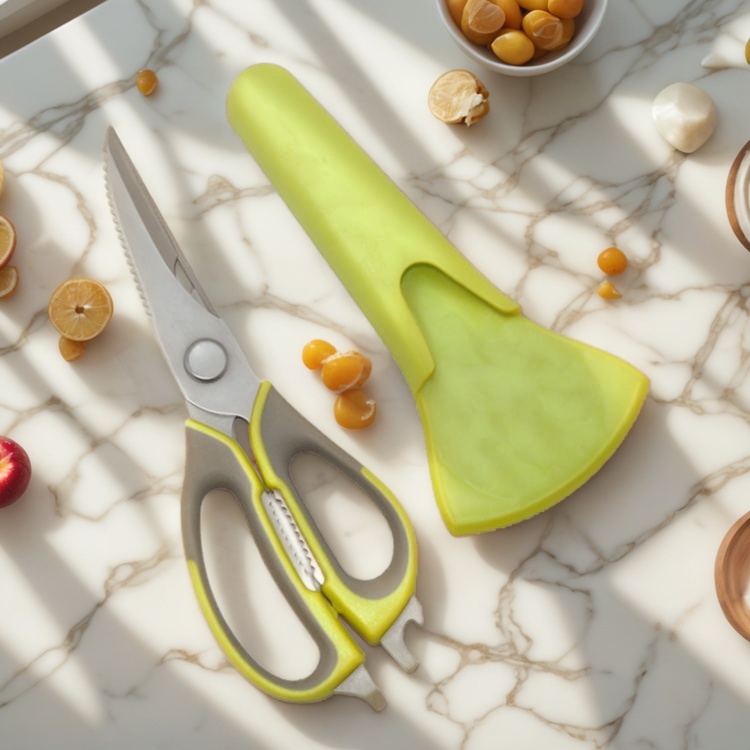
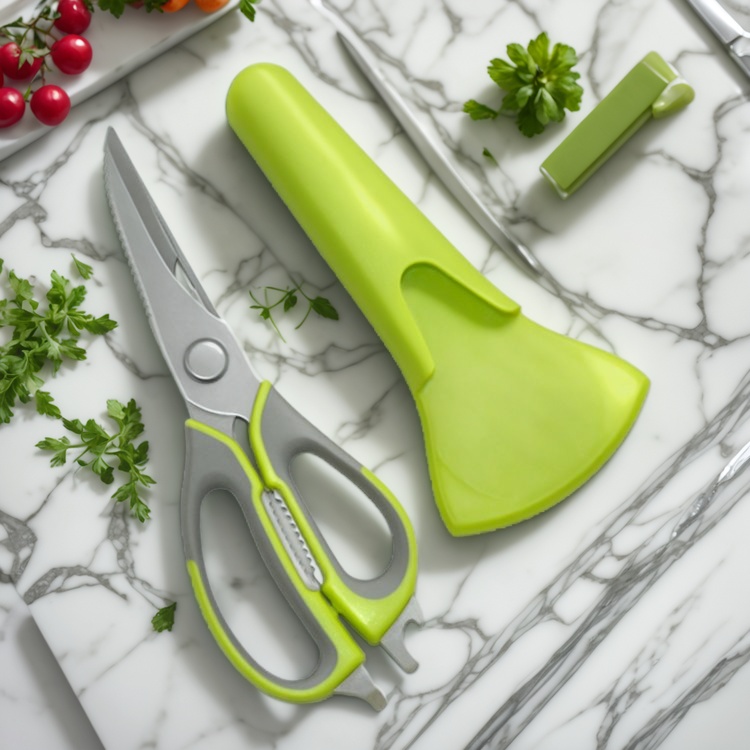
The original article highlights several useful product ideas: stainless steel blades, ergonomic handles, serrated cutting edges, non-slip grips, a gray and lime green color scheme, a built-in bottle opener, and a protective cover. These are common features buyers may look for in multi-purpose kitchen shears, but every detail should be confirmed in writing before purchase. For example, stainless steel can refer to different grades, finishes, and corrosion-resistance levels, so buyers should ask the manufacturer to state the exact material and any applicable test information they can provide.
For OEM projects, the goal is not only to find a good-looking product. Buyers also need repeatable quality, stable packaging, clear artwork control, and a supplier that understands private-label communication. A good sourcing process starts with a clear product brief and continues through sample review, quotation comparison, production confirmation, and inspection planning.
Core Design Features To Evaluate
Kitchen scissors are handled frequently, often with wet or oily hands, so the details matter. The handle should feel stable and comfortable, with no sharp plastic edges or loose assembly points. If the scissors include non-slip grip areas, check whether the texture is effective without being difficult to clean. For color schemes such as gray and lime green, ask whether color matching can be controlled across different production batches.
Blade performance should be tested on realistic kitchen tasks. Buyers can check how the scissors cut herbs, vegetables, packaging, and meat preparation items appropriate to the intended market. Serrated blades may help grip certain foods, but the supplier should explain the blade design and sharpening process. Edge alignment is also important: if the two blades do not meet correctly, cutting performance can feel weak even when the steel appears solid.
Kitchen Scissors With Cover: Why The Sheath Matters
A kitchen scissors with cover design can improve storage safety and help protect the cutting edge when the product is stored in a drawer, hung on a rack, or packed in a retail set. The cover should fit securely without being so tight that users struggle to remove it. If the cover includes a magnetic function or a special storage concept, ask the supplier to explain the intended use, packaging protection, and any care instructions.
During sample review, buyers should repeatedly insert and remove the scissors from the cover. Look for scratches, loose fit, weak retention, plastic stress marks, or rattling. If the product will be sold through retail channels, packaging should hold both the scissors and cover firmly so the item does not shift during transport.
Detachable Designs And Cleaning Access
Many buyers search for a detachable kitchen scissors supplier because removable blades can make cleaning easier. A detachable design may be helpful for households, food-service buyers, and private-label product lines that emphasize hygiene and maintenance. However, the mechanism must be secure. A product that separates too easily may create safety concerns, while a product that is too difficult to separate may disappoint users.
Ask the supplier how the scissors detach, how the joint locks during use, and whether the design has been evaluated through repeated opening, closing, and cleaning. If the model is not detachable, buyers should still check whether the hinge area can be cleaned easily and whether food particles can become trapped around screws or joints.
Comparison Checklist For Supplier Evaluation
| Evaluation Area | What To Check | Questions To Ask The Supplier |
|---|---|---|
| Blade material | Material name, finish, thickness, edge alignment | What exact blade material is used, and can it be documented? |
| Handle design | Grip comfort, texture, color consistency, edge smoothness | Can handle colors and materials be customized for OEM orders? |
| Cover or sheath | Fit, retention, storage safety, packaging protection | How is the cover tested for secure fit during shipping and use? |
| Detachable function | Locking strength, ease of cleaning, durability of joint | Is this model detachable, and how should users separate it safely? |
| Added functions | Bottle opener, grip areas, multi-use features | Which features are standard and which are optional for OEM projects? |
| Quality control | Sample consistency, inspection criteria, defect handling | What inspection steps are used before shipment? |
OEM And Wholesale Questions To Ask Before Ordering
Before choosing an OEM kitchen scissors manufacturer, buyers should prepare a written request that covers product details, packaging, branding, and commercial terms. Avoid vague requests such as “best quality kitchen scissors.” Instead, describe the target user, sales channel, expected packaging type, preferred color, and any required documentation for your market.
- What blade material, handle material, and cover material are used in the quoted model?
- Can the supplier provide pre-production samples with final color, logo, and packaging?
- Which parts can be customized, and which parts require new tooling or artwork setup?
- What are the supplier’s standard inspection points for blade sharpness, alignment, handle finish, and sheath fit?
- How are cartons packed to protect the scissors and covers during international transport?
- What lead time, minimum order quantity, and payment terms apply to the specific OEM project?
Sample Testing Tips For Importers And Brands
Sample testing should be practical and repeatable. Open and close each pair many times, check whether the blades scrape unevenly, and test the grip with dry and slightly wet hands. Cut several common kitchen materials and compare effort, control, and cut cleanliness. If the scissors include a bottle opener, confirm that the feature is comfortable to use and does not interfere with normal handling.
Buyers should also review packaging from a retail perspective. Is the product easy to understand without overclaiming? Are care instructions clear? Does the cover stay in place? If the scissors are sold as kitchen scissors with cover, the cover should feel like an integrated part of the product rather than a loose accessory added at the end.
FAQ
What should I verify first with an OEM kitchen scissors manufacturer?
Start with the exact blade material, handle material, dimensions, product weight, cover design, customization options, packaging format, MOQ, lead time, and inspection process.
Are detachable kitchen scissors always better?
Not always. Detachable scissors can be easier to clean, but the joint must lock securely and remain stable after repeated use. Non-detachable models may be suitable if the hinge area is easy to clean.
Why is a cover important for kitchen scissors?
A cover helps protect the blades during storage and can reduce accidental contact in drawers or packaging. Buyers should check fit, retention, and durability before approving production.
Can OEM buyers request custom colors or branding?
Many suppliers may offer color, logo, or packaging customization, but buyers should ask what is available for the specific model and whether customization affects cost, MOQ, or lead time.
How can I reduce sourcing risk?
Use a clear specification sheet, approve final samples, confirm packaging artwork, ask about inspection criteria, and avoid making product claims that the supplier has not documented.
Final Sourcing Perspective
Kitchen scissors may appear simple, but buyers should treat them as a functional cutting tool with safety, cleaning, packaging, and user-comfort considerations. The best sourcing results come from asking precise questions and testing samples carefully. Whether you need a detachable kitchen scissors supplier, kitchen scissors with cover, or a broader OEM kitchenware partner, focus on verified specifications and consistent execution rather than promotional claims.
