




Quick Answer:
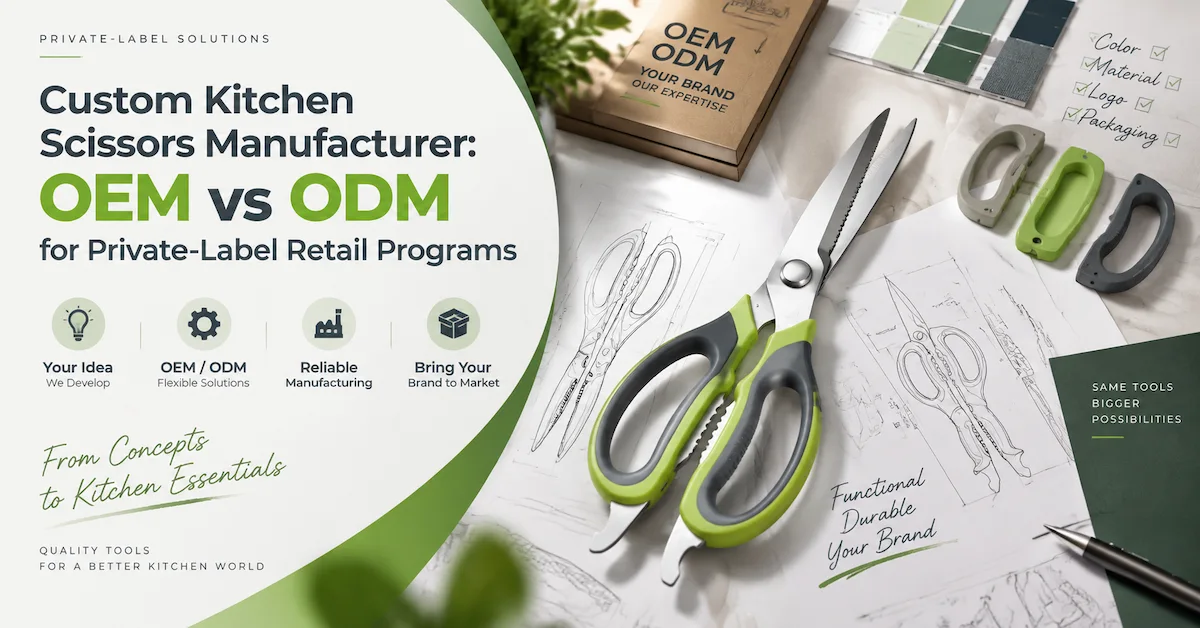
Choose OEM when an existing kitchen-scissors platform already fits the user's cutting, cleaning and storage needs and the commercial work is mainly color, logo, instructions or packaging. Choose ODM when the buyer needs the manufacturer to solve a product problem through structural or functional development. A hybrid route can use a proven blade and pivot platform while developing selected handle, holder or packaging elements. Whichever route is chosen, record design ownership, tooling, material evidence, sample gates, claims, MOQ layers, price assumptions, production files and reorder change control before committing to volume.
Introduction: OEM and ODM Are Decisions About Responsibility, Not Just Labels
Buyers often add “OEM/ODM available?” to a supplier email as though the two abbreviations describe one service. In practice, they can lead to very different projects. One route adapts a product platform that already exists. The other asks a manufacturer to participate in design and development. Between them sits a large hybrid area. A company may keep an established blade pair and pivot, change the molded handle, add a holder, and develop a new retail package. Calling all three routes “custom” is convenient for marketing but not precise enough for a purchase order.
The decision matters because responsibility changes. Who defines the user problem? Who owns the product drawing? Who pays for tooling? Who validates the cutting and cleaning conditions? Which party controls logo and packaging claims? What may be sold to another customer? Who keeps the source files and approved samples? A private-label team that does not answer those questions can believe it owns a design when it only selected a catalog color. It can also spend months on ODM work when a proven platform would have met the commercial need.
This guide helps brand managers, retail buyers, importers, distributors, sourcing offices and product developers select an appropriate route with a custom kitchen scissors manufacturer. It is a supplier-comparison and commercial-investigation article, not a promise that one route is always better. The recommended choice depends on the gap between the user's need and an available platform, the buyer's technical resources, evidence requirements, launch timing, forecast confidence and appetite for tooling or validation work.
BONET HOUSEWARE provides the factual company context. BONET's public site identifies the company in Yangjiang, Guangdong, China, describes a 5,000-square-meter facility and 6S management, and presents OEM/ODM services. The service page mentions drawing- or sample-based production, concept and structural work, material and color customization, logo printing or laser engraving, packaging customization, sampling, quotation, production and inspection support. Published scissors pages identify specific model architectures. These facts allow a practical route comparison without fabricating project data.
What Does OEM Mean for Kitchen Scissors?
In this guide, OEM describes a project based primarily on a manufacturer-controlled or already-established product platform. The buyer selects or approves the base scissors and then applies a defined brand program. Customization may include existing or custom resin colors, logo position and process, instruction language, retail package, barcode, labels, carton marks and inspection requirements. The product can still be distinctive in the market even when the underlying blade, pivot and mold are not newly designed for that buyer.
OEM is attractive when the base platform already fits the intended work. It can reduce development uncertainty because the factory knows the construction and routine process. That does not mean the buyer can skip evidence. A new color can change molding behavior; a logo can wear; a printed card can rub the blade; a different package can trap moisture or release the product. The final branded configuration still requires samples and a controlled release.
An OEM kitchen scissors manufacturer should clearly identify which parts are standard, which options are already validated internally, and which requests create new setup or testing. It should not describe a catalog product as exclusive merely because the buyer added artwork. If exclusivity matters, the agreement must state what is exclusive: a color combination, printed package, logo, tooling, geometry, market, term or another defined element.
What Does ODM Mean for Kitchen Scissors?
ODM describes a route in which the manufacturer contributes meaningful product design or engineering to solve a buyer-defined market problem. The starting point may be a written brief, sketch, competing reference, user complaint or unmet retail need rather than a finished drawing. Work can include concept selection, product architecture, blade or handle geometry, detachable interface, storage component, prototype, tooling, design-for-manufacturing review and validation planning.
ODM is not simply “OEM with more colors.” It introduces choices that can change function, safety, evidence, cost and ownership. A new detachable joint must assemble predictably. A revised handle must transfer force and remain comfortable. A magnetic holder must be evaluated on defined surfaces and orientations. An added opener or gripping feature can create edges or pinch points. The factory and buyer need a documented development process because attractive drawings do not prove a manufacturable, repeatable product.
An ODM kitchen scissors manufacturer should explain its design inputs, review gates, prototype methods, tooling responsibility, technical files and change procedure. The buyer should provide the problem, user, target market, constraints and commercial assumptions rather than outsourcing all judgment. The manufacturer can propose a solution, but the brand remains responsible for deciding whether claims and market requirements are suitable.
| Decision area | OEM route | ODM route | Hybrid route |
|---|---|---|---|
| Starting point | Existing named model or controlled factory platform | Buyer need, concept, sketch or performance problem | Existing blade/pivot platform plus selected new components |
| Main customization | Color, logo, instructions, packaging and configuration | Structure, function, components, tooling and complete presentation | Handle, holder, accessories or package around a proven core |
| Technical uncertainty | Usually lower, but branded configuration still needs approval | Higher because design and production questions must be resolved | Concentrated in the new components and interfaces |
| Ownership discussion | Brand artwork and agreed exclusivity boundaries | Drawings, tooling, design files, improvements and selling rights | Separate ownership by component and file |
| Commercial structure | Product, color, marking and print minimums | Development, prototype, tooling, validation and production minimums | Standard-platform cost plus new-component layers |
| Best fit | Faster differentiation when platform meets use case | Unmet user need with sufficient forecast and resources | Distinctive product without redesigning every subsystem |
Verified BONET Platforms That Can Anchor the Route Decision
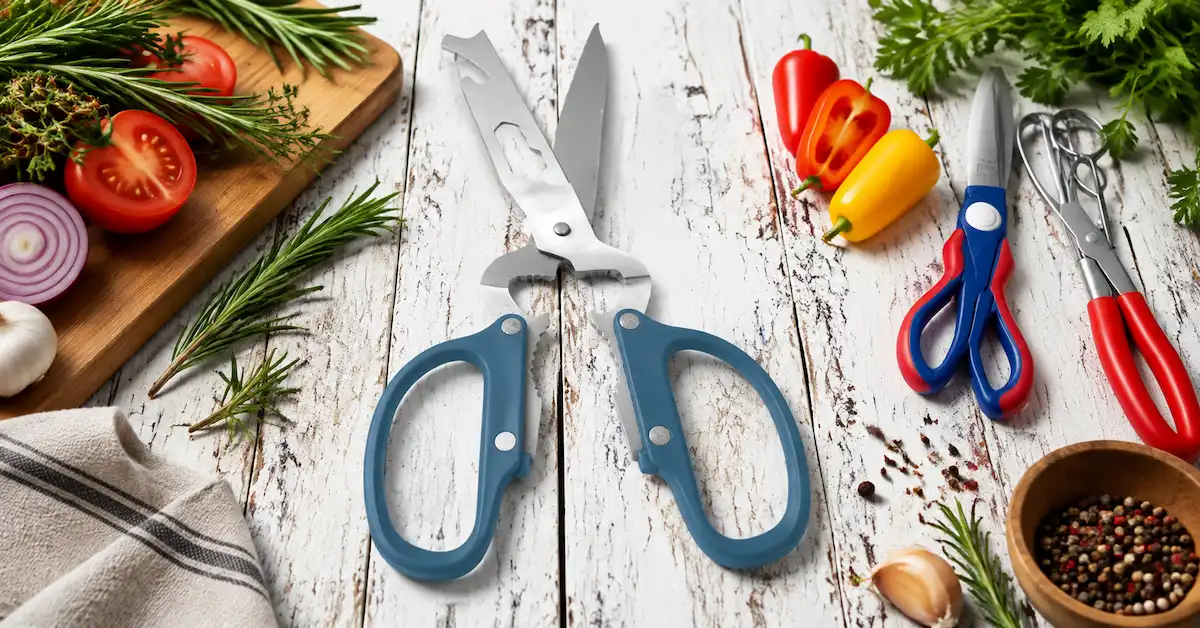
The G2003 versatile cooking shears page publishes 24 × 7.5 × 1.5 cm, 420 stainless steel and PP+TPR, with detachable blades and a storage direction. A buyer satisfied with that architecture could explore an OEM program based on color, marking and package. A buyer wanting a different handle relationship or storage interaction could ask whether a hybrid or ODM project is feasible.
The G2004 multi-purpose kitchen scissors page lists 19 × 9.5 × 1 cm, 420 stainless steel and PP in a detachable multifunction format. The G2011 magnetic kitchen scissors page lists 21.8 × 8.6 × 2 cm, 420 stainless steel and PP with a magnetic storage direction. The public SKI090 multi-functional scissors page lists 9 inches, 420 stainless steel and PP.
These examples help a buyer avoid a false blank-sheet assumption. A product need may already match a platform closely enough that only brand and channel work remains. Conversely, an existing silhouette may look close while failing a critical user task. The decision should be made from required use, cleaning, storage, package and evidence, not from whether a product photograph resembles the mood board.
No public product page settles current MOQ, tooling cost, development ownership, capacity, test result, package minimum or lead time for a future program. The buyer should use model facts to sharpen the RFQ, then request a dated commercial and technical response. Product pages are reference evidence, not a substitute for the project contract.
Step 1: Define the Market Problem and the Non-Negotiable User Outcome
Begin before the route label. Write what the user needs to accomplish, the channel where the product will be sold and the reason an existing offer is insufficient. “We need a premium kitchen scissors” is not a market problem. “Our grocery customer wants a compact pair that opens flexible pouches, trims herbs, separates for hand washing and hangs securely on a card without exposing the tips” gives the manufacturer decisions it can investigate.
Separate outcomes from proposed solutions. A buyer may request a rubber grip because complaints mention slipping, but handle texture, opening shape and operating force may also affect the experience. A team may ask for a magnetic sheath because customers lose scissors in drawers, while a wall hook, protective cover or drawer organizer could solve the same problem. Giving an ODM kitchen scissors manufacturer the user outcome allows it to compare architectures instead of merely drawing the first idea.
List hard constraints: overall size, target retail price architecture, planned channel, destination, cleaning statement, required functions, excluded tasks, package footprint, languages, branding, business date and forecast range. Then list preferences that may move. A project becomes easier to steer when the factory knows which constraint it may challenge. If the target price, structural novelty, low quantity and urgent date cannot all coexist, the team should choose which goal leads.
Close the step with a route hypothesis, not a final decision. State that the team expects OEM if a named platform meets all non-negotiable outcomes, hybrid if one or two interfaces need development, and ODM if no platform is suitable. Ask the manufacturer to explain its recommendation and evidence. This prevents the acronym in the inquiry subject line from deciding the project before feasibility is understood.
| Brief field | Example of a useful input | Route signal |
|---|---|---|
| User problem | Need easier cleaning after light food preparation | Existing detachable platform may support OEM |
| Product gap | Current samples cause pressure at the thumb opening | Handle change may require hybrid or ODM work |
| Storage outcome | Product must remain accessible on a defined metal surface | Existing magnetic platform may work; surface test remains required |
| Brand outcome | Two colors, front-facing logo and paper-based retail pack | Often OEM if geometry is unchanged |
| Business constraint | Fixed package footprint and launch window | Favors proven platform unless critical outcome is unmet |
Step 2: Map the Existing Platform Against the Brief
Create a fit-gap matrix for each candidate model. Rows should cover cutting tasks, size, grip, hand orientation, detachment, cleaning, lock, sheath or magnet, added functions, package footprint, material direction and target-market evidence. Mark each row as fits, requires confirmation, requires modification or does not fit. A platform with many “requires confirmation” cells is not yet an OEM shortcut; it is an untested assumption.
Inspect physical samples rather than relying on images. Check the cuts from the brief, full-stroke blade contact, pivot, handle pressure, disassembly, reassembly, washing route and storage. Place the product in the intended pack footprint. If the model has a magnetic holder, test the complete assembly on the intended representative surface and orientation. Record limitations. A known limitation can be managed in instructions or route choice; a hidden limitation appears later as returns.
Ask the factory which components and tooling belong to the platform. A product page may show one handle color while the mold supports several materials or inserts. Conversely, a seemingly simple color split may require separate batches for hard handle, soft grip and holder. Understand which changes are cosmetic and which interact with dimensions or assembly. The fit-gap matrix should be updated with the manufacturer's process knowledge.
Use a stop rule. If the base platform fails a non-negotiable function, do not keep adding artwork to rescue it. Either review another model or change the route. If the gaps are limited to brand presentation, stay disciplined and avoid unnecessary structural work. The best route is the smallest validated change that satisfies the user and business case.
Step 3: Assign Design, Evidence and Decision Ownership
Every development task needs one accountable owner and one approver. The buyer usually owns market requirements, brand assets, claims, destination research and final commercial approval. The manufacturer owns the accuracy of its process proposal, production drawings, internal controls and declared evidence. External laboratories or specialists may own test execution or legal advice. Write the responsibility map early so a missing task does not sit between companies.
For OEM, decide who maintains the product specification when the platform changes. The factory may own the base drawing while the buyer owns the branded configuration, package and inspection addendum. The purchase agreement should identify which files the buyer receives and how the factory notifies changes. A private label is not protected if a base model silently evolves and the buyer has no revision reference.
For ODM, address concept files, drawings, prototypes, tooling, software if any, test fixtures, improvements, defects and confidentiality. Tooling payment does not automatically answer every ownership or access question. State who owns the tool, where it stays, whether it can be moved, who maintains it, what happens after inactivity, and whether similar products may be sold to others. Obtain appropriate legal advice for the relevant jurisdictions rather than relying on casual email language.
Evidence ownership matters too. Decide who defines each test, who supplies samples, who pays, who receives the report, whether the report may be shown to retail customers, and how a material or process change affects validity. A report held only by a component supplier may not be sufficient for a finished product claim. The release should connect evidence to the actual model and revision.
| Work item | Buyer responsibility | Manufacturer responsibility | Joint decision |
|---|---|---|---|
| Market brief | User, channel, destination, price architecture and forecast | Clarifying questions and feasibility feedback | Final measurable design inputs |
| Product design | Approve outcome and brand constraints | Drawings, component choices and manufacturing proposal | Architecture and acceptable trade-offs |
| Tooling | Commercial approval and agreed ownership | Design-for-manufacture, build, maintenance proposal | Acceptance, access and change rights |
| Testing | Claims, destination and acceptance needs | Sample preparation and process evidence | Method, sample size, result and corrective action |
| Artwork/package | Brand copy, legal review and barcode | Dieline, print process and packing feasibility | Signed proof and packed sample |
| Production | Purchase order and release approval | Current instructions, process control and inspection | Change notification and shipment release |
Step 4: Build the OEM, ODM or Hybrid Business Case
Compare total program cost, not only unit price. OEM may involve product, color, logo, printed package and sample charges. ODM can add concept work, engineering, prototypes, tooling, test fixtures, external testing, more sample rounds and technical-file maintenance. Hybrid development places those additions around selected components. List one-time and recurring costs separately and model them across realistic forecast scenarios.
Include inventory exposure. A custom color, printed card, insert and master carton can each have a different economic batch. A low finished-product order may leave unused packaging or resin. ODM tooling can improve long-term differentiation but only if demand supports the investment and the buyer controls the relevant rights. Build conservative, expected and strong-demand cases instead of using one optimistic forecast.
Value schedule risk. OEM can be faster when the platform and customization are already understood, but package artwork and color approvals can still delay production. ODM includes concept selection, engineering reviews, prototypes, tooling, trials and validation. The route should show decision gates and rework allowance. A launch date without a design freeze is a wish, not a schedule.
Consider opportunity cost. A team of merchandisers may spend months reviewing a novel grip that customers do not value, while losing the sales season. The opposite can also happen: a rushed standard product may enter a crowded category with no meaningful reason to choose it. The business case should link each custom feature to a customer, retailer, service or operational benefit. Remove changes that cannot justify their cost or risk.
| Cost/risk layer | OEM question | ODM question | Decision evidence |
|---|---|---|---|
| Product | What is included in the platform price? | What new components and processes are proposed? | Itemized scope and assumptions |
| Development | Which samples and setup are charged? | Which concept, prototype and engineering stages are charged? | Milestone quote and acceptance gates |
| Tooling | Are standard molds used? | Who pays, owns, maintains and may use each tool? | Tool list and written rights |
| Evidence | Which existing records are relevant? | Which new tests or files are required? | Model-linked evidence plan |
| Inventory | Which color and package minimums apply? | Which custom components create separate batches? | Quantity matrix and excess-stock plan |
| Timing | Which customization gates drive release? | Which design and tooling gates drive release? | Dependency-based schedule |
Step 5: Prototype and Validate the Highest-Risk Assumption First
Do not spend equally on every question. Identify the assumption most likely to make the route fail. For an OEM program, it may be whether the existing handle fits the target users, whether the logo remains legible or whether the product fits the required package. For ODM, it may be whether the new joint can be manufactured, whether a modified handle provides enough leverage, or whether a magnetic holder stays in place while scissors are removed. Test the high-risk assumption before polishing low-risk artwork.
Use prototypes appropriate to the question. A visual model can confirm proportion but not cutting. A machined or printed handle may help evaluate grip but not represent molded material or surface. A hand-ground blade can explore geometry but may not represent production consistency. Label each prototype with what it can and cannot prove. The buyer should not approve a sales claim from a model built only for appearance.
Define observations before the test. For cutting, state the media, preparation, motion and failure criteria. For a detachable pair, define removal, reassembly and ordinary-use retention. For a holder, define surface, orientation, cleanliness, placement, observation time and removal action. For handles, record pressure points, finger clearance, slip and flex under a representative task. Qualitative tests can be valuable when the conditions and decision are documented.
After feasibility, move toward production-intent materials and processes. Repeat affected tests when a prototype changes into molded components, production grinding or the final pivot. A successful handmade sample can hide process difficulty. The manufacturer should explain which characteristics require fixtures, gauges or operator skill in production and how variation will be controlled.
Step 6: Control Tooling, Drawings and the Technical File
ODM and hybrid projects need a file register. Include design input, concept decision, drawings, component list, material proposal, tooling list, prototype records, test plans and results, approved samples, logo and package artwork, inspection plan, deviations and change log. Give each controlled document a title, revision and date. The register does not need sophisticated software; it needs consistency and access.
Review tooling acceptance separately from product approval. A mold can make parts while still producing flash, warpage, sink, color inconsistency or difficult assembly. Define trial quantity, dimensional checks, visual standard, material and production condition. Record modifications. If tooling is paid by the buyer, identify it physically and in the agreement. If the factory owns tooling, describe the buyer's usage or exclusivity rights without implying ownership.
Drawings should reflect the released product rather than an early concept. Confirm critical dimensions, materials, finishes, interfaces and revision. When the base platform remains manufacturer-owned, the buyer may receive a controlled specification rather than every proprietary drawing. That can be workable if the agreement identifies the product sufficiently, preserves approved performance and requires change notification. The buyer's objective is repeatability, not possession of files it cannot interpret.
Keep the technical file connected to commercial documents. The quotation should reference the same model and revision as the sample. The purchase order should reference the current quote and artwork. Inspection should use the released criteria. A complaint should point back to the order and revision. Disconnected technical and purchasing files create room for accidental substitution.
Step 7: Close Branding, Packaging and Claim Boundaries
Brand differentiation is not limited to putting a logo on a handle. It includes the product's color relationship, visible functions, package structure, photography, instructions, claims, naming and unboxing sequence. Decide which elements create value for the target customer. A restrained OEM program can feel distinctive when the color, package and explanation are coherent. An ODM product can still look generic when brand decisions arrive after engineering.
For custom logo kitchen scissors, choose placement and method with product use in mind. Laser marking on a blade, printing on PP, marking on TPR, a molded logo and package print have different size, contrast, wear and setup limits. Ask for the proposed process and approve it on final material. Test ordinary handling and the intended cleaning route. Keep master artwork, color, size and location in the release file.
Packaging must support the chosen route. An OEM platform may already have a safe packing method, but the buyer's paper card or box can change retention. An ODM shape may require a new insert or carton. Verify tip protection, product movement, abrasion, deformation, consumer removal, store hook, barcode, parcel shipment and master-carton count. The package should not make a function look available when it is not part of the selected model.
Claims need evidence and careful scope. A material designation, detachable feature or magnetic-storage statement should match the released construction. Terms such as “dishwasher safe,” “professional,” “food grade,” “rustproof,” quantified cutting life or universal magnetic attachment should not be borrowed from another product. Buyer, manufacturer and compliance reviewer should agree what is supportable for the destination. Keep approved copy and translations with the technical file.
Step 8: Convert the Chosen Route into a Comparable RFQ and Contract
The RFQ should begin with the route and its basis. For example: “OEM route using G2003 as the base platform; no blade or pivot change; two molded colors subject to feasibility; logo on package; new paper insert.” Or: “Hybrid route using an established blade pair with a newly developed handle and holder; buyer supplies user requirements; manufacturer proposes structure and tooling.” That sentence prevents the word custom from hiding scope.
Attach the quantity matrix, destination, required evidence, sample stages, package direction and target business date. Request an itemized quotation showing development, samples, tooling, recurring product, color, marking, packaging, inspection and trade terms. Ask the manufacturer to list exclusions and deviations. Current MOQ, price, production capacity and timing must be confirmed after technical review; no public BONET page establishes a universal value for every route.
Contract language should reflect ownership, confidentiality, tooling, files, approved subcontracting, quality agreement, change notification, inspection, rejection, corrective action, spare packaging, excess components and termination. Legal review should match the contracting jurisdictions and business risk. A purchase order alone may not answer the questions raised by a long ODM project.
Set a decision rule for route changes. If the OEM platform fails a non-negotiable user test, the team may move to hybrid or ODM. If ODM development cannot meet cost, timing or evidence boundaries, it may return to a proven platform. Record the reason and close obsolete files. Changing route is not failure when it follows evidence; hiding the change inside repeated sample revisions is.
| RFQ section | OEM detail | ODM/hybrid detail |
|---|---|---|
| Reference | Named model and exact unchanged components | Approved concept and inherited platform components |
| Custom scope | Color, logo, instructions, package and configuration | New geometry, interfaces, holder, functions or tooling |
| Commercial | Product/color/logo/print minimums and recurring price | Development milestones, tooling, validation and production minimums |
| Ownership | Artwork, brand elements and defined exclusivity | Drawings, tools, design rights, improvements and access |
| Evidence | Existing relevant records plus final branded-sample checks | New verification tied to design risks and destination |
| Schedule | Appearance, package and production approvals | Concept, prototype, tooling, trial, validation and release gates |
Step 9: Transfer the Design into Production and Govern Reorders
Design transfer asks whether production personnel can make what development approved. Review current drawings, component list, materials, work instructions, fixtures, gauges, reference samples, inspection methods and packaging. Run a first-piece or pilot review as appropriate to risk. Check the complete SKU, not a collection of loose components. Differences between prototype and production must be declared and accepted.
An OEM program still needs transfer discipline because branding and package may be new. Confirm color batches, logo setup, print proof, insert, labels and carton. An ODM program also needs process capability around new geometry and interfaces. Observe where variation could change cutting, pivot, grip, detachment, holder fit or appearance. Agree what is checked incoming, in process and final and what record is retained.
Reorder governance should specify which changes require notice. Blade material source, grinding route, pivot part, resin, colorant, mold, magnet, holder, marking method, package printer and carton can all matter. The response can be proportional: document review for one change, appearance sample for another, functional retest for a critical interface. The key is declaring the change before volume production and linking approval to a revision.
Review field and warehouse feedback by route. If an OEM color shows variation, investigate material and molding against the approved reference. If an ODM handle develops play, review design, tooling, assembly and use conditions. Capture model, lot, order, quantity, photographs and failure sequence. Corrective action should update the relevant design or process file so the next order benefits from the evidence.
Which Route Fits Common Private-Label Scenarios?
A new online brand with uncertain volume and a familiar customer need will often benefit from an OEM start. It can choose a proven platform, invest in clear instructions and packaging, and learn from sales before funding structural development. The brand should resist the temptation to add five low-value features simply to appear unique. Color, presentation and a truthful explanation of function can create a coherent offer.
An established retailer with recurring complaints about cleaning, handle comfort or storage may have a stronger ODM case. It owns customer evidence and can define an unmet outcome. The project can focus on the complaint rather than redesigning every component. Forecast confidence and retail access may justify development and validation. The buyer should still review existing BONET platforms first because a hybrid solution may address the gap with less risk.
A promotional buyer seeking a logo and event package usually does not need ODM. A foodservice distributor demanding repeated professional use may require more than a visual OEM change and should define performance, cleaning and service conditions.A wholesaler serving several markets may favor a stable base platform with modular language and packaging so it can control inventory. Route choice is commercial architecture as much as engineering.
| Buyer situation | Likely starting route | Reason | Watch item |
|---|---|---|---|
| New private-label brand, uncertain demand | OEM | Limits structural investment while testing market | Do not over-customize colors and packaging into separate minimums |
| Retailer has a clear unmet user complaint | Hybrid or ODM | Development can target a documented problem | Prove the complaint is solved with defined users and tasks |
| Promotional program needs mark and gift box | OEM | Product function may remain standard | Logo wear, packaging timing and claim control |
| Established range needs a distinctive holder | Hybrid | Keep proven scissors while developing storage interface | Interface, surface compatibility and package validation |
| Buyer owns a complete tested design | OEM production from drawing, subject to review | Factory executes a controlled design | Manufacturability, file accuracy and change ownership |
| Manufacturer develops new complete architecture | ODM | Factory contributes product solution and industrialization | Tooling, design rights, validation and long-term support |
Supplier Comparison Questions That Reveal Route Maturity
Ask a potential custom kitchen scissors supplier to describe one standard-platform project and one development-led project without disclosing customer secrets. Listen for decision gates, sample identifiers, tooling trials, evidence and change control. A mature answer explains what was learned and how production was released. A weak answer focuses only on how many colors or logos are available.
Ask who reviews user requirements and drawings, how prototypes differ from production, which processes are internal, how subcontracted work is controlled, and how design changes reach the line. Request a sample register and redacted inspection format. For a custom kitchen shears manufacturer, ask how it distinguishes the more demanding shears application from light general-purpose scissors and how the use case changes material, geometry and validation.
For a custom kitchen scissors factory China review, verify the legal entity, site, product scope and process ownership. Match quotations, certificates and bank or contract information carefully. Company-level ISO, BSCI or Sedex information can support due diligence, but it does not replace the selected model's evidence. Ask which named site will produce the order and which outside sources supply blades, fasteners, resin, magnets, packaging or special finishes.
Commercial behavior also reveals maturity. A thoughtful supplier identifies missing quantity splits, artwork, package structure and evidence before fixing a date. It explains MOQ layers and recurring versus one-time cost. It does not guarantee every market claim without review. It returns a deviation list. These habits may feel slower in the first email but reduce ambiguity later.
Illustrative Decision Case: A Retailer Choosing Between Speed and Differentiation
Consider a fictional regional retailer preparing a two-color kitchen-scissors line. The category team wants a detachable pair, a comfortable grip, paper packaging and a reason to stand apart from generic market offers. One stakeholder suggests a fully new design. Another wants to put the retailer's logo on the first available model. Neither option has been compared against user needs.
The team writes a brief: light household food preparation, opening pouches, herb trimming, hand washing, detachable cleaning, controlled tip presentation and a package that fits an existing shelf module. G2003 and G2004 are reviewed as public references. G2003 is closer to the desired grip and storage direction, while G2004 is closer to the compact format. Samples reveal that the existing G2003 architecture meets the required cuts but the retailer wants a different package footprint and a revised sheath interaction.
Instead of commissioning a complete blank-sheet design, the buyer requests a hybrid feasibility review. The blade, pivot and handle platform remain controlled; the holder and package are explored. Ownership is divided accordingly. The manufacturer produces an interface prototype before print design. After the holder behavior is accepted, molded color and package samples are combined. The quote separates standard product cost, new holder tooling, colors, artwork and recurring package.
The route is selected because it targets the retailer's actual differentiation without reopening proven subsystems. If the holder prototype had failed cost or schedule requirements, the fallback would have been an OEM package around the standard sheath. This hypothetical case illustrates decision logic, not a BONET customer claim. The value lies in documenting alternatives before the project accumulates sunk cost.
Frequently Asked Questions
Is OEM always faster and cheaper than ODM?
Not always, but it usually begins with fewer structural unknowns when the selected platform is available and suitable. Custom colors, logo processes, printed packaging, destination evidence and production scheduling can still require time and cost. ODM may create higher development and tooling expense, yet it can solve a valuable user problem or support differentiation. Compare complete scope, not acronym stereotypes.
Can an OEM kitchen scissors program still be exclusive?
It can have defined exclusive elements, but exclusivity must be written precisely. The buyer may own artwork and package, and the parties may agree on a color combination, accessory, market or term. A catalog platform is not automatically exclusive. Seek legal advice and avoid assuming that a private-label logo grants rights over underlying geometry or tooling.
Who owns an ODM kitchen scissors design?
Ownership depends on the agreement, pre-existing intellectual property, who contributes the design, tooling arrangements and applicable law. Payment for development or tooling does not answer every question automatically. Define ownership, licenses, selling rights, improvements, drawings, tooling access, confidentiality and post-termination treatment before substantial work begins.
When is a hybrid route better?
A hybrid route is useful when a proven core meets most requirements but one subsystem creates the desired value. Examples include retaining a known blade and pivot while developing a handle, sheath, magnetic holder, accessory or package. Concentrating development can reduce risk, provided interfaces and affected tests are clearly identified.
Does private label mean only changing the logo?
No. Private label kitchen scissors may include color, logo, instructions, packaging, assortment and inspection rules while retaining a standard platform. Some private-label programs include deeper custom development. Describe the actual changes instead of relying on the term.
What should appear in an OEM or ODM quotation?
The quotation should identify product or concept revision, quantities and variants, included components, materials, logo, packaging, development or tooling charges, sample stages, evidence assumptions, MOQ layers, unit price, trade term, payment, validity, schedule gates, inspection and exclusions. Request deviations from the RFQ in writing.
What does BONET publicly say it can customize?
BONET's OEM/ODM page lists drawing- or sample-based production, material and color choices, logo printing and laser engraving, packaging customization, quality inspection support, concept and structural development, sampling and quotation stages. The exact feasibility, commercial terms and evidence depend on the selected project and must be confirmed.
How should buyers protect repeat orders?
Keep the released model, drawing or controlled specification, material direction, approved sample, colors, logo, package, test and inspection plan, quotation and change log together. Require notification before relevant material, source, process, tooling or package changes. Review complaints by revision and lot so corrective action improves the next order.
Can this page guarantee a first-page Google result?
No. Search ranking and inquiry volume cannot be guaranteed. The page can improve usefulness by answering a real buying decision, citing verified products, distinguishing evidence from open questions, using extractable tables and FAQs, maintaining metadata and internal links, and updating the facts. Performance should be measured and the article improved with confirmed factory evidence over time.
Keyword and Product Links for Route Research
Buyers can review BONET as a custom kitchen scissors supplier through its named product range. A team seeking an OEM kitchen scissors manufacturer can submit an existing-model customization brief; a team seeking an ODM kitchen scissors manufacturer should submit user requirements and development boundaries. Private label kitchen scissors and custom logo kitchen scissors should be approved in their final package rather than as isolated artwork.
A buyer comparing a custom kitchen shears manufacturer should define the demanding cutting tasks that justify the shears description. Teams auditing a custom kitchen scissors factory China should match the legal entity, site, process and order evidence. Distributors planning wholesale custom kitchen scissors should send quantities by model, color, logo, package and market so inventory and carton assumptions are visible.
Conclusion: Select the Smallest Route That Solves the Real Problem
OEM, ODM and hybrid are useful only when they clarify responsibility. Begin with the user outcome, compare existing platforms, map gaps, assign ownership and build a business case. Prototype the highest-risk assumption before polishing the package. Control drawings, tooling, claims and evidence. Convert the chosen route into an RFQ that every supplier can interpret, then transfer the approved design into production and protect it with revision and change control.
For many private-label programs, the disciplined answer will be a proven BONET platform with focused brand customization. For others, a hybrid or ODM route can solve a documented need and support meaningful differentiation. The next action is to send BONET the user problem, reference products, required functions, quantity matrix, destination, evidence needs and business timing, then ask for a written route recommendation with assumptions and alternatives.
Have a product brief, reference sample or target retail program?
GET QUOTE