




Quick Answer:
An OEM ODM kitchenware manufacturer should help buyers choose the right development route for each SKU, define product and brand responsibilities, compare complete commercial scope, validate samples against the same quality gates, and transfer one approved file into repeat production. OEM is usually stronger when the buyer owns a defined specification; ODM adds development support when the brief is still open. A mixed range can use both routes if the buyer keeps one calendar, one revision system and one approval language.
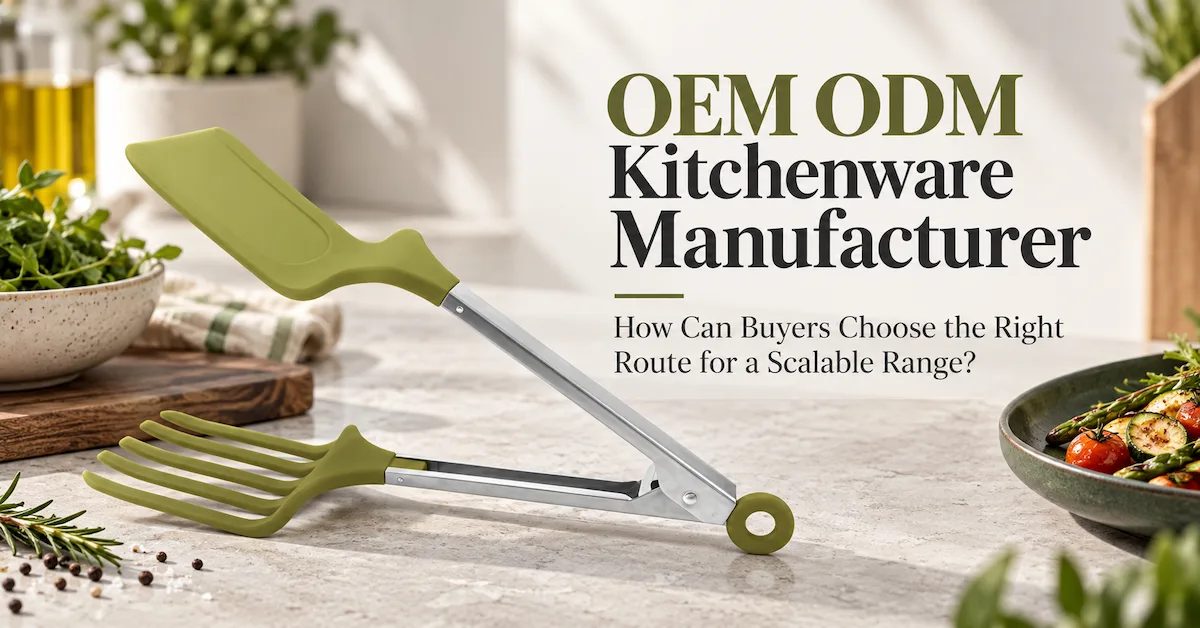
Introduction: One Kitchenware Range Can Need More Than One Route
Buying teams often ask for an OEM ODM kitchenware manufacturer as if OEM and ODM were two names for the same service. They are related, but they begin with different information. OEM usually starts with a buyer-controlled drawing, sample or specification. ODM starts with a market opportunity, user need or early concept and asks the manufacturer to contribute development decisions.
The distinction becomes important when a range contains several kinds of products. A proven kitchen knife may need OEM execution from an approved file. A new storage-friendly utensil may need ODM exploration. A chopping board may use an existing platform with private-label packaging. Treating all three items as one route can make the quote unclear, the sample schedule uneven and the responsibility for changes difficult to explain.
Buyers also have to manage the handoffs between commercial, product, brand, quality and production teams. A route that is clear to the salesperson may be unclear to the packaging designer. A sample that is approved by product may not include the final artwork. A quote that looks attractive may omit development work, tooling, packaging or capacity assumptions. The goal of this guide is to make those decisions visible before the purchase order.
The nine-step method below is designed for importers, retailers, distributors, e-commerce brands and hospitality buyers building a new range or upgrading an existing one. It focuses on governance across OEM, ODM, private label and custom development, rather than repeating a factory audit or an export-document checklist. The actual MOQ, price, lead time, certification and ownership terms must be confirmed for the specific project.
BONET HOUSEWARE provides a public working reference. Its website presents kitchen knives, kitchen utensils, chopping boards, kitchen gadgets, multifunctional kitchenware and scissors. Its OEM/ODM information describes work from drawings or samples, material and color customization, logos, packaging, inspection, concept development, structural optimization and mass-production support. Those public pages can support an initial brief, while the approved project files define the actual product.
What Does an OEM ODM Kitchenware Manufacturer Actually Do?
An OEM ODM kitchenware manufacturer connects product development and production capability with a buyer's commercial plan. Depending on the SKU, the manufacturer may execute a defined specification, adapt an existing platform, propose a concept, develop samples, support material and color choices, prepare packaging, coordinate inspection and move the approved version into mass production.
The buyer's responsibility is equally important. The buyer defines the target user, channel, range role, price position, market requirements, brand direction and acceptance priorities. In ODM, the buyer may not know the final structure at the start, but the buyer still owns the reason the product should exist. In OEM, the buyer may know the structure, but still needs to state which options, pack details and acceptance rules are mandatory.
A capable OEM kitchenware manufacturer should be able to preserve an approved version through production. A capable ODM partner should be able to show how open decisions become controlled decisions. The best relationship is not defined by a long list of services. It is defined by a clear path from the information available today to the evidence required before scale.
| Manufacturer contribution | Buyer decision | Evidence before scale |
|---|---|---|
| Route recommendation | Choose OEM, ODM, private label or hybrid by SKU | Written route and decision owners |
| Development or execution | Approve concepts, specifications, samples and changes | Revision-linked approval record |
| Production and quality | Confirm acceptance language and release conditions | Inspection result and exception disposition |
| Repeat support | Decide reorder mix and effective product changes | Updated production file and order reference |
OEM, ODM, Private Label or Custom: Start With the SKU
Route selection should happen at SKU level, not as a slogan for the entire supplier relationship. An importer can work with one manufacturer and still use different routes for different items. The route should reflect how much of the product is already known, who must contribute the missing decisions and what kind of evidence is needed before a purchase order.
OEM is usually appropriate when the buyer controls the product definition. ODM is useful when the manufacturer needs to contribute concept, structure, material or feasibility work. Private label describes a branding and packaging model that can sit on top of an existing platform or a developed product. Custom development is a broader description of a project with new requirements and shared engineering decisions.
The buyer should not select ODM only because it sounds more innovative, or OEM only because it sounds more controlled. The right question is: which route creates the clearest decision trail for this SKU, this channel and this launch date?
| Route | Starting information | Manufacturer contribution | Best question |
|---|---|---|---|
| OEM | Drawing, approved sample or controlled specification | Feasible execution and repeat production | Can you build the approved version consistently? |
| ODM | Market need, user problem or early concept | Concept, architecture, feasibility and samples | How will open decisions become approved files? |
| Private label | Existing platform plus brand and packaging needs | Brand application and controlled pack production | Which product revision is being branded? |
| Hybrid | Range brief with different SKU maturity levels | Route-specific work under one program view | Can every SKU keep its own gate and owner? |
The Nine-Step OEM and ODM Control Method
The nine steps below create a common governance layer for different development routes. They do not force every SKU through the same amount of work. A defined OEM line may move quickly through concept and focus on production approval. A new ODM item may spend more time in route definition, sampling and feasibility. The calendar can flex; the decision language should not.
Step 1: Define the Range Outcome
Before discussing route, describe what the range must achieve. Is the goal a new retail collection, a replacement for weak items, a channel-specific bundle, an entry price ladder or a more consistent private-label family? A manufacturer can support different goals, but each one changes the useful product mix and the decision priorities.
Give each proposed SKU a job in the range. An entry item may make the category easy to try. A core item may deliver the main volume. A trade-up item may justify a higher price through a meaningful benefit. A companion item may complete a task or raise basket value. This range language helps the manufacturer decide where OEM execution is enough and where ODM development would add value.
A buyer should also state the first launch market and channel. A supermarket, marketplace, specialty retailer and hospitality distributor may require different pack, quantity and content decisions. A clear outcome prevents the project from becoming a collection of attractive products with no commercial rhythm.
| Range role | Commercial purpose | Useful route question |
|---|---|---|
| Entry | Make the category easy to try and understand | Is an existing OEM or private-label platform enough? |
| Core | Deliver the main use case and expected volume | Which specification must stay stable? |
| Trade-up | Give the buyer a reason to spend more | Does ODM development create a visible benefit? |
| Companion | Complete the task or build the basket | Can it share brand, pack and production logic? |
Step 2: Classify Each SKU as OEM, ODM, Private Label or Hybrid
Now classify the maturity of each SKU. Do not let the supplier choose the route only from a sales conversation. Put the starting information on the range sheet: drawing available, reference sample available, existing platform, open product decisions, brand files, target price and desired launch window.
A mature SKU may be best handled as OEM even if the wider range is an ODM project. A new item may start as ODM and become OEM once the product file is approved. A private-label item may use an existing platform but still require a separate packaging and compliance review. The route can change during development; record the change rather than allowing the project to drift.
For buyers comparing an OEM ODM kitchenware supplier, this route sheet is a practical test. Ask whether the partner can explain how the route affects sample work, cost, tooling, ownership and production timing. If the answer is the same for every SKU, the program may not be sufficiently defined.
Step 3: Put Scope, Ownership and Change Rights on One Page
Route choice is incomplete without a scope boundary. Write who owns the product idea, drawing, master sample, artwork, tooling, packaging files, inspection standard and change log. State which inputs are buyer-specific and which are part of the manufacturer's existing platform. This does not need to become a heavy contract at the first conversation, but the direction must be clear before development investment grows.
Ownership questions matter most when a project crosses from ODM into an OEM production file. The buyer may approve a developed product for its brand, while the manufacturer retains its platform knowledge or reusable production method. Both sides should know which items are exclusive, which can be reused, who stores the files and how a future change is approved.
Use plain examples. Who can change the material after the sample? Who can move the logo? Who pays for a new tool? Who approves a substitute? Who receives the revised drawing? When the question is visible, it can be answered. When it is hidden, a small production change can become a commercial dispute.
| Scope item | Question to record | Why it prevents trouble |
|---|---|---|
| Product files | Who owns and updates the drawing, sample and master revision? | Production uses one current reference |
| Brand files | Who approves logo, artwork, pack copy and barcode? | Product approval is not confused with print approval |
| Tooling | Who funds, stores and authorizes tooling changes? | Investment and future use are visible |
| Change rights | Who can approve a material, price or timing change? | No silent substitute becomes the new version |
Need help separating OEM and ODM scope before requesting a quote?
Discuss Your Route MapStep 4: Normalize the Quote, Development Cost and Capacity
A route comparison should show more than the unit price. Ask the manufacturer to separate product configuration, development work, samples, tooling or setup, branding, packaging, inspection and production assumptions. For ODM, the concept and sample effort may be larger. For OEM, the development line may be smaller but the buyer's file may carry more responsibility. Either way, the scope should be visible.
Capacity is part of the commercial decision. A supplier may be able to develop a product but have a different production calendar for a new tool, a special finish, a mixed-color order or a multi-category launch. Ask what the quoted timing assumes and which decisions have to be frozen before the production window is real.
A kitchenware factory China buyer should also compare what happens when the scope changes. A lower quote with no development line may simply move the cost into later tooling, packaging or engineering changes. A complete comparison makes that choice deliberate.
| Quote block | OEM question | ODM question |
|---|---|---|
| Product | Which specification and option set is priced? | Which concept and feasibility assumptions are priced? |
| Development | Are samples, setup or file checks included? | How many concept and sample decisions are included? |
| Capacity | Can the approved version fit the requested window? | When does capacity become firm after feasibility? |
| Change | What happens if the buyer changes the file? | What happens if the concept changes after sampling? |
Step 5: Create Route-Specific Sample Gates
OEM and ODM samples should not be judged with identical development questions, but they should share a visible release discipline. For OEM, the main question is whether the sample matches the buyer's approved specification. For ODM, the main questions may include whether the product solves the intended use, whether the structure is feasible and whether the concept deserves another investment.
Write the objective for every sample. Note the revision, what changed, what was tested, who tested it, what passed, what remains open and what happens next. A buyer should be able to explain why a sample was approved without relying on memory. A supplier should be able to make the next sample from the same decision record.
Keep product, material, finish and packaging approval separate when needed. A product sample can be approved while the retail pack remains open. A color chip can be accepted without approving a complete unit.Staged gates reduce the chance that a positive comment on one layer is mistaken for final approval of the entire order.
| Gate | OEM evidence | ODM evidence |
|---|---|---|
| Identity | Sample matches drawing, option and revision | Concept revision is named and compared |
| Use | Approved performance or use criteria | Proof that the concept solves the user job |
| Pack | Pack follows approved artwork and protection | Pack supports the emerging product story |
| Release | Written production approval | Decision to refine, freeze or stop |
Want a route-specific sample and approval plan?
Request a Product DiscussionStep 6: Use One Quality Acceptance Language
Different development routes should not produce different meanings for “approved.” Build a common quality vocabulary for identity, use, appearance, packaging, carton condition and release. The exact acceptance limits depend on the product and market, but the structure should be understandable to the buyer, manufacturer and inspection team.
For an OEM ODM kitchenware manufacturer program, this shared language is especially valuable when the range contains both established and newly developed items. One SKU may have a detailed drawing while another has a concept approval. Both still need a named revision, an approval date, an inspection result and a disposition for exceptions.
Do not turn a quality gate into a promise that no variation can exist. A useful gate explains what was checked, against which reference, by whom and with what result. If an exception is accepted, record the exception and its scope. That record protects the next order from treating a one-time concession as the new standard.
Step 7: Align Brand, Packaging and Product Information
Brand and packaging decisions often arrive after product development, but they can change the route economics and production sequence. Confirm the logo method, position, color reference, artwork owner, barcode, language, care information, unit pack, carton marks and display needs. A private-label project may have an existing product but still require a new packaging review.
Product content should describe the actual approved item, not the early concept. If a feature changes during ODM development, the product name, pack message, images and sales copy may need to change too. If an OEM specification is revised, the same revision should reach the brand and packaging teams before print is released.
A private label kitchenware manufacturer relationship works best when brand approval is treated as a real gate. The product team approves the product. The brand team approves the message. Quality and production confirm that the printed and packed version matches both.
| Brand item | Approval owner | Check before print or pack |
|---|---|---|
| Logo method and position | Brand and product | Matches product surface and approved revision |
| Artwork and copy | Brand and market team | Describes the final item and intended use |
| Barcode and carton marks | Packaging and logistics | Matches SKU, case pack and receiving logic |
| Care and market information | Buyer and relevant advisers | Confirmed for the destination market |
Step 8: Transfer the Route Into One Production File and Purchase Order
When the product is approved, the development route should disappear from the line's daily work. Production needs one current file that states the product, revision, material, finish, color, logo, pack, carton, inspection points and approved exceptions. It also needs a purchase order that identifies the same SKU and version.
This is where OEM and ODM programs should converge. The OEM file may be built from the buyer's drawing. The ODM file may be built from joint development records. Once approved, both should make the production and inspection questions answerable. If the line must ask which sample is current, the transfer is not complete.
For a custom kitchenware manufacturer, define how a necessary production change is proposed, approved and added to the file. A change may be technically sensible but still affect use, appearance, cost, packaging or brand content. Keep the decision visible and give the next order an effective revision.
| Production file | Required content | Purchase-order check |
|---|---|---|
| Product specification | Revision, materials, dimensions, finish and options | PO line matches the approved SKU |
| Approved sample | Reference, date, result and exceptions | Sample revision is named |
| Brand and packaging | Logo, artwork, unit pack and carton data | Pack quantity and marks are included |
| Quality control | Inspection points and release rule | Exception owner is known before production |
Step 9: Review Launch Evidence and Reorder by Version
After launch, review OEM and ODM items in the same range dashboard. Record sales, user comments, returns, product issues, packaging damage, questions from the channel and the features that help the buyer choose. The purpose is not to rank the route. It is to decide whether the product and its message are doing the job assigned to them.
Classify the signal before changing the item. A wrong size may be a product issue. A confusing instruction may be a pack issue. Slow movement may be a price, channel or range-role issue. A finish complaint may require a material or process review. When the cause is clear, write the change into the product file, packaging file or next order rather than reopening the entire project without evidence.
For a wholesale kitchenware manufacturer program, version discipline protects the range from silent substitution. The next order should identify what stayed, what changed, which SKU mix is effective and which approval is still open. A repeat order is a new release of a known version, not a fresh memory of the first conversation.
Review Product Platforms Before Choosing the Route
Product selection can begin with a category review. Consider kitchen knives, kitchen utensils, chopping boards, kitchen gadgets, multifunctional kitchenware and all-purpose scissors. The category tells you where to look; the route sheet tells you how much development or execution control is needed.
A custom kitchen tools manufacturer can support a broad product conversation, but the buyer should make the route decision from the project facts. An existing item may need only OEM execution. A new function, pack or user experience may justify ODM support. The same brand can use both approaches without creating two disconnected systems.
OEM and ODM Manufacturer Scorecard
Use a scorecard to compare how a manufacturer manages the work, not only how many products appear in a catalog. The score should reflect evidence: clear questions, complete scope, realistic capacity, useful samples, consistent quality gates, controlled files and a repeat-order process.
| Evaluation area | Strong evidence | Question to ask |
|---|---|---|
| Route judgment | Supplier explains why the SKU needs OEM, ODM or hybrid | What information is still missing? |
| Scope control | Product, brand, tooling and change rights are written | Who owns and approves each file? |
| Commercial clarity | Quote separates product, development, pack and capacity assumptions | What changes the cost or timing? |
| Approval discipline | Sample, quality and release gates are revision-linked | What exactly does this approval cover? |
| Repeat support | Launch learning becomes a controlled next-order change | How will the next order identify the new version? |
OEM and ODM Project File Checklist
Prepare these records as the range moves forward. The file names can match the buyer's internal workflow, but the information should remain traceable from route selection to repeat order.
- Range outcome, SKU role, target channel and launch objective.
- Route classification for each SKU and the information supporting that choice.
- Product, brand, tooling, change and reorder ownership assumptions.
- Quotation with product, development, packaging, capacity and exclusions separated.
- Route-specific sample objectives, revisions, test results and approval decisions.
- Shared quality acceptance language, inspection points and exception process.
- Production transfer file with specification, approved sample, artwork, pack and PO references.
- Launch observations, diagnosed causes, effective changes and next-order version.
Frequently Asked Questions
What is the difference between an OEM and ODM kitchenware manufacturer?
OEM usually starts with a buyer-controlled drawing, sample or specification and focuses on controlled execution. ODM starts with a market need or early concept and includes more manufacturer input during concept, feasibility and sampling. A project can begin as ODM and move into an OEM-style production file after approval.
Can one manufacturer handle both OEM and ODM kitchenware?
Yes, when the manufacturer can explain the different route responsibilities and keep each SKU's files, owners and approval gates clear. The buyer should not assume that capability in one route automatically proves capability in the other.
When should a buyer choose a custom kitchenware manufacturer?
Choose a custom route when the product requirement, user experience, geometry, material or channel need is not well served by an existing platform. Ask how the manufacturer will handle feasibility, samples, ownership, target cost and the transfer into repeat production.
What should an OEM ODM kitchenware supplier include in a quotation?
The quotation should identify the product revision, development work, samples, tooling or setup, logo and packaging scope, quantity, capacity assumptions, timing basis, exclusions, payment terms and change conditions. A unit price without those assumptions is difficult to compare.
Ready to plan an OEM, ODM or hybrid kitchenware range?
Contact BONET for an InquiryConclusion: Use the Right Route With One Visible System
The best OEM ODM kitchenware manufacturer relationship is not the one that forces every product into the same route. It is the one that helps the buyer choose the route by SKU, makes scope and rights visible, compares complete commercial assumptions, uses appropriate sample gates and transfers every approved version into a repeatable production file.
For brands, importers and retailers, the practical benefit is control without unnecessary complexity. OEM can protect a defined product. ODM can add development support where the brief is open. Private label can accelerate a branded range. A hybrid program can use all three while keeping one calendar, one revision language and one reorder loop.
